Brief-Form #65: Large-scale Southern Pine Bettle Kill on Alabama’s Lake Guntersville State!
NOTE: Some of my GBH photo essays were not routinely distributed from mid-February through mid-June. I will resend those one by one, beginning the first week of July. Here is my Post from May 6 (https://stevejonesgbh.com/2026/05/06/brief-form-post-59-nashville-tn-finding-nature-where-you-are/)
I am pleased to add the 65th of my GBH Brief-Form Posts (Less than five minutes to read!) to my website. I get wordy with my routine Posts. I don’t want my enthusiasm for thoroughness and detail to discourage readers. So, I will occasionally publish these brief Posts.
On-site to attend the Alabama State Parks Foundation board meeting (June 18, 2026), at Lake Guntersville State Park, I arrived the prior morning to explore trails I had not yet wandered. I enjoyed a sweeping loop that covered the Terrell Connector, Terrell Trail, Graveyard Road, Service Road, Cave Trail, and Lodge Road, then returned through Terrell Trail and the Terrell Connector. I focused on what I could discover hidden in plain sight. See my weekly photo essay presenting highlights of my discoveries: https://stevejonesgbh.com/2026/08/31/mid-june-exploration-on-trails-new-to-me-on-lake-guntersville-state-park/. I address this essay to a major forest transformation sweeping Lake Guntersville State Park and other sectors of northern Alabama: the southern pine beetle.
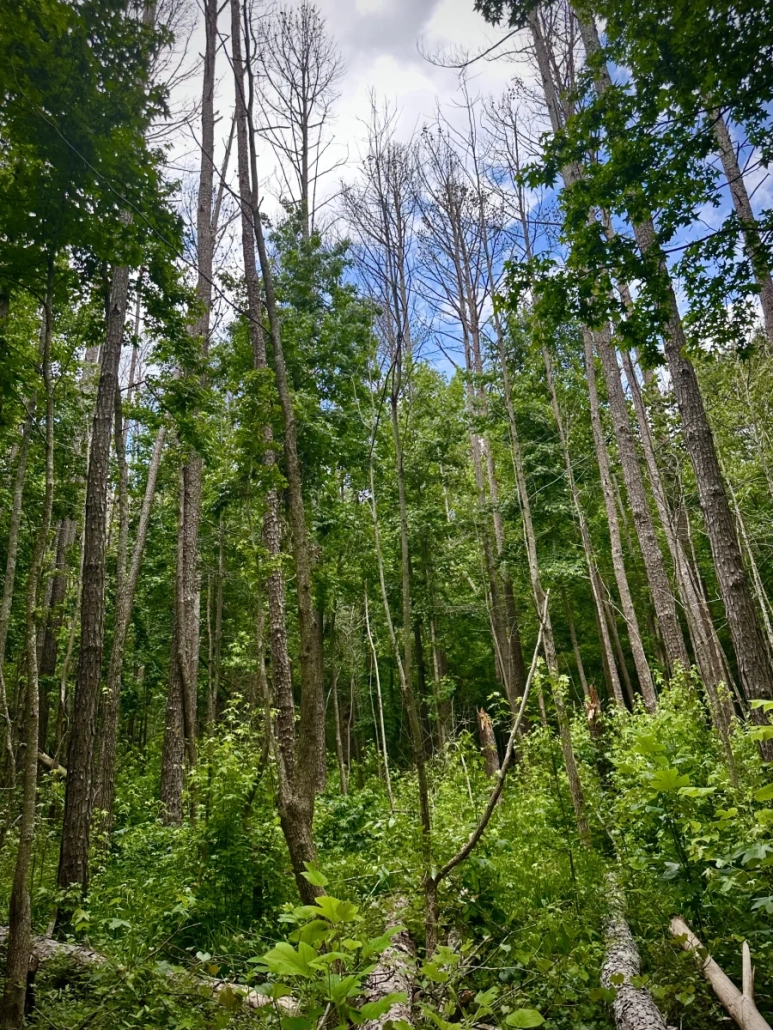
Lake Guntersville State Park experienced hundreds of acres of pine mortality from the summer of 2024 through 2025. I passed through extensive acreage of total pine stand decimation.
Clemson University’s Southern Pine Beetle Information Center tracks and reports SPB infestation activity southwide:
Southern pine beetle (Dendroctonus frontalis Zimmermann, SPB) is a native, eruptive forest pest that has caused significant damage to pine forests since it was first reported in the 1700’s. SPB has been found in the southeastern U.S. for decades, and was first documented as a major mortality agent in southern pine forests more than 120 years ago. Charles Zimmermann originally described the SPB in 1868, placing it in the family Hylurgidae under the tribe Hylurgi. He synonymized it with Bostrichus frontalis Fabr. in his description. This was later corrected by Le Conte (1876), and SPB was placed in the family Scolytidae. SPB is now placed within the family Curculionidae: subfamily Scolytinae. While frequent, severe, and widespread SPB outbreaks occurred throughout the Southeast in the last half of the 20th century, recent SPB activity in the region has been localized and short-lived. Reports from the mid-1800s through the mid-1900s indicated that outbreaks then were also less common.
I had seen scattered clusters of pine mortality during the first half of my circuit, where second-growth hardwood dominated. Widespread infestation appeared as I entered pine forest along the latter stretches. I recorded this 59-second video along a section of trail with a pine stand decimated by SPB.
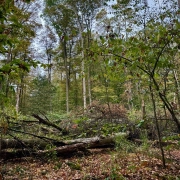
Park crews felled dead pine bordering active trails to remove overhanging hazzards. The tremendous volume of regional mortality overwhelmed markets, shutting down salvage opportunities. Already, a second or third year of full sunlight reaching the forest floor is unleashing the understory vegetation (see lush growth at right). Invisible at the moment, decomposers are hard at work returning dead and down woody debris to the soil. The carbon cycle is functioning at full speed. The booming sequence of forest growth, death, and renewal is well tuned and remarkably well practiced with a millennially-seasononed native eruptive forest pest!
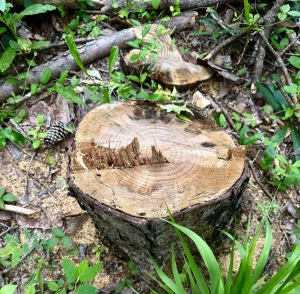
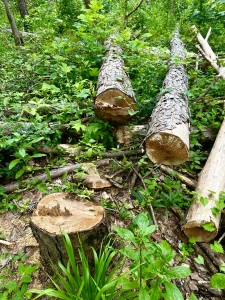
A dozen years from now, standing pine skeletons will have fallen, the downed trees will not be recognizable in decay, and the trailside hardwood forest will seem intact. Sure, the astute observer will read telltale signs of the devastating insect outbreak and the shift from pine forest to hardwood.
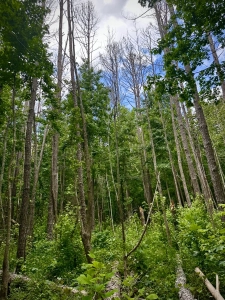
The periodic fatal infestations are nothing new across the southeastern US. Such is the case with an eruptive forest pest like SPB. The insect is native and has been as long as foresters and entomologists have paid attention. Union Camp Corporation, a then Fortune 500 Paper and Allied Products Manufacturer, hired me as an industrial forester in May of 1973. Among other assignments, I managed. We foresters kept vigil on SPB cycles, alert for eruptions, quick to salvage, and vigilant to establish buffers. We strove to stay ahead of the hopeless predicament the state park faced. Sometimes we succeeded; other times we, too, were overwhelmed.
There are management measures we can practice with our native SPB devil. However, across my 53-year career, forest scientists and foresters have lamented destructive invasive agents (insects and diseases).
Gypsy moths entered our fair land in 1869, posing a widespread oak and related hardwood devastation threat. Fortunately, 157 years later, the insect is mostly endemic, a naturalized insect pest, now buffered and controlled by its own introduced pests, including selective biological insecticides (Bacillus thuringiensis, a bacterium) and a small parasitic wasp (Encyrtidae) introduced in North America in 1909.
Chestnut Blight (Cryphonectria parasitica) entered the US from Asia in 1904, when it began its relentless devastation of american chestnut. Chestnut forests from southern Maine to central Alabama. I recall encountering abundant surviving chestnut saplings during my summer forestry employment on state forests in western Maryland. There remains hope for eventual, long-term recovery. From its website, The American Chestnut Foundation:
During the past 100 years, chestnut blight, caused by the Asian fungus Cryphonectria parasitica, killed an estimated four billion American chestnut (Castanea dentata) trees, and pushed the iconic species into a state of functional extinction. Human interference triggered the American chestnut’s demise–now scientific innovation offers us the best chance to save it. As reliable and productive as the American chestnut tree was, the species now exists in forests primarily in a state of stunted vegetative regeneration from surviving root systems, and this population continues to dwindle. The American Chestnut Foundation (TACF) is leading an unprecedented rescue mission to return the iconic American chestnut to its native range.
The goal of our forest restoration work is to implement plantings of genetically diverse and disease-resistant American chestnut trees that are capable of sustained population growth across the native range in the ever-changing landscape of our Eastern hardwood forests.
Dutch Elm disease entered the US in 1928 and decimated our native elm forests. I lived in Keene, New Hampshire several years ago. Know as Elm City, its once magnificent Elm-lined avenues and lanes are elm-barren.
An online USDA source indicates that the Emerald Ash Borer was first detected in North America in 2002 (southeast Michigan.)
The emerald ash borer (EAB), an invasive wood-boring beetle from Asia, is responsible for the death and decline of tens of millions of ash trees in North America. EAB lays its eggs in the bark crevices of ash trees. The eggs hatch and the larvae burrow into the tree where they feed. This feeding is what damages the trees. We have detected EAB infestations in 38 States and the District of Columbia. EAB is difficult to detect early when pest populations are small because damage to the trees is hidden under the bark and tree decline is gradual. The beetle is well-suited to our climate, is a good flyer, and spreads naturally. People contribute to the long-distance spread of the beetle when they move EAB-infested ash firewood, logs or nursery stock.
In early May of 2010, I chronicled in a single Great Blue Heron photo essay (https://stevejonesgbh.com/2018/06/05/six-hundred-sixty-mile-transect/), the ecology of my 600-mile drive from Madison, Alabama to Fairmont, West Virginia, noting my deep concern encountering the EAB mortality front:
Midway between Chattanooga and Knoxville, I spot a disturbing first along the route — dead ash trees along the highway. The imported (an international shipment stowaway) emerald ash-borer is spreading rapidly in North America across the range of genus Fraxinus. It is decimating ash. We saw the ubiquitous mortality from this point north to our destination, and beyond to Pennsylvania, Ohio, and Maryland. Oh, the price we pay for our shrinking globe. We do business in a global economy; we and all Earth species must sustain within a global ecosystem. I find the ash decline and imminent peril particularly disturbing. I have been a big ash fan from my days conducting forest inventory on State Forests in western Maryland during undergraduate summers… to conducting forest fertilization on planted green ash stands for Union Camp Corporation in Virginia and North Carolina… through my PhD research on Pennsylvania and New York Allegheny Hardwood stands (white ash a major component). I have revered its preference for high-quality sites, its fast growth, straight boles, strong wood, and deep green foliage. Nothing beats its easy response to a splitting maul, its non-sputtering flame and hi BTUs in a fireplace or stove, and the crack of a Louisville Slugger bat connecting with a fastball. As we’ve faced before with American Chestnut and American elm, how on Earth do we contend with vanishing ash!?
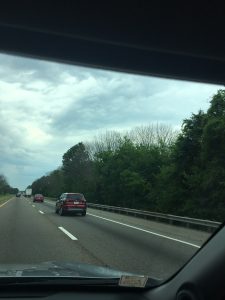
We encountered the dead ash for reasons other than crossing some ecological divide. Instead, we entered the geographic margin of spread from the borer’s Cleveland point of entry. Officials have already noted the green beetle’s presence in Alabama, though not yet widespread. Time will tell. We can hope for some climatic barrier… yet I fear the insect will continue its spread of infestation and death.
I am hopeful that the southward spread has slowed. I am not seeing widespread mortality in my northern Alabama forest wanderings. Are environmental conditions at work? Are 20 years of biological control programs (e.g., parasitoids) proving successful? See this comprehensive USDA APHIS report to learn more: (chromeextension://efaidnbmnnnibpcajpcglclefindmkaj/https://www.eppo.int/media/uploaded_images/MEETINGS/Meetings_2026/Agrilus%20presentations/Dodge%20Current%20status%2C%20successes%2C%20and%20limitations.pdf).
Natural barriers (oceans, mountains, deserts, etc.) used to limit the spread of invasive plants, animals, insects, and diseases. Today we have a difficult enough problem controlling native eruptive forest pests, like SPB. Toss in exotic insects and diseases, and we must turn to new and emerging technologies like biological control programs in addition to an arsenal of traditional control practices.
We are a wood-dependent human species. Mess with elements of this incredible renewable resource, whether chestnut, elm, ash, oaks, or other species, and you impair our ability to practice sustainable forestry. I’ve watched the battle intensify over my 50+ year forestry career. Don’t despair. Know that diligent and responsible science will prevail. Continue to enjoy Nature, learn more about the biological and physical factors affecting our forests, and embrace and promote informed forest stewardship.
Closing
I accept the challenge of distilling these Brief-Form Posts into a single distinct reflection:
Don’t despair of forest pests and diseases: embrace and promote science-informed forest stewardship.
Nature’s special treats await our discovery, our understanding, and our interpretation!
Subscribe to my free weekly photo essays (like this one) at: http://eepurl.com/cKLJdL