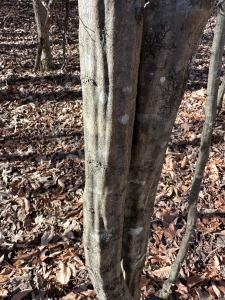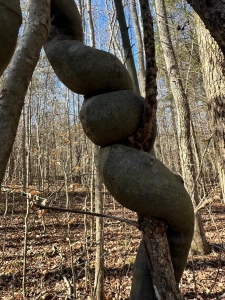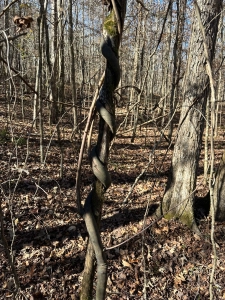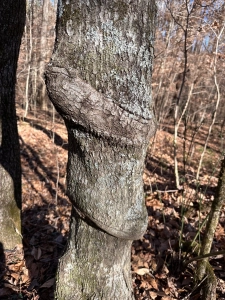
Posts

Brief-Form #65: Large-scale Southern Pine Bettle Kill on Alabama’s Lake Guntersville State!

NOTE: Some of my GBH photo essays were not routinely distributed from mid-February through mid-June. I will resend those one by one, beginning the first week of July. Here is my Post from May 6 (https://stevejonesgbh.com/2026/05/06/brief-form-post-59-nashville-tn-finding-nature-where-you-are/)


I am pleased to add the 65th of my GBH Brief-Form Posts (Less than five minutes to read!) to my website. I get wordy with my routine Posts. I don’t want my enthusiasm for thoroughness and detail to discourage readers. So, I will occasionally publish these brief Posts.

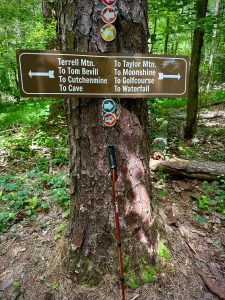
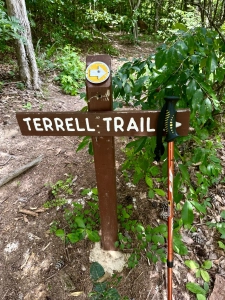
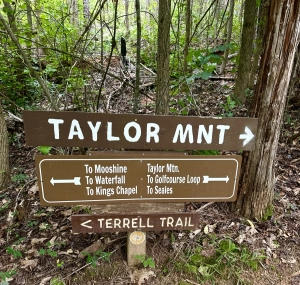
On-site to attend the Alabama State Parks Foundation board meeting (June 18, 2026), at Lake Guntersville State Park, I arrived the prior morning to explore trails I had not yet wandered. I enjoyed a sweeping loop that covered the Terrell Connector, Terrell Trail, Graveyard Road, Service Road, Cave Trail, and Lodge Road, then returned through Terrell Trail and the Terrell Connector. I focused on what I could discover hidden in plain sight. See my weekly photo essay presenting highlights of my discoveries: https://stevejonesgbh.com/2026/08/31/mid-june-exploration-on-trails-new-to-me-on-lake-guntersville-state-park/. I address this essay to a major forest transformation sweeping Lake Guntersville State Park and other sectors of northern Alabama: the southern pine beetle.

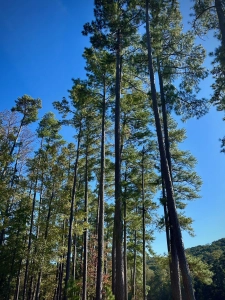
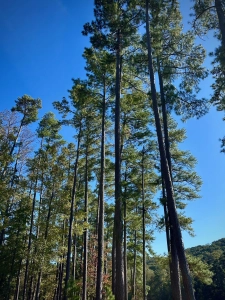
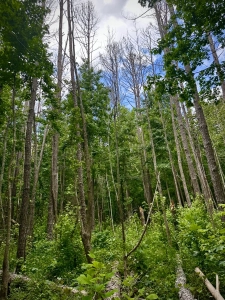
Lake Guntersville State Park experienced hundreds of acres of pine mortality from the summer of 2024 through 2025. I passed through extensive acreage of total pine stand decimation.

Clemson University’s Southern Pine Beetle Information Center tracks and reports SPB infestation activity southwide:

Southern pine beetle (Dendroctonus frontalis Zimmermann, SPB) is a native, eruptive forest pest that has caused significant damage to pine forests since it was first reported in the 1700’s. SPB has been found in the southeastern U.S. for decades, and was first documented as a major mortality agent in southern pine forests more than 120 years ago. Charles Zimmermann originally described the SPB in 1868, placing it in the family Hylurgidae under the tribe Hylurgi. He synonymized it with Bostrichus frontalis Fabr. in his description. This was later corrected by Le Conte (1876), and SPB was placed in the family Scolytidae. SPB is now placed within the family Curculionidae: subfamily Scolytinae. While frequent, severe, and widespread SPB outbreaks occurred throughout the Southeast in the last half of the 20th century, recent SPB activity in the region has been localized and short-lived. Reports from the mid-1800s through the mid-1900s indicated that outbreaks then were also less common.

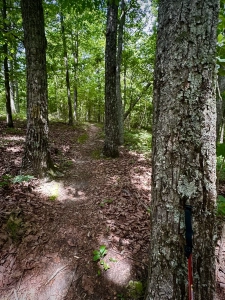
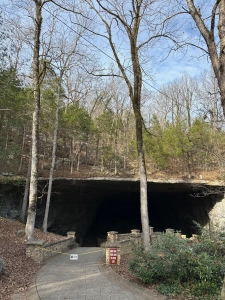
I had seen scattered clusters of pine mortality during the first half of my circuit, where second-growth hardwood dominated. Widespread infestation appeared as I entered pine forest along the latter stretches. I recorded this 59-second video along a section of trail with a pine stand decimated by SPB.


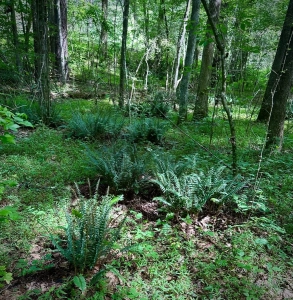
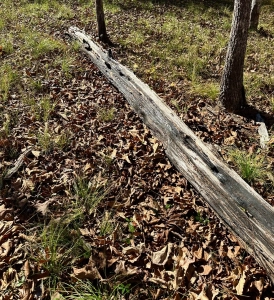
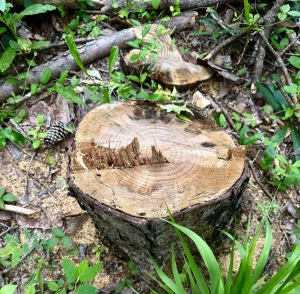
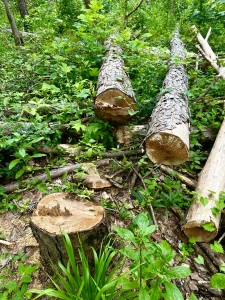
Park crews felled dead pine bordering active trails to remove overhanging hazzards. The tremendous volume of regional mortality overwhelmed markets, shutting down salvage opportunities. Already, a second or third year of full sunlight reaching the forest floor is unleashing the understory vegetation (see lush growth at right). Invisible at the moment, decomposers are hard at work returning dead and down woody debris to the soil. The carbon cycle is functioning at full speed. The booming sequence of forest growth, death, and renewal is well tuned and remarkably well practiced with a millennially-seasononed native eruptive forest pest!
Lake GSP


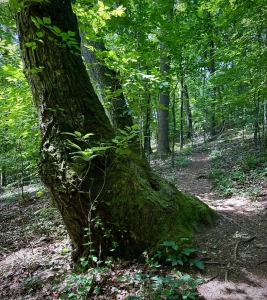
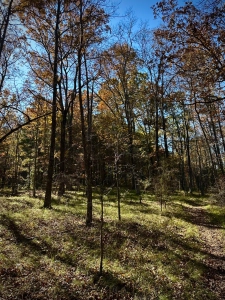
A dozen years from now, standing pine skeletons will have fallen, the downed trees will not be recognizable in decay, and the trailside hardwood forest will seem intact. Sure, the astute observer will read telltale signs of the devastating insect outbreak and the shift from pine forest to hardwood.
Lake GSP


The periodic fatal infestations are nothing new across the southeastern US. Such is the case with an eruptive forest pest like SPB. The insect is native and has been as long as foresters and entomologists have paid attention. Union Camp Corporation, a then Fortune 500 Paper and Allied Products Manufacturer, hired me as an industrial forester in May of 1973. Among other assignments, I managed. We foresters kept vigil on SPB cycles, alert for eruptions, quick to salvage, and vigilant to establish buffers. We strove to stay ahead of the hopeless predicament the state park faced. Sometimes we succeeded; other times we, too, were overwhelmed.

There are management measures we can practice with our native SPB devil. However, across my 53-year career, forest scientists and foresters have lamented destructive invasive agents (insects and diseases).

Gypsy moths entered our fair land in 1869, posing a widespread oak and related hardwood devastation threat. Fortunately, 157 years later, the insect is mostly endemic, a naturalized insect pest, now buffered and controlled by its own introduced pests, including selective biological insecticides (Bacillus thuringiensis, a bacterium) and a small parasitic wasp (Encyrtidae) introduced in North America in 1909.

Chestnut Blight (Cryphonectria parasitica) entered the US from Asia in 1904, when it began its relentless devastation of american chestnut. Chestnut forests from southern Maine to central Alabama. I recall encountering abundant surviving chestnut saplings during my summer forestry employment on state forests in western Maryland. There remains hope for eventual, long-term recovery. From its website, The American Chestnut Foundation:

During the past 100 years, chestnut blight, caused by the Asian fungus Cryphonectria parasitica, killed an estimated four billion American chestnut (Castanea dentata) trees, and pushed the iconic species into a state of functional extinction. Human interference triggered the American chestnut’s demise–now scientific innovation offers us the best chance to save it. As reliable and productive as the American chestnut tree was, the species now exists in forests primarily in a state of stunted vegetative regeneration from surviving root systems, and this population continues to dwindle. The American Chestnut Foundation (TACF) is leading an unprecedented rescue mission to return the iconic American chestnut to its native range.

The goal of our forest restoration work is to implement plantings of genetically diverse and disease-resistant American chestnut trees that are capable of sustained population growth across the native range in the ever-changing landscape of our Eastern hardwood forests.

Dutch Elm disease entered the US in 1928 and decimated our native elm forests. I lived in Keene, New Hampshire several years ago. Know as Elm City, its once magnificent Elm-lined avenues and lanes are elm-barren.

An online USDA source indicates that the Emerald Ash Borer  was first detected in North America in 2002 (southeast Michigan.)

The emerald ash borer (EAB), an invasive wood-boring beetle from Asia, is responsible for the death and decline of tens of millions of ash trees in North America. EAB lays its eggs in the bark crevices of ash trees. The eggs hatch and the larvae burrow into the tree where they feed. This feeding is what damages the trees. We have detected EAB infestations in 38 States and the District of Columbia. EAB is difficult to detect early when pest populations are small because damage to the trees is hidden under the bark and tree decline is gradual. The beetle is well-suited to our climate, is a good flyer, and spreads naturally. People contribute to the long-distance spread of the beetle when they move EAB-infested ash firewood, logs or nursery stock. 

In early May of 2010, I chronicled in a single Great Blue Heron photo essay (https://stevejonesgbh.com/2018/06/05/six-hundred-sixty-mile-transect/), the ecology of my 600-mile drive from Madison, Alabama to Fairmont, West Virginia, noting my deep concern encountering the EAB mortality front:

Midway between Chattanooga and Knoxville, I spot a disturbing first along the route — dead ash trees along the highway. The imported (an international shipment stowaway) emerald ash-borer is spreading rapidly in North America across the range of genus Fraxinus. It is decimating ash. We saw the ubiquitous mortality from this point north to our destination, and beyond to Pennsylvania, Ohio, and Maryland. Oh, the price we pay for our shrinking globe. We do business in a global economy; we and all Earth species must sustain within a global ecosystem. I find the ash decline and imminent peril particularly disturbing. I have been a big ash fan from my days conducting forest inventory on State Forests in western Maryland during undergraduate summers… to conducting forest fertilization on planted green ash stands for Union Camp Corporation in Virginia and North Carolina… through my PhD research on Pennsylvania and New York Allegheny Hardwood stands (white ash a major component). I have revered its preference for high-quality sites, its fast growth, straight boles, strong wood, and deep green foliage. Nothing beats its easy response to a splitting maul, its non-sputtering flame and hi BTUs in a fireplace or stove, and the crack of a Louisville Slugger bat connecting with a fastball. As we’ve faced before with American Chestnut and American elm, how on Earth do we contend with vanishing ash!?
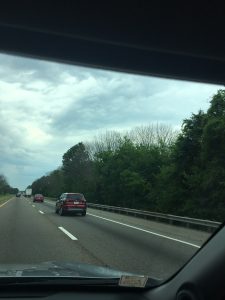
 

We encountered the dead ash for reasons other than crossing some ecological divide. Instead, we entered the geographic margin of spread from the borer’s Cleveland point of entry. Officials have already noted the green beetle’s presence in Alabama, though not yet widespread. Time will tell. We can hope for some climatic barrier… yet I fear the insect will continue its spread of infestation and death.

I am hopeful that the southward spread has slowed. I am not seeing widespread mortality in my northern Alabama forest wanderings. Are environmental conditions at work? Are 20 years of biological control programs (e.g., parasitoids) proving successful? See this comprehensive USDA APHIS report to learn more: (chromeextension://efaidnbmnnnibpcajpcglclefindmkaj/https://www.eppo.int/media/uploaded_images/MEETINGS/Meetings_2026/Agrilus%20presentations/Dodge%20Current%20status%2C%20successes%2C%20and%20limitations.pdf).

Natural barriers (oceans, mountains, deserts, etc.) used to limit the spread of invasive plants, animals, insects, and diseases. Today we have a difficult enough problem controlling native eruptive forest pests, like SPB. Toss in exotic insects and diseases, and we must turn to new and emerging technologies like biological control programs in addition to an arsenal of traditional control practices.

We are a wood-dependent human species. Mess with elements of this incredible renewable resource, whether chestnut, elm, ash, oaks, or other species, and you impair our ability to practice sustainable forestry. I’ve watched the battle intensify over my 50+ year forestry career. Don’t despair. Know that diligent and responsible science will prevail. Continue to enjoy Nature, learn more about the biological and physical factors affecting our forests, and embrace and promote informed forest stewardship.


Closing


I accept the challenge of distilling these Brief-Form Posts into a single distinct reflection:

Don’t despair of forest pests and diseases: embrace and promote science-informed forest stewardship.


Nature’s special treats await our discovery, our understanding, and our interpretation!


Subscribe to my free weekly photo essays (like this one) at: http://eepurl.com/cKLJdL
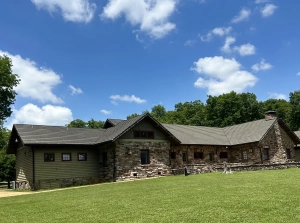


Teaching Beyond the Walls: An Alabama State Parks Workshop at Monte Sano State Park

NOTE: Some of my GBH photo essays were not routinely distributed from mid-February through mid-June. I will resend those one by one, beginning the first week of July. Here is my Post from April 29 (https://stevejonesgbh.com/2026/04/29/brief-form-post-58-forest-discoveries-while-measuring-tree-heights-on-monte-sano-state-park/)


I assisted the Alabama State Park staff in delivering the Teaching Beyond the Walls: Alabama’s Ecology In Action educators’ workshop at Monte Sano State Park on June 30, 2026. Funded by BlueCross BlueShield of Alabama, the ~30 participants enjoyed diverse sessions over the nine-hour program, including: Alabama’s biodiversity; immersion in forest ecology; student-centered science; place-based teaching and learning; water cycle and stream ecology; asking the right questions; seeking insight from others; and learning through Nature. Join me as I accompany the registered learning community participants at the State Park Lodge and its plateau-edge surroundings.

Monte SSPMonte SSP


The State Park System education and interpretation obiectives align with my professional retirement mission: Employ writing and speaking to educate, inspire, and enable readers and listeners to understand, appreciate, and enjoy Nature… and accept and practice Earth Stewardship. I find fullfillment in partnering with the park system to educate, inspire, and enable visitors to embrace Earth Stewardship. What better way than through educator workshops!

We learned indoors (blessed air conditioning) and out (welcome breezes and deep woods shade).

Monte SSPMonte SSP


I recorded a 54-second video showcasing the lodge and its immediate woodland outdoor laboratory.


I suppose that spending my youth in family Nature-based recreation, four years in forestry school (1973 BS), 12 years employed by a Fortune-500 paper and allied products manufacturing company, three years earning a doctoral degree in Applied Forest Ecology (1987 Ph.D.), and 35 years in higher education teaching, research,and administration at nine universities, positioned me to know all the answers. Not so! The more I learn, the less I know. Sure, I am pretty comfortable with how I can handle a day of learning and sharing in a northern Alabama forest. Just the same, it is I who benefit most from interacting with eager, inquisitive, and dedicated educators intent on sharpening their craft, deepening their knowledge, and fueling their environmental education passion.


Understanding and Appreciating Alabama’s Biodiversity


Dr. Scott Duncan’s SouthernWonder is a perfect launching pad for such a course. Alabama is the fourth most biologically diverse state in the country. Each participant exited the workshop with a copy for use as an invaluable environmental education resource.


Finding Inhabitant Wonder in a Plateau-top Brook


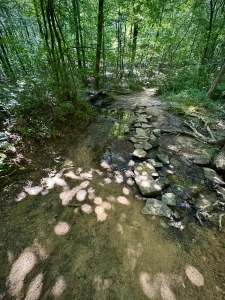
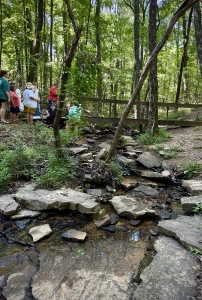
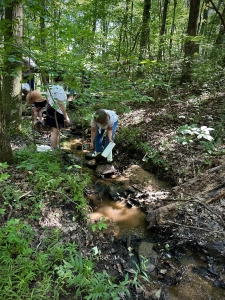
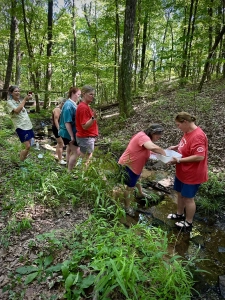
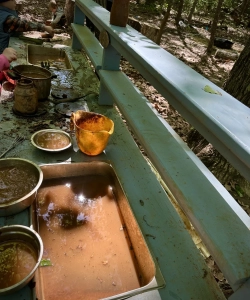
Environmental learning is a contact sport. The educators leaped into investigating abundant life (biodiversity) in the plateau-top brook near the lodge.

Monte SSP

Monte SSP


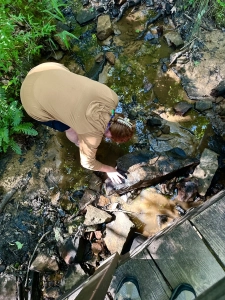
Participants turned over rocks, screened the water, and gathered nearby to share discoveries and compare observations.


There is excitement and celebration in learning, a demonstrable contact sport with feet in the water, knees in the mud, and hands on the tiny critters.

Monte SSP


Here is my 25-second video of learning in action, which is anything but learning inaction!


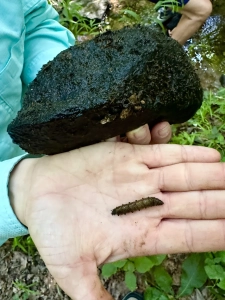
Amber Coger, the Alabama State Park NW District Naturalist, shares the caddis fly larva she found under a rock mid-brook. She may not have been more thrilled finding a gold nugget.

Monte SSP


Here’s my 59-second video recorded where the plateau-top brook exits at a ledge to depart for the Huntsville valley floor.


There is palpable magic in learning, sharing, understanding, and appreciating.


Seeing What Lies Hidden in Plain Sight


I often observe that I invest most of my time in forest wanderings discovering what wonders lie hidden in plain sight.

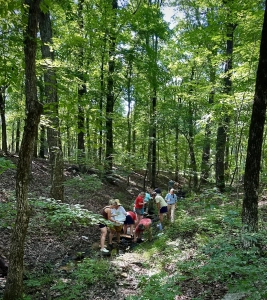
I recordeed this 58-second video of the workshop’s forest immersion experience, a designed quiet period to listen, relax, and absorb through all five human portals: mind, body, heart, soul, and spirit. Here’s the location where instructors released students one at a time to facilitate solitary immersion.


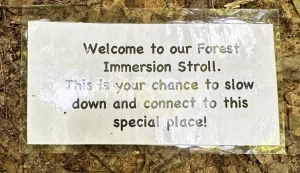
Instructors placed guidance along the way to help focus and implore deep thinking and full immersion.

Monte SSP


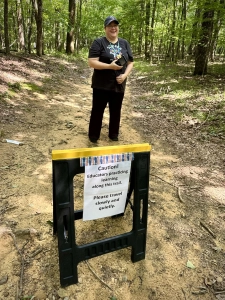
An instrucor cautioned participants and bikers to watch out for each other.

Monte SSP


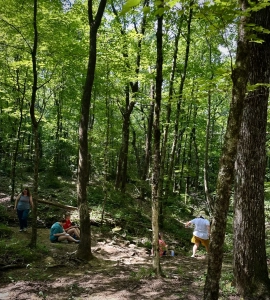
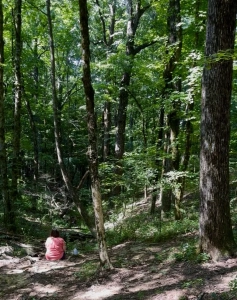
Teacher-students followed forest immersion practitice guidelines. I reminded myself that I need to be a more disciplined practitioner. I don’t sit quietly long enough. Come on, Steve, practice what you preach!

Monte SSP


One station suggested that students look into the crown, a perspective that forces us to think about the engine, Old Sol, that fuels forest energy flow.

Monte SSP


Although I seldon pause for a full forest immersion, I abhor wasting my time blindly hiking through Nature, intent on the destination… not the journey.

Monte SSP


John Muir advocated sauntering in Nature, as an online biographer source noted:

One day as I was resting in the shade Mr. Muir overtook me on the trail and began to chat in that friendly way in which he delights to talk with everyone he meets. I said to him: “Mr. Muir, someone told me you did not approve of the word ‘hike.’ Is that so?” His blue eyes flashed, and with his Scotch accent he replied: “I don’t like either the word or the thing. People ought to saunter in the mountains – not hike!”

John Muir lived up to his doctrine. He was usually the last man to reach camp. He never hurried. He stopped to get acquainted with individual trees along the way. He would hail people passing by and make them get down on hands and knees if necessary to see the beauty of some little bed of almost microscopic flowers. Usually he appeared at camp with some new flowers in his hat and a little piece of fir bough in his buttonhole.


Discovering Special Oddity, Curiosity, and Delight in Everyday Nature


Forest oddities, curiosities, and mysteries fascinate, puzzle, and entertain me on my forest excursions. I kept my eyes open as I wandered during the workshop. This chestnut oak stood in plain view where I recorded the start of the forest immersion video. I wondered how many noticed?

Monte SSP


A contorted sugar maple displayed clear evidence of some past physical battery (falling branch or tree, logging equipment damage, or some less-obvious injury). Nature is remarkably resilient.

Monte SSP


Naturally curious in its manner of growth, sparkleberry or farkleberry grows however it wishes, without apparent disciplinary rules.

Monte SSP


I love it for its mirthful common names and for its whimsical growth.

Monte SSP


I learned a new plant: leafy elephant’s-foot, a moniker worthy of inclusion in this listing of notable features in everyday Nature.

Monte SSP


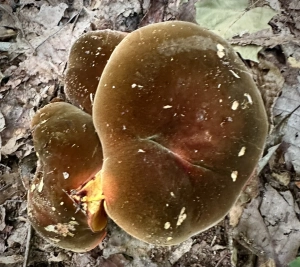
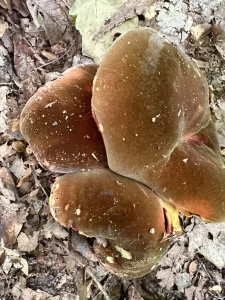
I consider myself a neophyte mycophile… a fungi enthusiast. I’m gaining confidence in identifying regional edibles. iNaturalist identified this mushroom as Neoboletus sp. ‘varietstibus. Its velvety brown, stocky appearance drew me closer. I saw no other individuals and because of its scarcity, I did not disturb it to capture a complete set of photo images: top, bottom, and side. Therefore I am not confident in the iNaturalist identification. I’ll consider whether this species is edible or not when I find a patch large enough to be certain.


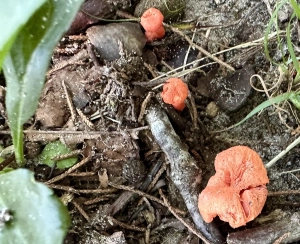
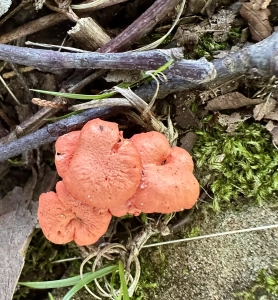
Red chanterelle mushrooms are edible, but are too diminutive to bother. I do forage larger chanterelles, but not from our State Parks.

Monte SSP


I recorded this 60-second red chanterelles video during the workshop.


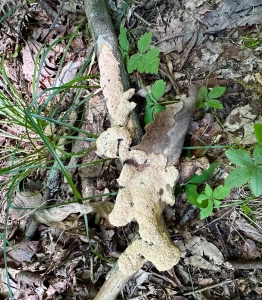
I present this final oddity, curiosity, and delight: dog vomit slime mold, which presented itself along the trail at the intersection where we launched individuals for their solitary immersions. So much lies hidden in plain sight.

Monte SSP


Like John Muir, I believe:

In every walk with Nature one receives far more than he seeks.


The Wonder of My Retirement Role


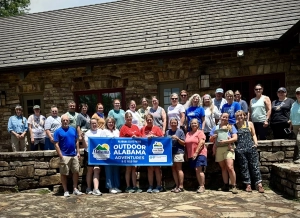
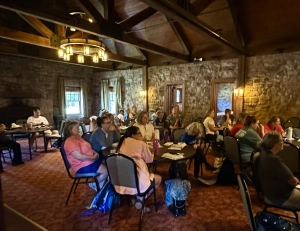
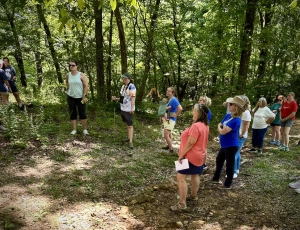
Here’s our contingent of ardent learners.


One of the educators (Shelly, employed in Tennessee) said to me after sharing a table during the indoor sessions, “You have the greatest volunteer retirement role I could ever imagine.” She nailed it:


Alabama State Parks Foundation

Thoughts and Reflections


I offer these observations:

  • Mr. Muir, someone told me you did not approve of the word ‘hike.’ Is that so?” His blue eyes flashed, and with his Scotch accent he replied: “I don’t like either the word or the thing. People ought to saunter in the mountains – not hike!” (Muir biographer)
  • There is excitement and celebration in learning, again, a demonstrable contact sport. (Steve Jones)
  • There is palpable magic in learning, sharing, understanding, and appreciating. (Steve Jones)

Inhale and absorb Nature’s elixir. May Nature Inspire, Inform, and Reward you!


Note: All blog post images created & photographed by Stephen B. Jones unless otherwise noted. Please circulate images with photo credit: “©2026 Steve Jones, Great Blue Heron LLC. All Rights Reserved.”

I am available for Nature-Inspired Speaking, Writing, and Consulting — contact me at steve.jones.0524@gmail.com

Subscribe to my free weekly photo essays (like this one) at: http://eepurl.com/cKLJdL


Reminder of my Personal and Professional Purpose, Passion, and Cause

If only more of us viewed our precious environment through the filters I employ. If only my mission and vision could be multiplied untold orders of magnitude:

Mission: Employ writing and speaking to educate, inspire, and enable readers and listeners to understand, appreciate, and enjoy Nature… and accept and practice Earth Stewardship.

Vision:

  • People of all ages will pay greater attention to and engage more regularly with Nature… and will accept and practice informed and responsible Earth Stewardship.
  • They will see their relationship to our natural world with new eyes… and will understand more clearly their Earth home.

Tagline/Motto: Steve (Great Blue Heron) encourages and seeks a better tomorrow through Nature-Inspired Living!


Steve’s Four Books


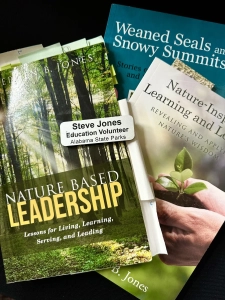
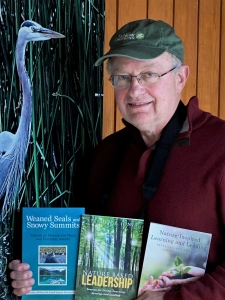
I wrote my books Nature Based Leadership (2016), Nature-Inspired Learning and Leading (2017), Weaned Seals and Snowy Summits: Stories of Passion for Place and Everyday Nature (2019; co-authored with Dr. Jennifer Wilhoit), and Dutton Land & Cattle: A Land Legacy Story (2023) to encourage all citizens to recognize and appreciate that every lesson for living, learning, serving, and leading is either written indelibly in or is powerfully inspired by Nature. All four of my books present compilations of personal experiences expressing my deep passion for Nature. All four books offer observations and reflections on my relationship with the natural world… and the broader implications for society. Order any from your local indie bookstore, or find them on IndieBound or other online sources such as Amazon and LifeRich.

I began writing books and Posts for several reasons:

  • I love hiking and exploring Nature
  • I see images I want to (and do) capture with my trusty iPhone camera
  • I enjoy explaining those images — an educator at heart
  • I don’t play golf!
  • I do love writing — it’s the hobby I never needed when my career consumed me
  • Judy suggested my writing is in large measure my legacy to our two kids, our five grandkids, and all the unborn generations beyond
  • And finally, perhaps my books and Blogs could reach beyond family and touch a few other lives… sow some seeds for the future


Monte SSP


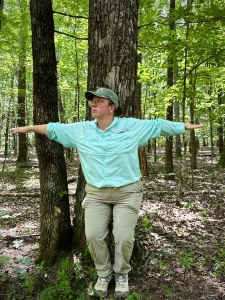
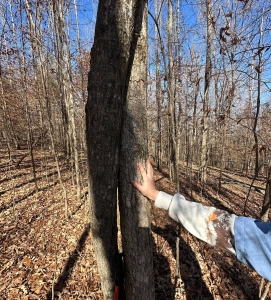
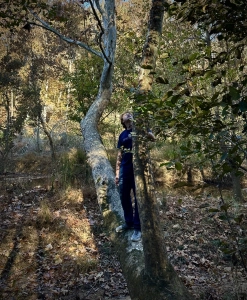
[Workshop facilitator Amber Coger depicting the right-angle branching character of black gum (the smaller tree at her right forearm).]

Mid-June Exploration on Trails New to Me on Lake Guntersville State Park!

NOTE: Some of my GBH photo essays were not routinely distributed from mid-February through mid-June. I will resend those one by one, beginning the first week of July. Here is my Post from April 21 (https://stevejonesgbh.com/2026/04/21/brief-form-post-57-reflection-in-on-beaverdam-tupelo-swamp-wheeler-national-wildlife-refuge/)


On-site to attend the Alabama State Parks Foundation board meeting (June 18, 2026), at Lake Guntersville State Park, I arrived the prior morning to explore trails I had not yet wandered. I enjoyed a sweeping loop that covered the Terrell Connector, Terrell Trail, Graveyard Road, Service Road, Cave Trail, and Lodge Road, then returned through Terrell Trail and the Terrell Connector. No, I refuse to claim mine was a hike. Like John Muir, I sauntered these forest trails and park roads to experience yet another northern Alabama second-growth Cumberland Plateau forest. I walked within the forest…not through the forest. I was absorbing all I could discover hidden in plain sight, not to reach benchmarks, score miles, and log elevation gain. Come along with me virtually.

The entire route transited second-growth forest. However, second-growth is a broad characterization encompassing nearly every acre of forest in the eastern USA. Very little of the original pre-Columbian forest escaped domestication, settlement, logging, and other disturbances. Although all second-growth, the LGSP forest is anything but uniform.


Entering a Forest Stand with an Ancient Aura


The Connector Trail transits a rich bottomland forest exhibiting old-growth characteristics: large-diameter towering hardwoods, abundant dead and down woody debris, and tiered canopy. I felt I had entered an ancient forest.

Lake GSPLGSP


A planked boardwalk kept my boots dry.

Lake GSP


A channel directed water through the bottomland. The waterway appeared to be human-made, suggesting a dragline or backhoe excavation drainage ditch through fertile farmland prior to the Corps of Engineers or TVA acquiring the basin property for Lake Guntersville. I have often observed that every parcel of forest has a story to tell. I can discern some of the tale from hints, allegations, and evidence on site, yet there is a juncture where conjecture blurs from certainty.

Lake GSP


Tufts of Christmas fern highlighted the fertile bottomland near the channel. Dense shade reduced understory growth, leaving the fern standing in isolation…alone in the gloam.

Lake GSP


I continued beyond the ancient feel of the Christmas fern glade.


Exiting the Apparent Old-Growth


The Connector Trail brought me to a spaghetti intersection. Several hours later I worked my way back to this loblolly pine tree, and then on to my car.

Lake GSP


The remainder of my transit stayed on uplands. Long ago when I was managing company-owned forest land, I would have subdivided the property into management units. Such was not the intent of my LGSP wanderings. I sought not to understand, differentiate, or consolidate…nor to consider the forest. I wanted only to discover the beauty, magic, wonder, awe, and inspiration that linked one marvel, curiosity, and oddity to another. This trail segment served as matrix, revealing nothing special… just a peaceful, quiet stretch that offered no distractions. This stand of mixed oaks and associated upland hardwoods seemed to fall within the age range of 80 to 110 years, typical of northern Alabama.

Lake GSP


A little further along, the fun began. The seeming even-aged matrix of 80-110-year-old forest was peppered with significantly larger, older, disfigured, and decayed  individuals, like this chestnut oak. I offer an explanation for this apparent two-aged forest. Loggers harvested commercially valuable individuals about a century ago, leaving unmerchantable trees behind. This chestnut oak will never secure a berth on a logging truck, yet in this public park setting, the tree’s non-forest-product value may be nearly incalculably high.

Lake GSPLake GSP


Among other benefits, the tree produces vast quantities of mast (acorns for animal consumption). The tree is hollow and likely has been since the logger noticed it was not worth felling early in the twentieth century. This oak occupies land, air, and soil covering at least one-fifth of an acre. Think of the vast quantities of organic matter processed by the tree, associated organisms (micro and macro), and energy flowing through this single tree ecosystem.

Lake GSP


And nearby a healthy, vibrant, ~90-year-old hickory reached high into the canopy, its bark revealing vigorous growth, distinct from the old denizen in the turtle-head massive monster image below.

Lake GSP


I recorded this 59-second video along the trail.


Again, imagine this gnarled hickory ignored by the forest sawyer so many years ago. Every tree has a story to tell. I’d like to hear this unique individual’s tale.

Lake GSP


I recorded this 60-second video of the gnarled hickory:


Eyes closed, the turtle (or is it a dragon!) relaxed as I snapped photographs and recorded the short video.

Lake GSP


A black oak signaled internal decay with its severly swollen branch stub at chest level above the trail surface. I’m reminded of the 12 weeks of bi-weekly physical therapy I endured following my April 13, 2026, total left shoulder reconstruction. People with braces, recent scars, bandages, and gimpy, healing limbs surrounded me. Nine weeks after surgery, here I was at LGSP in the midst of trees bearing wounds, injuries, infections, and diverse infirmities and imperfections!

Lake GSP


Even among the affected trees, including this blemished black oak, a glance upward revealed the beauty, promise, and inspiration of the sun smiling through its crown.

Lake GSP


A nearby white oak stood among the stricken, its decay-swelled old branch stub opening a portal to its hollow core.

Lake GSP


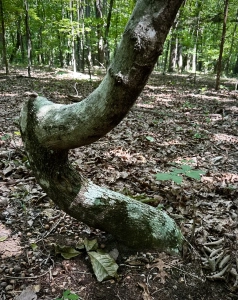
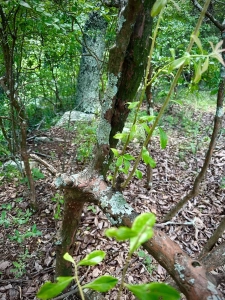
Not all oaks are misshappen, decayed, and physically disabled. However, all sourwood trees (Oxydendrum arboreum) rebel against growing in accord with the basic, fundamental dictates of negative geotropism and positive phototropism. Most trees grow opposite the attraction of gravity or directly toward the sun. Sourwood prefers sinuosity, a characteristic I’ve admired since first meeting the species in freshman Dendrology! Compare the curvy sourwood cluster below right to the three clumped yellow poplars beyond them standing at ramrod attention.

Lake GSP Lake GSP


Some Additional Curiosities:


Our native loblolly pines accumulate resins in core wood as they age and mature. The resin-soaked heartwood is decay resistant, as is evident from this old cut stump. Only the bark and the core remain.

Lake GSP

This corewood skeleton remains intact on the forest floor where it fell decades ago. When I fueled a fireplace in prior residences, I collected such lightered wood to start evening fires.

Lake GSP

So many stories to interpret, record, and later share as I sauntered through LGSP; so little reader’s time to consume!


Kings Chapel Cemetery


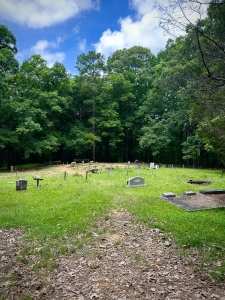
I abruptly entered a sacred opening, dropping back 100 years. The cemetery bordered a community then tethered to Kings Chapel and anchored to the Tennessee River. I found no interment that postdated Lake Guntersville’s 1939 completion.

Lake GSP


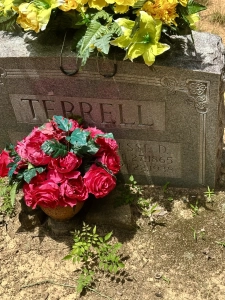
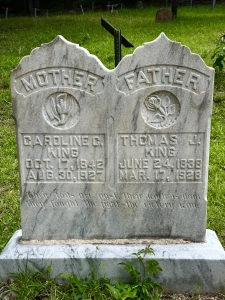
The Terrell and King families were prominent citizens. These individuals died in 1938 and 1927. Imagine the tremendous family, community, and economic tremors imposed by dam completion.

Lake GSPLake GSP


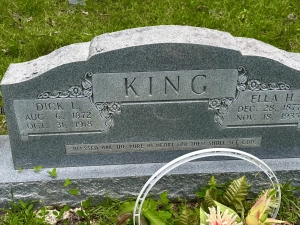
The King inscription reads: Their toils are past, their work is done, they fought the fight — the victory is won. Who now tends their graves? Who remembers them?

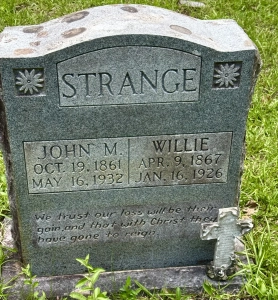
Friends, neighbors, and kinfolk, these King and Strange residents passed in 1918 and 1926. Did any still-adjacent trees witness their burial?

Lake GSP


The John and Willie Strange epitaph: We trust our loss will be their gain, and that with Christ they have gone to reign.

The Terrell memory lives on via a named trail. I can think of less favorable ways to be memorialized!

Lake GSP Lake GSP


Some Worthy Postscripts


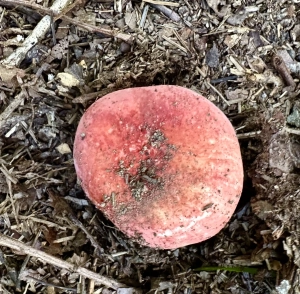
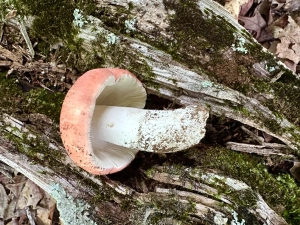
Two lovely mushrooms appeared, the first this hintapink (Russula paludosa), a brightly colored, edible brittlegill. I harvested only one of several, mostly to secure an underside photo for identification. I cooked the morsel with butter, pepper, and salt, finding the flavor mild and pleasant, but not nearly enough to truly gauge whether I’d want a full-omelette measure.

Lake GSP


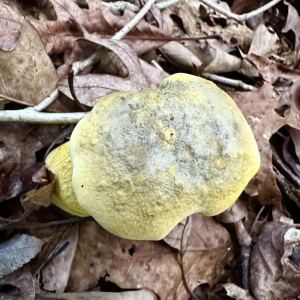
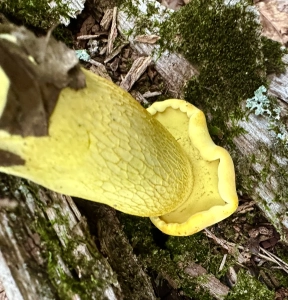
I saw a handful of this meaty ornate-stalked bolete, identified as edible with a caution that the species can be too bitter for consumption. I found it disagreeably acrid.

Lake GSPLake GSP


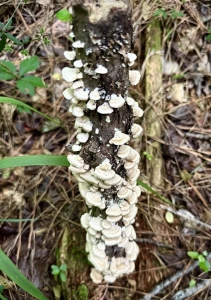
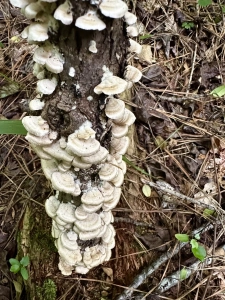
This violet-toothed polypore occupied an oak sapling snag, performing its dedicated decomposing mission. No, not edible!

Lake GSP


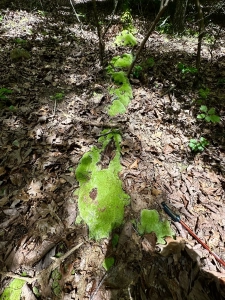
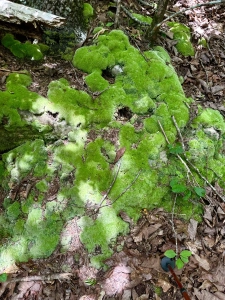
Pin cushion moss colonized a long decaying stump and trunk, both visible only as an outline of the organic matter remains of the downed woody debris.

Lake GSP

Lake GSP


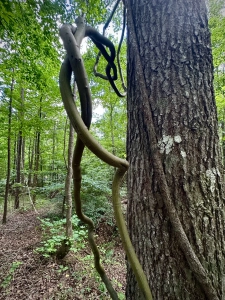
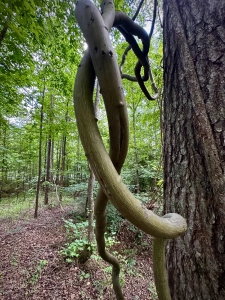
A supplejack vine clings to its black oak anchorage. I admire its smooth green bark and tendency to wrap in sinuous coils on tree stems and adjacent supplejack vines.

Lake GSP


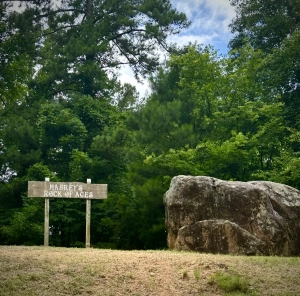
I leave you with an image of the LGSP Mabrey Rock of Ages, along the Service Road as I returned to to the Connector Trail.

Lake GSP


Alabama State Parks Foundation

Thoughts and Reflections


I offer these observations:

  • Take heart, not all oaks are misshapen, decayed, and physically disabled. (Steve Jones)
  • However, all sourwood trees (Oxydendrum arboreum) rebel against growing in accord with the basic, fundamental dictates of negative geotropism and positive phototropism. (Steve Jones)
  • I only went out for a walk and finally concluded to stay out till sundown, for going out, I found, was really going in. (John Muir)

Inhale and absorb Nature’s elixir. May Nature Inspire, Inform, and Reward you!


Note: All blog post images created & photographed by Stephen B. Jones unless otherwise noted. Please circulate images with photo credit: “©2026 Steve Jones, Great Blue Heron LLC. All Rights Reserved.”

I am available for Nature-Inspired Speaking, Writing, and Consulting — contact me at steve.jones.0524@gmail.com

Subscribe to my free weekly photo essays (like this one) at: http://eepurl.com/cKLJdL


Reminder of my Personal and Professional Purpose, Passion, and Cause

If only more of us viewed our precious environment through the filters I employ. If only my mission and vision could be multiplied untold orders of magnitude:

Mission: Employ writing and speaking to educate, inspire, and enable readers and listeners to understand, appreciate, and enjoy Nature… and accept and practice Earth Stewardship.

Vision:

  • People of all ages will pay greater attention to and engage more regularly with Nature… and will accept and practice informed and responsible Earth Stewardship.
  • They will see their relationship to our natural world with new eyes… and will understand more clearly their Earth home.

Tagline/Motto: Steve (Great Blue Heron) encourages and seeks a better tomorrow through Nature-Inspired Living!


Steve’s Four Books


I wrote my books Nature Based Leadership (2016), Nature-Inspired Learning and Leading (2017), Weaned Seals and Snowy Summits: Stories of Passion for Place and Everyday Nature (2019; co-authored with Dr. Jennifer Wilhoit), and Dutton Land & Cattle: A Land Legacy Story (2023) to encourage all citizens to recognize and appreciate that every lesson for living, learning, serving, and leading is either written indelibly in or is powerfully inspired by Nature. All four of my books present compilations of personal experiences expressing my deep passion for Nature. All four books offer observations and reflections on my relationship with the natural world… and the broader implications for society. Order any from your local indie bookstore, or find them on IndieBound or other online sources such as Amazon and LifeRich.

I began writing books and Posts for several reasons:

  • I love hiking and exploring Nature
  • I see images I want to (and do) capture with my trusty iPhone camera
  • I enjoy explaining those images — an educator at heart
  • I don’t play golf!
  • I do love writing — it’s the hobby I never needed when my career consumed me
  • Judy suggested my writing is in large measure my legacy to our two kids, our five grandkids, and all the unborn generations beyond
  • And finally, perhaps my books and Blogs could reach beyond family and touch a few other lives… sow some seeds for the future


Celebrating Vitamin ‘N’: Little Mountain Annual Learning Showcase at Monte Sano State Park!


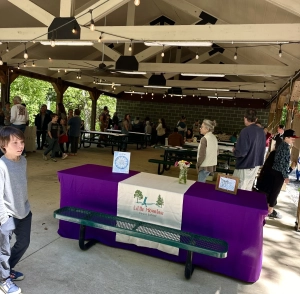
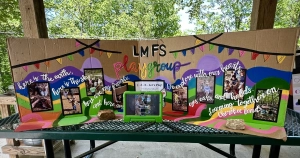
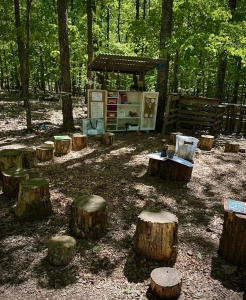
A Board Member of the Little Mountain Forest School in Huntsville, Alabama, I attended the school’s Annual Learning Showcase on Sunday afternoon, April 19, 2026, at Monte Sano State Park, where 60 students are enrolled and attend classes in the outdoor forest classroom. Come along with me as I reflect on the forest school concept, its philosophy, and the pioneering thinkers and practitioners who promote it. If you want to learn more about LMFS, visit the website: https://www.littlemountainforestschool.org/

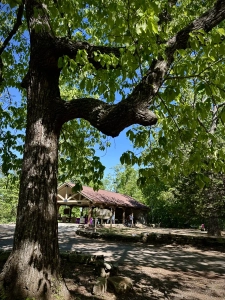
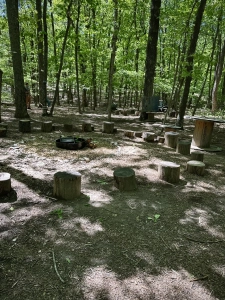
A massive chestnut oak framed the plateau-top pavilion, gathering site for the showcase.


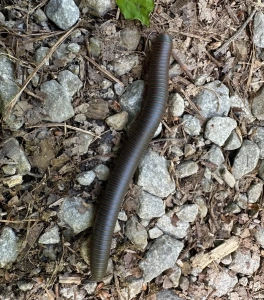
An American giant millipede welcomed my wife and me as we exited our car. Just one of many creature teachers who share their woodland classroom.


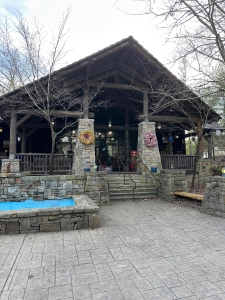
The Biker’s Pavilion at Monte Sano is ideal for hosting a Little Mountain Forest School event, launching a hike down the Sinks Trail to the forest haven I dub The CathedralForest, or for resting a few minutes after a vigorous woodland saunter.


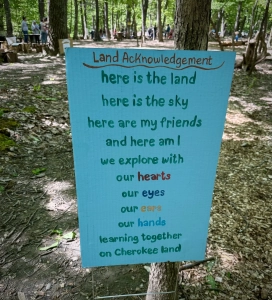
LMFS participants connect to the land, its essential richness, and the stories it lives and relates.

“Here is the Earth; here is the sky,

Here are my friends, and here am I.

We explore with our hearts.

Learning together on Cherokee lands.”


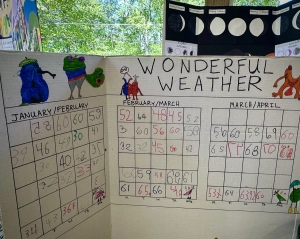
I am a lifelong student of weather, climate, atmospheric physics,and the dynamic envelope of atmosphere that surrounds, protects, and sustains us. I’ve been keeping weather records since elementary school. Sunny skies, persisten rain, wild thunderstorms, or wind-driven snow, I loved every dimension, mood, or effect. I embraced the science and artistry of understanding, appreciating, and relishing weather and its interplay with Place, Life, and Nature. As my life and career tracked along a forestry vector, wonderful weather trekked along every step of my incredible journey. If only a single LMFS enrollee catches a mere germ of my deep weather fascination and incurable addiction, my investment serving on the LMFS Board is amply rewarded.


I neglected to photograph the scientific rain gauge that staff recently placed near the outdoor classroom. It’s the real thing. I still recall with memory-giddiness many years ago when Mom gifted young me a rain gauuge. A high quality scientific instrument? Through today’s lens it was cheap plastic, but to very young Steve…priceless! And now, to very old Steve, tears are suddenly blearing the keyboard, as I realize the momentous impact left by thoughtful, caring, and knowing educators, including parents.

I recorded this 52-second video to capture the mood and moment of the Learning Showcase.


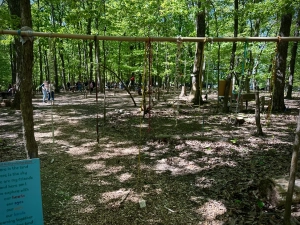
Students designed and fashioned the festive classroom entryway.


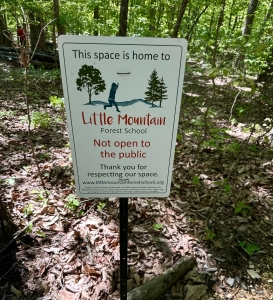
I sub-titled my third book, Stories of Passion for Place and Everyday Nature. This sign speaks volumes of this Special Place…Thank You for Respecting Our Space!


And, what a very SPECIAL Land Acknowledgement!


John Muir would have appreciated the LMFS classroom.

Everybody needs beauty as well as bread, places to play in and pray in, where Nature may heal and cheer and give strength to body and soul alike.


Such a great place to hide and abide…and not a molecule of plastic or a line of digital code! Richard Louv observed:

Nature is imperfectly perfect, filled with loose parts and possibilities, with mud and dust, nettles and sky, transcendent hands-on moments and skinned knees.


I see limitless beauty, magic, wonder, awe, and inspiration in the mundane and common of everyday Nature.


My former Antioch University New England colleague David Sobel remarked,

You can’t bounce off the walls If there are no walls: outdoor schools make kids happier—and smarter.


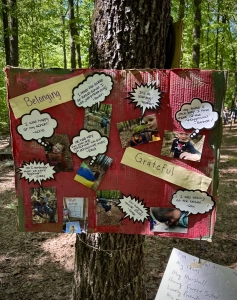
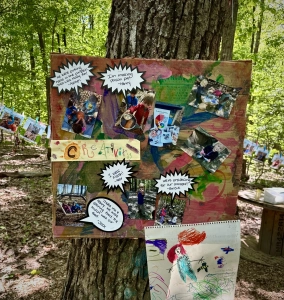
Signs proclain Belonging and Grateful (left) and Creative (right).


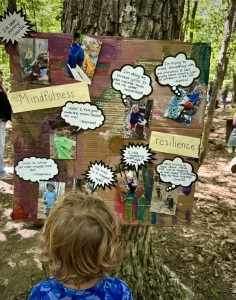
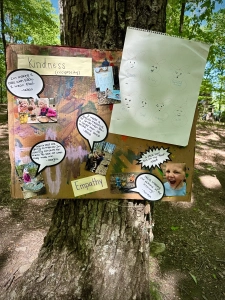
Mindfulness and Resilience (left) and Kindness, Reciprocity, and Empathy (right).


An artists’ workbench keeps essentials (soil, dirt, water, measuring flasks, buckets…) at the ready. No need to worry about messing up the floor!


This is an all-weather classroom for more than sixty kids. Richard Louv heralded a movement:

Humans are hard-wired to love and need exposure to the natural world. Researchers have found that regardless of culture people gravitate to images of nature, especially the savannah. Our inborn affiliation for nature may explain why we prefer to live in houses with particular views of the natural world.

Just beyond the woods at left, an overlook provides a vista to the E/NE into a valley 800 feet below the Monte Sano plateau summit. A youngster in the frameat right chooses to gain another three feet!


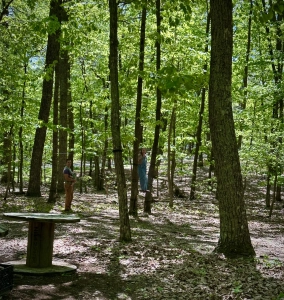
I recorded a 60-second video sweeping through the forest.


I would have loved learning in such an outdoor setting!


Alabama State Parks Foundation

Thoughts and Reflections


I offer these observations:

  • You can’t bounce off the walls If there are no walls: outdoor schools make kids happier—and smarter. (David Sobel)
  • Nature is imperfectly perfect, filled with loose parts and possibilities, with mud and dust, nettles and sky, transcendent hands-on moments and skinned knees. (Richard Louv)
  • Everybody needs beauty as well as bread, places to play in and pray in, where Nature may heal and cheer and give strength to body and soul alike. (John Muir)

Inhale and absorb Nature’s elixir. May Nature Inspire, Inform, and Reward you!


Note: All blog post images created & photographed by Stephen B. Jones unless otherwise noted. Please circulate images with photo credit: “©2026 Steve Jones, Great Blue Heron LLC. All Rights Reserved.”

I am available for Nature-Inspired Speaking, Writing, and Consulting — contact me at steve.jones.0524@gmail.com

Subscribe to my free weekly photo essays (like this one) at: http://eepurl.com/cKLJdL


Reminder of my Personal and Professional Purpose, Passion, and Cause

If only more of us viewed our precious environment through the filters I employ. If only my mission and vision could be multiplied untold orders of magnitude:

Mission: Employ writing and speaking to educate, inspire, and enable readers and listeners to understand, appreciate, and enjoy Nature… and accept and practice Earth Stewardship.

Vision:

  • People of all ages will pay greater attention to and engage more regularly with Nature… and will accept and practice informed and responsible Earth Stewardship.
  • They will see their relationship to our natural world with new eyes… and will understand more clearly their Earth home.

Tagline/Motto: Steve (Great Blue Heron) encourages and seeks a better tomorrow through Nature-Inspired Living!


Steve’s Four Books


I wrote my books Nature Based Leadership (2016), Nature-Inspired Learning and Leading (2017), Weaned Seals and Snowy Summits: Stories of Passion for Place and Everyday Nature (2019; co-authored with Dr. Jennifer Wilhoit), and Dutton Land & Cattle: A Land Legacy Story (2023) to encourage all citizens to recognize and appreciate that every lesson for living, learning, serving, and leading is either written indelibly in or is powerfully inspired by Nature. All four of my books present compilations of personal experiences expressing my deep passion for Nature. All four books offer observations and reflections on my relationship with the natural world… and the broader implications for society. Order any from your local indie bookstore, or find them on IndieBound or other online sources such as Amazon and LifeRich.

I began writing books and Posts for several reasons:

  • I love hiking and exploring Nature
  • I see images I want to (and do) capture with my trusty iPhone camera
  • I enjoy explaining those images — an educator at heart
  • I don’t play golf!
  • I do love writing — it’s the hobby I never needed when my career consumed me
  • Judy suggested my writing is in large measure my legacy to our two kids, our five grandkids, and all the unborn generations beyond
  • And finally, perhaps my books and Blogs could reach beyond family and touch a few other lives… sow some seeds for the future


I was just six days past left shoulder replacement revision surgey when Judy drove us to the the LMFS Annual Learning Showcase.


Brief-Form Post #61: Mid-February OLLI Eagle Safari at Lake Guntersville State Park

I am pleased to add the 61st of my GBH Brief-Form Posts (Less than five minutes to read!) to my website. I get wordy with my routine Posts. I don’t want my enthusiasm for thoroughness and detail to discourage readers. So, I will occasionally publish these brief Posts.


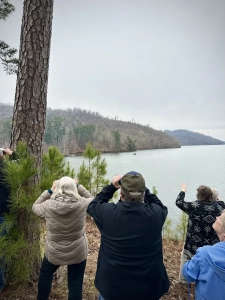
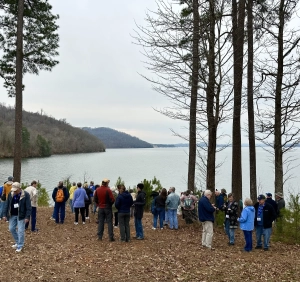
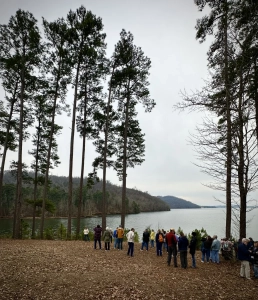
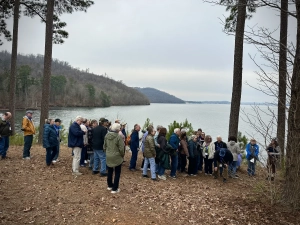
Along with fellow retired forester Chris Stuhlinger, I co-led a University of Alabama in Huntsville OLLI (Osher Lifelong Learning Institute) Eagle Observation Safari on February 14, 2026, to Alabama’s Lake Guntersville State Park (LGSP). Alabama State Parks Northeast District Naturalist Erik Cline and Park Naturalist Anna Crow presented the program, leading us to two nest observation sites in the Park and another along the Sunset Greenway in Guntersville, AL. Come along to experience the tour stops the 55 of us enjoyed as we spotted ten eagles!

Unfortunately, because my trusty iPhone cannot capture images of eagles nesting or in flight, well enough to post in these photo essays, I’ll rely on you to imagine the magnificent eagle safari stars. I intend to demonstrate the remarkable enthusiasm that a low-intensity, half-day Nature outing within sixty minutes of campus can inspire among mostly retired, eager learners. Count me among them! Moreover, my retirement life mission impels me to employ writing and speaking to educate, inspire, and enable readers and listeners (and eagle safari participants) to understand, appreciate, and enjoy Nature… and accept and practice Earth Stewardship. Thus, through my OLLI engagement, I am reaching and inspiring concerned Earth citizens to observe, understand, feel, and act on behalf of our pale blue orb.

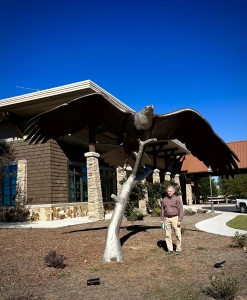
Chris stands under the iconic Park Lodge Bald Eagle on October 23, when we scouted for the February excursion: https://stevejonesgbh.com/2025/12/15/brief-form-post-52-late-october-afternoon-scouting-for-eagles-and-nests-at-lake-guntersville-state-park/


Our group convened in The Gathering Place indoor social hall in the Park campground at lakeside. The Lodge stands ~300 feet above us atop the plateau rim.

Lake GSP


The Gathering Place kept us snug and warm as Anna effectively oriented us to eagle biology and ecology.

Lake GSP


I recorded this 34-second video from the Gathering Place, viewing the lakeshore, panning the audience, then sweeping out the opposite side, and bringing the lodge down to our level.


Who could ask for a finer place to launch our safari?!

Following lots of questions and eager discussion we drove to our first observation site at the Park cabins, where we aimed our binoculars, spotting scopes, and cameras to an occupied nest 200 yards across the inlet. This first nest, as were all three nests we visited, was firmly anchored in a large-crowned loblolly pine tree. We logged a single mature eagle nest-setting. We spotted no mate nor eaglet.

We showed few signs of cracking under the chilling mid-40s clouds and dampness, although I heard a few grumblings and witnessed signs of efforts to maintain body heat. The eagle sighting kept our attention.


I recorded this 59-second video with narrative as the group anticipated what lies ahead.


The group of seasoned learners paid the price of a chilly, cloudy spring morning for the pleasure of inhaling Nature’s elixir and seeing multiple individuals of a species on the brink of disaster earlier in our lifetime.


Here is my 58-second video of the stop without narrative.


Our second observation point, also along the lakeshore with target nest some 200 yards across the lake rewarded us with six sightings: an adult in the nest, another adult in a nearby tree, two matures in flight and alighting in the nest tree vicinity, and two more flying by above the lake nearer to our shore. That took us to seven. Elation describes our mood.

We retreated to the lodge for lunch and warmth. I’ve visited LGSP many times, never tiring of the special Nature of the place: the lake, her hills, wooded trails, wildlife, wildflowers, seasonal variations, and the embrace of its soothing moods and themes.

I snapped these photos on a May 2025 visit. Afternoon image from the lodge (left) and dawn from the Mabry Overlook, one-quarter mile east of the lodge, still on the rim above the lake.
LGSP

LGSP


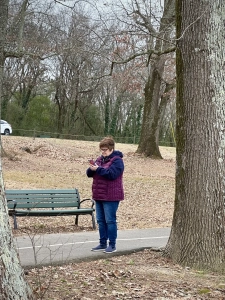
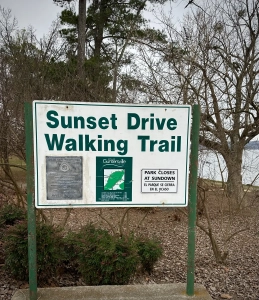
Following a leisurely lunch, we caravaned to Sunset Drive Greenway in the city of Guntersville. Eagles have maintained and reared young in this unlikely congested location for at least the past eight years. I am standing at least 200 feet from the tree’s base, located within a copse of pine trees beyond the observers.

Lake GSP


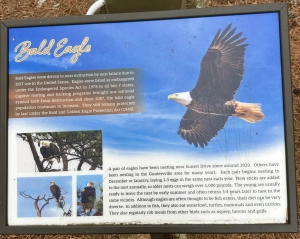
I admit to decades associating eagles to wild, remote, natural settings, distant from the hustle and bustle of urban life and living…until we lived four years in Alaska. Seeing this 1,000+ pound nest 70-feet up a pine tree between a greenway heavily traveled by walkers, runners, skateboarders, and bicyclists, and a busy roadway, however, still strikes me as surprising. An adult stayed on the nest during our hour on-site. Some in our party had already departed when two adults performed a beautiful fly-by!

LGSP

LGSP


John Denver’s The Eagle And The Hawk shaped my earlier impression:

I am the eagle, I live in high country in rocky cathedrals that reach to the sky.
I am the hawk, and there’s blood on my feathers.
But time is still turning, they soon will be dry.
And all those who see me, and all who believe in me
share in the freedom I feel when I fly. Come dance with the west wind and touch on the mountain tops.
Sail o’er the canyons and up to the stars.
And reach for the heavens and hope for the future
and all that we can be, and not what we are.

Alaska opened my eyes and mind to a different bird, a magnificent predator and shameless scavenger, adept at both capturing live game in the wild and dumpster diving in Sitka, Alaska. Eagles are culinary (and nest site) opportunists, at home in both high, rocky cathedrals and the domesticated bustle of Guntersville, Alabama.

LGSP

LGSP


I remind you that nothing in Nature is static. Everything changes…every hour of every day across the seasons and over the eons. The same is true of my impressions, knowledge, and wisdom, such as it is. Eagles are just as noble, elegant, persistant, and rich-with-national-symbolic meaningful as ever. Back from near extinction, the eagle exemplifies the human ability to overcome our collective ignorance. As Louis Bromfield repeated, we are capable of changing some corner of our Earth for the better through wisdom, knowledge, and hard work!

A successful venture — ten eagles! My hope is that the OLLI Eagle Safari awakens all of us to our obligation to wisely steward our One Earth.


Closing


I accept the challenge of distilling these Brief-Form Posts into a single distinct reflection, this one cut and pasted from above:

My retirement life mission impels me to employ writing and speaking to educate, inspire, and enable readers and listeners (and eagle safari participants) to understand, appreciate, and enjoy Nature… and accept and practice Earth Stewardship. Thus, through my OLLI engagement, I am reaching and inspiring concerned Earth citizens to observe, understand, feel, and act on behalf of our pale blue orb.


Nature’s special treats await our discovery, our understanding, and our interpretation!


Subscribe to my free weekly photo essays (like this one) at: http://eepurl.com/cKLJdL
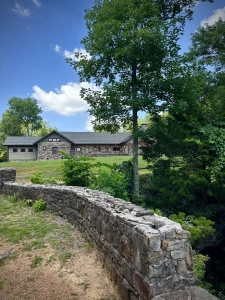


Mid-December Above Ground Exploration at Cathedral Caverns State Park

I published a photo essay of my July 2020 Cathedral Caverns tour on October 20, 2020: https://stevejonesgbh.com/2020/10/01/wonder-below-ground-cathedral-caverns-state-park/. I pledged a subsequent visit to explore the park’s surface trails, not knowing that 5.5 years would elapse before my December 11, 2025, four-hour venture with Hannah Hembree, Park Naturalist for Cathedral and Rickwood Caverns State Parks, Amber Coger, NW Alabama District Naturalist, and Chris Stuhlinger, a fellow retired forester. I sorted, selected, edited, and placed these 29 photos within a WordPress format on December 14, 2026. I’m drafting text five weeks later, on January 12, 2026, debating whether I should have begun a month earlier while my memory remained sharp!

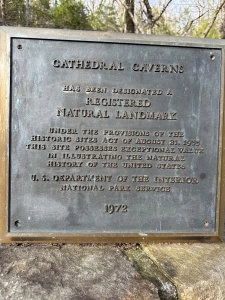
I photographed the park entrance sign in 2020.

Cathedral


Hannah, Chris, and Amber showed their enthusiasm for our journey, backdropped by the mixed upland forest growing among scattered limestone boulders. Hannah stands at the edge of a distinct sinkhole (right), where trees reach more than 100 feet vertically owing to deep limestone-derived soil, abundant moisture, and protected slope position. We enountered a diverse overstory species mix, another expression of the productive site.

CathedralCathedral


We admired this massive American beech tree dominating the convex ridgetop, a terrain position not generally conducive to large diameter, straight, tall beech. As we progressed, I marveled increasingly at the high site productivity reflected in species diversity and average canopy height.

Cathedral


I recorded this 58-second video of the upland hardwood forest and the wide flat trail system we explored.


I would like to return to catalog the tree species, identifying a complete list. We paid attention but did not keep a tally. We guessed 20 individual main canopy species.


Oddities and Curiosities


Always alert for tree form curiosities and oddities, I photographed a pair of pole-size yellow buckeye and sweetgum trees embraced, a union that is termed inosculation when they grasp more securely and intimately.

Cathedral


I never tire of seeing Carpinus carolinia, which I learned 56 years ago in dendrology as musclewood for the distinctive sinewy, muscle-like appearance of its stem. Also known as American hornbeam, blue-beech, ironwood, and muscle-beech, the species grows in the understory of hardwood forests from Alabama to New England, occasionally reaching heights of 25-30 feet. Most of the curious phenotypes I photograph are variant forms from the typical genotypye. Musclewood’s sinewy stem form is the standard genotype, not an abberation. So, its oddity is its standard form. Nothing special except to an aficiando like me!

Cathedral


Supplejack, in my humble opinion, is the boa conscrictor of native Alabama forest vines. Its smooth green stem one could conclude is snake-like. What makes it boa-like is its extraordinary knack for appearing to choke the living daylight out of any sapling that offers purchase and a route to fuller sunlight above.

CathedralCathedral


The supplejack doesn’t always win the squeeze-battle. This sapling sugar maple appears to have prevailed. Life in any plant-based ecosystem involves fierce competition (often life and death) for essentials…nutrients, moisture, sunlight, and space, both above and below ground. This struggle left scars in form of a clockwise spiralled disfirgurement…a tree form curiosity. Every tree has a story to tell to those of us intent on learning the language.

Cathedral


Leonardo da Vinci understood that there may be no truly inexplicable mysteries in Nature:

There is no result in nature without a cause; understand the cause and you will have no need of the experiment!

Mr. da Vinci knew many languages…of trees, geography, skies, and the pure elegance of shade, light, colors, hues, distance, and all other elements that constitute Nature’s visible beauty, magic, wonder, and awe.

Some fellow nature enthusiasts seem intent on ascribing a common tree form curiosity to Native American manipulation of trees and branches. Their purpose was to create Tree Markers directing and guiding fellow travelers to important landscape features (springs, choice trails, hunting spots, fishing holes, villages, trail routes to significant landmarks, etc.). The bent eastern hop hornbean (Ostrya virginiana) below is most certainly not an Indian Marker tree. The stand we traversed is less than 100 years old, post-dating Native American wildland occupation by well over half a cenutury. I frequently see such disfigurement…resulting from breakage by fallen trees or branches, wind, ice, or some other force. Trees are resilient, clinging valiantly to life, intent upon surviving to reproduce, which is the ultimate pursuit of every living creature…from earth worms to humans.


This suger maple suffered a crushing blow from above when just a sapling. The youngster responded with vertical shoots, three of which persist to today. Sugar maple tolerates shade. The stunted shrub of a tree persists in the understory, standing humbly with its tree moss skirt amid a cluster of mossy limestone boulders.

Cathedral


Sassafras is common as deep shade seedlings, understory shrubs, and occupying the imtermediate canopy. We found a 12-inch diameter sassafras tree reaching to a co-dominant position. This individual sported a vertical scar revealing its hollowed trunk, a condition favored by cavity-coveting birds, mammals, reptiles, and other forest critters.

Cathedral


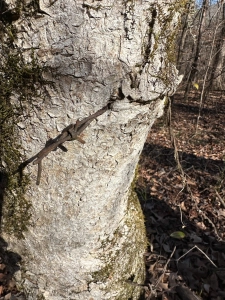
As we proceeded I pondered previous land use, which I believed included domestication, timber harvesting, grazing, and even selected cropping. We found compelling evidence in form of barbed wire protruding from the base of a white oak…a remnant fence that either kept stock in or out.


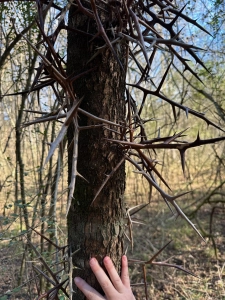
One among us (I’m withholding identity to protect the innocent!) had not seen the imposing compound thorns of honey locust. Farmers have told me that these fearsome spikes can puncture a tractor tire. The thorns don’t scare me, but they certainly earn my respect!

Cathedral


Fan moss drapes this yellow buckeye pair.


In quick progression allow me to chronicle a few observation highlights absent detailed narration, beginning with this handsome yellow buckeye.

Cathedral


A pole-sized yellow poplar bears the striking pattern of vertical white stripes and pale camouflage patches.


A two-foot diameter loblolly pine carries decades of horizontal yellow-bellied sapsucker wounds.

Cathedral


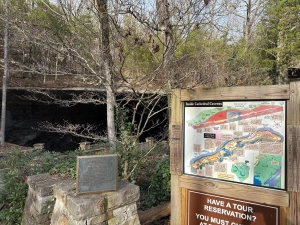
We returned to the cavern entrance. Interpretive signage tells the geologic tale and human history.


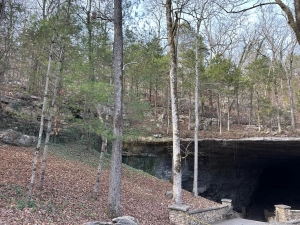
An imposing entrance!


Visitors Center and Park Store.

Cathedral


The Karst topographic signature and large yellow buckeye behind the headquarters.

CathedralCathedral


Alabama State Parks Foundation

Thoughts and Reflections


I offer these observations:

  • There is no result in nature without a cause; understand the cause and you will have no need of the experiment! (Leonardo da Vinci)
  • Every tree has a story to tell to those of us intent on learning the language. (Steve Jones)
  • A short autumn morning saunter can reveal volumes on the magic of everyday Nature. (Steve Jones)

Inhale and absorb Nature’s elixir. May Nature Inspire, Inform, and Reward you!


Note: All blog post images created & photographed by Stephen B. Jones unless otherwise noted. Please circulate images with photo credit: “©2026 Steve Jones, Great Blue Heron LLC. All Rights Reserved.”

I am available for Nature-Inspired Speaking, Writing, and Consulting — contact me at steve.jones.0524@gmail.com

Subscribe to my free weekly photo essays (like this one) at: http://eepurl.com/cKLJdL
 

Reminder of my Personal and Professional Purpose, Passion, and Cause

If only more of us viewed our precious environment through the filters I employ. If only my mission and vision could be multiplied untold orders of magnitude:

Mission: Employ writing and speaking to educate, inspire, and enable readers and listeners to understand, appreciate, and enjoy Nature… and accept and practice Earth Stewardship.

Vision:

  • People of all ages will pay greater attention to and engage more regularly with Nature… and will accept and practice informed and responsible Earth Stewardship.
  • They will see their relationship to our natural world with new eyes… and will understand more clearly their Earth home.

Tagline/Motto: Steve (Great Blue Heron) encourages and seeks a better tomorrow through Nature-Inspired Living!


Steve’s Four Books


I wrote my books Nature Based Leadership (2016), Nature-Inspired Learning and Leading (2017), Weaned Seals and Snowy Summits: Stories of Passion for Place and Everyday Nature (2019; co-authored with Dr. Jennifer Wilhoit), and Dutton Land & Cattle: A Land Legacy Story (2023) to encourage all citizens to recognize and appreciate that every lesson for living, learning, serving, and leading is either written indelibly in or is powerfully inspired by Nature. All four of my books present compilations of personal experiences expressing my deep passion for Nature. All four books offer observations and reflections on my relationship with the natural world… and the broader implications for society. Order any from your local indie bookstore, or find them on IndieBound or other online sources such as Amazon and LifeRich.

I began writing books and Posts for several reasons:

  • I love hiking and exploring Nature
  • I see images I want to (and do) capture with my trusty iPhone camera
  • I enjoy explaining those images — an educator at heart
  • I don’t play golf!
  • I do love writing — it’s the hobby I never needed when my career consumed me
  • Judy suggested my writing is in large measure my legacy to our two kids, our five grandkids, and all the unborn generations beyond
  • And finally, perhaps my books and Blogs could reach beyond family and touch a few other lives… sow some seeds for the future


Cathedral


Mid-November 25-Year Return to Alabama’s Chewacla State Park

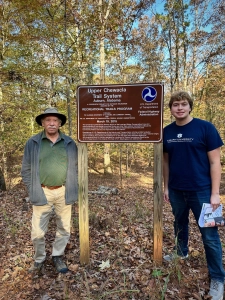
Having arrived in Auburn, Alabama on Thursday evening November 13, 2026, fellow retired forester (and Auburn University forestry graduate) Chris Stuhlinger, my grandson Jack (18), and I visited the College of Forestry, Wildlife, and Environment’s (CFWE) Kreher Forest Ecology Preserve and Nature Center, spent all day Friday at sundry engagements on AU’s campus, and hiked several trails Saturday morning at AL’s nearby Chewacla State Park. I invite you to join us as we hike the Upper Chewacla Trail System.

Chewacla


I had last visited the park 25 years ago, before I left my Auburn position as Director, Alabama Cooperative Extension System, heading to NC State University. I was pleased to revisit Chewacla in good company.

Chewacla


I welcome these autumn days of comfortable temperatures. I contend that our southern winter is a gradual transition from fall to spring, with an occasional cold spell thrown in for good measure.


Sauntering along the Mountain Laurel Trail and Return on a Ridgetop Trail


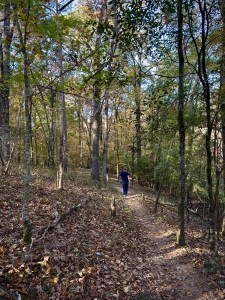
We parked at the Mountain Laurel Trailhead and worked downstream to the falls. We enjoyed pleasant temperature and morning sun as we strolled through the mixed hardwood forest along the toe slope.

Chewacla


The open understory presented a parklike scenario, and evidenced a high deer population effectively browsing the understory.

Chewacla


The stream flow corroborated the persistent autumn dry period that preceded our trek. A great morning for reflecting and reflection!

Chewacla

Chewacla


No heat, excess humidity, biting, sucking, or irritating insects — only the welcome crunch of early leaf-fall, a few bird calls, a scampering squirrel, and an occasional acorn dropping. Peace, serenity, and tranquility suggesting that all is good! Sauntering the gentle trail and soft fall woods with friend and family, I think of John Muir’s classic quote:

When we contemplate the whole globe as one great dewdrop, striped and dotted with continents and islands, flying through space with other stars all singing and shining together as one, the whole universe appears as an infinite storm of beauty.

Here’s my 60-second video from the Chewacla Creek channel.


Above the dam, the channel expands to a calm lake. A persimmon loaded with fruit leans over the water. I believe the mood and word of the morning is tranquil.


I recorded this 56-second video where the stream flattened to the lake.


Saw palmetto is common from central Alabama south to the coast. From 1981-85, I served as Union Camp Corporation’s Land Manager, responsible for the company’s 325,000 forestland acres (500 square miles) in Alabama, 100K north of the black belt (prairie soil divide just south of Auburn and Montgomery) and the remainder to the south. Seeing saw palmetto sparked deep memories of those years of action-packed industrial forestry!

Chewacla


I suppose I could elucidate what ecosystem factors at Chewacla signal deep within me the feeling that I am in the deep south, starting with the saw palmetto! North Alabama, although still in the South, has a more northern feel.


Curiosities and Oddities along the Way


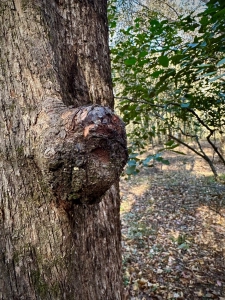
I discover and appreciate tree form oddities, curiosities, and mysteries wherever I roam. This sweetgum sports an agrobacterial burl three feet above the ground.


A red maple streamside bears burls from its base to the live crown. When I took forest pathology in 1971-72, I would have termed the tree’s condition as diseased, attributing its abnormal growth to an infectious organism (fungal, bacterial, viral).

Chewacla


A Google AI Overview offered:

A tree disease is a harmful deviation from a tree’s normal function, typically caused by pathogens like fungi, bacteria, or viruses, or by environmental stress, leading to symptoms like discolored leaves, cankers, wilting, or stunted growth, and can ultimately weaken or kill the treeThese issues disrupt water, nutrient, and energy flow, often targeting roots, stems, or foliage, with factors like drought, soil issues, or physical damage increasing susceptibility.  

One-half century ago, my forest pathology focused on tree health relative to timber products, i.e. commercial value. This maple has no value for lumber production, yet it may have novelty commercial value. My point is that diseased in this case, may not be a cause for alarm.

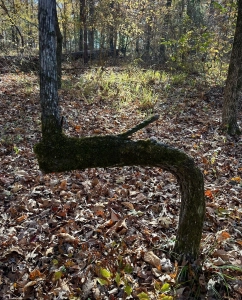
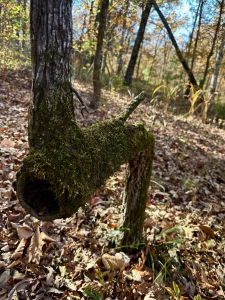
Like so many tree form anomalies, this sycamore suffered a crushing blow from above years ago, bending the tree to 30 degrees from horizontal, then sending a new short vertical. The form is distorted; the cause is clear; the future is affected; a disease organism is not involved,

Chewacla


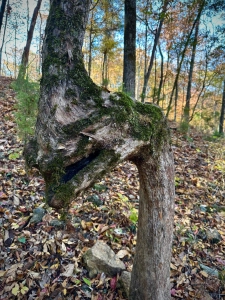
Make what you will of this dragon-headed Ostrya virginiana (ironwood), its mouth agape in grin (left) and its eye piercing and nostril flared (right). Once again, injury from above explains the origin of disfigurement.

ChewaclaChewacla


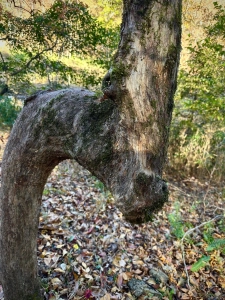
The same cause and effect explain this hickory abnormality, not a face but a large caliber muzzle.

Chewacla


I wanted to make a head/snout/face out of this Ostrya burl, but nothing comes to me. Do with it what you will.

Chewacla


Simon and Garfunkel’s America (1968) came to mind as I struggled for a descriptive totem for this particular burl.

Laughing on the busPlaying games with the facesShe said the man in the gabardine suit was a spyI said “Be careful, his bowtie is really a camera

I suppose it’s okay to be just a burl!


Other Notable Feature


Vaccinium arboreum (aka sparkleberry or farkleberry) is the only tree form of the native blueberry genus. I appreciate its mirthful common names, showy bark, interesting shape and texture, and its evergreen foliage.

Chewacla Chewacla


How could I trek the Mountain Laurel Trail without posting mountain laurel photographs?!

Chewacla


We spent little more than 90-minutes at Chewacla. I wanted to showcase with this photo essay what a short morning saunter can reveal about the magic of everyday Nature.

Chewacla Falls


Without further elaboration, I give you the falls.

Chewacla


I recorded this 58-second video at Chewacla Falls.

I remind you of my third book, co-authored with Dr. Jennifer J. Wilhoit, Weaned Seals and Snowy Summits: Stories of Passion for Place and Everyday Nature. Without deep thought or deliberate intention, my series of ~500 Great Blue Heron weekly Posts has trended to six consistent theme elements:

  • Stories of passion for place and everyday Nature emerge wherever and whenever I wander (and wonder).
  • Nature-inspired life and living color and direct my living, learning, serving, leading, and praying.
  • Nature’s beauty, magic, wonder, and awe lie mostly hidden in plain sight.
  • Look deep into Nature, and then you will understand everything better. (Albert Einstein)
  • And into the forest I go, to lose my mind and find my soul. (John Muir)
  • In every walk in Nature, one finds far more than he seeks. (Muir)

Certainly, there is more, yet these six simple themes cover most of my Nature musings.

Alabama State Parks Foundation

Thoughts and Reflections


I offer these observations:

  • Look deep into nature, and then you will understand everything better. (Albert Einstein)
  • And into the forest I go, to lose my mind and find my soul. (John Muir)
  • A short autumn morning saunter can reveal volumes on the magic of everyday Nature. (Steve Jones)

Inhale and absorb Nature’s elixir. May Nature Inspire, Inform, and Reward you!


Note: All blog post images created & photographed by Stephen B. Jones unless otherwise noted. Please circulate images with photo credit: “©2026 Steve Jones, Great Blue Heron LLC. All Rights Reserved.”

I am available for Nature-Inspired Speaking, Writing, and Consulting — contact me at steve.jones.0524@gmail.com

Subscribe to my free weekly photo essays (like this one) at: http://eepurl.com/cKLJdL
 

Reminder of my Personal and Professional Purpose, Passion, and Cause

If only more of us viewed our precious environment through the filters I employ. If only my mission and vision could be multiplied untold orders of magnitude:

Mission: Employ writing and speaking to educate, inspire, and enable readers and listeners to understand, appreciate, and enjoy Nature… and accept and practice Earth Stewardship.

Vision:

  • People of all ages will pay greater attention to and engage more regularly with Nature… and will accept and practice informed and responsible Earth Stewardship.
  • They will see their relationship to our natural world with new eyes… and will understand more clearly their Earth home.

Tagline/Motto: Steve (Great Blue Heron) encourages and seeks a better tomorrow through Nature-Inspired Living!


Steve’s Four Books


I wrote my books Nature Based Leadership (2016), Nature-Inspired Learning and Leading (2017), Weaned Seals and Snowy Summits: Stories of Passion for Place and Everyday Nature (2019; co-authored with Dr. Jennifer Wilhoit), and Dutton Land & Cattle: A Land Legacy Story (2023) to encourage all citizens to recognize and appreciate that every lesson for living, learning, serving, and leading is either written indelibly in or is powerfully inspired by Nature. All four of my books present compilations of personal experiences expressing my deep passion for Nature. All four books offer observations and reflections on my relationship with the natural world… and the broader implications for society. Order any from your local indie bookstore, or find them on IndieBound or other online sources such as Amazon and LifeRich.

I began writing books and Posts for several reasons:

  • I love hiking and exploring Nature
  • I see images I want to (and do) capture with my trusty iPhone camera
  • I enjoy explaining those images — an educator at heart
  • I don’t play golf!
  • I do love writing — it’s the hobby I never needed when my career consumed me
  • Judy suggested my writing is in large measure my legacy to our two kids, our five grandkids, and all the unborn generations beyond
  • And finally, perhaps my books and Blogs could reach beyond family and touch a few other lives… sow some seeds for the future


Chewacla


Brief-Form Post #54: Second Autumn Afternoon Near the Lodge and Cabins at AL’s DeSoto State Park!

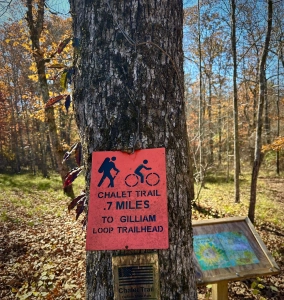
I attended an Alabama State Parks Foundation Board morning meeting on Thursday, November 6, 2026, at the DeSoto State Park Lodge. I had hiked extensively at the park the previous afternoon. Following the board session, I hiked the Chalet Trail from the Lodge and circuited the nearby cabins area. I am seldom disappointed by the magic a short saunter reveals, if only one looks deeply enough to discover what lies hidden in plain sight.

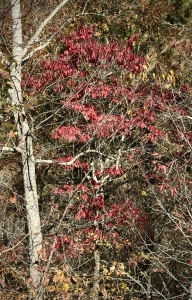
Come along with me to see the beauty, magic, wonder, and awe I spotted. The lodge deck overlooking the canyon of the West Fork of the Little River proved a good place to begin my trek. A brilliantly red sourwood tree stood at eye level, peering through the now-leafless yellow poplar (left). A smaller sourwood shrub topped a sandstone ledge near the deck (right). As a run-of-the-mill guy who knows only the basic rainbow colors, I referred to sourwood’s fall cape simply as red. Online leafyplace.com relied on more color-proficient descriptors: vibrant shades of crimson red to burgundy and purple.

DeSoto


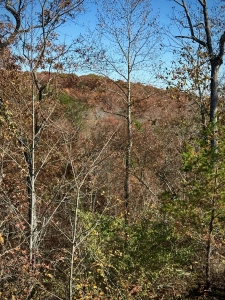
The canyon reached ~250′ from stream to rimrock. Summer foliage hides the opposite ridge, now visible with leaf-drop.


I recorded this 58-second video from the Lodge deck.


Intent on uncovering more of the forest’s secrets, I walked from the Lodge to the Chalet Trailhead.


Afternoon along the Chalet Trail


A hike doesn’t need to be long and daunting to offer rewards. A perfect afternoon for leisurely sauntering is ideal for recovering mentally from a Board meeting, and for preparing physically for the required two-hour drive home.


I recorded this 59-second video within the forest along the trail.


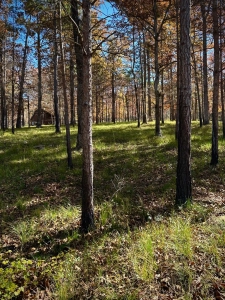
Periodic prescribed fire has eliminated understory trees and shrubs, creating an open-grown grassy impression. Some refer to the appearance as park-like, a condition that many persons queried in surveys prefer.

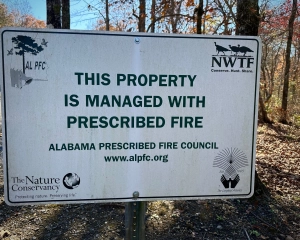
I chose the Chalet Trail to focus on the benefits and consequences of prescribed fire as a parkland management tool. Note that the sign is sanctioned by: Alabama Prescribed Fire Council; National Wild Turkey Federation; The Nature Conservancy; and The Longleaf Alliance.

DeSoto


The understory is open, with no brambles or thickets impeding walking and, ostensibly, hiding snakes, critters, and other scary woodland denizens. I speak in jest of scary woodland denizens, yet I, too, prefer parklike stands in an area heavily trafficked around picnic tables, campgrounds, and cabins.

Chewacla


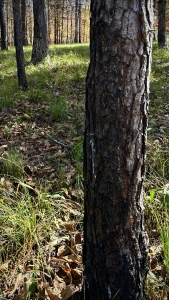
I recorded a 60-second video of the stand managed by fire and evidencing charred trunks.


I observe in nearly every Great Blue Heron photo essay that death is a big part of life in our forests. Whether a wildfire or controlled burn, dead and down woody debris is part of the ground-level fuel. Occasionally even a intentionally administered prescription fire will burn intensely enough to damage cambium at the base, opening a court of fungal infection. The kickory tree at left bears a catface, a hollow resulting from heart decay. The rot extends upward, eliminating any commercial timber value and weakening structural soundness. However, in this park cabin area management regime, timber value is of little consequence. Instead, squirrels, snakes, birds, and other critters value tree cavities! All the better for park wildlife enthusiasts.

DeSoto


Fall colors, open canopy, an orchard stocking level, and a welcoming understory tell me that controlled fire is an effective management tool.

DeSoto


Charred trunks and nearly bare forest floor evidence employed fire success.


Across my 12 years practicing forestry in the southeastern US for a Fortune-500 paper and allied forest products manufacturer, I control-burned tens of thousands of acres of company-owned forest land. Whether site preparation or established stand burning, the tool is essential to meeting our seeming insatiable demand for pulp, lumber, poles, chips, and miscellaneous other probucts. For the record our South Alabama crews once ignited and safely managed a rough-reduction, aerial ignition day when we covered 4,300 acres, a banner accomplishment!

Many surprises in Nature lie hidden in plain sight, including this groundhog head. A burl on a water oak trunk trailside. The critter sports a moustached mouth, abbreviated proboscis, two eyes (its right one with a lichened, overhanging brow), and a plated forebrow. It’s okay to employ a little imagination when searching our forests for obscure mammal residents.

DeSoto


Albert Einstein observed:

Imagination is more important than knowledge. Knowledge is limited. Imagination encircles the world.

It is the supreme art of the teacher to awaken joy in creative expression and knowledge.


Closing


I accept the challenge of distilling these Brief-Form Posts into a single distinct reflection.

Aldo Leopold, a preeminent mid-Twentieth Century ecologist, is my conservation hero, and his writing, A Sand County Almanac, is a lyrical conservation classic. Leopold encouraged informed and responsible land management, employing an arsenal of effective, bold practices informed by experience, wisdom, and hard work. He professed:

Prudence never kindled a fire in the human mind; I have no hope for conservation born of fear.


Wandering Peak-Color Autumn Forests Afternoon at AL’s DeSoto State Park!

I explored the Azalea Cascade, Orange, Blue, and Chalet Trails at AL’s DeSoto State Park on November 5 & 6, 2025. Perfect weather and peak fall colors elevate my pleasurable routine saunters to an extraordinary experience. It’s no wonder that I am addicted to Special Places and Everyday Nature! DeSoto State Park sits atop Sand Mountain at 1,600 feet above sea level in northeast Alabama, eight miles from Fort Payne, and not much further to the Georgia line. Come along with me on a gorgeous autumn afternoon.

As I began drafting this photo essay narrative (November 25, 2025), the ground in Fairbanks, Alaska, where we lived for four years, has carried a snowpack for six weeks, and the lows dip well below zero. I noticed on this morning’s news that portions of Michigan’s Upper Peninsula are expecting 2-3 feet of lake effect by Thanksgiving. Lucky me — I am enjoying the prime outdoor season in North Alabama. Autumn, winter, and spring invite, welcome, and comfort me during these perfect days. Forget about frostbite, howling bitter winds, drifting snow, clouds of mosquitoes, insuferable chiggars, stifling heat, torrid humidity, and other natural tortures. This is heavenly!

Peak color, blue sky, bright sun, and a towering hardwood forest reached out, grabbed me, and dragged me along the Azalea Cascade Talmadge Butler Boardwalk. The deep alluvial soil and protected cove position spelled ample year-round moisture and a nutrient-rich, high-productivity site. The mixed hardwood forest stood greater than 100 feet tall.

DeSoto


I don’t see need for a lot of science-based narrative. Instead, I give you a guided tour along a series of trails during what may be the best day of the year, with perfect weather, a languid afternoon, a stress-free mind, and full autumn colors in a southern upland hardwood forest!

DeSoto


I recorded this 59-second video along the boardwalk.


Sourwood (Oxydendron arboreum) is a common intermediate canopy species in our North Alabama upland forests. It refuses to be either positively phototropic (growing toward the sun) or negatively geotropic (growing vertically opposite gravity). Instead, it chooses its own course, like this one leaning in no particular direction.

DeSoto


Most main canopy species reach heavenward, seeking the bounty of full sun high above.

DeSoto


The boardwalk leads to azalea cascade, where a small stream enters a reflecting pool through the boulders.

DeSoto


Here is my 29-second video of the spectacular autumn leaves reflections.


A birch tree clings to the rock ledge where its seed germinated decades ago, sending its roots to exploit mineral soil both uphill and beneath the ledge. Every tree has a compelling story to tell.

DeSoto


Several hundred feet above the cascade the trail crosses the stream on a rustic footbridge.

DeSoto


I recorded a 58-second video at the quaint woodland footbridge.


I’ll offer a little forestry lesson at this 30-inch-diameter yellow poplar tree. The species reigns supreme across Alabama’s most productive forest sites…well-drained bottomlands and upland cove sites. The species, unlike sourwood, insists on growing straight and tall. It has a low relative stocking density, contrasting it to white oak and American Beech, among some others. Note how little crown space this yellowpoplar occupies. A beech or white oak of this diameter would have a crown of at least 50 percent greater area, i.e. a greater relative stand density.

DeSoto


Rhododendron is a classic broad-leaved evergreen, thriving in moist, sheltered forest micro sites. Sourwood (right) bursts in deep color, rivalling the flaming sugar maple magic of New England autumn.

DeSoto


Brilliant emerald moss brightens this sandstone ledge along the trail.

DeSoto

DeSoto


Lost Falls served as my destination, its upstream brook reflecting the late afternoon sun touching the ridge. The dry autumn streamflow furnishes little of the excitement I’ve witnessed during the maelstrom of early April’s wet season.

DeSoto


Here is my 40-second video of Lost Falls.


Beyond the falls, a sandstone glade ecotype dominates for a while. Exposed sandstone bedrock, very thin and acidic soils, and extremely variable moisture conditions prevail, ranging from standing surface water in the dormant season to xeric in summer. Thick reindeer lichen, and obligate glade plants make for challenging and entertaining botanizing.


I recorded this 58-second video of the glade.


From the Azalea Cascade to the sandstone ledge forest to the glades, my trek traversed at least three major ecotypes. This stretch of the glade is other worldly.

DeSoto


Leaving the glades behind, I descended toward the Azalea Cascade, through a stand control-burned three years ago to reduce understory vegetation. The forest floor is no longer densely populated with understory trees, shrubs, and herbaceous plants. Bark-charred standing trees and burned woody debris evidence the burn.

DeSoto


Without offering explanation, I will simply observe that some hardwood trees have spiral grain, evident only when the stem is dead (de-barked by progressive decomposition), whether vertical or on the ground. I have not found definitive literature revelations on why trees spiral. When I find the answer, I will devote an entire  photo essay to the explanation.

DeSoto


Returning to the boardwalk cove, the forest-yellow, pale blue late afternoon sky, and camo-green sandstone ledges bid me farewell.

DeSoto


The evening gloaming is descending, offering a late autumn kiss on the cheek.

DeSoto


Even the deer emerged along the road, another signal that the autumn day has run full circle.

DeSoto


My Nature wanderings come in many shapes and sizes. Judy and I wander our suburban neighborhood nearly every day. I find wonder and delight even in the everyday Nature within walking distance of my home. I venture into regional State Parks, the nearby Wheeler National Wildlife Refuge, Land Trust Nature Preserves, and other natural areas withinin 90-minutes of home once a week. Two or three times annually I seek out of state locations to eplore, requiring travel, overnight stays, and greater expense. Now that I am 74 years old, I believe my international Nature-Based consulting assignments may have ended, the last one in 2019 to Kazakhstan. Regardless, I will continue to find beauty, magic, wonder, awe, passion, inspiration, and spiritual renewal in special places and everyday Nature!

Alabama State Parks Foundation

Thoughts and Reflections


I offer these observations:

  • Look deep into nature, and then you will understand everything better. (Albert Einstein)
  • Fall beauty is unbounded by life form. (Steve Jones)
  • I embrace Nature’s relentless magic, wonder, awe, and inspiration — her infinite storm of BEAUTY! (Steve Jones)
  • I will continue to find beauty, magic, wonder, awe, passion, inspiration, and spiritual renewal in special places and everyday Nature! (Steve Jones)

Inhale and absorb Nature’s elixir. May Nature Inspire, Inform, and Reward you!


Note: All blog post images created & photographed by Stephen B. Jones unless otherwise noted. Please circulate images with photo credit: “©2026 Steve Jones, Great Blue Heron LLC. All Rights Reserved.”

I am available for Nature-Inspired Speaking, Writing, and Consulting — contact me at steve.jones.0524@gmail.com

Subscribe to my free weekly photo essays (like this one) at: http://eepurl.com/cKLJdL
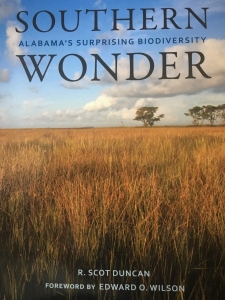
 

Reminder of my Personal and Professional Purpose, Passion, and Cause

If only more of us viewed our precious environment through the filters I employ. If only my mission and vision could be multiplied untold orders of magnitude:

Mission: Employ writing and speaking to educate, inspire, and enable readers and listeners to understand, appreciate, and enjoy Nature… and accept and practice Earth Stewardship.

Vision:

  • People of all ages will pay greater attention to and engage more regularly with Nature… and will accept and practice informed and responsible Earth Stewardship.
  • They will see their relationship to our natural world with new eyes… and will understand more clearly their Earth home.

Tagline/Motto: Steve (Great Blue Heron) encourages and seeks a better tomorrow through Nature-Inspired Living!


Steve’s Four Books


I wrote my books Nature Based Leadership (2016), Nature-Inspired Learning and Leading (2017), Weaned Seals and Snowy Summits: Stories of Passion for Place and Everyday Nature (2019; co-authored with Dr. Jennifer Wilhoit), and Dutton Land & Cattle: A Land Legacy Story (2023) to encourage all citizens to recognize and appreciate that every lesson for living, learning, serving, and leading is either written indelibly in or is powerfully inspired by Nature. All four of my books present compilations of personal experiences expressing my deep passion for Nature. All four books offer observations and reflections on my relationship with the natural world… and the broader implications for society. Order any from your local indie bookstore, or find them on IndieBound or other online sources such as Amazon and LifeRich.

I began writing books and Posts for several reasons:

  • I love hiking and exploring Nature
  • I see images I want to (and do) capture with my trusty iPhone camera
  • I enjoy explaining those images — an educator at heart
  • I don’t play golf!
  • I do love writing — it’s the hobby I never needed when my career consumed me
  • Judy suggested my writing is in large measure my legacy to our two kids, our five grandkids, and all the unborn generations beyond
  • And finally, perhaps my books and Blogs could reach beyond family and touch a few other lives… sow some seeds for the future


DeSoto


Brief-Form Post #52: Late October Afternoon Scouting for Eagles and Nests at Lake Guntersville State Park!

I am pleased to add the 52nd of my GBH Brief-Form Posts (Less than five minutes to read!) to my website. I get wordy with my routine Posts. I don’t want my enthusiasm for thoroughness and detail to discourage readers. So, I will occasionally publish these brief Posts.


Fellow retired forester Chris Stuhligher and I visited Lake Guntersville State Park (LGSP) on October 23, 2025, to scout a scheduled spring 2026 eagle view outing for the University of Alabama in Huntsville Osher Lifelong Learning Institute (OLLI). The LGSP map in hand, we stopped by several indicated locations. I present an overview of our afternoon ramblings, keeping the narrative brief and technically superficial.

The eagle at the lodge set the tone for our scouting venture.


We enjoyed lunch at the lodge restaurant, our table overlooking the lake.


Cabins Shoreline


Our first suggested viewing spot was the shoreline adjacent to the cabins. We were to search the opposite bank for a summer-foliage-obscured nest. We did not find it, yet we spotted a pair of eagles soaring above us, an adult and an immature.

Lake GSP


The photo at left shows the opposite shoreline, where the eagle’s nest, we were assured, lies hidden to our eyes. Regradless, who could not appreciate the cerulean sky, bright sunshine, and comfortable early autumn temperature!

Lake GSP


Here is my 58-second video from the cabins lakeshore.


I’m a sucker for tall loblollies and shoreline vistas.

Lake GSP


I wanted to revisit the nearby Cave Trail, hoping to quickly photograph the oak burled in the distinctive Big Foot image.


Brief Saunter at the Cave Trail


Here is my July 18, 2018 photo:


I intended to insert the new image here. However, just as there are days when I cannot remember what I had for lunch the day before, I failed to navigate us back the the infamous tree! I will try another day when we have more time for frivality. However, in searching, I did find a very unattractive, yet photo-worthy canker along the Cave Trail.

I recorded this 58-second grotesque Halloween canker video on an elm tree.


I sampled a twig from the elm and offer a still photo.

Lake GSPLake GSP


Town Creek Boat Launch


Our second viewing location forced us to look across the lake directly into the late afternoon sun. We imagined how much better the spot would be with the morning sun at our backs. However, the location kindly presented us with a great blue heron buffeted by persistent winds and surrounded by whitecaps.

I recorded this 59-second video of the windy great blue heron. Pardon the wind drowning out my narrative.


Unfortunately, the heron took graceful flight when I stopped recording.


As regular readers know, I am a huge fan of great blue herons.


Sunset Drive Greenway in Guntersville, Alabama


We drove to a final suggested site, this one off the State Park along Sunset Drive Greenway in the town of Guntersville. The shoreline and greenway are lovely. I intend to visit with Judy during the coming months, to enjoy a mid-morning stroll followed by lunch in Guntersville.

Lake GSP


A highlight for such a stroll will be the massive eagle’s nest in a grand loblolly pine.

My 60-second Sunset Drive Eagle’s Nest.

Ours was not an outing requiring months of planning, air travel, and expensive lodging. We needed no reservations. Instead, we boarded Chris’ car after adjouring our 10:00 to 11:30 AM National Parks (LearningQuest) class session at Hampton Cove, drove 45 minutes to the park, grabbed lunch at the lodge, and began our scouting. I am a firm advocate of enjoying Nature near at hand…making the most of special places and everyday Nature!

Closing


I accept the challenge of distilling these Brief-Form Posts into a single distinct reflection, a task far more elusive than assembling a dozen pithy statements.

I cannot offer a quote more poignantly apropos than this anonymous statement:

The strength of the bald eagle lies not just in its wings, but in its unyielding spirit…its symbol of purity, grandeur, wildness, mastery, freedom, independence, integrity, and Americanism. 


Nature’s special treats await our discovery, our understanding, and our interpretation!


Subscribe to my free weekly photo essays (like this one) at: http://eepurl.com/cKLJdL