Brief-Form Post #66: My Tribute to Wendell Berry, a Conservationist for the Ages!
NOTE: Some of my GBH photo essays were not routinely distributed from mid-February through mid-June. I will resend those one by one, beginning the first week of July. Here is my Post from May 13 (https://stevejonesgbh.com/2026/05/13/brief-form-post-60-oddities-curiosities-and-mysteries-in-a-wheeler-national-wildlife-refuge-bottomland-hardwood-forest/)
I am pleased to add the 66th of my GBH Brief-Form Posts (Less than five minutes to read!) to my website. I get wordy with my routine Posts. I don’t want my enthusiasm for thoroughness and detail to discourage readers. So, I will occasionally publish these brief Posts.
We have lived our lives by the assumption that what was good for us would be good for the world. We have been wrong. We must change our lives so that it will be possible to live by the contrary assumption, that what is good for the world will be good for us. And that requires that we make the effort to know the world and learn what is good for it.
(Wendell Erdman Berry)

________________________________________________-
My Sept 2, 2026 Facebook Post
I learned this morning that 92-year-old Wendell Berry, American novelist, poet, essayist, environmental activist, cultural critic, and farmer, departed his Earthly domain on August 31, 2026.
The Loved Ones, by Wendell Berry
Berry’s Timeless Conservation and Sustainability Wisdom
The care of the Earth is our most ancient and most worthy, and after all, our most pleasing responsibility. To cherish what remains of it and to foster its renewal is our only hope.
Outdoors we are confronted everywhere with wonders; we see that the miraculous is not extraordinary, but the common mode of existence. It is our daily bread.
The primary motive for good care and good use of the land-community is always going to be affection, which is too often lacking.
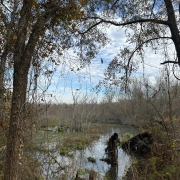
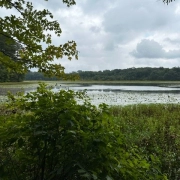
When despair for the world grows in me and I wake in the night at the least sound in fear of what my life and my children’s lives may be, I go and lie down where the wood drake rests in his beauty on the water, and the great heron feeds. I come into the peace of wild things who do not tax their lives with forethought of grief. I come into the presence of still water. And I feel above me the day-blind stars waiting with their light. For a time I rest in the grace of the world, and am free.
To cherish what remains of the Earth and to foster its renewal is our only legitimate hope of survival.
Good farmers, who take seriously their duties as stewards of Creation and of their land’s inheritors, contribute to the welfare of society in more ways than society usually acknowledges, or even knows. These farmers produce valuable goods, of course; but they also conserve soil, they conserve water, they conserve wildlife, they conserve open space, they conserve scenery.
Musing about Berry prompted me to drop back 45 years. Union Camp Corporation Woodlands Division senior management assigned me to draft the Fortune 500 company’s Forest Management Practices. I was Manager of Land Use and Forest Practices within the Corporate Office of Environmental Affairs. I pulled the 1981 bound FMPs from my shelf. How well did they conform to the basic tenets of forestry, sustainability, and ethical land and forest stewardship? Importantly, UCC owned 2.3 million acres.
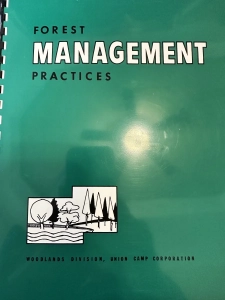
Excerpts from the FMPs Introduction
The Woodlands Division is committed to endorsing and implementing these FMPs. Compliance is required for all activities on Company lands and should be achieved on outside lands [where we procured purchased stumpage]. Beyond satisfying the requirements of various regulatory programs, compliance with the FMPs maintains and/or improves the timber-producing potential of UCC’s land asset.
Woodlands business involves a combination of short-term and long-term issues. Pressures to meet weekly or monthly production and profit goals often take precedence over long-range objectives. Actions taken to improve immediate production or costs can adversely affect long-range objectives and benefits. The results can reduce asset value, but never show in the P&L statement. The Division, its managers, and its supervisors should be held accountable for decisions that adversely affect long-range management objectives.
Proper balance… will be achieved in our Woodland operations. The adoption and implementation of the FMPs is a necessary first step.
A serious commitment to the FMPs is essential. Compliance will satisfy current environmental requirements, forestall future government regulations, and improve the long-term Corporate interests of land and timber asset management.
Furthermore, Forest Management Practices form the framework for a Corporate Woodlands stewardship policy.
My 45-Year Look in the Way-Back Machine
I feel relief. I believe that my FMPs fared well over four-and-a-half decades! They stood the test of time. Not bad for a 30-year-old, very young, bachelor-educated industrial forester!
We do not need to plan or devise a “world of the future”; if we take care of the world of the present, the future will have received full justice from us. A good future is implicit in the soils, forests, grasslands, marshes, deserts, mountains, rivers, lakes, and oceans that we have now, and in the good things of human culture that we have now; the only valid “futurology” available to us is to take care of those things. We have no need to contrive and dabble at “the future of the human race”; we have the same pressing need that we have always had – to love, care for, and teach our children. (Wendell Berry)
The FMPs take care of the world of the present. I think that Mr. Berry would have approved.
Closing
I accept the challenge of distilling these Brief-Form Posts into a single distinct reflection. Wendell Berry nailed it:
The care of the Earth is our most ancient and most worthy, and after all, our most pleasing responsibility. To cherish what remains of it and to foster its renewal is our only hope.
Nature’s special treats await our discovery, our understanding, and our interpretation!
Subscribe to my free weekly photo essays (like this one) at: http://eepurl.com/cKLJdL