Mid-June Exploration on Trails New to Me on Lake Guntersville State Park!
NOTE: Some of my GBH photo essays were not routinely distributed from mid-February through mid-June. I will resend those one by one, beginning the first week of July. Here is my Post from April 21 (https://stevejonesgbh.com/2026/04/21/brief-form-post-57-reflection-in-on-beaverdam-tupelo-swamp-wheeler-national-wildlife-refuge/)
On-site to attend the Alabama State Parks Foundation board meeting (June 18, 2026), at Lake Guntersville State Park, I arrived the prior morning to explore trails I had not yet wandered. I enjoyed a sweeping loop that covered the Terrell Connector, Terrell Trail, Graveyard Road, Service Road, Cave Trail, and Lodge Road, then returned through Terrell Trail and the Terrell Connector. No, I refuse to claim mine was a hike. Like John Muir, I sauntered these forest trails and park roads to experience yet another northern Alabama second-growth Cumberland Plateau forest. I walked within the forest…not through the forest. I was absorbing all I could discover hidden in plain sight, not to reach benchmarks, score miles, and log elevation gain. Come along with me virtually.
The entire route transited second-growth forest. However, second-growth is a broad characterization encompassing nearly every acre of forest in the eastern USA. Very little of the original pre-Columbian forest escaped domestication, settlement, logging, and other disturbances. Although all second-growth, the LGSP forest is anything but uniform.
Entering a Forest Stand with an Ancient Aura
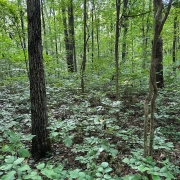
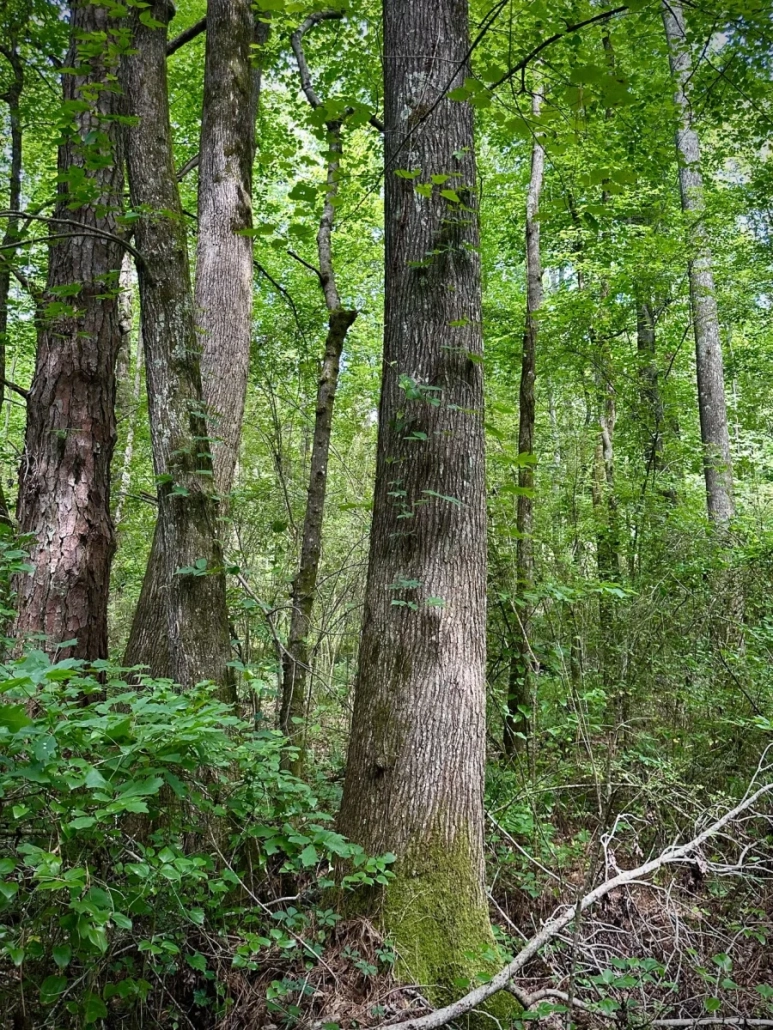
The Connector Trail transits a rich bottomland forest exhibiting old-growth characteristics: large-diameter towering hardwoods, abundant dead and down woody debris, and tiered canopy. I felt I had entered an ancient forest.
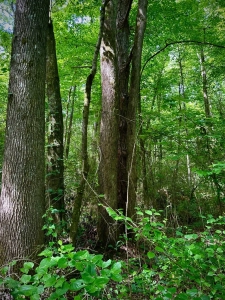
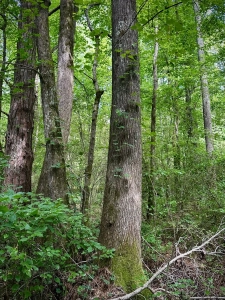
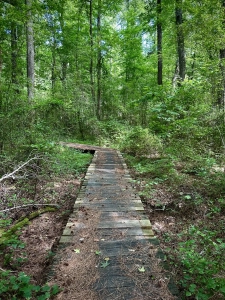
A planked boardwalk kept my boots dry.
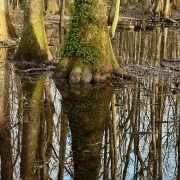
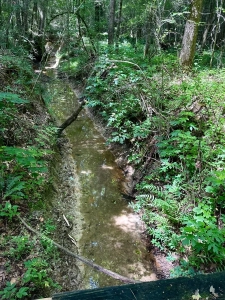
A channel directed water through the bottomland. The waterway appeared to be human-made, suggesting a dragline or backhoe excavation drainage ditch through fertile farmland prior to the Corps of Engineers or TVA acquiring the basin property for Lake Guntersville. I have often observed that every parcel of forest has a story to tell. I can discern some of the tale from hints, allegations, and evidence on site, yet there is a juncture where conjecture blurs from certainty.
Tufts of Christmas fern highlighted the fertile bottomland near the channel. Dense shade reduced understory growth, leaving the fern standing in isolation…alone in the gloam.
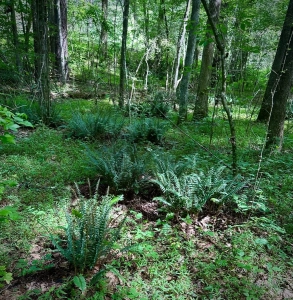
I continued beyond the ancient feel of the Christmas fern glade.
Exiting the Apparent Old-Growth
The Connector Trail brought me to a spaghetti intersection. Several hours later I worked my way back to this loblolly pine tree, and then on to my car.
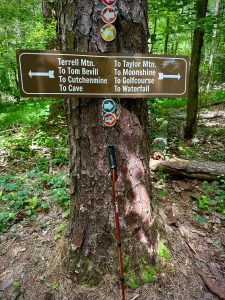
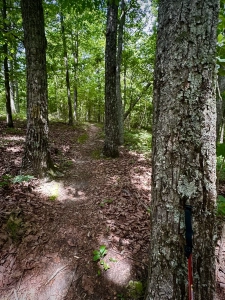
The remainder of my transit stayed on uplands. Long ago when I was managing company-owned forest land, I would have subdivided the property into management units. Such was not the intent of my LGSP wanderings. I sought not to understand, differentiate, or consolidate…nor to consider the forest. I wanted only to discover the beauty, magic, wonder, awe, and inspiration that linked one marvel, curiosity, and oddity to another. This trail segment served as matrix, revealing nothing special… just a peaceful, quiet stretch that offered no distractions. This stand of mixed oaks and associated upland hardwoods seemed to fall within the age range of 80 to 110 years, typical of northern Alabama.
A little further along, the fun began. The seeming even-aged matrix of 80-110-year-old forest was peppered with significantly larger, older, disfigured, and decayed individuals, like this chestnut oak. I offer an explanation for this apparent two-aged forest. Loggers harvested commercially valuable individuals about a century ago, leaving unmerchantable trees behind. This chestnut oak will never secure a berth on a logging truck, yet in this public park setting, the tree’s non-forest-product value may be nearly incalculably high.
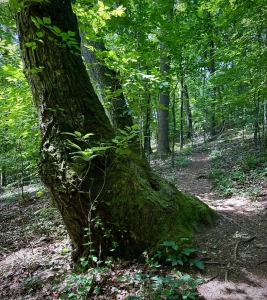
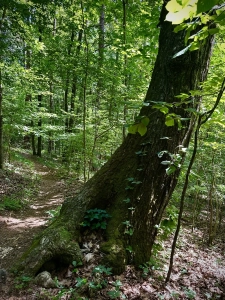
Among other benefits, the tree produces vast quantities of mast (acorns for animal consumption). The tree is hollow and likely has been since the logger noticed it was not worth felling early in the twentieth century. This oak occupies land, air, and soil covering at least one-fifth of an acre. Think of the vast quantities of organic matter processed by the tree, associated organisms (micro and macro), and energy flowing through this single tree ecosystem.
And nearby a healthy, vibrant, ~90-year-old hickory reached high into the canopy, its bark revealing vigorous growth, distinct from the old denizen in the turtle-head massive monster image below.

I recorded this 59-second video along the trail.
Again, imagine this gnarled hickory ignored by the forest sawyer so many years ago. Every tree has a story to tell. I’d like to hear this unique individual’s tale.
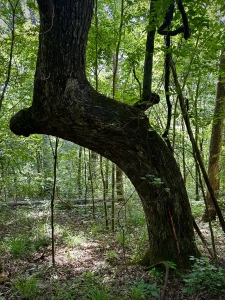
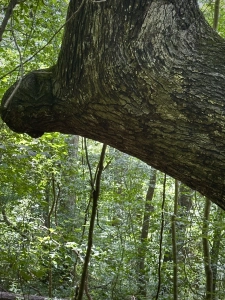
I recorded this 60-second video of the gnarled hickory:
Eyes closed, the turtle (or is it a dragon!) relaxed as I snapped photographs and recorded the short video.
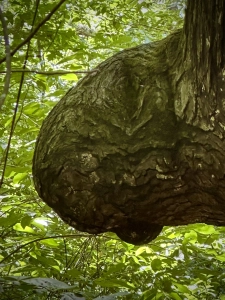
A black oak signaled internal decay with its severly swollen branch stub at chest level above the trail surface. I’m reminded of the 12 weeks of bi-weekly physical therapy I endured following my April 13, 2026, total left shoulder reconstruction. People with braces, recent scars, bandages, and gimpy, healing limbs surrounded me. Nine weeks after surgery, here I was at LGSP in the midst of trees bearing wounds, injuries, infections, and diverse infirmities and imperfections!
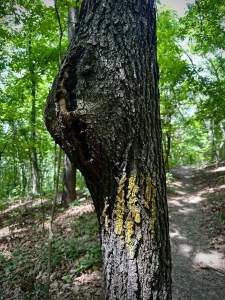
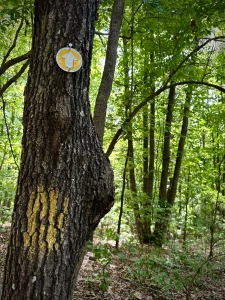
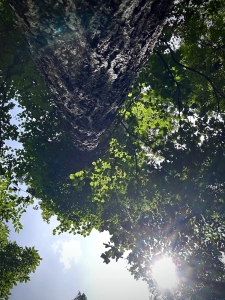
Even among the affected trees, including this blemished black oak, a glance upward revealed the beauty, promise, and inspiration of the sun smiling through its crown.
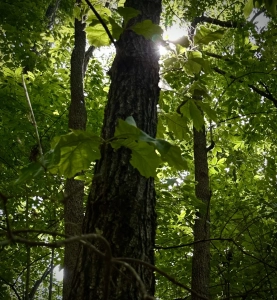
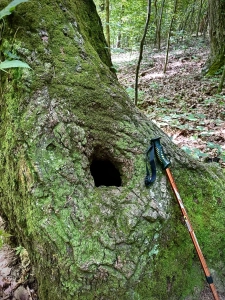
A nearby white oak stood among the stricken, its decay-swelled old branch stub opening a portal to its hollow core.
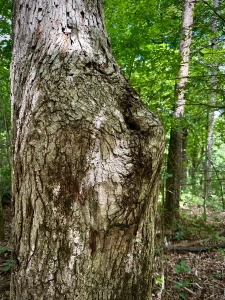
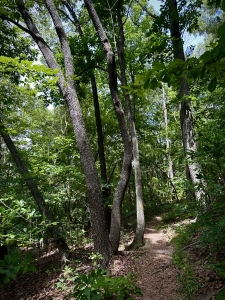
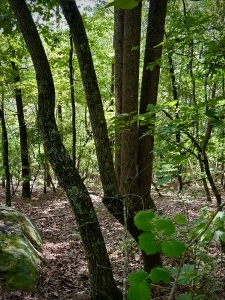
Not all oaks are misshappen, decayed, and physically disabled. However, all sourwood trees (Oxydendrum arboreum) rebel against growing in accord with the basic, fundamental dictates of negative geotropism and positive phototropism. Most trees grow opposite the attraction of gravity or directly toward the sun. Sourwood prefers sinuosity, a characteristic I’ve admired since first meeting the species in freshman Dendrology! Compare the curvy sourwood cluster below right to the three clumped yellow poplars beyond them standing at ramrod attention.
Some Additional Curiosities:
Our native loblolly pines accumulate resins in core wood as they age and mature. The resin-soaked heartwood is decay resistant, as is evident from this old cut stump. Only the bark and the core remain.
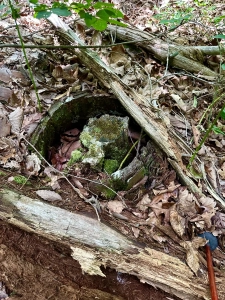
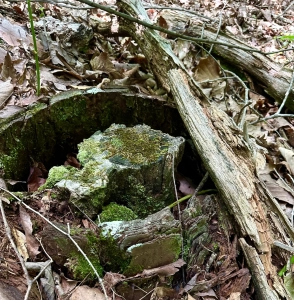
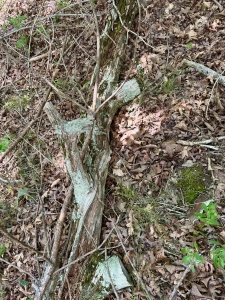
This corewood skeleton remains intact on the forest floor where it fell decades ago. When I fueled a fireplace in prior residences, I collected such lightered wood to start evening fires.
So many stories to interpret, record, and later share as I sauntered through LGSP; so little reader’s time to consume!
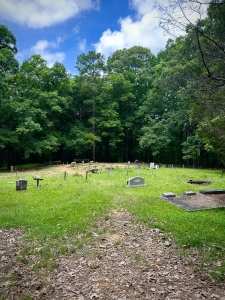
Kings Chapel Cemetery
I abruptly entered a sacred opening, dropping back 100 years. The cemetery bordered a community then tethered to Kings Chapel and anchored to the Tennessee River. I found no interment that postdated Lake Guntersville’s 1939 completion.
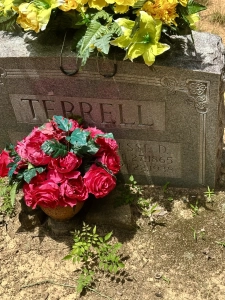
The Terrell and King families were prominent citizens. These individuals died in 1938 and 1927. Imagine the tremendous family, community, and economic tremors imposed by dam completion.
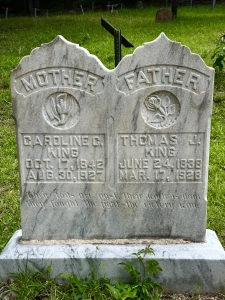
The King inscription reads: Their toils are past, their work is done, they fought the fight — the victory is won. Who now tends their graves? Who remembers them?
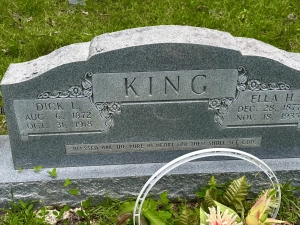
Friends, neighbors, and kinfolk, these King and Strange residents passed in 1918 and 1926. Did any still-adjacent trees witness their burial?
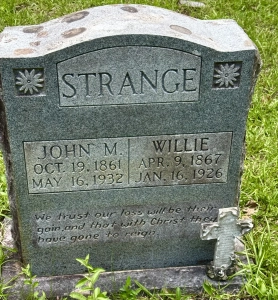
The John and Willie Strange epitaph: We trust our loss will be their gain, and that with Christ they have gone to reign.
The Terrell memory lives on via a named trail. I can think of less favorable ways to be memorialized!
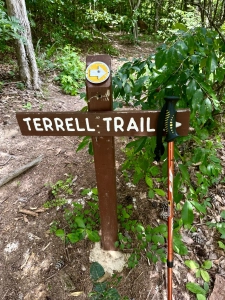
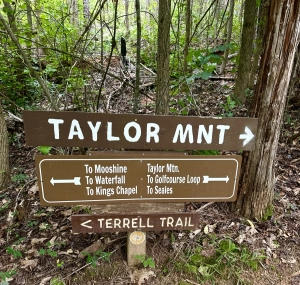
Some Worthy Postscripts
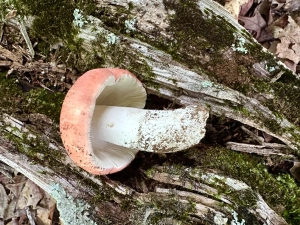
Two lovely mushrooms appeared, the first this hintapink (Russula paludosa), a brightly colored, edible brittlegill. I harvested only one of several, mostly to secure an underside photo for identification. I cooked the morsel with butter, pepper, and salt, finding the flavor mild and pleasant, but not nearly enough to truly gauge whether I’d want a full-omelette measure.
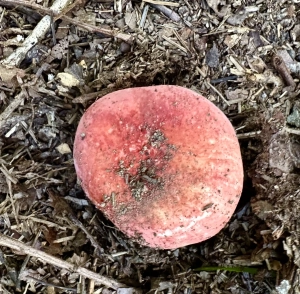
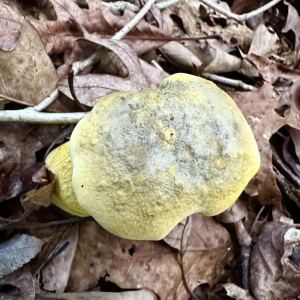
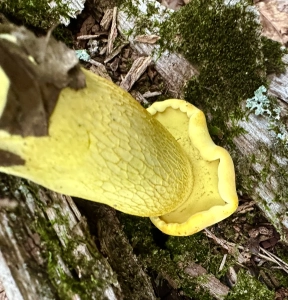
I saw a handful of this meaty ornate-stalked bolete, identified as edible with a caution that the species can be too bitter for consumption. I found it disagreeably acrid.
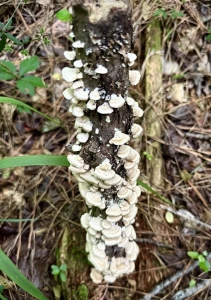
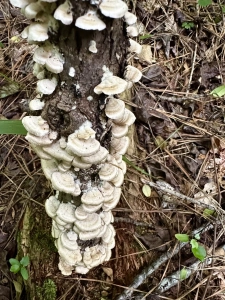
This violet-toothed polypore occupied an oak sapling snag, performing its dedicated decomposing mission. No, not edible!
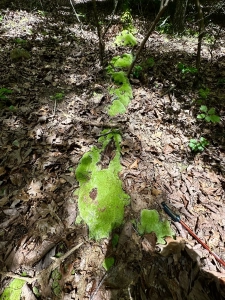
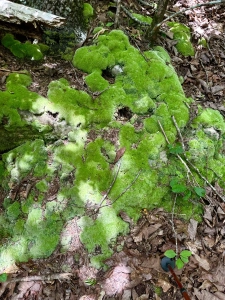
Pin cushion moss colonized a long decaying stump and trunk, both visible only as an outline of the organic matter remains of the downed woody debris.
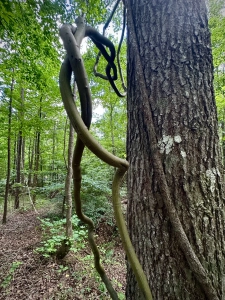
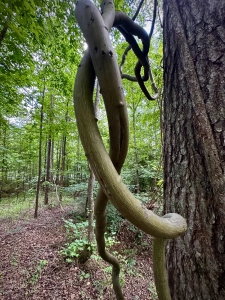
A supplejack vine clings to its black oak anchorage. I admire its smooth green bark and tendency to wrap in sinuous coils on tree stems and adjacent supplejack vines.
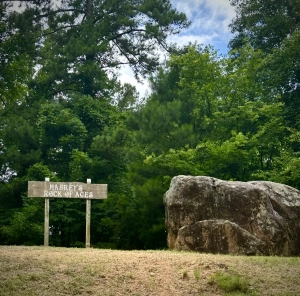
I leave you with an image of the LGSP Mabrey Rock of Ages, along the Service Road as I returned to to the Connector Trail.
Alabama State Parks Foundation
Thoughts and Reflections
I offer these observations:
- Take heart, not all oaks are misshapen, decayed, and physically disabled. (Steve Jones)
- However, all sourwood trees (Oxydendrum arboreum) rebel against growing in accord with the basic, fundamental dictates of negative geotropism and positive phototropism. (Steve Jones)
- I only went out for a walk and finally concluded to stay out till sundown, for going out, I found, was really going in. (John Muir)
Inhale and absorb Nature’s elixir. May Nature Inspire, Inform, and Reward you!
Note: All blog post images created & photographed by Stephen B. Jones unless otherwise noted. Please circulate images with photo credit: “©2026 Steve Jones, Great Blue Heron LLC. All Rights Reserved.”
I am available for Nature-Inspired Speaking, Writing, and Consulting — contact me at steve.jones.0524@gmail.com
Subscribe to my free weekly photo essays (like this one) at: http://eepurl.com/cKLJdL
Reminder of my Personal and Professional Purpose, Passion, and Cause
If only more of us viewed our precious environment through the filters I employ. If only my mission and vision could be multiplied untold orders of magnitude:
Mission: Employ writing and speaking to educate, inspire, and enable readers and listeners to understand, appreciate, and enjoy Nature… and accept and practice Earth Stewardship.
Vision:
- People of all ages will pay greater attention to and engage more regularly with Nature… and will accept and practice informed and responsible Earth Stewardship.
- They will see their relationship to our natural world with new eyes… and will understand more clearly their Earth home.
Tagline/Motto: Steve (Great Blue Heron) encourages and seeks a better tomorrow through Nature-Inspired Living!
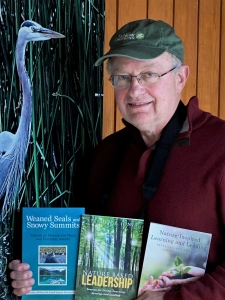
Steve’s Four Books
I wrote my books Nature Based Leadership (2016), Nature-Inspired Learning and Leading (2017), Weaned Seals and Snowy Summits: Stories of Passion for Place and Everyday Nature (2019; co-authored with Dr. Jennifer Wilhoit), and Dutton Land & Cattle: A Land Legacy Story (2023) to encourage all citizens to recognize and appreciate that every lesson for living, learning, serving, and leading is either written indelibly in or is powerfully inspired by Nature. All four of my books present compilations of personal experiences expressing my deep passion for Nature. All four books offer observations and reflections on my relationship with the natural world… and the broader implications for society. Order any from your local indie bookstore, or find them on IndieBound or other online sources such as Amazon and LifeRich.
I began writing books and Posts for several reasons:
- I love hiking and exploring Nature
- I see images I want to (and do) capture with my trusty iPhone camera
- I enjoy explaining those images — an educator at heart
- I don’t play golf!
- I do love writing — it’s the hobby I never needed when my career consumed me
- Judy suggested my writing is in large measure my legacy to our two kids, our five grandkids, and all the unborn generations beyond
- And finally, perhaps my books and Blogs could reach beyond family and touch a few other lives… sow some seeds for the future