Posts

Mid-June Exploration on Trails New to Me on Lake Guntersville State Park!

NOTE: Some of my GBH photo essays were not routinely distributed from mid-February through mid-June. I will resend those one by one, beginning the first week of July. Here is my Post from April 21 (https://stevejonesgbh.com/2026/04/21/brief-form-post-57-reflection-in-on-beaverdam-tupelo-swamp-wheeler-national-wildlife-refuge/)


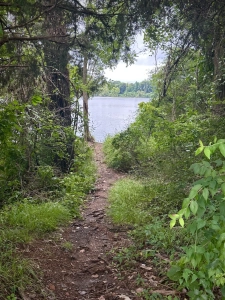
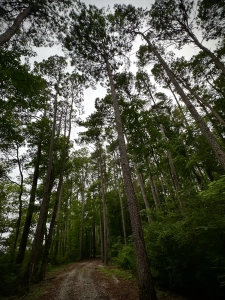
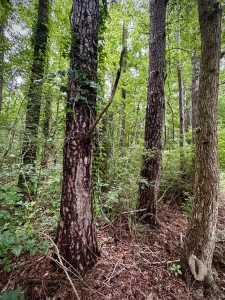
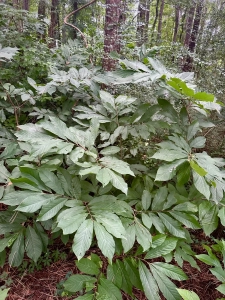
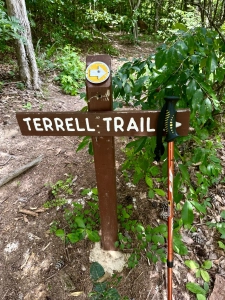
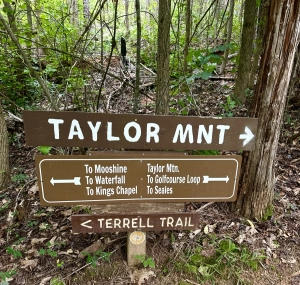
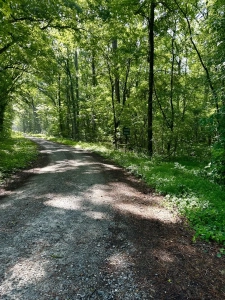
On-site to attend the Alabama State Parks Foundation board meeting (June 18, 2026), at Lake Guntersville State Park, I arrived the prior morning to explore trails I had not yet wandered. I enjoyed a sweeping loop that covered the Terrell Connector, Terrell Trail, Graveyard Road, Service Road, Cave Trail, and Lodge Road, then returned through Terrell Trail and the Terrell Connector. No, I refuse to claim mine was a hike. Like John Muir, I sauntered these forest trails and park roads to experience yet another northern Alabama second-growth Cumberland Plateau forest. I walked within the forest…not through the forest. I was absorbing all I could discover hidden in plain sight, not to reach benchmarks, score miles, and log elevation gain. Come along with me virtually.

The entire route transited second-growth forest. However, second-growth is a broad characterization encompassing nearly every acre of forest in the eastern USA. Very little of the original pre-Columbian forest escaped domestication, settlement, logging, and other disturbances. Although all second-growth, the LGSP forest is anything but uniform.


Entering a Forest Stand with an Ancient Aura


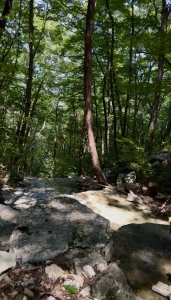
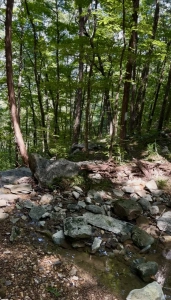
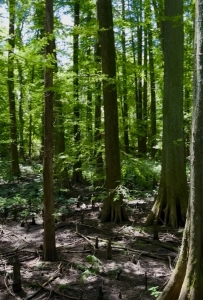
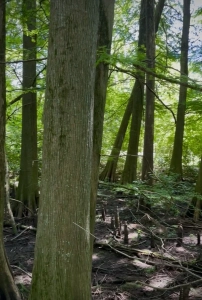
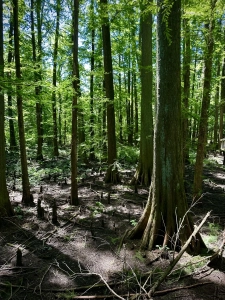
The Connector Trail transits a rich bottomland forest exhibiting old-growth characteristics: large-diameter towering hardwoods, abundant dead and down woody debris, and tiered canopy. I felt I had entered an ancient forest.

Lake GSPLGSP


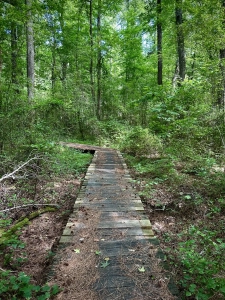
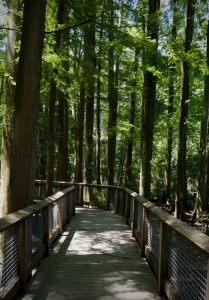
A planked boardwalk kept my boots dry.

Lake GSP


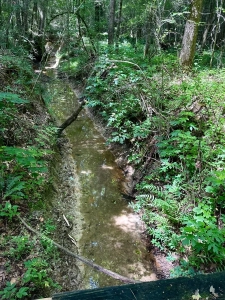
A channel directed water through the bottomland. The waterway appeared to be human-made, suggesting a dragline or backhoe excavation drainage ditch through fertile farmland prior to the Corps of Engineers or TVA acquiring the basin property for Lake Guntersville. I have often observed that every parcel of forest has a story to tell. I can discern some of the tale from hints, allegations, and evidence on site, yet there is a juncture where conjecture blurs from certainty.

Lake GSP


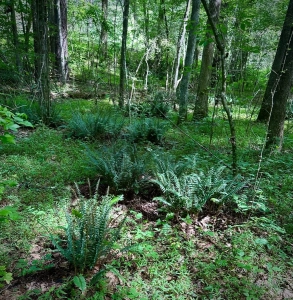
Tufts of Christmas fern highlighted the fertile bottomland near the channel. Dense shade reduced understory growth, leaving the fern standing in isolation…alone in the gloam.

Lake GSP


I continued beyond the ancient feel of the Christmas fern glade.


Exiting the Apparent Old-Growth


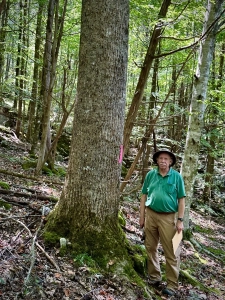
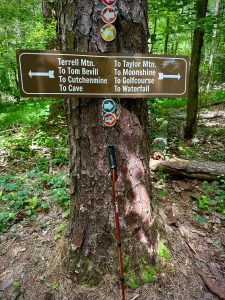
The Connector Trail brought me to a spaghetti intersection. Several hours later I worked my way back to this loblolly pine tree, and then on to my car.

Lake GSP


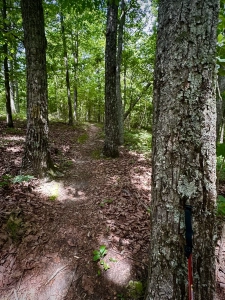
The remainder of my transit stayed on uplands. Long ago when I was managing company-owned forest land, I would have subdivided the property into management units. Such was not the intent of my LGSP wanderings. I sought not to understand, differentiate, or consolidate…nor to consider the forest. I wanted only to discover the beauty, magic, wonder, awe, and inspiration that linked one marvel, curiosity, and oddity to another. This trail segment served as matrix, revealing nothing special… just a peaceful, quiet stretch that offered no distractions. This stand of mixed oaks and associated upland hardwoods seemed to fall within the age range of 80 to 110 years, typical of northern Alabama.

Lake GSP


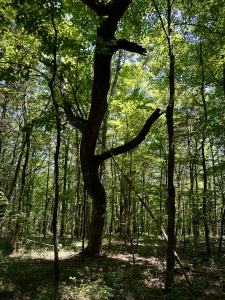
A little further along, the fun began. The seeming even-aged matrix of 80-110-year-old forest was peppered with significantly larger, older, disfigured, and decayed  individuals, like this chestnut oak. I offer an explanation for this apparent two-aged forest. Loggers harvested commercially valuable individuals about a century ago, leaving unmerchantable trees behind. This chestnut oak will never secure a berth on a logging truck, yet in this public park setting, the tree’s non-forest-product value may be nearly incalculably high.

Lake GSPLake GSP


Among other benefits, the tree produces vast quantities of mast (acorns for animal consumption). The tree is hollow and likely has been since the logger noticed it was not worth felling early in the twentieth century. This oak occupies land, air, and soil covering at least one-fifth of an acre. Think of the vast quantities of organic matter processed by the tree, associated organisms (micro and macro), and energy flowing through this single tree ecosystem.

Lake GSP


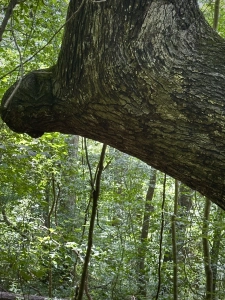
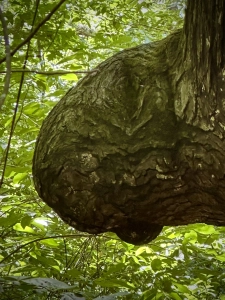
And nearby a healthy, vibrant, ~90-year-old hickory reached high into the canopy, its bark revealing vigorous growth, distinct from the old denizen in the turtle-head massive monster image below.

Lake GSP


I recorded this 59-second video along the trail.


Again, imagine this gnarled hickory ignored by the forest sawyer so many years ago. Every tree has a story to tell. I’d like to hear this unique individual’s tale.

Lake GSP


I recorded this 60-second video of the gnarled hickory:


Eyes closed, the turtle (or is it a dragon!) relaxed as I snapped photographs and recorded the short video.

Lake GSP


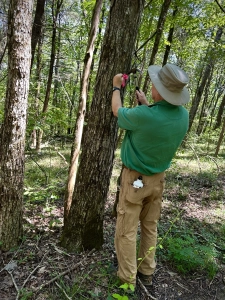
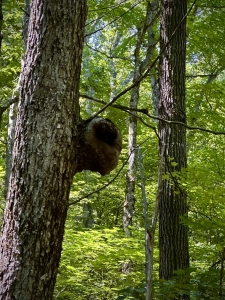
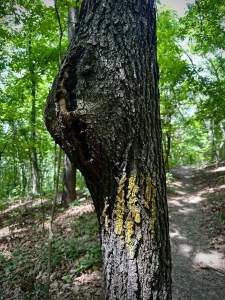
A black oak signaled internal decay with its severly swollen branch stub at chest level above the trail surface. I’m reminded of the 12 weeks of bi-weekly physical therapy I endured following my April 13, 2026, total left shoulder reconstruction. People with braces, recent scars, bandages, and gimpy, healing limbs surrounded me. Nine weeks after surgery, here I was at LGSP in the midst of trees bearing wounds, injuries, infections, and diverse infirmities and imperfections!

Lake GSP


Even among the affected trees, including this blemished black oak, a glance upward revealed the beauty, promise, and inspiration of the sun smiling through its crown.

Lake GSP


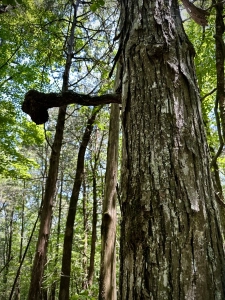
A nearby white oak stood among the stricken, its decay-swelled old branch stub opening a portal to its hollow core.

Lake GSP


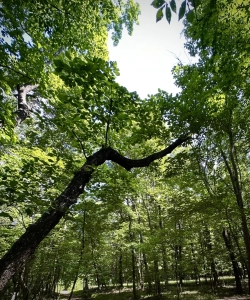
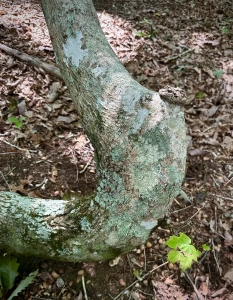
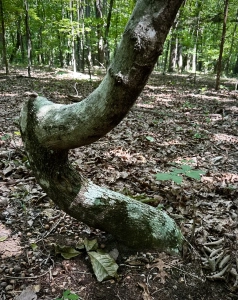
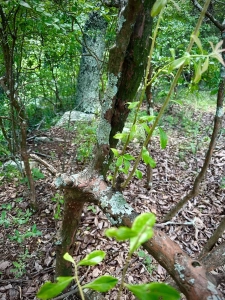
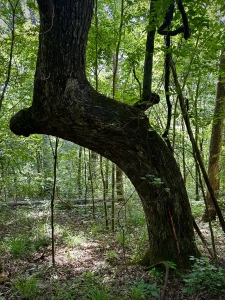
Not all oaks are misshappen, decayed, and physically disabled. However, all sourwood trees (Oxydendrum arboreum) rebel against growing in accord with the basic, fundamental dictates of negative geotropism and positive phototropism. Most trees grow opposite the attraction of gravity or directly toward the sun. Sourwood prefers sinuosity, a characteristic I’ve admired since first meeting the species in freshman Dendrology! Compare the curvy sourwood cluster below right to the three clumped yellow poplars beyond them standing at ramrod attention.

Lake GSP Lake GSP


Some Additional Curiosities:


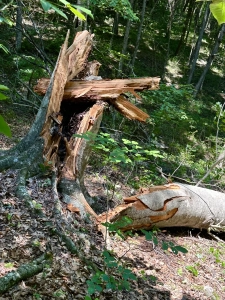
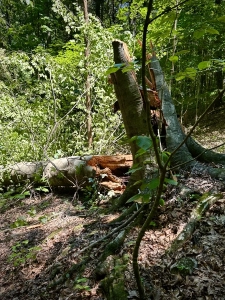
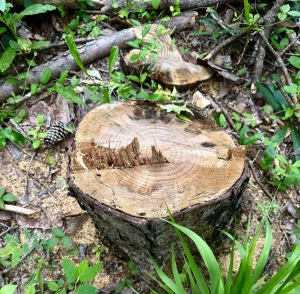
Our native loblolly pines accumulate resins in core wood as they age and mature. The resin-soaked heartwood is decay resistant, as is evident from this old cut stump. Only the bark and the core remain.

Lake GSP

This corewood skeleton remains intact on the forest floor where it fell decades ago. When I fueled a fireplace in prior residences, I collected such lightered wood to start evening fires.

Lake GSP

So many stories to interpret, record, and later share as I sauntered through LGSP; so little reader’s time to consume!


Kings Chapel Cemetery


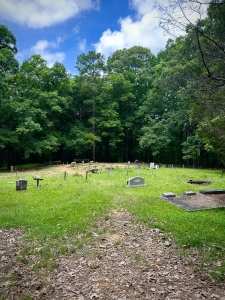
I abruptly entered a sacred opening, dropping back 100 years. The cemetery bordered a community then tethered to Kings Chapel and anchored to the Tennessee River. I found no interment that postdated Lake Guntersville’s 1939 completion.

Lake GSP


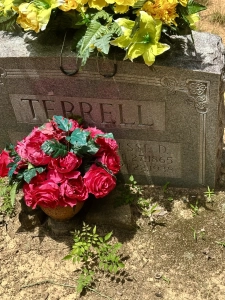
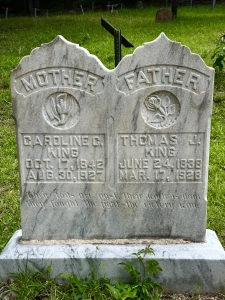
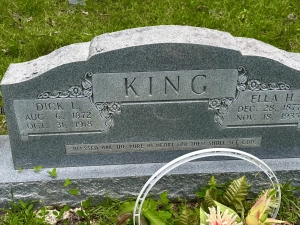
The Terrell and King families were prominent citizens. These individuals died in 1938 and 1927. Imagine the tremendous family, community, and economic tremors imposed by dam completion.

Lake GSPLake GSP


The King inscription reads: Their toils are past, their work is done, they fought the fight — the victory is won. Who now tends their graves? Who remembers them?

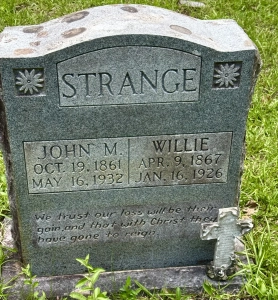
Friends, neighbors, and kinfolk, these King and Strange residents passed in 1918 and 1926. Did any still-adjacent trees witness their burial?

Lake GSP


The John and Willie Strange epitaph: We trust our loss will be their gain, and that with Christ they have gone to reign.

The Terrell memory lives on via a named trail. I can think of less favorable ways to be memorialized!

Lake GSP Lake GSP


Some Worthy Postscripts


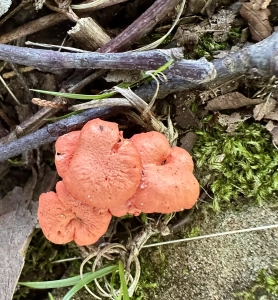
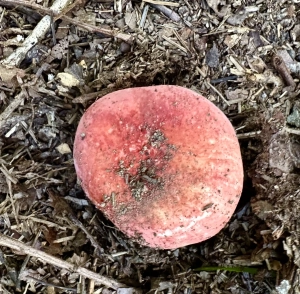
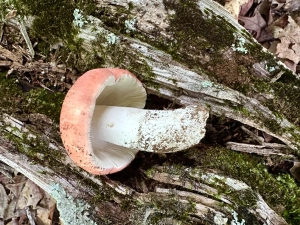
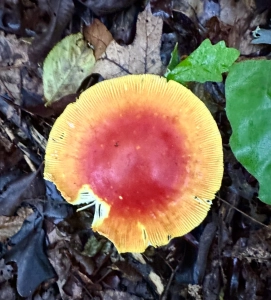
Two lovely mushrooms appeared, the first this hintapink (Russula paludosa), a brightly colored, edible brittlegill. I harvested only one of several, mostly to secure an underside photo for identification. I cooked the morsel with butter, pepper, and salt, finding the flavor mild and pleasant, but not nearly enough to truly gauge whether I’d want a full-omelette measure.

Lake GSP


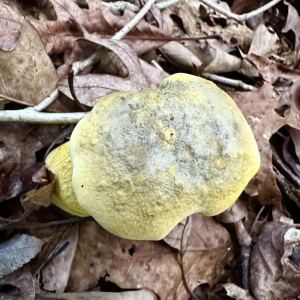
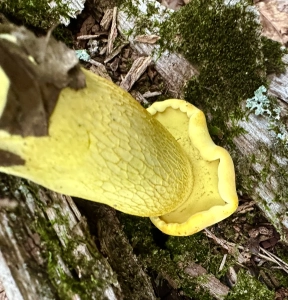
I saw a handful of this meaty ornate-stalked bolete, identified as edible with a caution that the species can be too bitter for consumption. I found it disagreeably acrid.

Lake GSPLake GSP


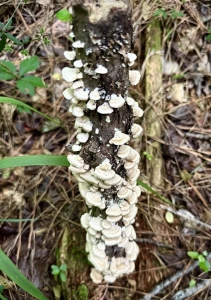
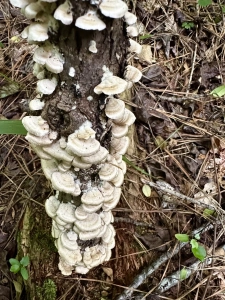
This violet-toothed polypore occupied an oak sapling snag, performing its dedicated decomposing mission. No, not edible!

Lake GSP


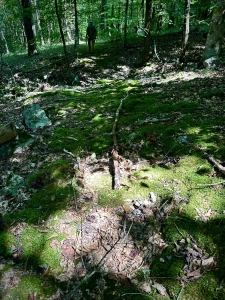
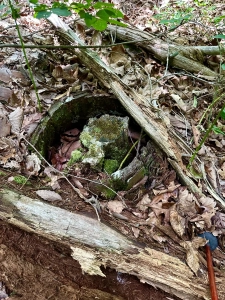
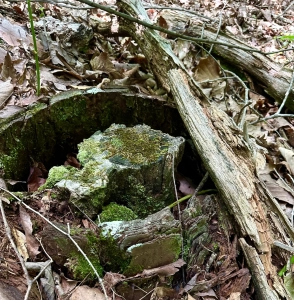
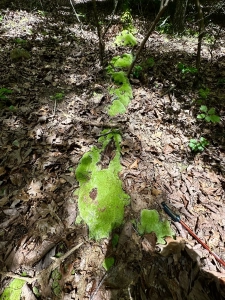
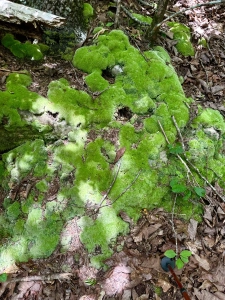
Pin cushion moss colonized a long decaying stump and trunk, both visible only as an outline of the organic matter remains of the downed woody debris.

Lake GSP

Lake GSP


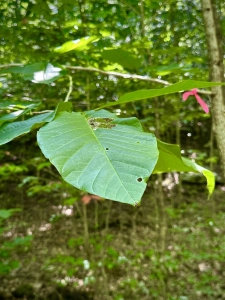
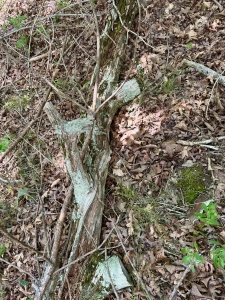
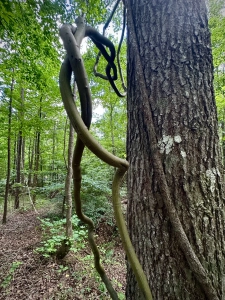
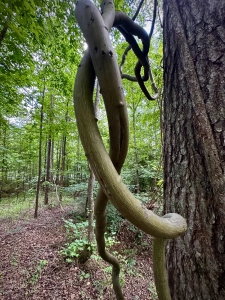
A supplejack vine clings to its black oak anchorage. I admire its smooth green bark and tendency to wrap in sinuous coils on tree stems and adjacent supplejack vines.

Lake GSP


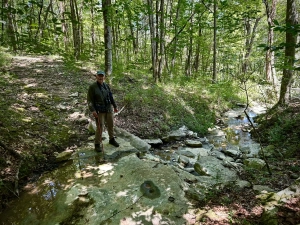
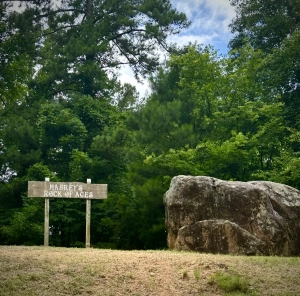
I leave you with an image of the LGSP Mabrey Rock of Ages, along the Service Road as I returned to to the Connector Trail.

Lake GSP


Alabama State Parks Foundation

Thoughts and Reflections


I offer these observations:

  • Take heart, not all oaks are misshapen, decayed, and physically disabled. (Steve Jones)
  • However, all sourwood trees (Oxydendrum arboreum) rebel against growing in accord with the basic, fundamental dictates of negative geotropism and positive phototropism. (Steve Jones)
  • I only went out for a walk and finally concluded to stay out till sundown, for going out, I found, was really going in. (John Muir)

Inhale and absorb Nature’s elixir. May Nature Inspire, Inform, and Reward you!


Note: All blog post images created & photographed by Stephen B. Jones unless otherwise noted. Please circulate images with photo credit: “©2026 Steve Jones, Great Blue Heron LLC. All Rights Reserved.”

I am available for Nature-Inspired Speaking, Writing, and Consulting — contact me at steve.jones.0524@gmail.com

Subscribe to my free weekly photo essays (like this one) at: http://eepurl.com/cKLJdL


Reminder of my Personal and Professional Purpose, Passion, and Cause

If only more of us viewed our precious environment through the filters I employ. If only my mission and vision could be multiplied untold orders of magnitude:

Mission: Employ writing and speaking to educate, inspire, and enable readers and listeners to understand, appreciate, and enjoy Nature… and accept and practice Earth Stewardship.

Vision:

  • People of all ages will pay greater attention to and engage more regularly with Nature… and will accept and practice informed and responsible Earth Stewardship.
  • They will see their relationship to our natural world with new eyes… and will understand more clearly their Earth home.

Tagline/Motto: Steve (Great Blue Heron) encourages and seeks a better tomorrow through Nature-Inspired Living!


Steve’s Four Books


I wrote my books Nature Based Leadership (2016), Nature-Inspired Learning and Leading (2017), Weaned Seals and Snowy Summits: Stories of Passion for Place and Everyday Nature (2019; co-authored with Dr. Jennifer Wilhoit), and Dutton Land & Cattle: A Land Legacy Story (2023) to encourage all citizens to recognize and appreciate that every lesson for living, learning, serving, and leading is either written indelibly in or is powerfully inspired by Nature. All four of my books present compilations of personal experiences expressing my deep passion for Nature. All four books offer observations and reflections on my relationship with the natural world… and the broader implications for society. Order any from your local indie bookstore, or find them on IndieBound or other online sources such as Amazon and LifeRich.

I began writing books and Posts for several reasons:

  • I love hiking and exploring Nature
  • I see images I want to (and do) capture with my trusty iPhone camera
  • I enjoy explaining those images — an educator at heart
  • I don’t play golf!
  • I do love writing — it’s the hobby I never needed when my career consumed me
  • Judy suggested my writing is in large measure my legacy to our two kids, our five grandkids, and all the unborn generations beyond
  • And finally, perhaps my books and Blogs could reach beyond family and touch a few other lives… sow some seeds for the future
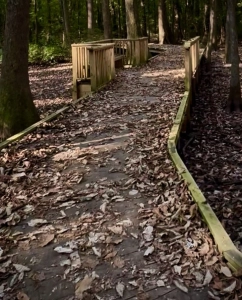


Brief-Form Post #64: Mid-June Visit to a WNWR Bottomland Forest and a Drying Buckeye Impoundment!

NOTE: Some of my GBH photo essays were not routinely distributed from mid-February through mid-June. I will resend those one by one, beginning the first week of July. Here is my Post from April 15 (https://stevejonesgbh.com/2026/04/15/brief-form-post-56-quick-circuit-of-the-dallas-fanning-nature-preserve/)


I am pleased to add the 64th of my GBH Brief-Form Posts (Less than five minutes to read!) to my website. I get wordy with my routine Posts. I don’t want my enthusiasm for thoroughness and detail to discourage readers. So, I will occasionally publish these brief Posts.


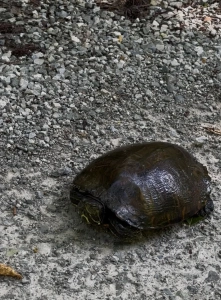
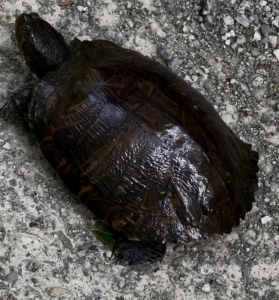
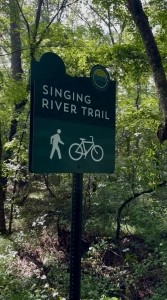
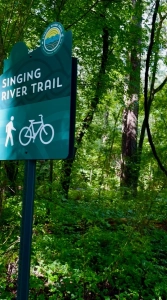
I am fortunate to live just a dozen miles due north of Alabama’s 35,000-acre Wheeler National Wildlife Refuge, where I decided to wander for several hours on June 9, 2026. I searched in a familiar bottomland hardwood forest for wild edible mushrooms: early chanterelles, oysters, boletes, chicken of the woods, and black-staining polypores. Finding only non-edibles, I made acquaintance with a road-crossing river cooter, photographed new Singing River Trail signage, and explored the sights and sounds of the Refuge’s Buckeye Impoundment, an important wildlife management feature.


Bottomland Forest


Search my website Blog link (https://stevejonesgbh.com/blog/) for Wheeler National Wildlife Refuge; choose from more than 50 prior posts on aspects of this nationally significant refugium. Were the refuge a single mile wide, it would extend 55 miles. Here is the interior road (HGH Road) that runs east-west about a mile north of the Tennessee River (Lake Wheeler), just into Limestone County, adjoining Madison County to the east. I often bushwalk (bushwhack) through this rich bottomland, which if not for the TVA/COE purchasing land to buffer the 1936 Wheeler Dam inudation property, would now probably be in private agricultural production.


Mushroom Venture


I ventured for 90 minutes in the bottomland finding abundant mushrooms of various inedible species.

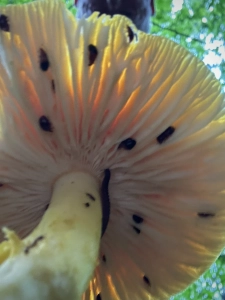
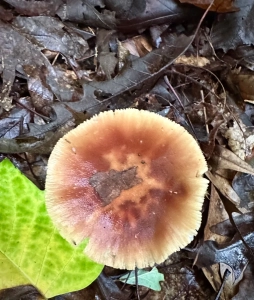
Amanita were scattered in the deep and damp understory shade. This one served as a luncheon buffet for underside invertebrates.


Amanita color hue and sharpness vary with age.


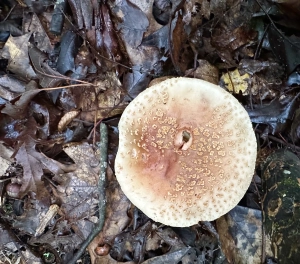
Yet another Amanita species.


Unlike the gilled Amanitas, all Boletes have spongy pores under their caps. This is known as bitter Bolete, a common name that suggests it may not be inedible, but it assuredly is not suitable for consumption.


This Caloboletus firmus, considered too bitter to consume, bears perfect leaf impression artwork.


Its pink underside shows the characteristic spongy Bolete pore surface.


A Mushroom Consumer


I stopped for a friendly river cooter gravel road crossing chat. The shell-shocked retile refused to share edible mushroom location secrets with me!


I recorded this 43-second video of my turtle friend.


Singing River Trail Thoroughfare


The Singing River Trail will be a 200+ mile greenway system once completed. The Refuge recently posted signage delineating the SRT route. I recorded this 60-second video introducing the route. My narrative incorrectly identifies the road as Jolly B. It is HGH Road, which ties in to Jolly B a mile to the east.


The sign below is at the northern entrance to the Refuge on Jolly B Road.


Buckeye Impoundment


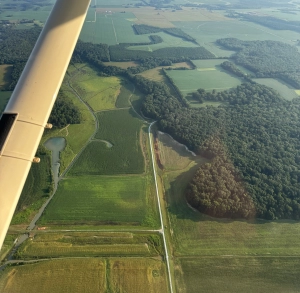
Buckeye Impoundment lies just beyond the point where HGH Road turns north (where I recorded the SRT video). Here is my Great Blue Heron Post from my 2024 overflight of WNWR and the image below of Buckeye Impoundment: https://stevejonesgbh.com/2024/12/05/buckeye-impoundment-in-early-october-on-the-wheeler-national-wildlife-refuge-part-one/


I entered the aerial photo image above on June 9, 2026 where the straight N/S road candy-canes into Buckeye Impoundment from the bottomland forest to the east.

I recorded this 60-second Buckeye Impoundment video.


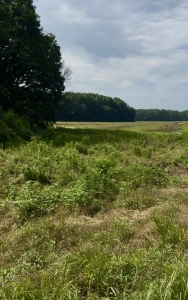
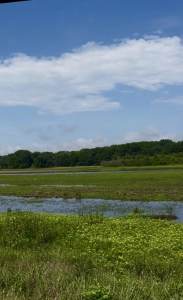
The views below are to the SSE and the SW. I plan to return to examine and compare end of summer vegetative growth to this early June visit.


The impoundment is drying after an extended dormant season of intentional engineered flooding.


Summer Wildflower Profusion


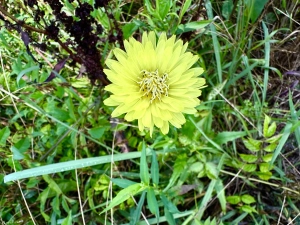
Here are my observed early summer flower highlights at the marge of the impoundment.

Carolina desert chickory


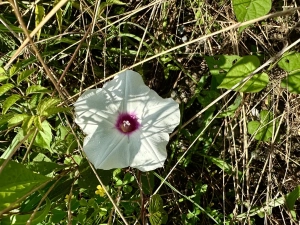
Wild potato vine


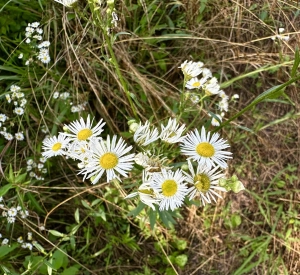
Annual fleabane


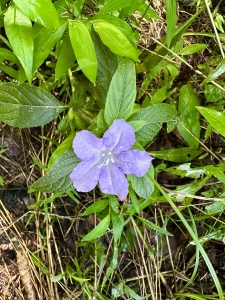
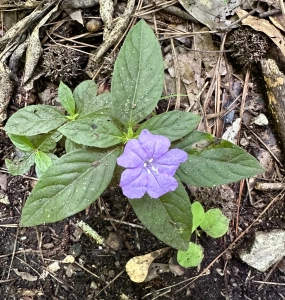
Carolina ruellia


A quick, low investment visit into Nature pays high dividents in peace of mind, satisfaction, exercise, and learning and discovery. John Muir nailed it:

In every walk with nature one receives far more than he seeks.


Closing


I accept the challenge of distilling these Brief-Form Posts into a single distinct reflection, this one cut, modified, and pasted from above:

I am fortunate to live just a dozen miles due north of Alabama’s 35,000-acre Wheeler National Wildlife Refuge, where I decided to wander for several hours on June 9, 2026. A quick, low investment visit into Nature pays high dividents in peace of mind, satisfaction, exercise, and learning and discovery. John Muir nailed it:

In every walk with nature one receives far more than he seeks.


Nature’s special treats await our discovery, our understanding, and our interpretation!


Subscribe to my free weekly photo essays (like this one) at: http://eepurl.com/cKLJdL


Brief-Form Post #63: Mid-Summer Osher Lifelong Learning Institute Nature Walk at the Wheeler National Wildlife Refuge!

NOTE: Some of my GBH photo essays were not routinely distributed from mid-February through mid-June. I will resend those one by one, beginning the first week of July. Here is my Post from April 9 (https://stevejonesgbh.com/2026/04/09/mid-december-delights-and-mysteries-on-the-wnwr-hiking-and-bicycling-trail/)

_________________________________________________________________________________________


I am pleased to add the 63rd of my GBH Brief-Form Posts (Less than five minutes to read!) to my website. I get wordy with my routine Posts. I don’t want my enthusiasm for thoroughness and detail to discourage readers. So, I will occasionally publish these brief Posts.


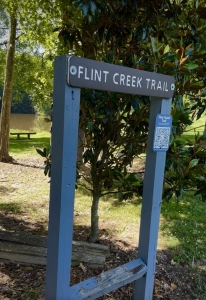
Fellow retired forester Chris Stuhlinger and I co-led an OLLI (Osher Lifelong Learning Institute, University of Alabama in Huntsville) Nature walk on June 13, 2026, at the Wheeler National Wildlife Refuge in Decatur, Alabama. We planned to saunter through the rich bottomland forest along the Flint Creek Trail, slowly exploring the beauty, magic, awe, and inspiration of Nature hidden in plain sight. Three of us appropriately dallied, immersed in wonder, wandering within the forest, truly focusing on the intended discovery and learning. The other dozen or so participants yielded to resident bottomland blood-sucking mosquitoes. As a result, the three of us were persuaded to abandon the trek and head to the nearby Refuge Visitors Center instead. I’ll take you there with me.


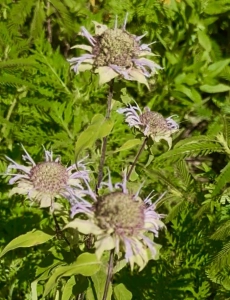
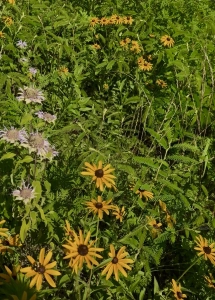
I had arrived at the trailhead early enough to examine the parking area Refuge buffer of sowed wildflower mix. Bergamots were among the plants already flowering.


I recorded this 53-second video of the beds dominated at the moment by bergamots and black-eyed Susans.


Black-eyed Susans are among my favorite summer natives.


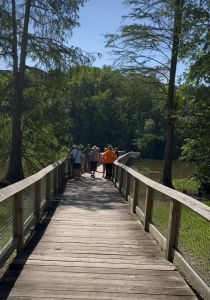
We began our trek within sight of the beds, by crossing the boardwalk, which carried us across a sunny, breezy, mosquito-free (a relevant point as I will soon reveal) passage into the forest.


I recorded this 59-second video as we approached the trail via the boardwalk.


Pond cypress, a water-tolerant deciduous conifer, stood in the Flint Creek inlet at the boardwalk trailhead.

Flint CrFlint Cr


My Musings on What Warrants Doing as Time Wanes


We entered the forest where wonders awaited some of us… and two-winged, six-legged terrorists inflicted intolerable annoyance on the others. Summer passage through certain northern Alabama ecotypes exacts a toll. The circumstances of this day lead me to pledge (to self) that I will heretofore exercise greater caution in agreeing to which particular OLLI (or any other) missions I shall choose/decide to accept. 

None of us knows how many woodland excursions lie ahead. I do know that the window eventually closes. The clock continues ticking. I love my deliberate, succinct retirement mission:

Employ writing and speaking to educate, inspire, and enable readers, and listeners to understand, appreciate, and enjoy Nature… and accept and practice Earth Stewardship.

Mightn’t I have been better advised to persue a Nature jaunt of my own design, intent, passion, purpose, and ken, rather than one where the participants are easily dissuaded from the effort? As I draft this text, I will enter my fourth quarter of a century in two days. Chances are slim (to none) that a fifth awaits me (Well, maybe it’s with partaking a fifth of Old Forester that my chance improves!).

Without belaboring my disappointment, allow me to point out that at least eight of our 14 participants wore short-sleeve shirts/blouses, despite our advance suggestion to avoid attracting unwanted insect attention and voracious feeding.


An Abbreviated Woodland Exploration


The bottomland forest presented abundant mushrooms for those of us not flushed ahead by the pesky skeeters. Rather than escort you with deep narrative, allow me to introduce our welcoming fungi. Lactarius psammicola gave us palm-size shrooms.

Flint Cr


Golden-gilled gerronema showed their characteristic biege funnels.

Flint Cr


Although very attractive, the species is not considered edible.

Flint Cr


Bolete mushrooms are a group of fungi with spongy pores under their caps instead of gills, including some edible species. I’ve reached a point in my foraging where I’m gaining enough knowledge and confidence to begin selecting certain boletes. This individual is in an advanced state of decay, rotting with a bolete mould.

Flint CrFlint Cr


Nearby we spotted dog vomit slime mold, a fungus that has a moniker that, even if it were edible, would discouraged human consumers.

Flint CrFlint Cr


I spotted an unfamiliar understory plant, whitenymph. By this point of progress, the mosquito-spurred group had raced way ahead of us.

Flint Cr


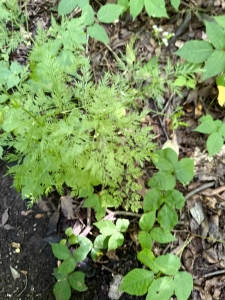
I felt compelled to photograph Carolina ruellia, a lovely little ground-hugging early summer wildflower.

Flint Cr


Quick Trip across the Highway to the Visitors Center Cypress Pond


The larger group hailed us before we had traversed half the distance they covered. We agreed to return to our vehicles, and then leave to the visitors center about a mile away, across the highway, where we anticipated far fewer human-blood-consuming insects. Some of the original group did not transfer to the visitors center.

I’ll touch briefly on our mosquito-abatement alternative. I always enjoy the bald cypress pond and boardwalk near the visitors center.

Cypress Pond


Stems are packed tightly and reach high. Cypress knees perform their function, whether securing incremental anchorage or assisting in gaseous exchange.

Cypress Pond


I recorded this 60-second video within the cypress pond, adding a little Righteous Brothers accompaniment.


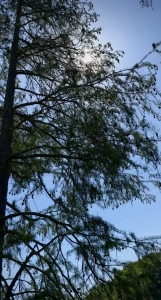
I always glance heavenward from the boardwalk. The dense trunk-stocking suggests crowded, intersecting and overlapping crowns. Instead, cypress expresses crown shyness… faithfully, maintaining space-margins and no-touch zones separating one crown from another! Is it my own certifiable introvert personality that explains my admiration of sylvan crown shyness?

Cypress


Perhaps I overreacted to our change in plans; perhaps not. However, in no small part owing to my seminal life benchmark (75 years!), my angst and pique were real… and persist. I shall be recalibrating priorities. From a time-of-life-dawn, the brim-full hour glass left plenty of room for judgement error. Today, with a setting sun ahead, the sand grains rush unceasingly. The relative cost of each one amplifies. My maternal grandmother, a country girl from Appalachian-region West Virginia, said as much: “The older I get, the faster time goes!”


Closing


I accept the challenge of distilling these Brief-Form Posts into a single distinct reflection, this one cut, modified, and pasted from above:

None of us knows how many woodland excursions lie ahead. I do know that the window eventually closes. The clock continues ticking. I love my deliberate, succinct retirement mission:

Employ writing and speaking to educate, inspire, and enable readers and listeners to understand, appreciate, and enjoy Nature… and accept and practice Earth Stewardship.

Mightn’t I have been better advised to pursue a Nature jaunt of my own design, intent, passion, purpose, and ken?


Nature’s special treats await our discovery, our understanding, and our interpretation!


Subscribe to my free weekly photo essays (like this one) at: http://eepurl.com/cKLJdL


Flint Cr

A Chilly, Saturated Late May Morning at a Butler County, PA Horse Barn!

[Some of my GBH photo essays were not routinely distributed from mid-February through mid-June. I will resend those one by one, beginning the first week of July. Here is my Post from April 1 (https://stevejonesgbh.com/2026/04/01/squeezing-a-90-minute-woodland-saunter-into-four-hours/)]

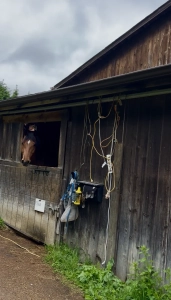
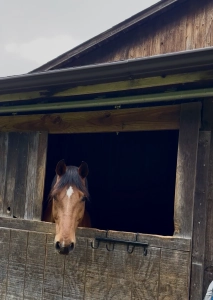
Our 18-year-old granddaughter, Hannah, graduated from high school the week of May 18, 2026, in Butler County, Pennsylvania, north of Pittsburgh. Judy and I enjoyed five days with our son Matt and his family. The three PA grandkids attended school on the weekdays of our visit. Judy and I accompanied Matt and 15-year-old granddaughter Mallory on Saturday to the horse barn, 20 miles north of their Cranberry Township home, where Mallory rides and tends the stables. Although still wearing a sling/brace from April 13, 2026, shoulder replacement/revision surgery, I gathered Nature observations and reflections based on wandering the grounds, snapping photographs, and recording brief videos.


Overview of Barn and Grounds


The temperature on the unseasonably cold late spring midday barely topped 50 degrees. This stoic equine seemed content to remain indoors. To the contrary, I was elated to embrace weather conditions I will not see again in northern Alabama until October.


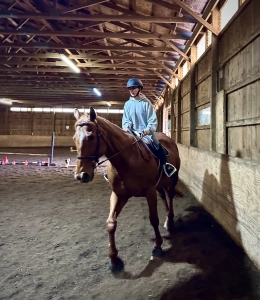
I recorded this 40-second video of Mallory riding indoors, verifying that I appended my Nature-Inspired Life and Living field research to a genuine grandfatherly pursuit!


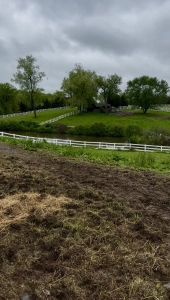
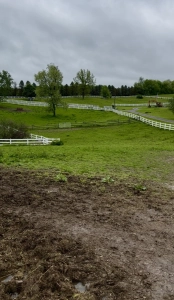
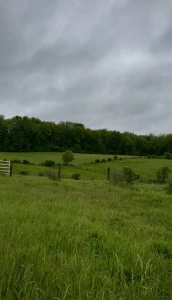
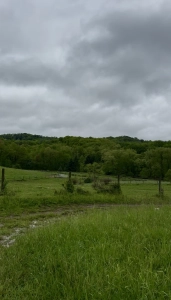
I’m a glutton for springtime, flush with new greenery, borderline cold breezes, surface runoff, deep mud, and low clouds skudding across hillsides adorned with white fences.


Here’s my 59-second video of the farmstead residence, entrance road, and pond I recorded from the front side of the horse barn and arena.


I grew up just 150 miles SSE of this location on the east side of the Allegheny Front in western Maryland, a landscape peppered with valley farmsteads similar to this. I am a student and champion of special places and everyday Nature.


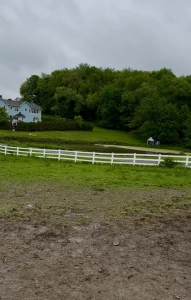
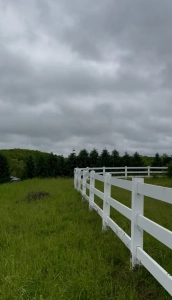
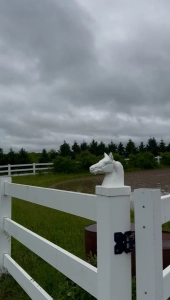
Ascending pastureland behind the barn, I came to a fenced outdoor riding track and performance ground, where Mallory will train and exercise the horses in the pleasant months ahead.


The riding track lies beyond the decorative horse-head post top.

I recorded this 59-second video of the surrounding landscape, capturing the seasonal essence of this special place.


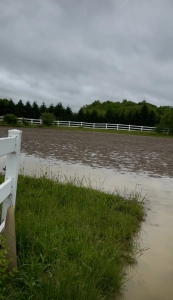
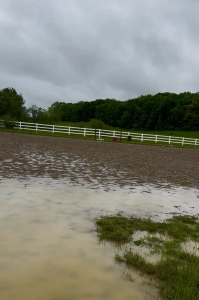
Over an inch of rain soaked the barn grounds overnight.


I’ve often observed that the spring-green pallette may be as rich with shades, hues, and moods worthy of comparison to the colors of autumn.


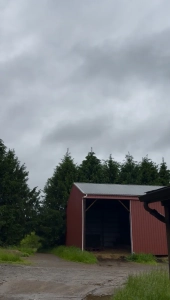
I admit that I miss the depth of seasonal fluxes evident here at 40.86 degrees north latitude, relative to the 34.71 at my Madison, Alabama home. My many years residing in cold weather regions leave me occasionally aching for a deep winter, epic snow, blow, and several days of homebound isolation. Even rows of planted Norway spruce reminded me of the mantle of snow that will grace the lane and out-building behind the barn. Although I failed to snap a photo, wind trembled the leaves on a nearby hilltop quaking aspen tree, another reminder of northern forests that sets my heart aflutter (i.e. in a state of tremulous excitement)!


So, too, does a working farmstead lift my soul. I love the wildness of forests, yet I am in love with the grandeur of a land and its owner/caretaker committed to informed and responsible Earth stewardship, generating intentional ends through applied means. Conservation entails wise use and management, applying scientific principles and practices to yield desired outcomes, whether forest products, productive pasture, baled hay, or the compelling essence of a well-managed landscape.

The Norway spruce edging the barn is one element of the landscape magic. I recorded this 58-second video of the Norway spruce hedgerow.


Shingle Oak and Bacterial Crown Galls!


Shingle oak is a deciduous tree in the red oak group. It is native primarily to the Midwestern and Upper South regions of North America.


I don’t see the species often in my Alabama wanderings, although I did chronicle the demise of the Alabama State Champion shingle oak on Joe Wheeler State Park (https://stevejonesgbh.com/2022/10/19/a-state-champion-yields-to-decay-and-gravity/). I found this unusual shingle oak specimen just 300 feet from the barn. This individual drew me closer. Standing pondside, promising delightful summer shade weeks ahead, the tree carried a heavy load I could not identify until I came closer.


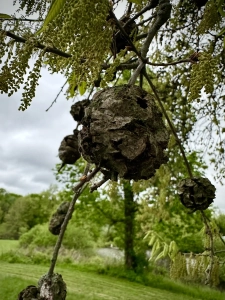
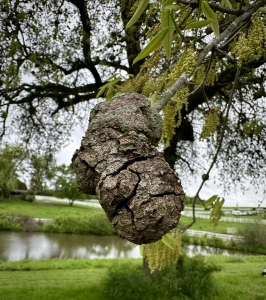
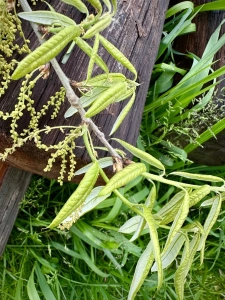
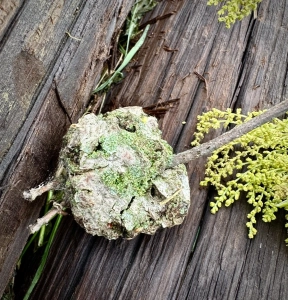
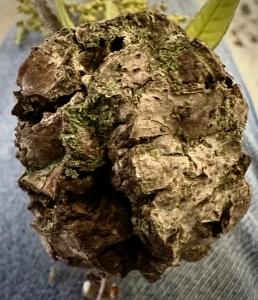
The tree was laden with a heavy burden of woody bacterial crown galls.


An online Missouri Botanical Garden reference describes the condition for many ornamental plants of the rose family:

Crown gall is a plant disease caused by the soil-inhabiting bacterium, Agrobacterium tumefaciens. The bacterium causes abnormal growths or galls on roots, twigs, and branches. The bacterium stimulates the rapid growth of plant cells that result in the galls. In addition to being unsightly, the galls weaken and stunt the growth of the plant. Although galls can disrupt the flow of water and nutrients up the roots and branches, they usually do not cause total plant death. The disease can spread to other susceptible plants through contaminated soil and tools. Most chemical treatments are not effective.

However, the same online reference suggests a different causal agent for these similar galls on oaks:

The galls on forsythia, viburnum, highbush blueberry, American elm, hickory, maple, oak, and privet are believed to be caused by a fungus, Phomopsis sp.

I am confident that the oak is diseased, perhaps by fungal…or maybe bacterial agents. Fatal? Probably not. The tree appears robust, with a emerging full foliar canopy, and a tremendous flower crop. A curiosity? Absolutely! A tree condition oddity worthy of highlighting for readers of these Great Blue Heron weekly photo essays!


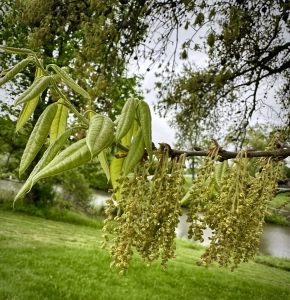
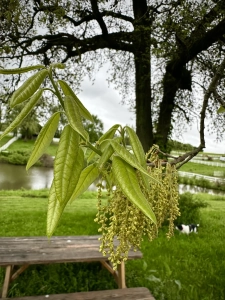
Shingle oaks are what during my forest industry years (1973-1985) I termed ELROs, entire-leaf red oaks (without lobes). The leaves are much like the willow oak leaves of the tree in my Alabama backyard. I admire the appearance of the newly emerged leaves, fresh flowers, and a woody gall against the bakdrop of the weathered-wood picnic table.


The galls portray character, each one a distinct size and shape. One might expect a mishappen product of disease to look a little less mirthful!


A Farm Pond Celebration of Life and Living


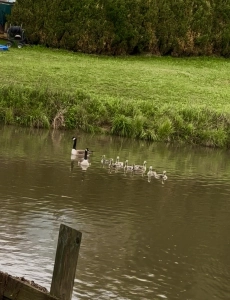
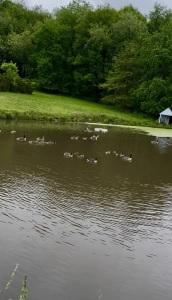
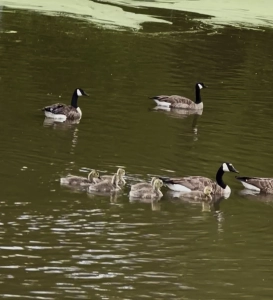
I wondered whether these Canada geese are recent arrivales from the southland 0r, like those on my Alabama neighborhood pond, are they year-round residents. If so, how do they survive a pond frozen for many weeks of bitter winter and shrouding snow?


Aldo Leopold knew geese well, yet he spoke of the magic of their mystery:

What a dull world if we knew all about geese!

One swallow does not make a summer, but one skein of geese, cleaving the murk of a March thaw, is the spring.

So sad that our Madison, Alabama geese know nothing of cleaving the murk of a March thaw. I love them just the same.

I recorded this 57-second video at the horse barn pond.


A single frame expressing Nature-Inspired Life and Living!


I spent 35 years at nine different universities, rising through faculty ranks to serving senior adminstrative positions to holding the presidency at four institutions and chairing the governing board at the University of the Arctic, a consortium of 110 northern circumpolar colleges and universities enrolling 800,000 students. Throughout my academic career, I shared a fundamental concern that academic conservationist Aldo Leopold so elequently expressed:

Is education possibly a process of trading awareness for things of lesser worth? The goose who trades his is soon a pile of feathers.


Thoughts and Reflections


I offer these observations:

  • Is education possibly a process of trading awareness for things of lesser worth? The goose who trades his is soon a pile of feathers. (Aldo Leopold)

  • One swallow does not make a summer, but one skein of geese, cleaving the murk of a March thaw, is the spring. (Aldo Leopold)

  • Sadly, our Madison, Alabama geese know nothing of cleaving the murk of a March thaw. (Steve Jones)

Inhale and absorb Nature’s elixir. May Nature Inspire, Inform, and Reward you!


Note: All blog post images created & photographed by Stephen B. Jones unless otherwise noted. Please circulate images with photo credit: “©2026 Steve Jones, Great Blue Heron LLC. All Rights Reserved.”

I am available for Nature-Inspired Speaking, Writing, and Consulting — contact me at steve.jones.0524@gmail.com

Subscribe to my free weekly photo essays (like this one) at: http://eepurl.com/cKLJdL


Reminder of my Personal and Professional Purpose, Passion, and Cause

If only more of us viewed our precious environment through the filters I employ. If only my mission and vision could be multiplied untold orders of magnitude:

Mission: Employ writing and speaking to educate, inspire, and enable readers and listeners to understand, appreciate, and enjoy Nature… and accept and practice Earth Stewardship. Until I can’t!

Vision:

  • People of all ages will pay greater attention to and engage more regularly with Nature… and will accept and practice informed and responsible Earth Stewardship.
  • They will see their relationship to our natural world with new eyes… and will understand more clearly their Earth home.

Tagline/Motto: Steve (Great Blue Heron) encourages and seeks a better tomorrow through Nature-Inspired Living!


Steve’s Four Books


I wrote my books Nature Based Leadership (2016), Nature-Inspired Learning and Leading (2017), Weaned Seals and Snowy Summits: Stories of Passion for Place and Everyday Nature (2019; co-authored with Dr. Jennifer Wilhoit), and Dutton Land & Cattle: A Land Legacy Story (2023) to encourage all citizens to recognize and appreciate that every lesson for living, learning, serving, and leading is either written indelibly in or is powerfully inspired by Nature. All four of my books present compilations of personal experiences expressing my deep passion for Nature. All four books offer observations and reflections on my relationship with the natural world… and the broader implications for society. Order any from your local indie bookstore, or find them on IndieBound or other online sources such as Amazon and LifeRich.

I began writing books and Posts for several reasons:

  • I love hiking and exploring Nature
  • I see images I want to (and do) capture with my trusty iPhone camera
  • I enjoy explaining those images — an educator at heart
  • I don’t play golf!
  • I do love writing — it’s the hobby I never needed when my career consumed me
  • Judy suggested my writing is in large measure my legacy to our two kids, our five grandkids, and all the unborn generations beyond
  • And finally, perhaps my books and Blogs could reach beyond family and touch a few other lives… sow some seeds for the future
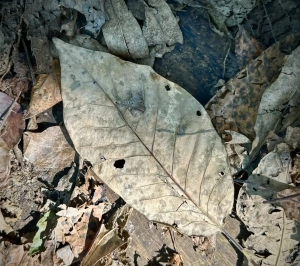


First Time Visit to Graham Farm and Nature Preserve

[Some of my GBH photo essays were not routinely distributed from mid-February through mid-June. I will resend those one by one, beginning the first week of July. Here is my Post from March 24 (https://stevejonesgbh.com/2026/03/24/mid-december-above-ground-exploration-at-cathedral-caverns-state-park/)]

I toured the Alabama Cooperative Extension System (ACES) Jackson County Graham Farm and Nature Center on June 24, 2026, with friends Chris Stuhlinger, Bill and Becky Heslip, and Roxanne Pennington. I served as ACES Director from 1996 to 2001, leading the unification of Auburn University and A&M University’s distinct extension programs under a Federal Court Order that settled a long-standing legal dispute involving both institutions and the state of Alabama. I had looked forward to seeing the 491-acre outdoor education, conservation, and preservation enterprise borne of a dedicated joint endeavor. Come along with me for my initial observations, reflections, photographic images, and brief videos.


Doorway to a Special Place: Wisps of Memories and Vapors of Possibilities


I had driven past the Center on prior trips through the valley to visit a waterfall owned by friends about two miles beyond. I saw the GF&NC signage, but knew only enough to whet my curiosity and prompt me to arrange a tour and orientation, which led to scheduling this visit. I felt a deep connection, sentimental I suppose in part, from my intimate role in forging and leading the inter-university, involuntary (Federal Court-ordered) cooperative venture that stood during the era of my tenure in the national spotlight. My purpose is not to focus on what we then termed The Unification. The ACES directorship was the toughest role of my university administrative career. I’ll mention only that Auburn University President Bill Muse said, “We asked Steve to do the impossible, and he damned near did it!”

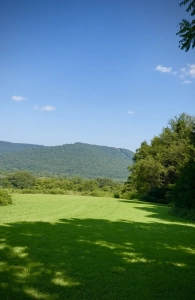
Driving onto the property, the Paint Rock Valley and surrounding Cumberland Plateau terrain beguiled and bewitched me. I reflected on my third book, Weaned Seals and Snowy Summits: Stories of Passion for Place and Everyday Nature, co-authored with Dr. Jennifer Wilhoit (published in 2019). My book Introduction included:

Awakening to nature does not require a trip to the Grand Canyon or a trek across the Gobi. Nature is in our backyard, a trip to a nearby city park, or a state park just down the road. Anyone can develop a relationship with nature wherever you are, a point I reiterate in each and every nature-inspired life and living address I deliver. My relationship with nature is spiritual. I view my engagement as a calling, and a noble cause to sow seeds so that others might do their own part to change some small corner of this Earth for the better.

I awakened to the Nature of this special place when I entered the Graham Farm and Nature Center. The sense and spirit beckoned me, pulled me into its magic. It was real and palpable, strengthening with each moment during our six hours on the property, seeing and inhaling its essence, meeting and getting to know staff, and sharing ideas and dreams. Wisps of memories and vapors of possibilities infused my vision of a potential volunteer niche role for me, an admittedly self-satisfying venture for yet another chapter of my retirement. I recently crossed my 75th birthday threshold, entering my 4th quarter of a century of life on Earth. A senior former forestry faculty colleague remarked in response to my fourth quarter of a century comment, “Remember that in football, in the 4th quarter, every play counts!”


I share a relevant excerpt from Notes from the Field: Paint Rock and the New Nation (July 4, 2026) by Bill Finch, Founding Director, Paint Rock Forest Research Center, located in the same valley and ecosystem as GF&NC:

Paint Rock appears to have escaped the worst of 19th and 20th century deforestation and plowing. But the modern forest is a dim reflection of what it was in the 18th century. Mountainsides then as now likely supported the most diverse assembly of deciduous trees and shrubs in the United States, in some places so tall and dense they blocked the sun for much of the year. But the slopes may have been less uniformly covered in trees. Fragments of sun-loving, summer blooming sunflowers, tall green gentians, lilies, moon-flowered silphiums, and warm season grasses still dot the slopes, the remnants of what must have been extensive nearly treeless glades. Plants that are now rare in that forest, like smoketrees and the federally threatened Morefield’s clematis vine, are struggling to find the light they once knew.

I have no doubt that this Paint Rock Valley is a Special Place. I recorded this 60-second video as a brief introduction to Graham Farm and Nature Center.


I will not burden you with tireless narrative based only upon a preliminary superficial reconnaissance. I’m hooked enough to return to get to know her better, and share what I learn, both the obvious and the mystery.

The Center


As Chancellor, the University of Alaska Fairbanks, America’s Arctic University, I fell in love with America’s Last Frontier. Alaska is not just a vast place…it’s a spirit, an abiding spirit. Robert Service, a Brit who spent several years in the Yukon during the turn of the prior century goldrush days, expressed the Far North essence more clearly than any I’ve read. Excerpting from his The Spell of the Yukon:

There’s a land — oh, it beckons and beckons,

And I want to go back — and I will.

It’s the great, big, broad land ‘way up yonder,

It’s the forests where silence has lease;

It’s the beauty that thrills me with wonder,

It’s the stillness that fills me with peace.


Granted, Alaska is unmatched. It’s also not within an hour and 15 minute drive of my house! I welcome a Nature affair with a special place of beauty, magic, wonder, awe, and inspiration… where I want to go back — and I can… and I will. Graham Farm and Nature Center fits the bill!

Allow me to rely upon selected photos and brief videos to present a GF&NC overview. I pledge to develop focused photo essays from future visits. The pavilion and operational hub occupy a commanding knoll at the valley core of the 491-acre property.


An old photograph of the pre-ACES Graham farm is among exhibits that reach back into the farm and valley’s rich history.


Our June 24, 2026 contingent consisted of Bill and Becky Heslip, me in the rear echelon, Center Director Themika L. “Mike” Sims, Chris Stuhlinger, Roxanne Pennington, and Administrative Support Specialist II Donna Sands behind the camera.


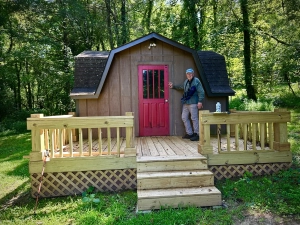
Although we didn’t have an opportunity to visit this charming woods-edge cottage, we understood that it will see future use as an overnight accommodation.


We visited the trailhead of a mountain forest trail. When summer’s heat abates I will return to explore this and many other trails.


The valley does indeed beckon.


Even the open land near the creeks promises discoveries in ecotype transition from field to meadow to brush to forest to wetland to stream channel.


Meadowland transitioning to brush then to forest will afford learning and discovery to Center visitors for the ages.


Wild carrot presented its lacy blossoms in the lower meadows.


I’m eager to follow and admire the Center’s changing seasonal faces. Multiply the one-hour-of-one-afternoon a hundred fold to anticipate the Nature-magic that lies ahead.


Larkin Creek enters Paint Rock River at this juncture on the property. I look forward to seeing the flow when it is not turbid from recent flooding, and also when the streams are at overflow. This landscape feature lies 1,000 vertical feet below the property’s highest. Spring at the union arrives more than a week in advance of the peak; autumn a week later. The place and its seasons are complex, varied, and exhilarating.


I recorded this 60-second video of the Larkin Creek juncture with Paint Rock River.


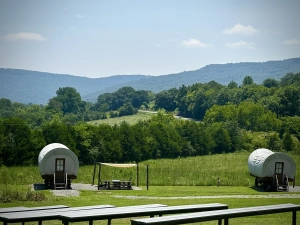
Perhaps I will find reason to stay overnight in the Connestoga Wagon Pampering Accommodations!


Here is my 60-second video of the overnight pampering wagons.


Chris and I are returning to GF&NC on July 30 to scout a tree and shrub identification trail, providing fodder for a subsequent Great Blue Heron GF&NC photo essay.

Thoughts and Reflections


I offer these observations:

  • I view my engagement (with Graham Farm and Nature Center) as a calling, and a noble cause to sow seeds so that others might do their own part to change some small corner of this Earth for the better. (Steve Jones)

  • The sense and spirit of this special place beckoned me, pulled me into its magic! (Steve Jones)
  • Remember that in football, in the 4th quarter, every play counts! (Dr. Russell Briggs)

  • Awakening to Nature does not require a trip to the Grand Canyon or a trek across the Gobi. (Steve Jones)


Inhale and absorb Nature’s elixir. May Nature Inspire, Inform, and Reward you!

Note: Unless otherwise noted, all blog post images are created & photographed by Stephen B. Jones.

Please circulate images with photo credit: “©2026 Steve Jones, Great Blue Heron. All Rights Reserved.”


I am available for Nature-Inspired Speaking, Writing, and Consulting — contact me at steve.jones.0524@gmail.com


Subscribe to my free weekly photo essays (like this one) at: http://eepurl.com/cKLJdL


A reminder of my Personal and Professional Purpose, Passion, and Cause

If only more of us viewed our precious environment through the filters I employ. If only my mission and vision could be multiplied by untold orders of magnitude:

Mission: Employ writing and speaking to educate, inspire, and enable readers and listeners to understand, appreciate, and enjoy Nature… and accept and practice Earth Stewardship.

Vision:

  • People of all ages will pay greater attention to and engage more regularly with Nature… and will accept and practice informed and responsible Earth Stewardship.
  • They will see their relationship to our natural world with new eyes… and understand their Earth home more clearly.

Tagline/Motto: Steve (Great Blue Heron) encourages and seeks a better tomorrow through Nature-Inspired Living!


Steve’s Four Books


I wrote my books Nature Based Leadership (2016), Nature-Inspired Learning and Leading (2017), Weaned Seals and Snowy Summits: Stories of Passion for Place and Everyday Nature (2019; co-authored with Dr. Jennifer Wilhoit), and Dutton Land & Cattle: A Land Legacy Story (2025) to encourage all citizens to recognize and appreciate that every lesson for living, learning, serving, and leading is either written indelibly in or is powerfully inspired by Nature. All four of my books present compilations of personal experiences expressing my deep passion for Nature. All four books offer observations and reflections on my relationship with the natural world… and the broader implications for society. Order any from your local indie bookstore, or find them on IndieBound or other online sources such as Amazon and LifeRich.

I began writing books and Posts for several reasons:

  • I love hiking and exploring Nature
  • I see images I want to (and do) capture with my trusty iPhone camera
  • I enjoy explaining those images — an educator at heart
  • I don’t play golf!
  • I do love writing — it’s the hobby I never needed when my career consumed me
  • Judy suggested my writing is in large measure my legacy to our two kids, our five grandkids, and all the unborn generations beyond
  • And finally, perhaps my books and Blogs could reach beyond family and touch a few other lives… sow some seeds for the future
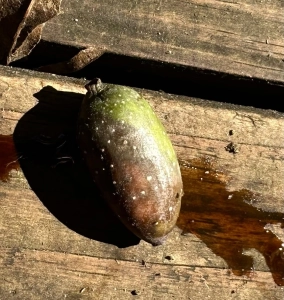


Understory and Ground Cover at Marshall Forest Preserve National Natural Landmark in Rome, Georgia!

NOTE: Some of my GBH photo essays were not routinely distributed from mid-February through mid-June. I will resend those one by one, beginning the first week of July. Here is my Post from March 18 (https://stevejonesgbh.com/2026/03/18/brief-form-post-55-auburn-universitys-college-of-forestry-wildlife-and-environment-crooked-oaks-nature-resort/)

Fellow retired forester Chris Stuhlinger, retired videographer Bill Heslip, and I visited Marshall Forest Preserve, established as Georgia’s first National Natural Landmark near Rome, Georgia, on April 5, 2026. Recognized by the Old Growth Forest Network (https://www.oldgrowthforest.net/), the preserve encompasses ~300 acres of undisturbed upland pine and hardwood forest. I focus this photo essay on the forest understory and ground cover we observed on the preserve.

The entrance sculpture suggested to me a maze, a puzzle, a secret hidden within, although nothing in signage or on the MFP website revealed its intended meaning. I’ll stick with my interpretation because it aligns with what every one of my woodland rambles divulges:

In every walk with nature, one receives far more than he seeks. (John Muir)

Look deep into nature, and then you will understand everything better. (Albert Einstein)

MFP


Overnight-rain-wetted Asian wisteria clogged the trail and dampened our clothing as we penetrated its dense growth from ground to ten feet.

MFP


The scarce ground cover under the massive oak is typical across the preserve.

MFP


The two images below reveal one cause of the spartan ground cover. Both show a distinct browse line to five to six feet above ground, typical in hardwood forests with high deer density.

MFP


Muscadine grape seedlings hug the ground. Deer will feed on the new foliage, thus keeping the muscadine constrained to an understory carpet. We saw very few hardwood tree seedlings, another clue to excessive deer density.

MFP


Although we hiked during the height of spring wildflower season, we noted a dearth of spring ephemerals, yet another nod to over grazing.

MFP


I recorded this one-minute video of the sparsely vegetated ground cover dominated by muscadine grape seedlings.


We noted an oak surrounded by a circle of seedling wood sorrell. I’ll classify this one-of-a-kind novelty as unexpected, peculiar, and worthy of explanation…yet none of us could fathom why we found this unique, isolated concentration.

MFP


A single striped wintergreen found a means of penetrating and standing above a thick carpet of last fall’s oak leaves.MFP


An American giant millipede grazed microrganisms on that same oak leaf forest floor.

MFP


Ever on the lookout for mushrooms, especially edibles, I found only this lonesome clump of trainwrecker mushrooms, a basidiomycete parasite of coniferous trees. The species is tough enough to resist creosote and grow even on railroad ties. Online resources indicate that they are edible when young. Let’s see, tough enough to grow on creosote-treated railroad ties…is edible! I am not ready to place a checkmark on my future foraging list. Regardless, they are handsome.

Rome


Bill borrowed my iPhone to photograph me strolling along a moss-carpet trail section.


White moss occupied trunk collars and windthrow hummocks, mounds, and pillows.

Rome

Rome


The carbon cycle is continuous, ranging from a recent windfall, to last year’s leaf drop, to a decades old downed tree well along to reincorporating with the soil.

Rome


Eight days after exploring Marshall Forest Preserve, I reported to a Huntsville, Alabama surgery center for scheduled left shoulder replacement revision, prosthesis reversal. Fifty-two days (as I compose this narrative on June 4) of physical therapy later, I am ready to return to woods-wandering. I am once again feeling vibrant. Yet, I think of an anonymous conservationist quote, “A tree’s role is to add a little new wood each year.” My wood-incrementing pace is fading. I used to measure hikes in miles per day. Today I revel in logging observations, reflections, photos, and brief videos per hour. Distance itself holds lesser and lesser significance and value. What I see, feel, discover, and ponder ignite my passion, fuel my wanderings (and wonderings), and lead me to add a little new wood each year, even if at a reduced pace.


Thoughts and Reflections


I offer these observations:

  • Look deep into nature, and then you will understand everything better. (Albert Einstein)

  • Death is a powerful and ubiquitous part of forest life. (Steve Jones)

  • What I see, feel, discover, and ponder ignite my passion, fuel my wanderings (and wonderings), and lead me to add a little new wood each year, even if at a reduced pace. (Steve Jones)


Inhale and absorb Nature’s elixir. May Nature Inspire, Inform, and Reward you!

Note: Unless otherwise noted, all blog post images are created & photographed by Stephen B. Jones.

Please circulate images with photo credit: “©2026 Steve Jones, Great Blue Heron. All Rights Reserved.”


I am available for Nature-Inspired Speaking, Writing, and Consulting — contact me at steve.jones.0524@gmail.com


Subscribe to my free weekly photo essays (like this one) at: http://eepurl.com/cKLJdL


A reminder of my Personal and Professional Purpose, Passion, and Cause

If only more of us viewed our precious environment through the filters I employ. If only my mission and vision could be multiplied by untold orders of magnitude:

Mission: Employ writing and speaking to educate, inspire, and enable readers and listeners to understand, appreciate, and enjoy Nature… and accept and practice Earth Stewardship.

Vision:

  • People of all ages will pay greater attention to and engage more regularly with Nature… and will accept and practice informed and responsible Earth Stewardship.
  • They will see their relationship to our natural world with new eyes… and understand their Earth home more clearly.

Tagline/Motto: Steve (Great Blue Heron) encourages and seeks a better tomorrow through Nature-Inspired Living!


Steve’s Four Books


I wrote my books Nature Based Leadership (2016), Nature-Inspired Learning and Leading (2017), Weaned Seals and Snowy Summits: Stories of Passion for Place and Everyday Nature (2019; co-authored with Dr. Jennifer Wilhoit), and Dutton Land & Cattle: A Land Legacy Story (2025) to encourage all citizens to recognize and appreciate that every lesson for living, learning, serving, and leading is either written indelibly in or is powerfully inspired by Nature. All four of my books present compilations of personal experiences expressing my deep passion for Nature. All four books offer observations and reflections on my relationship with the natural world… and the broader implications for society. Order any from your local indie bookstore, or find them on IndieBound or other online sources such as Amazon and LifeRich.

I began writing books and Posts for several reasons:

  • I love hiking and exploring Nature
  • I see images I want to (and do) capture with my trusty iPhone camera
  • I enjoy explaining those images — an educator at heart
  • I don’t play golf!
  • I do love writing — it’s the hobby I never needed when my career consumed me
  • Judy suggested my writing is in large measure my legacy to our two kids, our five grandkids, and all the unborn generations beyond
  • And finally, perhaps my books and Blogs could reach beyond family and touch a few other lives… sow some seeds for the future
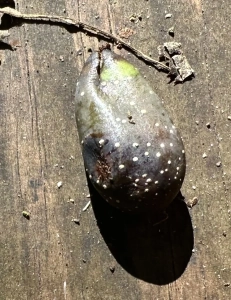


Celebrating Vitamin ‘N’: Little Mountain Annual Learning Showcase at Monte Sano State Park!


A Board Member of the Little Mountain Forest School in Huntsville, Alabama, I attended the school’s Annual Learning Showcase on Sunday afternoon, April 19, 2026, at Monte Sano State Park, where 60 students are enrolled and attend classes in the outdoor forest classroom. Come along with me as I reflect on the forest school concept, its philosophy, and the pioneering thinkers and practitioners who promote it. If you want to learn more about LMFS, visit the website: https://www.littlemountainforestschool.org/

A massive chestnut oak framed the plateau-top pavilion, gathering site for the showcase.


An American giant millipede welcomed my wife and me as we exited our car. Just one of many creature teachers who share their woodland classroom.


The Biker’s Pavilion at Monte Sano is ideal for hosting a Little Mountain Forest School event, launching a hike down the Sinks Trail to the forest haven I dub The CathedralForest, or for resting a few minutes after a vigorous woodland saunter.


LMFS participants connect to the land, its essential richness, and the stories it lives and relates.

“Here is the Earth; here is the sky,

Here are my friends, and here am I.

We explore with our hearts.

Learning together on Cherokee lands.”


I am a lifelong student of weather, climate, atmospheric physics,and the dynamic envelope of atmosphere that surrounds, protects, and sustains us. I’ve been keeping weather records since elementary school. Sunny skies, persisten rain, wild thunderstorms, or wind-driven snow, I loved every dimension, mood, or effect. I embraced the science and artistry of understanding, appreciating, and relishing weather and its interplay with Place, Life, and Nature. As my life and career tracked along a forestry vector, wonderful weather trekked along every step of my incredible journey. If only a single LMFS enrollee catches a mere germ of my deep weather fascination and incurable addiction, my investment serving on the LMFS Board is amply rewarded.


I neglected to photograph the scientific rain gauge that staff recently placed near the outdoor classroom. It’s the real thing. I still recall with memory-giddiness many years ago when Mom gifted young me a rain gauuge. A high quality scientific instrument? Through today’s lens it was cheap plastic, but to very young Steve…priceless! And now, to very old Steve, tears are suddenly blearing the keyboard, as I realize the momentous impact left by thoughtful, caring, and knowing educators, including parents.

I recorded this 52-second video to capture the mood and moment of the Learning Showcase.


Students designed and fashioned the festive classroom entryway.


I sub-titled my third book, Stories of Passion for Place and Everyday Nature. This sign speaks volumes of this Special Place…Thank You for Respecting Our Space!


And, what a very SPECIAL Land Acknowledgement!


John Muir would have appreciated the LMFS classroom.

Everybody needs beauty as well as bread, places to play in and pray in, where Nature may heal and cheer and give strength to body and soul alike.


Such a great place to hide and abide…and not a molecule of plastic or a line of digital code! Richard Louv observed:

Nature is imperfectly perfect, filled with loose parts and possibilities, with mud and dust, nettles and sky, transcendent hands-on moments and skinned knees.


I see limitless beauty, magic, wonder, awe, and inspiration in the mundane and common of everyday Nature.


My former Antioch University New England colleague David Sobel remarked,

You can’t bounce off the walls If there are no walls: outdoor schools make kids happier—and smarter.


Signs proclain Belonging and Grateful (left) and Creative (right).


Mindfulness and Resilience (left) and Kindness, Reciprocity, and Empathy (right).


An artists’ workbench keeps essentials (soil, dirt, water, measuring flasks, buckets…) at the ready. No need to worry about messing up the floor!


This is an all-weather classroom for more than sixty kids. Richard Louv heralded a movement:

Humans are hard-wired to love and need exposure to the natural world. Researchers have found that regardless of culture people gravitate to images of nature, especially the savannah. Our inborn affiliation for nature may explain why we prefer to live in houses with particular views of the natural world.

Just beyond the woods at left, an overlook provides a vista to the E/NE into a valley 800 feet below the Monte Sano plateau summit. A youngster in the frameat right chooses to gain another three feet!


I recorded a 60-second video sweeping through the forest.


I would have loved learning in such an outdoor setting!


Alabama State Parks Foundation

Thoughts and Reflections


I offer these observations:

  • You can’t bounce off the walls If there are no walls: outdoor schools make kids happier—and smarter. (David Sobel)
  • Nature is imperfectly perfect, filled with loose parts and possibilities, with mud and dust, nettles and sky, transcendent hands-on moments and skinned knees. (Richard Louv)
  • Everybody needs beauty as well as bread, places to play in and pray in, where Nature may heal and cheer and give strength to body and soul alike. (John Muir)

Inhale and absorb Nature’s elixir. May Nature Inspire, Inform, and Reward you!


Note: All blog post images created & photographed by Stephen B. Jones unless otherwise noted. Please circulate images with photo credit: “©2026 Steve Jones, Great Blue Heron LLC. All Rights Reserved.”

I am available for Nature-Inspired Speaking, Writing, and Consulting — contact me at steve.jones.0524@gmail.com

Subscribe to my free weekly photo essays (like this one) at: http://eepurl.com/cKLJdL


Reminder of my Personal and Professional Purpose, Passion, and Cause

If only more of us viewed our precious environment through the filters I employ. If only my mission and vision could be multiplied untold orders of magnitude:

Mission: Employ writing and speaking to educate, inspire, and enable readers and listeners to understand, appreciate, and enjoy Nature… and accept and practice Earth Stewardship.

Vision:

  • People of all ages will pay greater attention to and engage more regularly with Nature… and will accept and practice informed and responsible Earth Stewardship.
  • They will see their relationship to our natural world with new eyes… and will understand more clearly their Earth home.

Tagline/Motto: Steve (Great Blue Heron) encourages and seeks a better tomorrow through Nature-Inspired Living!


Steve’s Four Books


I wrote my books Nature Based Leadership (2016), Nature-Inspired Learning and Leading (2017), Weaned Seals and Snowy Summits: Stories of Passion for Place and Everyday Nature (2019; co-authored with Dr. Jennifer Wilhoit), and Dutton Land & Cattle: A Land Legacy Story (2023) to encourage all citizens to recognize and appreciate that every lesson for living, learning, serving, and leading is either written indelibly in or is powerfully inspired by Nature. All four of my books present compilations of personal experiences expressing my deep passion for Nature. All four books offer observations and reflections on my relationship with the natural world… and the broader implications for society. Order any from your local indie bookstore, or find them on IndieBound or other online sources such as Amazon and LifeRich.

I began writing books and Posts for several reasons:

  • I love hiking and exploring Nature
  • I see images I want to (and do) capture with my trusty iPhone camera
  • I enjoy explaining those images — an educator at heart
  • I don’t play golf!
  • I do love writing — it’s the hobby I never needed when my career consumed me
  • Judy suggested my writing is in large measure my legacy to our two kids, our five grandkids, and all the unborn generations beyond
  • And finally, perhaps my books and Blogs could reach beyond family and touch a few other lives… sow some seeds for the future
 

I was just six days past left shoulder replacement revision surgey when Judy drove us to the the LMFS Annual Learning Showcase.


Curiosities and Oddities at Marshall Forest Preserve National Natural Landmark in Rome, Georgia!

NOTE: Some of my GBH photo essays were not routinely distributed from mid-February through mid-June. I will resend those one by one, beginning the first week of July. Here is my Post from March 5 (https://stevejonesgbh.com/2026/03/05/re-visiting-auburn-universitys-louise-kreher-forest-ecology-preserve-and-nature-center/)


Fellow retired forester Chris Stuhlinger, retired videographer Bill Heslip, and I visited Marshall Forest Preserve on April 5, 2026. Established as Georgia’s first National Natural Landmark, near Rome, Georgia, the Preserve is recognized by the Old Growth Forest Network (https://www.oldgrowthforest.net/). The preserve encompasses ~300 acres of undisturbed upland pine and hardwood forest. Our wandering began as persistent overnight rain ended, rewarding us with trunks stem-flow-darkened and bark surfaces beautifully algae-patterned in the relatively limited light under low clouds. The dampened woodland seemed to accent the curiosities and oddities I highlight in this weekly photo essay.

MFP


A twisted, stunted, dwarfed black cherry tree presented a gnome-arch trailside near the trailhead. Were I younger and more nimble, I may have made a ceremonial entrance on hands and knees. However, were I not incessantly young at heart, I may not have viewed the natural scupture as a fairy gateway!

MFP


A forked chestnut oak provided an eye-level sightline into the forest. There is nothing unusual about a forked oak. I include this tree only as a prop for the interesting photo that follows.

MFP


A bark-stripped standing dead loblolly pine had recently yielded to gravity, snapping three feet above the ground, vectoring gently enough that its bole neatly lodged in the forked notch of an adjacent oak, not unlike the lower-forked oak above. What were the chances? Perhaps within five of the 360 degree circumference available to it. The fallen stem leans at a perfect 45-degree angle. I wonder how long the laws of Nature will hold the pine trunk aloft before it slams to the ground, where agents of decomposition will act more earnestly. Ashes to ashes; dust to dust; an inevitable end game for life on Earth.

MFP


I love seeing Vaccinium arboreum, the only tall shrub/tree form of the blueberry genus. I encounter it most often on rocky slopes and cragggy exposed sites. Its orange-striped, twisted stems compel me to take a closer look, engage my imagination, and snap a photograph. Its physical form, distinctive bark color, and common names demand more than a casual glance. How can I resist sparkleberry, farkleberry, and winter huckleberry!

MFP


Resisting being out-contorted by sparkle/farkle/huckleberry, this understory black cherry insists not to comport by the natural laws of geotropism and phototropism. It seems to live indepedent of the laws generally applicable to its main canopy brethren that reach straight and tall in opposition to gravity and drawn by sunlight above.

RomeRome


Only its distinctive cornflake shredded bark and emerging spring leaves belie its identity as Prunus serotina.

Rome


Nature is amazingly resilient, valiantly attempting to survive impact and injury to eventually produce seed and extened its genetic lineage. Some force (a branch from above, a tree, or a heavy snow or ice load) slammed a sapling black cherry to horizontal several decades ago. The fallen stem activated a shoot from a dormant (adventitious) bud 15 feet from the overturned base. The vertical shoot may produce seed, achieving its ultimate purpose.

RomeRome


I marvel at Nature’s endless novelties. However, even as I classify these phenomena as new or unusual (i.e. novel), I admit that I never fail to discover tree form oddities and curiosities wherever I wander forests. Are these features deserving of special recogntion as novel, odd, curious, or unusual? A question worth pondering. I believe the answer is, yes, any circumstance that prompts me to wonder about the cause that led to a visible result is worthy of a special recognition moniker: oddity, curiosity, novel…

Leonardo da Vinci observed 500 years ago that natural phenomena can be explained by the universal laws of nature.

There is no result in nature without a cause; understand the cause and you will have no need of the experiment.
and
Nature never breaks her own laws!

Albert Einstein would have concurred:

I have no special talent. I am only passionately curious.

and

The important thing is not to stop questioning. Curiosity has its own reason for existing.


Dead and Down Woody Debris


Significant biomass in dead and down woody debris is one distinguishing feature of old-growth forests. The resin-saturated pine skeleton below is the interior lightered core of a long dead pine. The outer dead wood that was not decomposer-resistant worked its way into the carbon cycle decades, if not centuries, ago.

Rome


The distinct pine knots will litter the forest floor for many years hence.

Rome


My companions agreed with me that this fallen pine corpse retains a dragon head reaching to the trail edge.


A standing dead pine snag retains a curious cupped depression three above ground. The wound looks mechanical, yet I’ve never seen a chainsaw create such a scoop mark. We noted the novel appearance…and moved along the trail, content that even we could not discern a cause for every result.

MFP


This veteran oak sported a porcine snout 20 feet up its bole. An old branch stub, the snout likely opens to a hollow core.

MFP


This wound on another oak clearly opens to a hollow interior. The misshapen swollen trunk is a sure indication of rot and fungal infection.

RomeRome


Yet another oak shows the signs of decay, suggested by an open branch stub portal, also signalling a hollow decayed core. A large burl also attracts attention. The rarity in this forest my be trees without distinguishing oddities, curiosities, and novelties.

Rome


A total anomaly, this black cherry tree comported with none of the identifying criteria listed in species keys.

RomeRome


The conspicuous lowland gorilla face did not assist our musings.

Rome


We marveled at an agrobacterial oak crown gall. I reminisced on the two years when I was responsible for procuring hardwood sawlogs for a Union Camp (my employer 1973-1985) hardwood lumber mill near the Virginia/North Carolina coastal plain border. Nearly every novelty I’ve mentioned would have been a defect rejecting delivery to the mill yard. Union Camp did not reward my latent talent for pondering tree form curiosities, oddities, and novelties!

Rome


I find beautiful patterns, especially on rain-wetted bark, this loblolly pine as an example. Bark crevices, with their associated microclimates, support fissure-colonies of algae, highlighting the plate margins with pale green.

Rome


I saw only a single tree example of this loblolly pine with a unique shredded, shed-bark trunk collar phenomenon, which shouted out for my attention. I suppose that the shredded bark skin at its base is resistant to decay (dry-layered above the moist mineral soil), even if very flammable. This segment of th MFP has not burned, at least for decades. Sometimes seeing a curiosity accomplishes little more than spark my interest in being on the lookout for seeing it again. Repetition may open my eyes to seeing it often enough to foster understanding and explanation.

Rome

Rome


We’ve all heard the admonition about not seeing the forest for the trees. Across many chapters of my life and career, I saw the forest and the trees. Only later in this retirement life-chapter did I begin focusing on curiosities, novelties, oddities, and mysteries. Like Albert Einstein, I have evolved into a creature of passionate curiosity.

Thoughts and Reflections


I offer these observations:

  • There is no result in nature without a cause; understand the cause and you will have no need of the experiment. (Leonardo da Vinci)

  • Death is a powerful and ubiquitous part of forest life. Ashes to ashes; dust to dust; an inevitable end game for life on Earth. (Steve Jones)
  • Look deep into nature, and then you will understand everything better. (Albert Einstein)

Inhale and absorb Nature’s elixir. May Nature Inspire, Inform, and Reward you!

Note: Unless otherwise noted, all blog post images are created & photographed by Stephen B. Jones.

Please circulate images with photo credit: “©2026 Steve Jones, Great Blue Heron. All Rights Reserved.”


I am available for Nature-Inspired Speaking, Writing, and Consulting — contact me at steve.jones.0524@gmail.com


Subscribe to my free weekly photo essays (like this one) at: http://eepurl.com/cKLJdL


A reminder of my Personal and Professional Purpose, Passion, and Cause

If only more of us viewed our precious environment through the filters I employ. If only my mission and vision could be multiplied by untold orders of magnitude:

Mission: Employ writing and speaking to educate, inspire, and enable readers and listeners to understand, appreciate, and enjoy Nature… and accept and practice Earth Stewardship.

Vision:

  • People of all ages will pay greater attention to and engage more regularly with Nature… and will accept and practice informed and responsible Earth Stewardship.
  • They will see their relationship to our natural world with new eyes… and understand their Earth home more clearly.

Tagline/Motto: Steve (Great Blue Heron) encourages and seeks a better tomorrow through Nature-Inspired Living!


Steve’s Four Books


I wrote my books Nature Based Leadership (2016), Nature-Inspired Learning and Leading (2017), Weaned Seals and Snowy Summits: Stories of Passion for Place and Everyday Nature (2019; co-authored with Dr. Jennifer Wilhoit), and Dutton Land & Cattle: A Land Legacy Story (2025) to encourage all citizens to recognize and appreciate that every lesson for living, learning, serving, and leading is either written indelibly in or is powerfully inspired by Nature. All four of my books present compilations of personal experiences expressing my deep passion for Nature. All four books offer observations and reflections on my relationship with the natural world… and the broader implications for society. Order any from your local indie bookstore, or find them on IndieBound or other online sources such as Amazon and LifeRich.

I began writing books and Posts for several reasons:

  • I love hiking and exploring Nature
  • I see images I want to (and do) capture with my trusty iPhone camera
  • I enjoy explaining those images — an educator at heart
  • I don’t play golf!
  • I do love writing — it’s the hobby I never needed when my career consumed me
  • Judy suggested my writing is in large measure my legacy to our two kids, our five grandkids, and all the unborn generations beyond
  • And finally, perhaps my books and Blogs could reach beyond family and touch a few other lives… sow some seeds for the future


The Nature of the Wings Over North Georgia Airshow!

NOTE: Some of my GBH photo essays were not routinely distributed from mid-February through mid-June. I will resend those one by one, beginning the first week of July. Here is my Post from February 25 (https://stevejonesgbh.com/2026/02/25/early-december-nature-explorations-along-the-natchez-trace-parkway/)


On April 4, 2026, two retired friends and I attended The Wings Over North Georgia Airshow near Rome. Normally, I focus these weekly photo essays on wildland forays, principally woodland ventures. I did not anticipate finding a Great Blue Heron Post topic during a day at the regional airport. However, my Dad, a WWII Pacific theatre Army Air Corps veteran, instilled in me a love of flight and weather (as well as Nature). The variable weather on April 4 prompted me to see the Nature of Wings Over North Georgia as a GBH Post topic.

The local forecast called for frontal rain to arrive near sunset. However, the first convective pop-up shower arrived soon after we set up our viewing lawn chairs without rain gear, a quarter-mile from the car! We toughed it out, thinking this was a rogue shower. The sky to the west, upstream in the firmament, looked bright and mostly clear. Fear not!


The show began, umbrellas transitioned from rain-shields to sun-brellas. Brilliant sunshine encouraged a few darkening cumulus to develop.


The crowd enjoyed a spectacular performance by an F-15 squadron of the Louisiana Air National Guard.


I recorded this 14-second video as one of the jets screamed down the flight line. My friends did not notice that behind my sunglasses I watched with tears in my eyes, my long-deceased Dad standing with me.


An innocent looking cumulus entered from the west, dropped a brand new rain curtain as we watched, and soaked us for no more than five minutes. The shower deepened and the sky darkened as it moved east-northeast into the north Georgia Appalachian foothills, providing a perfect backdrop for the looping smokeplane!


I recorded this 56-second smoke stunt plane video.


Climate and weather are the fundamental essence…the prevailing substrate…for every facet of Nature that drew me into foresrty and that powers me through retirement. There are those who wonder why anyone would waste time talking aimlessly about the weather. I can’t think of anything I’d rather discuss!

The weather held through more stunt and novelty performances. We all awaited the main act, the US Air Force Thunderbirds.

I recorded this 59-second video of the Thunderbirds taxiing out. I nervously watched cumulus building upstream to the west.


Rain drops peppered us as the six Thunderbirds reached the far end of the runway.


Never one to miss a good downpour, I recorded this 16-second video of the drenching shower.


It was far too late to return to the car for raingear. I took solace that my skin has never leaked; I’ve been wet many times before!


Mild temperatures and the promise of returning sunshine eased the discomfort for those who’d prefer to watch rain through a window.


I recorded this 31-second video as the rain ended.


Finally, the birds flew! I recorded this 37-second video (three segments spliced).


Still dripping from my rain-soaked hat and hair, I masked the emotion-triggered tears as these incredible flying machines powered over Rome, Georgia.


Deep memories, sweet nostalgia, the power and beauty of flight, and the magic and science of our dynamic weather lifted me high into the spring sky.

Dad died 30 years ago. I delivered his eulogy, including John Gillespie MaGee, Jr’s High Flight, Dad carried a copy in his wallet.

High Flight

“Oh! I have slipped the surly bonds of Earth
And danced the skies on laughter-silvered wings;
Sunward I’ve climbed, and joined the tumbling mirth
of sun-split clouds, — and done a hundred things
You have not dreamed of – wheeled and soared and swung
High in the sunlit silence. Hov’ring there,
I’ve chased the shouting wind along, and flung
My eager craft through footless halls of air….

Up, up the long, delirious, burning blue
I’ve topped the wind-swept heights with easy grace.
Where never lark, or even eagle flew —
And, while with silent, lifting mind I’ve trod
The high untrespassed sanctity of space,
– Put out my hand, and touched the face of God.”

High Flight is a 1941 sonet written by war poet Magee, inspired by his experiences as a fighter pilot of the Royal Canadian Air Force in World War II. Magee began writing the poem on 18 August, while stationed outside London He mailed a completed manuscript to his family on 3 September, three months before he died in a training accident.

You may recall President Reagan referencing High Flight in memorializing the Challenger crew.

Nature comprises the firmament, the soil, the terrain, and all life that abounds…and all that has come before, that is, and that will be. I relished a few hours experiencing high flight, variable spring weather, good friends, and sharing time with the man who shaped my Nature-psyche and lives within me yet…until I have slipped the surly bonds of Earth!


Thoughts and Reflections


I offer these observations:

  • I’ve topped the wind-swept heights with easy grace.
    Where never lark, or even eagle flew. (John Gillespie Magee)

  • Deep memories, sweet nostalgia, the power and beauty of flight, and the magic and science of our dynamic weather lifted me high into the spring sky. (Steve Jones)


Inhale and absorb Nature’s elixir. May Nature Inspire, Inform, and Reward you!

Note: Unless otherwise noted, all blog post images are created & photographed by Stephen B. Jones.

Please circulate images with photo credit: “©2026 Steve Jones, Great Blue Heron. All Rights Reserved.”


I am available for Nature-Inspired Speaking, Writing, and Consulting — contact me at steve.jones.0524@gmail.com


Subscribe to my free weekly photo essays (like this one) at: http://eepurl.com/cKLJdL


A reminder of my Personal and Professional Purpose, Passion, and Cause

If only more of us viewed our precious environment through the filters I employ. If only my mission and vision could be multiplied by untold orders of magnitude:

Mission: Employ writing and speaking to educate, inspire, and enable readers and listeners to understand, appreciate, and enjoy Nature… and accept and practice Earth Stewardship.

Vision:

  • People of all ages will pay greater attention to and engage more regularly with Nature… and will accept and practice informed and responsible Earth Stewardship.
  • They will see their relationship to our natural world with new eyes… and understand their Earth home more clearly.

Tagline/Motto: Steve (Great Blue Heron) encourages and seeks a better tomorrow through Nature-Inspired Living!


Steve’s Four Books


I wrote my books Nature Based Leadership (2016), Nature-Inspired Learning and Leading (2017), Weaned Seals and Snowy Summits: Stories of Passion for Place and Everyday Nature (2019; co-authored with Dr. Jennifer Wilhoit), and Dutton Land & Cattle: A Land Legacy Story (2025) to encourage all citizens to recognize and appreciate that every lesson for living, learning, serving, and leading is either written indelibly in or is powerfully inspired by Nature. All four of my books present compilations of personal experiences expressing my deep passion for Nature. All four books offer observations and reflections on my relationship with the natural world… and the broader implications for society. Order any from your local indie bookstore, or find them on IndieBound or other online sources such as Amazon and LifeRich.

I began writing books and Posts for several reasons:

  • I love hiking and exploring Nature
  • I see images I want to (and do) capture with my trusty iPhone camera
  • I enjoy explaining those images — an educator at heart
  • I don’t play golf!
  • I do love writing — it’s the hobby I never needed when my career consumed me
  • Judy suggested my writing is in large measure my legacy to our two kids, our five grandkids, and all the unborn generations beyond
  • And finally, perhaps my books and Blogs could reach beyond family and touch a few other lives… sow some seeds for the future
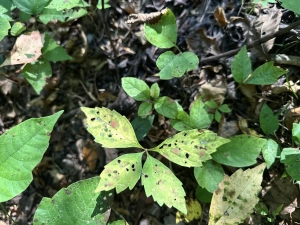


Marshall Forest Preserve National Natural Landmark in Rome, Georgia!

NOTE: Some of my GBH photo essays were not routinely distributed from mid-February through mid-June. I will resend those one by one, beginning the first week of July. Here is my Post from February 18 (https://stevejonesgbh.com/2026/02/18/mid-november-25-year-return-to-alabamas-chewacla-state-park/)

Fellow retired forester Chris Stuhlinger, retired videographer Bill Heslip, and I visited Marshall Forest Preserve, established as Georgia’s first National Natural Landmark near Rome, Georgia, on April 5, 2026. Recognized by the Old Growth Forest Network (https://www.oldgrowthforest.net/), the preserve encompasses ~300 acres of undisturbed upland pine and hardwood forest. Our wandering began as persistent overnight rain ended, rewarding us with trunks stem-flow-darkened and bark surfaces beautifully algae-patterned in the relatively limited light under low clouds. I’m a big fan of National Natural Landmarks!

Bill and Chris stood at the traihead monument, a provocative stone symbol, rich with imagined meaning.

MFP


The stone graphic and concentric metal totem below hinted that the forest itself may pose mysteries and puzzles for us to ponder.

MFP


I recorded a 60-second rain-dampened video of our entry to MFP.


Although the preserve forest falls short of the scale and sanctity of old-growth redwood and coastal Douglas fir stands, an eastern US perspective allowed me to appreciate this untouched upland ecosystem. A large loblolly pine reached well over one hundred feet above, spreading wide.

Rome


Nearby, a regal red oak stood fat and tall. Had a logging crew been given a chance (logger’s choice), this specimen would have been the first to grace a log truck mill-bound. We foresters commonly sleuth stand history by the quality of tress left, even long after severed stumps have decayed. I saw no evidence at MFP of prior high-grading, the practice of removing high quality standing timber and leaving less commercially valuable stems: smaller, degraded, lower desirability species, hollowed, and decayed.

MFP


Like the loblolly, the oak occupies a dominant canopy position.

Rome


Old-Growth vs. Undisturbed Forest


I’ve been guilty a few times by my own persistent stereotype that the term old-growth implies an ancient forest of magnificent large trees, heavily-shaded understory, mossy ground cover, and fairy tale images fleeting among wisps of fog and vapors. I’ve seen such forests in west coastal rain forests, from northern California redwoods to Oregon’s Douglas fir to the western hemlock and Sitka spruce of southeastern Alaska. I’ve wandered into an occasional dreamscape, magical stand here in the eastern US under the right conditions of landscape, weather, light, and mood (my mood!). I relax my criteria for the reality of our eastern forests.

I also distinguish old-growth from undisturbed forest. Marshall Forest Preserve is undisturbed according to the historical narrative that supported its classification as a National Natural Landmark. Likewise, I cannot contest that it is old-growth. I make the distinction because I routinely visit two local north Alabama disturbed forests that are crossing the threshold (and may have already entered) from late mature to old-growth. One is an 80-90-year-old bottomland forest on the Wheeler National Wildlife Refuge. A second is what I call the Cathedral Forest on Monte Sano State Park. The WNWR stand regenerated naturally from abandoned farmland. I believe the Cathedral Forest regenerated naturally following a combination of natural disturbance and timber harvesting.


Additional Old-Growth Evidence


Allow me to attempt conveying additional evidence of the old-growth character of MFP. I’ll borrow photos from two places on prior occasions to make my point. The 22-inch diameter loblolly pine below stands in a  rich riparian abandoned agricultural field on the Wheeler National Wildlife Refuge near Huntsville, Alabama. The tree is ~80 years old. I am sure that the annual growth rings are wide, evidencing rapid diameter growth. The bark furrows are deep, also suggesting vigorous radial expansion.


This loblolly, planted less than 30 years ago on an old field converted to a disc golf course on the North Alabama Land Trust’s Chapman Mountain Nature Preserve has grown rapidly across its short life. Thinned at least once, the forest is growing audibly (okay, I’m exagerating a bit). Prescribed fire is holding vegetative competition at bay. Nothing could be further from exhibiting old-growth character than this intensively managed forest.


Perhaps 30 inches in diameter, this MFP loblolly tells a different tale. It’s shallowly furrowed broad platy bark suggests an extended period (many decades) of mature radial expansion. This old sentinel is content for now. There is no need to secure additional moisture, nutrients, and space. Its shredded, shed bark trunk collar is a phenomenon I have seldom seen, yet it shouted out for my attention. I suppose that the shredded bark skin at its base is resistant to decay (dry-layered above the moist mineral soil), even if very flammable. This segment of th MFP has not burned, at least for decades.

Its spreading flat-top canopy stands beside a massive dominant oak.

Rome


Another dominant loblolly pine stands tall, with crown space separating it from adjacent hardwoods, another indication perhaps that the old, mature stand has achieved a level of equilibrium. No longer does fierce competition among trees rule the day.

Rome


I recorded this 60-second video of a large white oak and adjacent loblolly tree near the trailhead, expressing the same characteristics of main canopy stability.


Another reverent white oak monarch stands watch on a preserve hillside.

MFP


Large ancient trees are absent across much of the preserve. Every acre does not portray the old-growth label. In fact, I wonder whether without having read the MFP history and its desgination as a National Natural Landmark, I would have immediately declared, “This forest is unquestionably old-growth.”

MFP


Old-growth or not, spring was erupting on the preserve.


I shall never tire of seeing mountain azalea proclaiming the vernal season in our southern forests!

RomeRome


I recorded this 59-second, a celebratory homage, as the sun broke through the persistant stratus.


Succulent oak gall wasp ovipositors have riddled these fresh oak leaves with visible postules.

Rome


Life in the forest ecosystem is complex, layered among its richly diverse floral, fauna, food chains, consumers, decomposers, competitors, symbionts, and life forms, and agents of death and renewal.

An Enigma


I’ll end with a full portfolio of old forester embarrassment. I spotted a strange growth (fungal; bacterial; alien life form; extraterrestrial???) on the side of an old sweetgum. Odd grey matter with a green wig-like shroud, and some lateral orange highlights.

Rome


I snapped a few photos, including close-ups. My colleagues were forging ahead. I didn’t take time to feel, probe, or handle. I thought I could identify later with iNaturalist and reference books, or perhaps a query with relevant FaceBook groups.

Rome


If nothing else, I felt that I may have discovered a new or rare life form. My reference books, internet search, and iNaturalist efforts yielded nothing. So I shifted to Facebook groups. Several folks pointed to nothing more exciting than some former woods traveler had bound the younger sweetgum with a colorful nylon or polypropylene rope; the tree grew around it; and only the cut ends protrude from the tree. Perhaps my camera managed to capture fairy tale images fleeting among wisps of fog and vapors. 

Albert Einstein would have chastized this old forester:

Look deep into nature, and then you will understand everything better.

I failed to look deeply into these strange organisms. I’m embarrassed, yet not fully convinced that an old-growth forest sweetgum could scam me with a modern rope protruding from its ancient core. Fool me once, shame on you; fool me twice, shame on me. I want to go back for a second, deeper look!


Thoughts and Reflections


I offer these observations:

  • I shall never tire of seeing mountain azalea proclaiming the vernal season in our southern forests! (Steve Jones)

  • I’m a big fan of National Natural Landmarks! (Steve Jones)
  • Look deep into nature, and then you will understand everything better. (Einstein)

  • Don’t be fooled by fairy tale images fleeting among wisps of fog and vapor. (Steve Jones)


Inhale and absorb Nature’s elixir. May Nature Inspire, Inform, and Reward you!

Note: Unless otherwise noted, all blog post images are created & photographed by Stephen B. Jones.

Please circulate images with photo credit: “©2026 Steve Jones, Great Blue Heron. All Rights Reserved.”


I am available for Nature-Inspired Speaking, Writing, and Consulting — contact me at steve.jones.0524@gmail.com


Subscribe to my free weekly photo essays (like this one) at: http://eepurl.com/cKLJdL


A reminder of my Personal and Professional Purpose, Passion, and Cause

If only more of us viewed our precious environment through the filters I employ. If only my mission and vision could be multiplied by untold orders of magnitude:

Mission: Employ writing and speaking to educate, inspire, and enable readers and listeners to understand, appreciate, and enjoy Nature… and accept and practice Earth Stewardship.

Vision:

  • People of all ages will pay greater attention to and engage more regularly with Nature… and will accept and practice informed and responsible Earth Stewardship.
  • They will see their relationship to our natural world with new eyes… and understand their Earth home more clearly.

Tagline/Motto: Steve (Great Blue Heron) encourages and seeks a better tomorrow through Nature-Inspired Living!


Steve’s Four Books


I wrote my books Nature Based Leadership (2016), Nature-Inspired Learning and Leading (2017), Weaned Seals and Snowy Summits: Stories of Passion for Place and Everyday Nature (2019; co-authored with Dr. Jennifer Wilhoit), and Dutton Land & Cattle: A Land Legacy Story (2025) to encourage all citizens to recognize and appreciate that every lesson for living, learning, serving, and leading is either written indelibly in or is powerfully inspired by Nature. All four of my books present compilations of personal experiences expressing my deep passion for Nature. All four books offer observations and reflections on my relationship with the natural world… and the broader implications for society. Order any from your local indie bookstore, or find them on IndieBound or other online sources such as Amazon and LifeRich.

I began writing books and Posts for several reasons:

  • I love hiking and exploring Nature
  • I see images I want to (and do) capture with my trusty iPhone camera
  • I enjoy explaining those images — an educator at heart
  • I don’t play golf!
  • I do love writing — it’s the hobby I never needed when my career consumed me
  • Judy suggested my writing is in large measure my legacy to our two kids, our five grandkids, and all the unborn generations beyond
  • And finally, perhaps my books and Blogs could reach beyond family and touch a few other lives… sow some seeds for the future
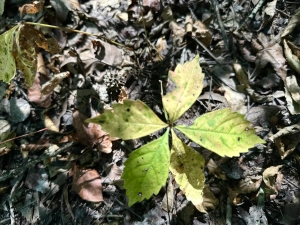
 

Rome