Brief-Form Post #60: Oddities, Curiosities, and Mysteries in a Wheeler National Wildlife Refuge Bottomland Hardwood Forest
I am pleased to add the 60th of my GBH Brief-Form Posts (Less than five minutes to read!) to my website. I get wordy with my routine Posts. I don’t want my enthusiasm for thoroughness and detail to discourage readers. So, I will occasionally publish these brief Posts.
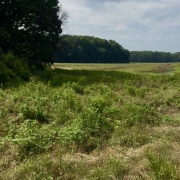
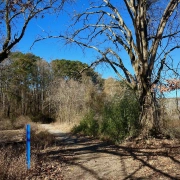
I once again entered the Wheeler National Wildlife Refuge bottomland hardwood forest south of HGH Road on January 15, 2026. I sought a break from writing, reading, and preparing for the two courses I’ll be teaching in the winter term at the Osher Lifelong Learning Institute at the University of Alabama in Huntsville and at LearningQuest, a similar program offered through the Madison County Huntsville Library. Each time I explore this extraordinarily fertile and rich WNWR forest, I seek the beauty, magic, wonder, and awe that I always find hidden in plain sight.
Temperature still in the upper twenties; these oyster mushrooms are frozen solid, adorning a downed hickory trunk, their mycelia decomposing the cellulose within. I’ve found that oysters are early saprophytes, flourishing within three years of tree mortality. I know nothing about cultivating oysters with home kits, much less commercial production. I harvested a few of these for omeletts, the first time I gathered frozen specimens.
Nearby I recorded this 59-second video within the forest, including a big oak.
The oak’s diameter breast height (4.5-feet above ground; DBH) exceeded three feet.
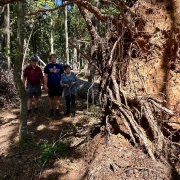
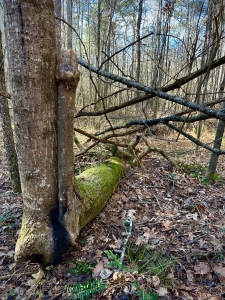
When still a supple sapling, this sweetgum suffered an impact from above, slamming it to the ground, yet maintaining its roots’ connectivity to the soil. The concussive force broke the now horizontal stem, where the gaping mouth remains today. A doramt bud erupted, sending a new stem/trunk vertically (left). The entire horizontal portion is hollowed by decay. The larger opening (right) is where the sapling roots still reach downward. The blowhole 18 inches from the severed topside root basal opening adds character and mystery to this woodland ogre.
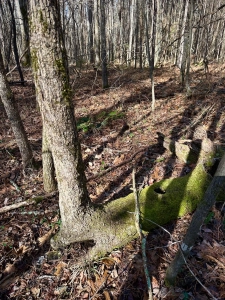
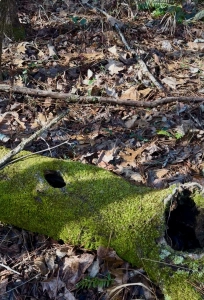
I recorded this 59-second video of the fallen and somewhat recovered sweetgum and the similary tortured yellow poplar just 30 feet beyond.
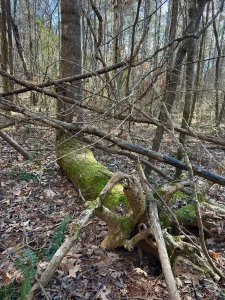
The same toppled signature and fate. Both trees survive through natural resilience. Forest objects have been crashing onto hardwood saplings for thousands of generations of sweetgum and yellow poplar. Evolution has prepared both species (and many others) for striving beyond catastrophe to ensure seed production to extend the individual’s gene pool. The poplar at left fell toward the photo point. The other view is from the root end.
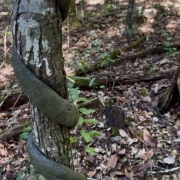
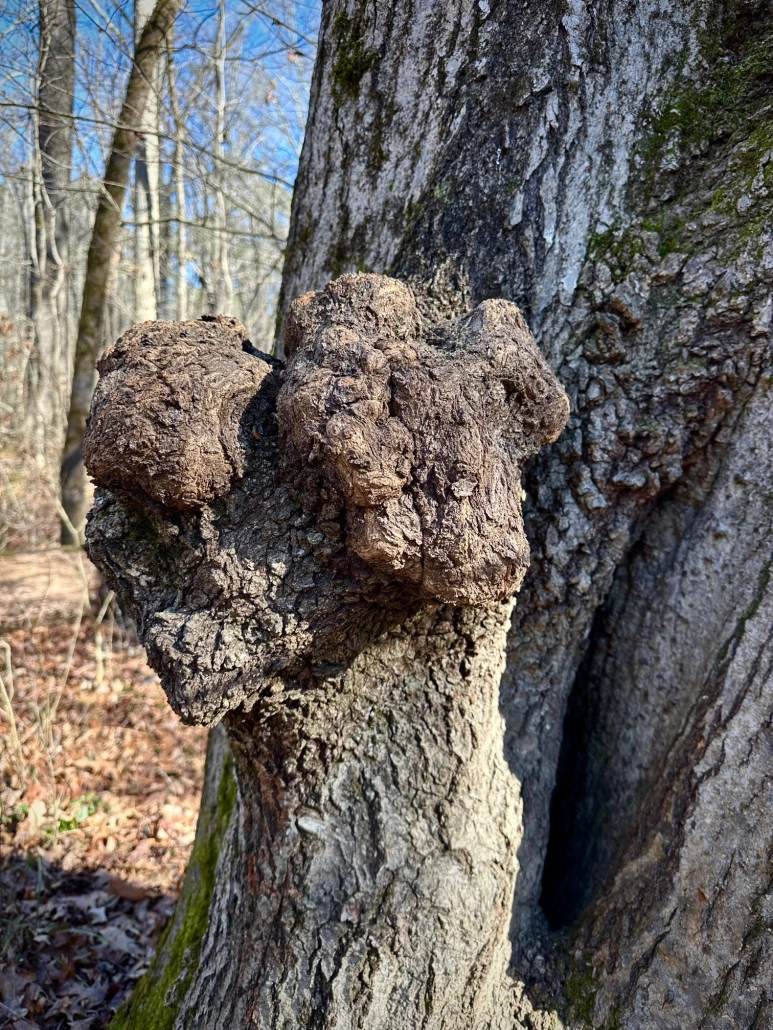
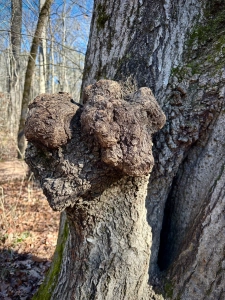
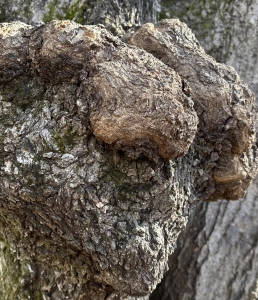
A peculiar red oak burl watched me approach. All of us, I posit, have playfully identified cloud shapes on spring and summer afternoons. I admit to engaging in the same pursuit with tree oddities. Can you do better than a praying mantis head with this one?
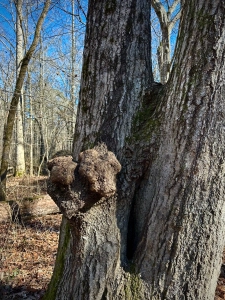

I may some day venture forth to capture images of these obscure, startling, and potentially evil growths in the dark of night…if I can get the nerve!
Washington Irving mused about the menace of darkness in The Legend of Sleepy Hollow:
There is nothing like the silence and loneliness of night to bring dark shadows over the brightest mind.
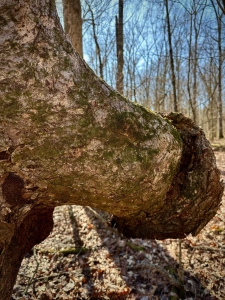
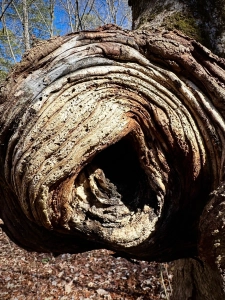
This sweetgum appendage matches the oak burl’s menacing scale! Shift the view angle by 90 degrees and get a completely different creature.
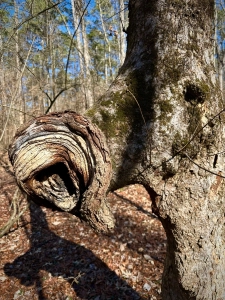
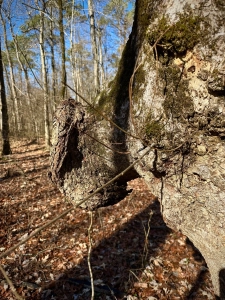
Subtle perspective shifts yield seeming endless varieties, especially when viewed through lenses of imagination. Again, try it in the dark!
Once again, Washington Irving (The Legend of Sleepy Hollow) saw the macabre and horror in such tree embodiments:
In the dark shadow of the grove, on the margin of the brook, he beheld something huge, misshapen, black, and towering. It stirred not, but seemed gathered up in the gloom, like some gigantic monster ready to spring upon the traveller.
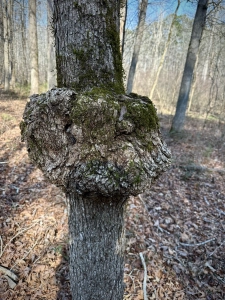
This eight-inch DBH eastern hophornbeam (Ostrya virginiana) sports an impressive waist-high burl, a spherical benign tumorous growth triggered by viral, bacterial, or fungal (or a combination) infectuous agents. If I stretch my imagination, I see a full frontal countenance with two eyes, pug nose, puffy cheeks, and a closed, slightly frowing mouth.
Albert Einstein was a tireless proponent of both imagination and good humor!
Imagination is more important than knowledge. Knowledge is limited. Imagination encircles the world.
The only thing that interferes with my learning is my education.
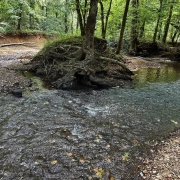
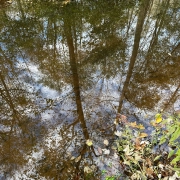
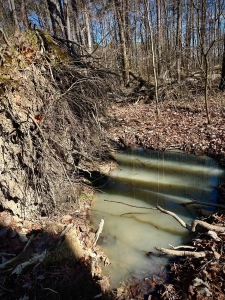
The bottomlands have shallow winter water tables. Windthrow is common, creating hummocks and hollows, mounds and pits, and pillows and cradles, colloquial expressions for the resultant microtopography. The hollows hold water until spring when evaporation and transporation increase to lower the water table. Many hold clear water. Critters are keeping this one muddy. Frogs?
Closing Observations
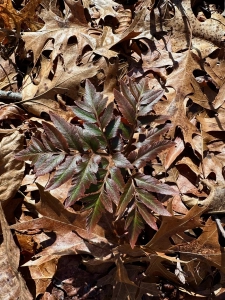
I spotted just a single cutleaf grapefern plant, fresh and colorful amid the stark brown leaves.
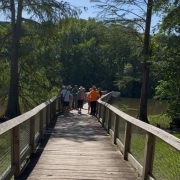
Before departing the refuge, I stopped by Blackwell Swamp along Jolly B Road. I leave you to enjoy the beauty of a sunny WNWR winter morning.
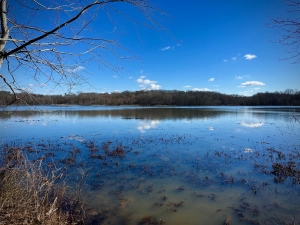
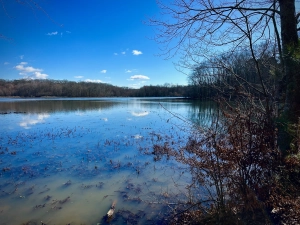
There is nothing dark, menacing, or gloomy about my morning Wheeler National Wildlife Refuge saunter.
Closing
I accept the challenge of distilling these Brief-Form Posts into a single distinct reflection, a task far more elusive than assembling a dozen pithy statements.
I cannot offer a quote more apropos than Washington Irving’s observation from The Legend of Sleepy Hollow:
In the dark shadow of the grove, on the margin of the brook, he beheld something huge, misshapen, black, and towering. It stirred not, but seemed gathered up in the gloom, like some gigantic monster ready to spring upon the traveler.
Nature’s special treats await our discovery, our understanding, and our interpretation!
Subscribe to my free weekly photo essays (like this one) at: http://eepurl.com/cKLJdL