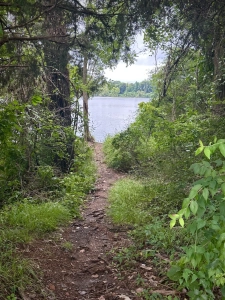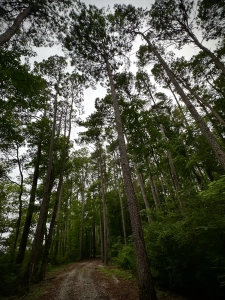
“Sharing My Story” with CoHort-II of RaMP-Woods to Water (W2W) at ACES Graham Center!
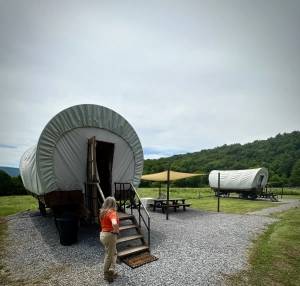
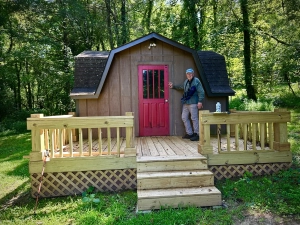
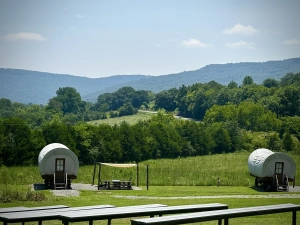
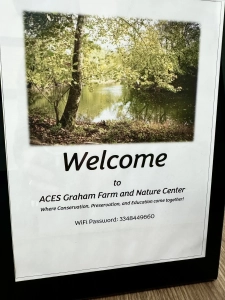
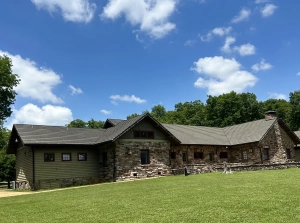
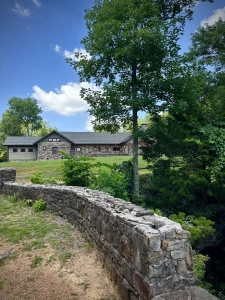
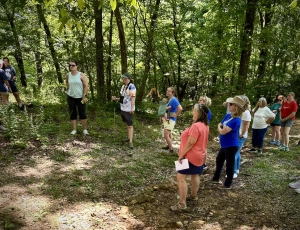
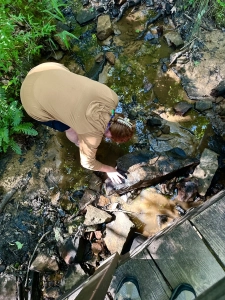
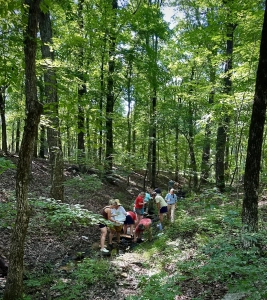
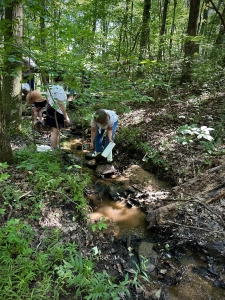
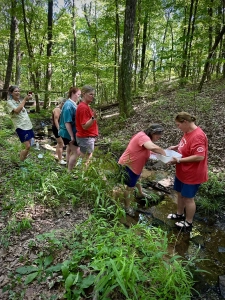
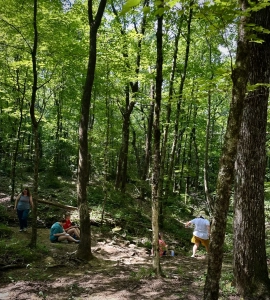
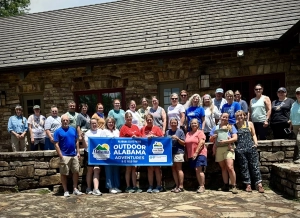
I returned to Graham Farm and Nature Center at 7:30 AM on August 22, 2026. The ten Research and Mentoring for Postbaccalaureate, Woods to Water (RaMP-W2W) participants and three program staff arrived mid-afternoon the previous day. Staff stayed overnight in the GFNC Conestoga wagon accommodations; students overnighted in tents adjacent to the pavilion. I was here by invitation to observe, interact with the enrollees, and offer formal comments in the classroom. Administrative Support Specialist II Donna Sands asked me to “Tell them your story.”
Having first visited GFNC on July 4, 2026, I am already a champion for the place, its mission, and its special spirit. I welcomed the chance to spend a day with the RaMP-W2W program at this great learning and exploration facility in the heart of northeastern Alabama’s Paint Rock River Valley.
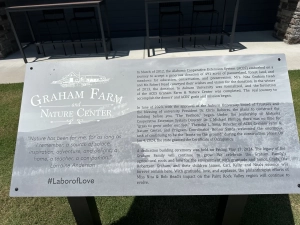
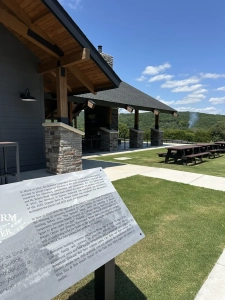
The University of Alabama-associated RaMP-W2W website narrative succinctly describes this 12-month dreamscape learning experience that bridges a bachelor’s degree to graduate school or a professional career.
Woods to Water (W2W)
Training the Next Generation of Ecologists and Natural Resource Managers
Post-Baccalaureate Program
The Woods to Water (W2W) project is an experience-based post-baccalaureate learning program aimed at helping early career scientists understand critical linkages between terrestrial and aquatic ecosystems. The program will provide a year-long, immersive, cohort- and field-based program in standardized methods and data science.
The Woods and Water Program provides:
- Stipend support and free housing.
- Collaborative interactions with leading scientists, technicians, and researchers at The University of Alabama, the National Ecological Observatory Network (NEON), and the Jones Center at Ichauway (JCI)
- Training in key field techniques that link water, carbon, and nutrient fluxes among ecosystems
- Comprehensive classroom, field experiences, laboratory, and independent research approaches to building skills and self-confidence in field research
- Opportunities to present and publish research and facilitate transition into the ecological workforce.
- Development of skills required to succeed and stand out in today’s STEM job market
The Research and Mentoring for Postbaccalaureates (RaMP) in Biological Sciences program is a National Science Foundation (NSF) program to establish networks to support full-time research, mentoring, and training for recent college graduates who have had few or no research or training opportunities during college. Broadly, its goal is to create a competitive and highly representative science, technology, engineering, and mathematics (STEM) workforce in the U.S. with a focus on the biological sciences. Projects are expected to train individuals for a range of potential career pathways in the biological sciences, including: research-focused M.S. or Ph.D. graduate programs; entry-level positions in industry, federal, tribal, or state agencies, education and research centers, or not-for-profit science-based organizations; or other STEM careers.
I recorded this 60-second video of the RaMP participants gathering before breakfast
RaMP-W2W is a competitive program; these are exceptional young men and women embarking on an exciting journey. The visit to GFNC officially launched the 2026-27 RaMP-W2W year.
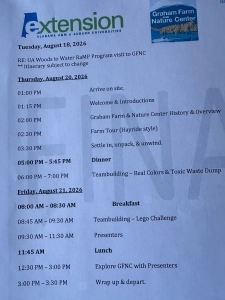
The ten participants list their home addresses as follows:
Lehi, UT; Oakland, CA; Auburn, AL; Santa Cruz, CA; Chattanooga, TN; Clarksville, OH; New Orleans, LA; Tuscaloosa, AL; Lexington, KY; Fairhope, AL
Widely dispersed geography, diverse topical interests, and varying career aspirations define the group. Their futures will lead in many directions. Their stories will share this common year-long bond and will diverge in whatever route they choose. Some know their intended path. Others are not so certain.
Center Director Mike Sims led the orientation session after breakfast.
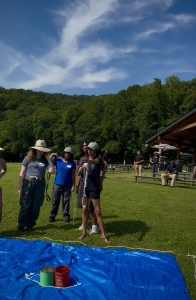
What better way to begin the RaMP kickoff than a series of team-building challenges? Mike directed them through a series of challenges.
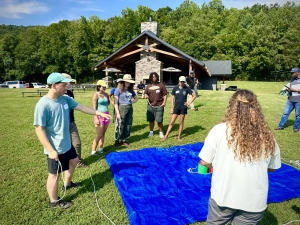
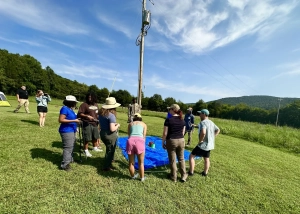
I recorded a sixty-second video of a team-building challenge.
Mike demanded that participants follow strict rules and guidelines, practice selfless teamwork, and share purpose and spirit. I enjoyed watching the process unfold from the comfortable shade under the pavilion canopy.
A late-summer cirrus sky over the Center backdropped the challenge.
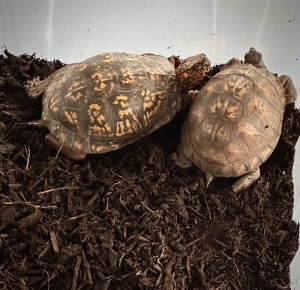
Jonathan Nemati, Wildlife Programming, introduced the group to Center reptiles.
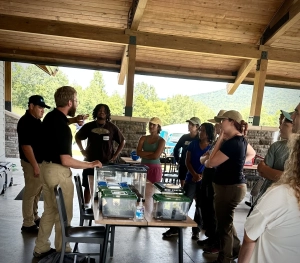
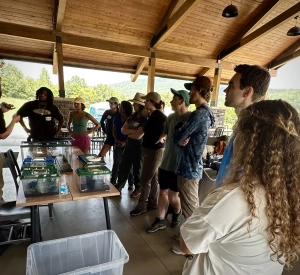
I recorded this 58-second video of the group interacting with Jonathan’s reptile discussion.
Snakes and box turtles highlighted the reptilian cast.
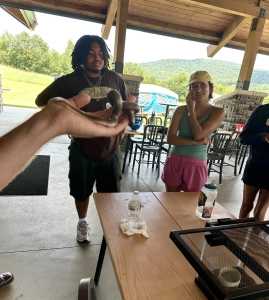
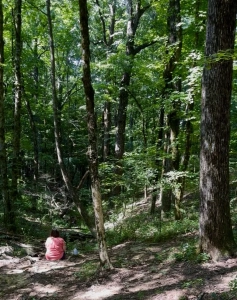
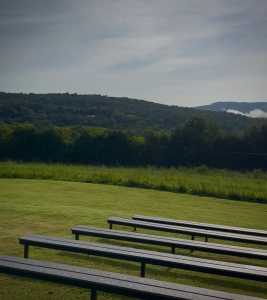
As summer’s heat fades to cooler temperatures, the outdoor classroom will have greater appeal.
Telling Them My Story
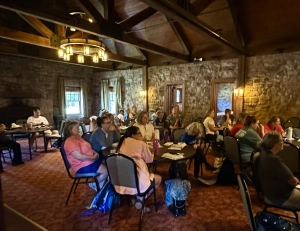
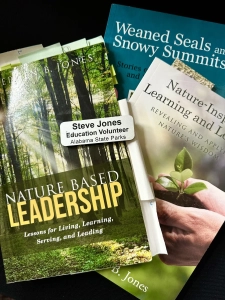
The August 22 weather was more conducive to offering my remarks in the Center classroom. That was the easy decision. More difficult: choosing which elements of “My Story” to share with these incredibly bright, enthusiastic, and ambitious learners. I came with a satchel of books, each flagged with Post-its marking relevant quotations. After spending the morning with the group, I had a good idea of where to start, and then let our one-hour interaction unfold through their reactions, questions, and interests.
I had recently read Ben & Me (Eric Weiner, 2024), a book commemorating our country’s 250th anniversary celebration and recognizing (and appreciating) Ben Franklin’s pivotal role. My copy of the book sprouts multi-colored Post-its marking kernels of wisdom and reflection worthy of revisiting. One stands out, and that is where I began my remarks;
Distrust not providence!
Written in Yoda-esque fashion, Ben opined in three words that the hand of providence guides, directs, counsels, and influences our journey… if we allow. In effect, Ben implored, Trust Providence! I have, and it has made all the difference. Some examples:
- The spring I graduated high school, the local community college announced it would open a pre-forestry program in September.
- The program Director and I stayed close for half a century. He opened the door to a Maryland Forest Service summer internship through my undergraduate degree.
- The Director arranged a junior year transfer with full credit to the State University of New York College of Environmental Science and Forestry (SUNY ESF at Syracuse University).
- A faculty mentor there steered me to a paper and allied products manufacturing company in the southeastern US.
- My industrial forestry career advanced rapidly with assignments of increasing responsibility across 12 years in Virginia, Georgia, and Alabama.
- A second SUNY ESF mentor encouraged me to eventually enter a Ph.D. program with him after gaining forest industry work and life experience. He pledged to hold up his end of the agreement if I committed to bring what he saw in me back to ESF. We completed the challenging, life-altering Ph.D. (Applied Ecology) pursuit in 36 months. My wife of now 54 years shared the journey with me, offering support, love, and adventure.
- We chose from five diverse positions after the doctoral degree; one of them was a faculty position in the School of Forest Resources at Penn State University. The other four were outside of higher education. In essence, “Five roads diverged in a yellow wood.” (Robert Frost)
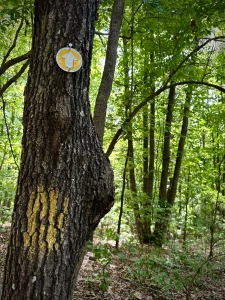
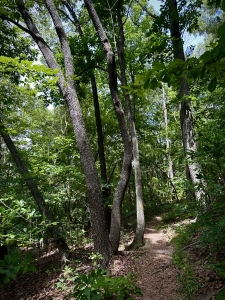
Two roads diverged in a yellow wood,And sorry I could not travel bothAnd be one traveler, long I stoodAnd looked down one as far as I couldTo where it bent in the undergrowth;
-
…..I shall be telling this with a sighSomewhere ages and ages hence:Two roads diverged in a wood, and I—I took the one less traveled by,And that has made all the difference.
- We trusted providence then, and continued through the following 40 years, serving nine universities and in retirement.
- I have stayed true to my natural resources passion, extending to my formal retirement mission:
Employ writing and speaking to educate, inspire, and enable readers and listeners to understand, appreciate, and enjoy Nature… and accept and practice Earth Stewardship.
I modeled my mission after words that Louis Bromfield used to describe his life’s passion for rehabilitating the old, worn-out farm he owned and tended near Mansfield, Ohio, in the mid-20th century:
The adventure at Malabar is by no means finished… The land came to us out of eternity, and when the youngest of us associated with it dies, it will still be here. The best we can hope to do is to leave the mark of our fleeting existence upon it, to die knowing that we have changed a small corner of this earth for the better by wisdom, knowledge, and hard work.
I urged the attendees to seek and secure fulfillment, reward, and purpose in the natural sciences… to find the power of passion for Nature in the service of reason
Albert Einstein observed that Nature holds the key to human and life permanence:
Look deep into nature, and then you will understand everything better.
I encouraged them to recognize and appreciate their good fortune in being selected for this incredible learning and life experience. From my end-of-career, life-sunset perspective, I said, You are blessed! Providence has opened a door… a gateway to whatever awaits. Open your arms, your mind, and your heart to opportunity, adventure, and challenge. Don’t resist what emerges.
Distrust not Providence! This year-long RaMP-W2W adventure at the University of Alabama, the National Ecological Observatory Network, and Georgia’s Jones Center at Ichauway (a half-year at each for the ten participants split into two groups) can and will shape their future.
Learn from the conservation great ones, like John Muir:
It’s always sunrise somewhere; the dew is never all dried at once; a shower is forever falling; vapor is ever rising. Eternal sunrise, eternal sunset, eternal dawn and gloaming, on sea and continents and islands, each in its turn, as the round earth rolls.
When we contemplate the whole globe as one great dewdrop, striped and dotted with continents and islands, flying through space with other stars all singing and shining together as one, the whole universe appears as an infinite storm of beauty.
Flourish on your one great dewdrop… your infinite storm of beauty! Serve humanity through your devotion to understanding the natural sciences. I wish you well.
Thoughts and Reflections
I offer these observations:
-
Distrust not providence. (Ben Franklin)
-
Look deep into nature, and then you will understand everything better. (Albert Einstein)
- Flourish on your one great dewdrop… your infinite storm of beauty! Serve humanity through your devotion to understanding the natural sciences. I wish you well. (Steve Jones)
Inhale and absorb Nature’s elixir. May Nature Inspire, Inform, and Reward you!
Note: Unless otherwise noted, all blog post images are created & photographed by Stephen B. Jones.
Please circulate images with photo credit: “©2026 Steve Jones, Great Blue Heron. All Rights Reserved.”
I am available for Nature-Inspired Speaking, Writing, and Consulting — contact me at steve.jones.0524@gmail.com
Subscribe to my free weekly photo essays (like this one) at: http://eepurl.com/cKLJdL
A reminder of my Personal and Professional Purpose, Passion, and Cause
If only more of us viewed our precious environment through the filters I employ. If only my mission and vision could be multiplied by untold orders of magnitude:
Mission: Employ writing and speaking to educate, inspire, and enable readers and listeners to understand, appreciate, and enjoy Nature… and accept and practice Earth Stewardship.
Vision:
- People of all ages will pay greater attention to and engage more regularly with Nature… and will accept and practice informed and responsible Earth Stewardship.
- They will see their relationship to our natural world with new eyes… and understand their Earth home more clearly.
Tagline/Motto: Steve (Great Blue Heron) encourages and seeks a better tomorrow through Nature-Inspired Living!
Steve’s Four Books
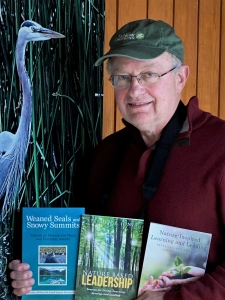
I wrote my books Nature-Based Leadership (2016), Nature-Inspired Learning and Leading (2017), Weaned Seals and Snowy Summits: Stories of Passion for Place and Everyday Nature (2019; co-authored with Dr. Jennifer Wilhoit), and Dutton Land & Cattle: A Land Legacy Story (2025) to encourage all citizens to recognize and appreciate that every lesson for living, learning, serving, and leading is either written indelibly in or is powerfully inspired by Nature. All four of my books compile personal experiences expressing my deep passion for Nature. They offer observations and reflections on my relationship with the natural world… and the broader implications for society. Order any from your local indie bookstore, or find them on IndieBound or other online sources such as Amazon and LifeRich.
I began writing books and Posts for several reasons:
- I love hiking and exploring Nature
- I see images I want to (and do) capture with my trusty iPhone camera
- I enjoy explaining those images — an educator at heart
- I don’t play golf!
- I do love writing — it’s the hobby I never needed when my career consumed me
- Judy suggested my writing is in large measure my legacy to our two kids, our five grandkids, and all the unborn generations beyond
- And finally, perhaps my books and Blogs could reach beyond family and touch a few other lives… sow some seeds for the future