Curiosities, Oddities, Mysteries, and Seasonal Features on The N AL Land Trust’s Oak Park Trail!
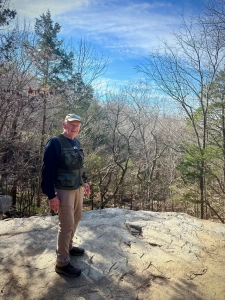
I co-led a North Alabama Land Trust Nature Hike on December 13, 2025, at Monte Sano Nature Preserve. I had never trekked the Oak Park Trail, which climbs ~300 feet up the north side of Monte Sano Mountain. We returned via a counter-clockwise circuit to the trailhead. I didn’t know what to expect, but my focus on woodland curiosities, oddities, mysteries, and seasonal features yielded plenty to cover in this photo essay!
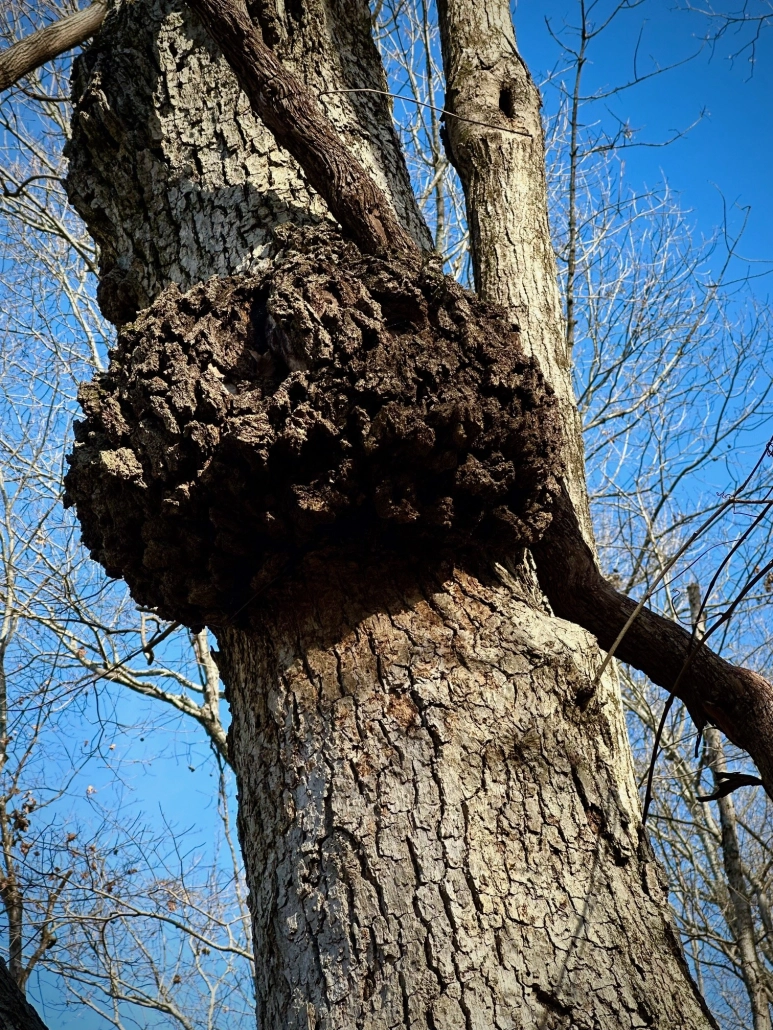
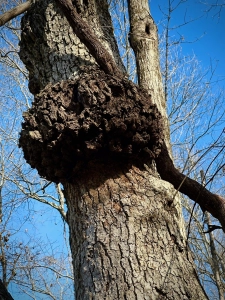
Always alert for unusual tree forms and features, I spotted this agrobacterial crown gall about 20 feet up the trunk of a yellow buckeye.
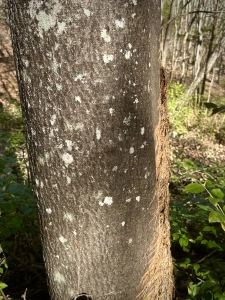
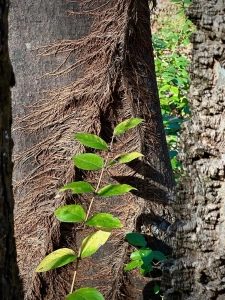
This triad of pole-size hickory, paulownia, and hackberry (left to right) struck me as peculiar with three distinct species clustered so tightly. Winter honeysuckle serves as basal greenery. A Virginia creeper vine, with air roots clinging to the stem, grows diagonally along the paulownia.
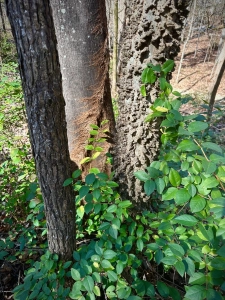
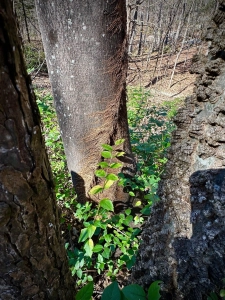
Paulownia is native to east Asia. Common names for paulownia include princess tree, royal paulownia, and butterfly tree. Its bark, flowers, and leaves are distinct.
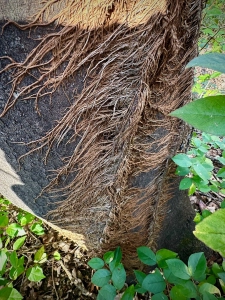
People often see Virginia creeper’s prominent air roots and mistake the vine for poison ivy, which has finer, more hair-like air roots.
An Indian marker tree? No, this white oak was an acorn long after resident Native Americans were wildland residents in what is now Huntsville. Instead, something from above crashed upon the oak when just a sapling, bending its stem to 90 degrees at three feet above ground. The crushed stem sent a shoot vertically and another at the stub end of the bent and broken top. Sure, the bent stem points to something, but only coincidentally.
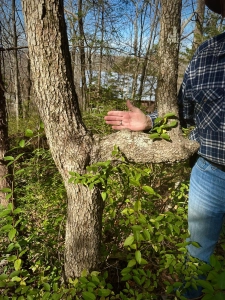
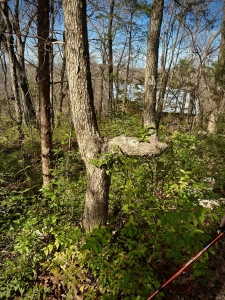
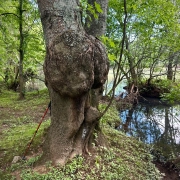
This elbow-bent white oak likewise suffered injury from above. My imagination, ofttimes a little too vivid, sees a deer face glancing to my left.
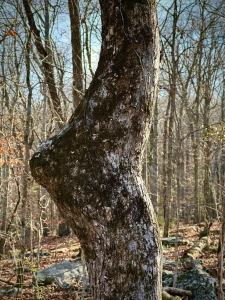
Perhaps it is I, rather than these curious tree form features, who is the anomaly…the oddity. I seldom meet other Nature enthusiasts so enamored with woodland mysteries as I.
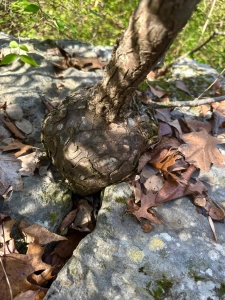
Let’s call this a sweetgum war club! Emerging from a limestone crevice, the tree sports a burl seeming to rest at its base, secured by the stone fissure. Burls result from fungal, bacterial, or viral infection, alone or in combination, triggering physiological abnormalities, much like a benign tumor in humans or other animals.
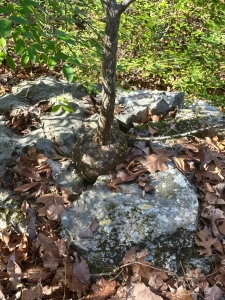
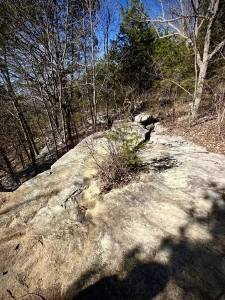
Known as Buzzards’ Roost, this exposed limestone ledge overlooks the cove and its wet season stream below. The ledge hosts a terrarium depression holding moisture, mosses, and shallow soil, and supporting a colony of herbaceous and woody plants. Does the scant isolated growth meet my criteria for oddity, curiosity, or mystery? I suppose that Nature sets no limits for standard, normal, and possible. Because I write the rules for these weekly Posts, if it catches my eye or piques my interest, a vegetated rock ledge depression qualifies.
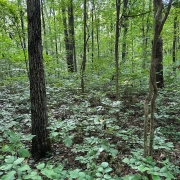
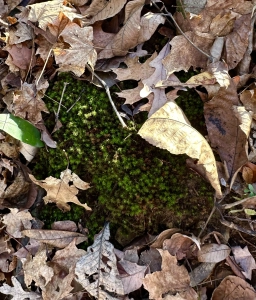
There’s nothing unusual about a moss-covered stone bedded in a brown leaf carpet, yet it did catch my eye and encourage a seasonally appropriate image. This is winter in our North Alabama woods. Don’t wait for a snowy forest floor scene. We average only two inches of snow annually. A warm sunny next day afternoon will not spoil this visual expression!
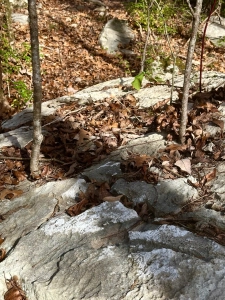
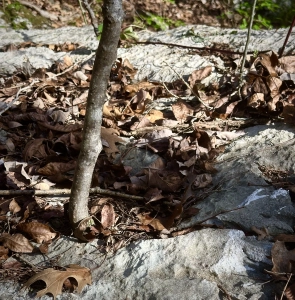
Any port in a storm may best account for these saplings finding suitable anchorage and succor atop a limestone outcrop. The storm consists of high seed predation, mice and other nibblers consuming germinants, physical stressors (desiccation, freezing, sunscald), insects, and diseases. Will these seedlings secure sustenance by extending roots to exploit mineral soil beyond the barren stone surface?
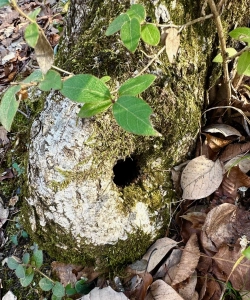
Speaking of ports in a storm, what self-respecting chipmunk would not welcome the shelter of a near-ground white oak cavity, which likely extends into the trunk many feet above?
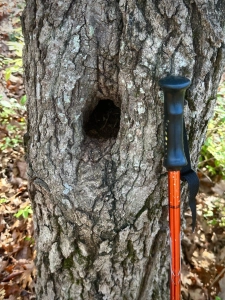
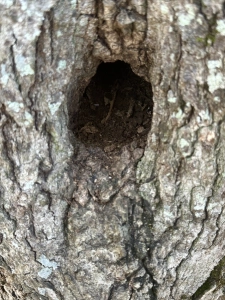
Peek into this three-feet-high red oak hollow. Soft interior debris evidences that critters have made a home. Reptile, bird, or mammal? Does it matter? I remind you that a tree does not a forest make. A tree is just one element of the entire ecosystem.
John Muir made the vast global life system complexity and interdependence clear:
When we try to pick out anything by itself, we find it hitched to everything else in the Universe.
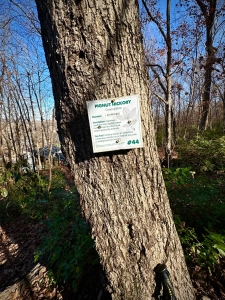
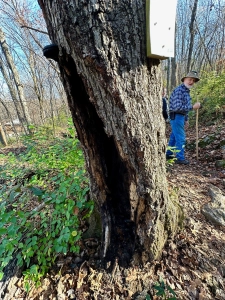
Just as all living things are interconnected, life and death are a continuum. The labelled pignut hickory’s life has thrived in part on the decayed organic remains of prior life. Likewise, the fungal-hollowed tree’s decaying wood is already nurturing vegetation surrounding it. The carbon cycle spins without end.
Our woodland roaming 12 days before Christmas revealed many hidden mysteries and delights. Some anticipated…some not!
John Muir distilled Nature into one succinct observation on a grand scale:
When we contemplate the whole globe as one great dewdrop, striped and dotted with continents and islands, flying through space with other stars all singing and shining together as one, the whole universe appears as an infinite storm of beauty.
Thoughts and Reflections
I offer these observations:
- Just as all living things are interconnected, life and death are a continuum. (Steve Jones)
- Perhaps it is I, rather than these curious tree form features, who is the anomaly…the oddity. (Steve Jones)
- When we contemplate the whole globe as one great dewdrop, striped and dotted with continents and islands, flying through space with other stars all singing and shining together as one, the whole universe appears as an infinite storm of beauty. (John Muir)
Inhale and absorb Nature’s elixir. May Nature Inspire, Inform, and Reward you!
Note: All blog post images created & photographed by Stephen B. Jones unless otherwise noted. Please circulate images with photo credit: “©2026 Steve Jones, Great Blue Heron LLC. All Rights Reserved.”
I am available for Nature-Inspired Speaking, Writing, and Consulting — contact me at steve.jones.0524@gmail.com
Subscribe to these free weekly Nature Blogs (photo essays) at: http://eepurl.com/cKLJdL
Reminder of my Personal and Professional Purpose, Passion, and Cause
If only more of us viewed our precious environment through the filters I employ. If only my mission and vision could be multiplied untold orders of magnitude:
Mission: Employ writing and speaking to educate, inspire, and enable readers and listeners to understand, appreciate, and enjoy Nature… and accept and practice Earth Stewardship.
Vision:
- People of all ages will pay greater attention to and engage more regularly with Nature… and will accept and practice informed and responsible Earth Stewardship.
- They will see their relationship to our natural world with new eyes… and will understand more clearly their Earth home.
Tagline/Motto: Steve (Great Blue Heron) encourages and seeks a better tomorrow through Nature-Inspired Living!
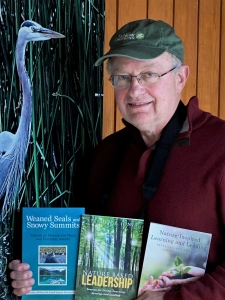
Steve’s Four Books
I wrote my books Nature Based Leadership (2016), Nature-Inspired Learning and Leading (2017), Weaned Seals and Snowy Summits: Stories of Passion for Place and Everyday Nature (2019; co-authored with Dr. Jennifer Wilhoit), and Dutton Land & Cattle: A Land Legacy Story (2023) to encourage all citizens to recognize and appreciate that every lesson for living, learning, serving, and leading is either written indelibly in or is powerfully inspired by Nature. All four of my books present compilations of personal experiences expressing my deep passion for Nature. All four books offer observations and reflections on my relationship with the natural world… and the broader implications for society. Order any from your local indie bookstore, or find them on IndieBound or other online sources such as Amazon and LifeRich.
I began writing books and Posts for several reasons:
- I love hiking and exploring Nature
- I see images I want to (and do) capture with my trusty iPhone camera
- I enjoy explaining those images — an educator at heart
- I don’t play golf!
- I do love writing — it’s the hobby I never needed when my career consumed me
- Judy suggested my writing is in large measure my legacy to our two kids, our five grandkids, and all the unborn generations beyond
- And finally, perhaps my books and Blogs could reach beyond family and touch a few other lives… sow some seeds for the future