Posts

Teaching Beyond the Walls: An Alabama State Parks Workshop at Monte Sano State Park

NOTE: Some of my GBH photo essays were not routinely distributed from mid-February through mid-June. I will resend those one by one, beginning the first week of July. Here is my Post from April 29 (https://stevejonesgbh.com/2026/04/29/brief-form-post-58-forest-discoveries-while-measuring-tree-heights-on-monte-sano-state-park/)


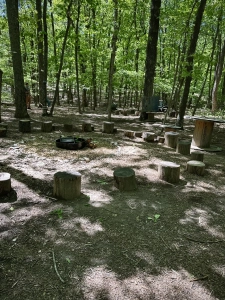
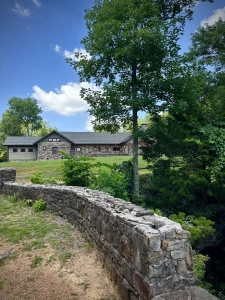
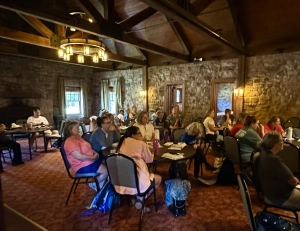
I assisted the Alabama State Park staff in delivering the Teaching Beyond the Walls: Alabama’s Ecology In Action educators’ workshop at Monte Sano State Park on June 30, 2026. Funded by BlueCross BlueShield of Alabama, the ~30 participants enjoyed diverse sessions over the nine-hour program, including: Alabama’s biodiversity; immersion in forest ecology; student-centered science; place-based teaching and learning; water cycle and stream ecology; asking the right questions; seeking insight from others; and learning through Nature. Join me as I accompany the registered learning community participants at the State Park Lodge and its plateau-edge surroundings.

Monte SSPMonte SSP


The State Park System education and interpretation obiectives align with my professional retirement mission: Employ writing and speaking to educate, inspire, and enable readers and listeners to understand, appreciate, and enjoy Nature… and accept and practice Earth Stewardship. I find fullfillment in partnering with the park system to educate, inspire, and enable visitors to embrace Earth Stewardship. What better way than through educator workshops!

We learned indoors (blessed air conditioning) and out (welcome breezes and deep woods shade).

Monte SSPMonte SSP


I recorded a 54-second video showcasing the lodge and its immediate woodland outdoor laboratory.


I suppose that spending my youth in family Nature-based recreation, four years in forestry school (1973 BS), 12 years employed by a Fortune-500 paper and allied products manufacturing company, three years earning a doctoral degree in Applied Forest Ecology (1987 Ph.D.), and 35 years in higher education teaching, research,and administration at nine universities, positioned me to know all the answers. Not so! The more I learn, the less I know. Sure, I am pretty comfortable with how I can handle a day of learning and sharing in a northern Alabama forest. Just the same, it is I who benefit most from interacting with eager, inquisitive, and dedicated educators intent on sharpening their craft, deepening their knowledge, and fueling their environmental education passion.


Understanding and Appreciating Alabama’s Biodiversity


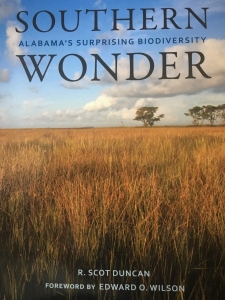
Dr. Scott Duncan’s SouthernWonder is a perfect launching pad for such a course. Alabama is the fourth most biologically diverse state in the country. Each participant exited the workshop with a copy for use as an invaluable environmental education resource.


Finding Inhabitant Wonder in a Plateau-top Brook


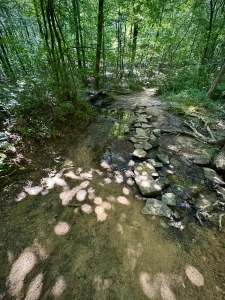
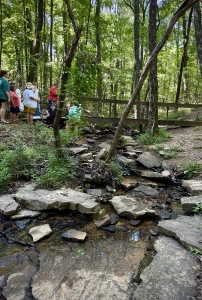
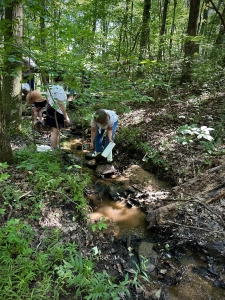
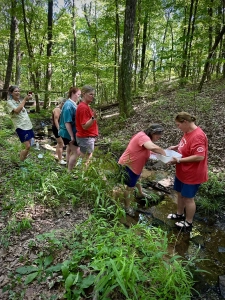
Environmental learning is a contact sport. The educators leaped into investigating abundant life (biodiversity) in the plateau-top brook near the lodge.

Monte SSP

Monte SSP


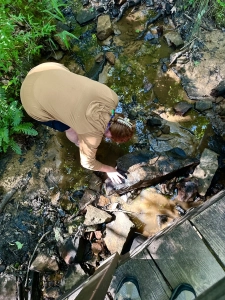
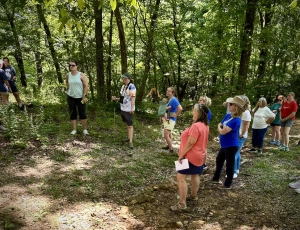
Participants turned over rocks, screened the water, and gathered nearby to share discoveries and compare observations.


There is excitement and celebration in learning, a demonstrable contact sport with feet in the water, knees in the mud, and hands on the tiny critters.

Monte SSP


Here is my 25-second video of learning in action, which is anything but learning inaction!


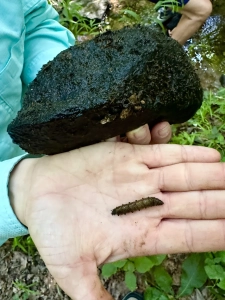
Amber Coger, the Alabama State Park NW District Naturalist, shares the caddis fly larva she found under a rock mid-brook. She may not have been more thrilled finding a gold nugget.

Monte SSP


Here’s my 59-second video recorded where the plateau-top brook exits at a ledge to depart for the Huntsville valley floor.


There is palpable magic in learning, sharing, understanding, and appreciating.


Seeing What Lies Hidden in Plain Sight


I often observe that I invest most of my time in forest wanderings discovering what wonders lie hidden in plain sight.

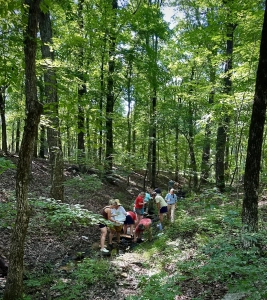
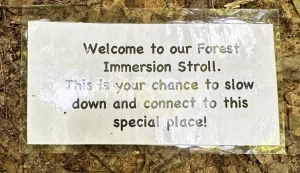
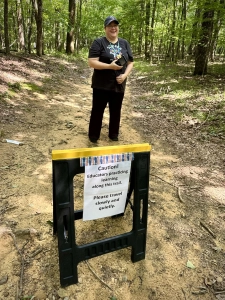
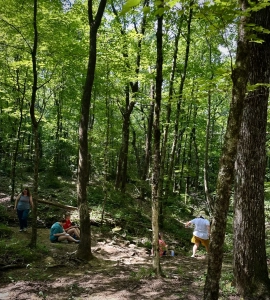
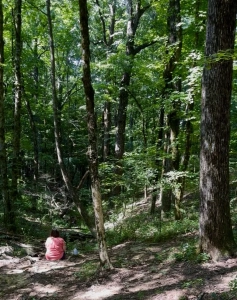
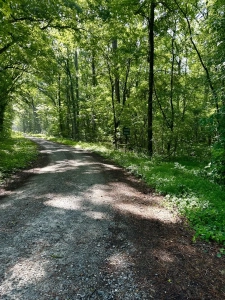
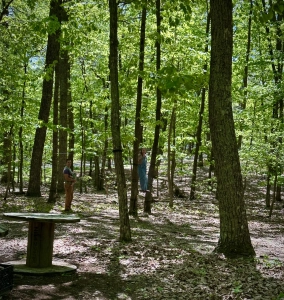
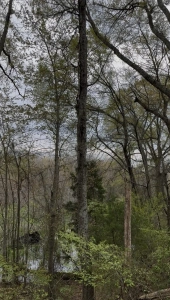
I recordeed this 58-second video of the workshop’s forest immersion experience, a designed quiet period to listen, relax, and absorb through all five human portals: mind, body, heart, soul, and spirit. Here’s the location where instructors released students one at a time to facilitate solitary immersion.


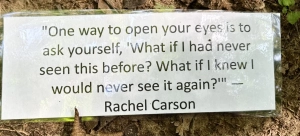
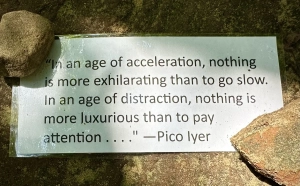
Instructors placed guidance along the way to help focus and implore deep thinking and full immersion.

Monte SSP


An instrucor cautioned participants and bikers to watch out for each other.

Monte SSP


Teacher-students followed forest immersion practitice guidelines. I reminded myself that I need to be a more disciplined practitioner. I don’t sit quietly long enough. Come on, Steve, practice what you preach!

Monte SSP


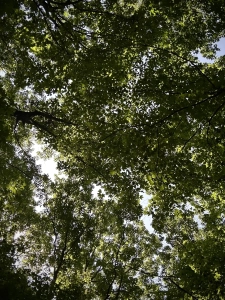
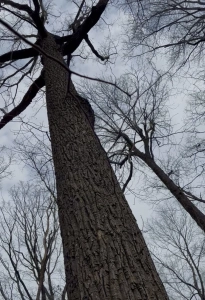
One station suggested that students look into the crown, a perspective that forces us to think about the engine, Old Sol, that fuels forest energy flow.

Monte SSP


Although I seldon pause for a full forest immersion, I abhor wasting my time blindly hiking through Nature, intent on the destination… not the journey.

Monte SSP


John Muir advocated sauntering in Nature, as an online biographer source noted:

One day as I was resting in the shade Mr. Muir overtook me on the trail and began to chat in that friendly way in which he delights to talk with everyone he meets. I said to him: “Mr. Muir, someone told me you did not approve of the word ‘hike.’ Is that so?” His blue eyes flashed, and with his Scotch accent he replied: “I don’t like either the word or the thing. People ought to saunter in the mountains – not hike!”

John Muir lived up to his doctrine. He was usually the last man to reach camp. He never hurried. He stopped to get acquainted with individual trees along the way. He would hail people passing by and make them get down on hands and knees if necessary to see the beauty of some little bed of almost microscopic flowers. Usually he appeared at camp with some new flowers in his hat and a little piece of fir bough in his buttonhole.


Discovering Special Oddity, Curiosity, and Delight in Everyday Nature


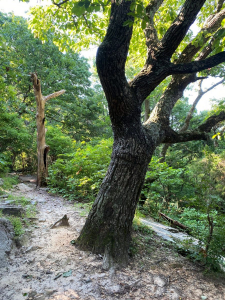
Forest oddities, curiosities, and mysteries fascinate, puzzle, and entertain me on my forest excursions. I kept my eyes open as I wandered during the workshop. This chestnut oak stood in plain view where I recorded the start of the forest immersion video. I wondered how many noticed?

Monte SSP


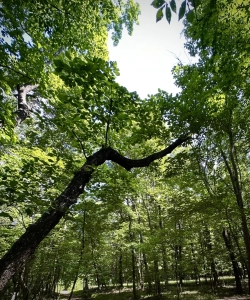
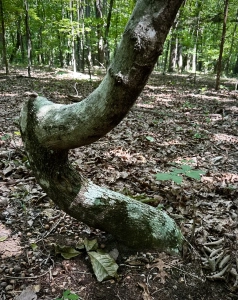
A contorted sugar maple displayed clear evidence of some past physical battery (falling branch or tree, logging equipment damage, or some less-obvious injury). Nature is remarkably resilient.

Monte SSP


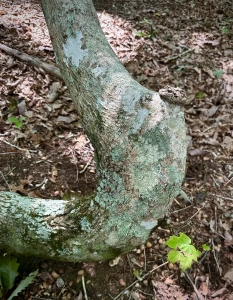
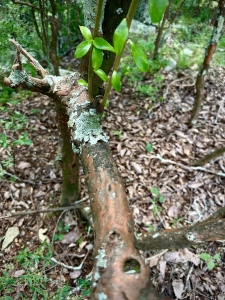
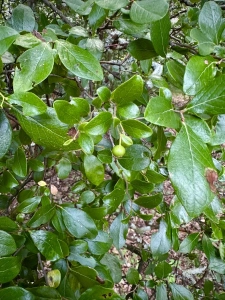
Naturally curious in its manner of growth, sparkleberry or farkleberry grows however it wishes, without apparent disciplinary rules.

Monte SSP


I love it for its mirthful common names and for its whimsical growth.

Monte SSP


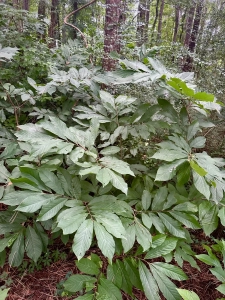
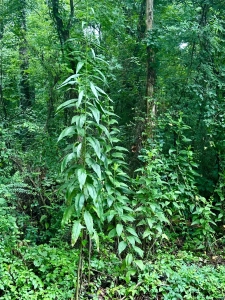
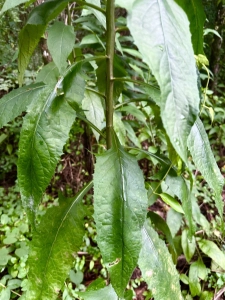
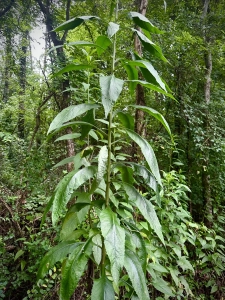
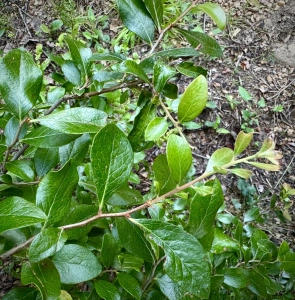
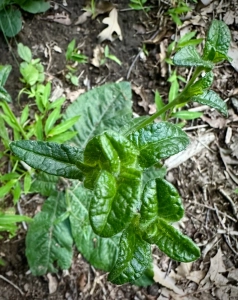
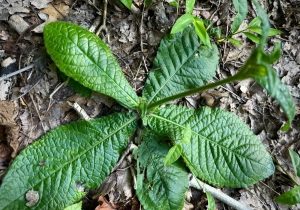
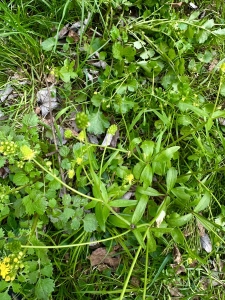
I learned a new plant: leafy elephant’s-foot, a moniker worthy of inclusion in this listing of notable features in everyday Nature.

Monte SSP


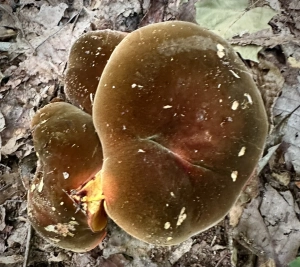
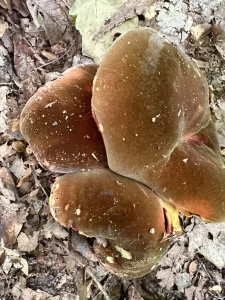
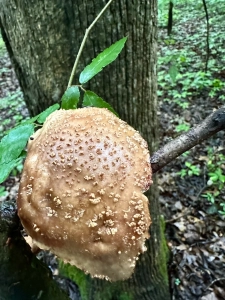
I consider myself a neophyte mycophile… a fungi enthusiast. I’m gaining confidence in identifying regional edibles. iNaturalist identified this mushroom as Neoboletus sp. ‘varietstibus. Its velvety brown, stocky appearance drew me closer. I saw no other individuals and because of its scarcity, I did not disturb it to capture a complete set of photo images: top, bottom, and side. Therefore I am not confident in the iNaturalist identification. I’ll consider whether this species is edible or not when I find a patch large enough to be certain.


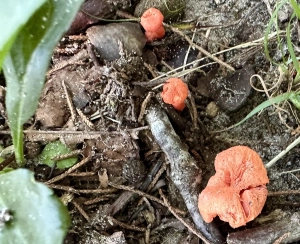
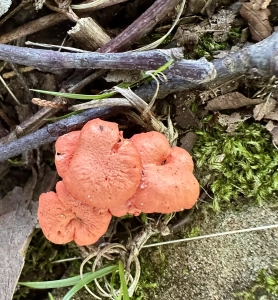
Red chanterelle mushrooms are edible, but are too diminutive to bother. I do forage larger chanterelles, but not from our State Parks.

Monte SSP


I recorded this 60-second red chanterelles video during the workshop.


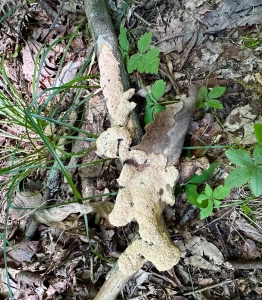
I present this final oddity, curiosity, and delight: dog vomit slime mold, which presented itself along the trail at the intersection where we launched individuals for their solitary immersions. So much lies hidden in plain sight.

Monte SSP


Like John Muir, I believe:

In every walk with Nature one receives far more than he seeks.


The Wonder of My Retirement Role


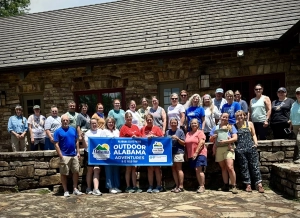
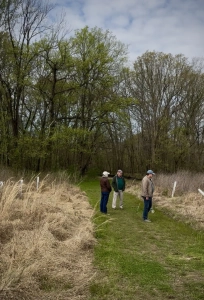
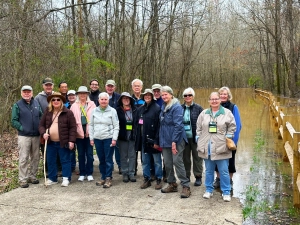
Here’s our contingent of ardent learners.


One of the educators (Shelly, employed in Tennessee) said to me after sharing a table during the indoor sessions, “You have the greatest volunteer retirement role I could ever imagine.” She nailed it:


Alabama State Parks Foundation

Thoughts and Reflections


I offer these observations:

  • Mr. Muir, someone told me you did not approve of the word ‘hike.’ Is that so?” His blue eyes flashed, and with his Scotch accent he replied: “I don’t like either the word or the thing. People ought to saunter in the mountains – not hike!” (Muir biographer)
  • There is excitement and celebration in learning, again, a demonstrable contact sport. (Steve Jones)
  • There is palpable magic in learning, sharing, understanding, and appreciating. (Steve Jones)

Inhale and absorb Nature’s elixir. May Nature Inspire, Inform, and Reward you!


Note: All blog post images created & photographed by Stephen B. Jones unless otherwise noted. Please circulate images with photo credit: “©2026 Steve Jones, Great Blue Heron LLC. All Rights Reserved.”

I am available for Nature-Inspired Speaking, Writing, and Consulting — contact me at steve.jones.0524@gmail.com

Subscribe to my free weekly photo essays (like this one) at: http://eepurl.com/cKLJdL


Reminder of my Personal and Professional Purpose, Passion, and Cause

If only more of us viewed our precious environment through the filters I employ. If only my mission and vision could be multiplied untold orders of magnitude:

Mission: Employ writing and speaking to educate, inspire, and enable readers and listeners to understand, appreciate, and enjoy Nature… and accept and practice Earth Stewardship.

Vision:

  • People of all ages will pay greater attention to and engage more regularly with Nature… and will accept and practice informed and responsible Earth Stewardship.
  • They will see their relationship to our natural world with new eyes… and will understand more clearly their Earth home.

Tagline/Motto: Steve (Great Blue Heron) encourages and seeks a better tomorrow through Nature-Inspired Living!


Steve’s Four Books


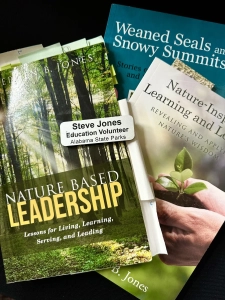
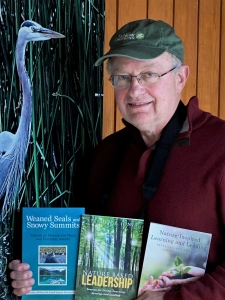
I wrote my books Nature Based Leadership (2016), Nature-Inspired Learning and Leading (2017), Weaned Seals and Snowy Summits: Stories of Passion for Place and Everyday Nature (2019; co-authored with Dr. Jennifer Wilhoit), and Dutton Land & Cattle: A Land Legacy Story (2023) to encourage all citizens to recognize and appreciate that every lesson for living, learning, serving, and leading is either written indelibly in or is powerfully inspired by Nature. All four of my books present compilations of personal experiences expressing my deep passion for Nature. All four books offer observations and reflections on my relationship with the natural world… and the broader implications for society. Order any from your local indie bookstore, or find them on IndieBound or other online sources such as Amazon and LifeRich.

I began writing books and Posts for several reasons:

  • I love hiking and exploring Nature
  • I see images I want to (and do) capture with my trusty iPhone camera
  • I enjoy explaining those images — an educator at heart
  • I don’t play golf!
  • I do love writing — it’s the hobby I never needed when my career consumed me
  • Judy suggested my writing is in large measure my legacy to our two kids, our five grandkids, and all the unborn generations beyond
  • And finally, perhaps my books and Blogs could reach beyond family and touch a few other lives… sow some seeds for the future
 

Monte SSP


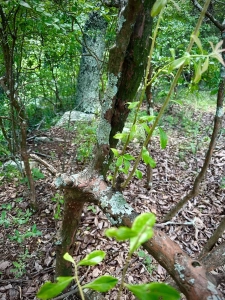
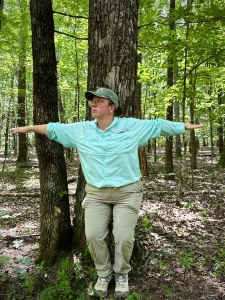
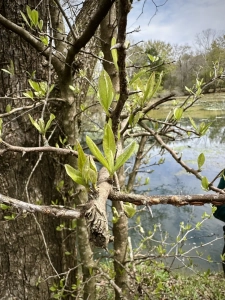
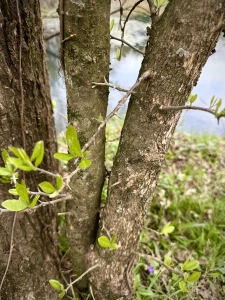
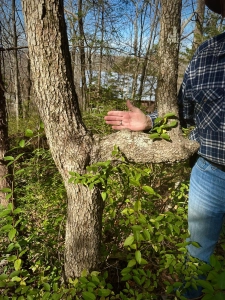
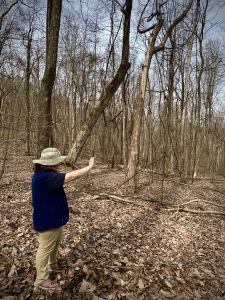
[Workshop facilitator Amber Coger depicting the right-angle branching character of black gum (the smaller tree at her right forearm).]

Brief-Form Post #64: Mid-June Visit to a WNWR Bottomland Forest and a Drying Buckeye Impoundment!

NOTE: Some of my GBH photo essays were not routinely distributed from mid-February through mid-June. I will resend those one by one, beginning the first week of July. Here is my Post from April 15 (https://stevejonesgbh.com/2026/04/15/brief-form-post-56-quick-circuit-of-the-dallas-fanning-nature-preserve/)


I am pleased to add the 64th of my GBH Brief-Form Posts (Less than five minutes to read!) to my website. I get wordy with my routine Posts. I don’t want my enthusiasm for thoroughness and detail to discourage readers. So, I will occasionally publish these brief Posts.


I am fortunate to live just a dozen miles due north of Alabama’s 35,000-acre Wheeler National Wildlife Refuge, where I decided to wander for several hours on June 9, 2026. I searched in a familiar bottomland hardwood forest for wild edible mushrooms: early chanterelles, oysters, boletes, chicken of the woods, and black-staining polypores. Finding only non-edibles, I made acquaintance with a road-crossing river cooter, photographed new Singing River Trail signage, and explored the sights and sounds of the Refuge’s Buckeye Impoundment, an important wildlife management feature.


Bottomland Forest


Search my website Blog link (https://stevejonesgbh.com/blog/) for Wheeler National Wildlife Refuge; choose from more than 50 prior posts on aspects of this nationally significant refugium. Were the refuge a single mile wide, it would extend 55 miles. Here is the interior road (HGH Road) that runs east-west about a mile north of the Tennessee River (Lake Wheeler), just into Limestone County, adjoining Madison County to the east. I often bushwalk (bushwhack) through this rich bottomland, which if not for the TVA/COE purchasing land to buffer the 1936 Wheeler Dam inudation property, would now probably be in private agricultural production.


Mushroom Venture


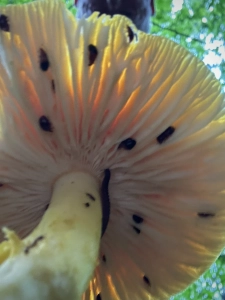
I ventured for 90 minutes in the bottomland finding abundant mushrooms of various inedible species.

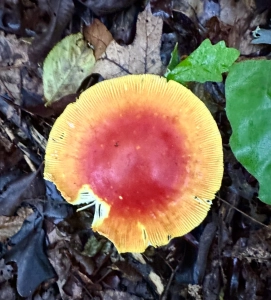
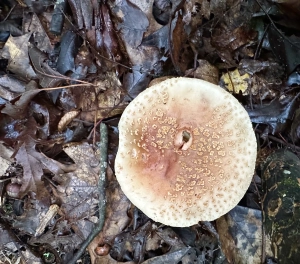
Amanita were scattered in the deep and damp understory shade. This one served as a luncheon buffet for underside invertebrates.


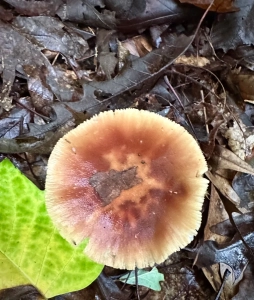
Amanita color hue and sharpness vary with age.


Yet another Amanita species.


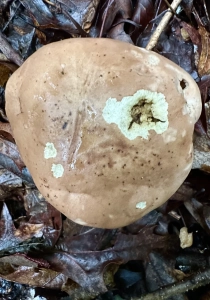
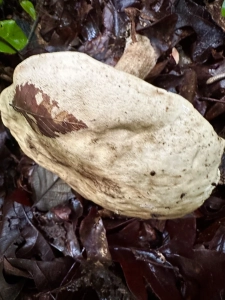
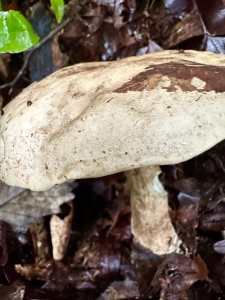
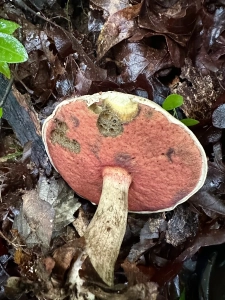
Unlike the gilled Amanitas, all Boletes have spongy pores under their caps. This is known as bitter Bolete, a common name that suggests it may not be inedible, but it assuredly is not suitable for consumption.


This Caloboletus firmus, considered too bitter to consume, bears perfect leaf impression artwork.


Its pink underside shows the characteristic spongy Bolete pore surface.


A Mushroom Consumer


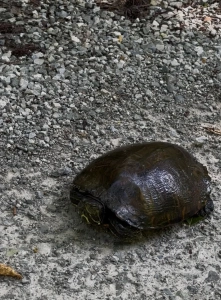
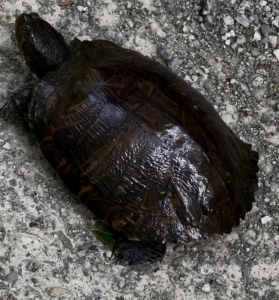
I stopped for a friendly river cooter gravel road crossing chat. The shell-shocked retile refused to share edible mushroom location secrets with me!


I recorded this 43-second video of my turtle friend.


Singing River Trail Thoroughfare


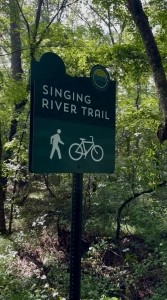
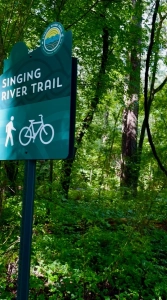
The Singing River Trail will be a 200+ mile greenway system once completed. The Refuge recently posted signage delineating the SRT route. I recorded this 60-second video introducing the route. My narrative incorrectly identifies the road as Jolly B. It is HGH Road, which ties in to Jolly B a mile to the east.


The sign below is at the northern entrance to the Refuge on Jolly B Road.


Buckeye Impoundment


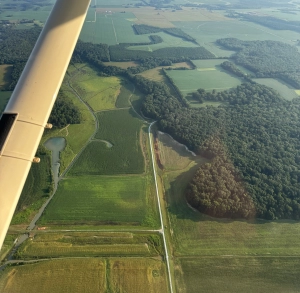
Buckeye Impoundment lies just beyond the point where HGH Road turns north (where I recorded the SRT video). Here is my Great Blue Heron Post from my 2024 overflight of WNWR and the image below of Buckeye Impoundment: https://stevejonesgbh.com/2024/12/05/buckeye-impoundment-in-early-october-on-the-wheeler-national-wildlife-refuge-part-one/


I entered the aerial photo image above on June 9, 2026 where the straight N/S road candy-canes into Buckeye Impoundment from the bottomland forest to the east.

I recorded this 60-second Buckeye Impoundment video.


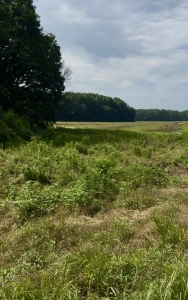
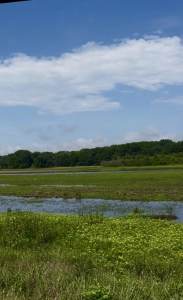
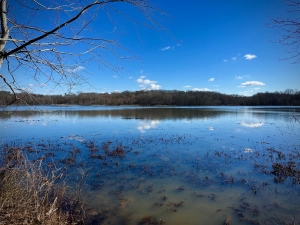
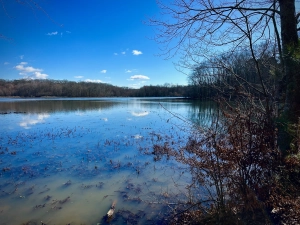
The views below are to the SSE and the SW. I plan to return to examine and compare end of summer vegetative growth to this early June visit.


The impoundment is drying after an extended dormant season of intentional engineered flooding.


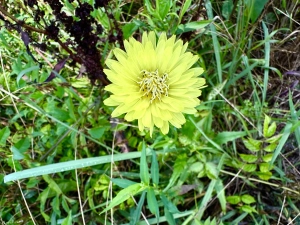
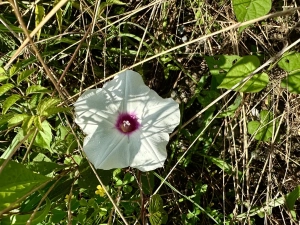
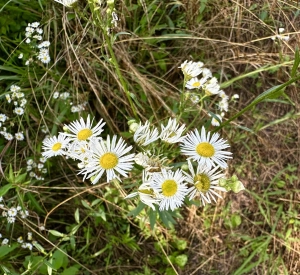
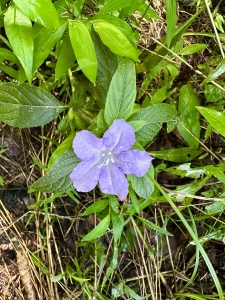
Summer Wildflower Profusion


Here are my observed early summer flower highlights at the marge of the impoundment.

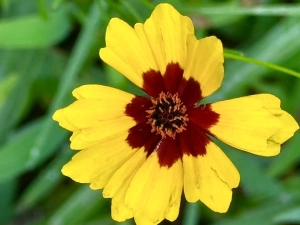
Carolina desert chickory


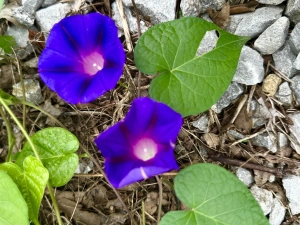
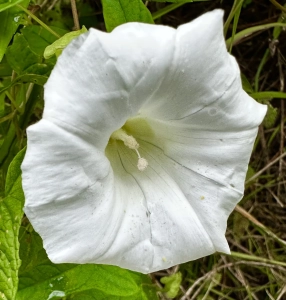
Wild potato vine


Annual fleabane


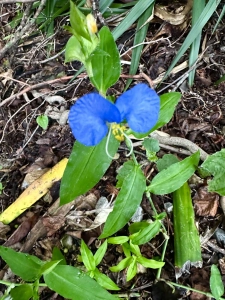
Carolina ruellia


A quick, low investment visit into Nature pays high dividents in peace of mind, satisfaction, exercise, and learning and discovery. John Muir nailed it:

In every walk with nature one receives far more than he seeks.


Closing


I accept the challenge of distilling these Brief-Form Posts into a single distinct reflection, this one cut, modified, and pasted from above:

I am fortunate to live just a dozen miles due north of Alabama’s 35,000-acre Wheeler National Wildlife Refuge, where I decided to wander for several hours on June 9, 2026. A quick, low investment visit into Nature pays high dividents in peace of mind, satisfaction, exercise, and learning and discovery. John Muir nailed it:

In every walk with nature one receives far more than he seeks.


Nature’s special treats await our discovery, our understanding, and our interpretation!


Subscribe to my free weekly photo essays (like this one) at: http://eepurl.com/cKLJdL


Celebrating Vitamin ‘N’: Little Mountain Annual Learning Showcase at Monte Sano State Park!


A Board Member of the Little Mountain Forest School in Huntsville, Alabama, I attended the school’s Annual Learning Showcase on Sunday afternoon, April 19, 2026, at Monte Sano State Park, where 60 students are enrolled and attend classes in the outdoor forest classroom. Come along with me as I reflect on the forest school concept, its philosophy, and the pioneering thinkers and practitioners who promote it. If you want to learn more about LMFS, visit the website: https://www.littlemountainforestschool.org/

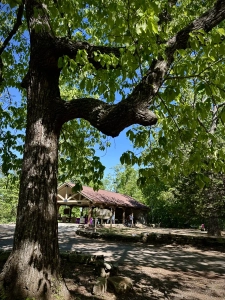
A massive chestnut oak framed the plateau-top pavilion, gathering site for the showcase.


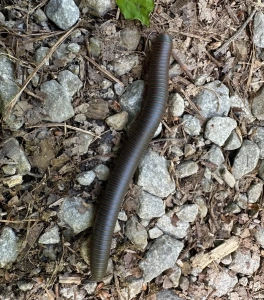
An American giant millipede welcomed my wife and me as we exited our car. Just one of many creature teachers who share their woodland classroom.


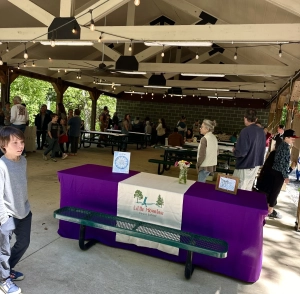
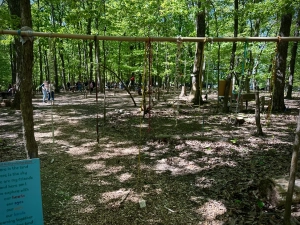
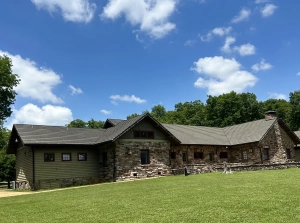
The Biker’s Pavilion at Monte Sano is ideal for hosting a Little Mountain Forest School event, launching a hike down the Sinks Trail to the forest haven I dub The CathedralForest, or for resting a few minutes after a vigorous woodland saunter.


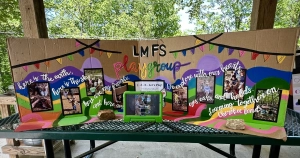
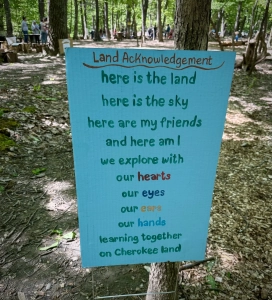
LMFS participants connect to the land, its essential richness, and the stories it lives and relates.

“Here is the Earth; here is the sky,

Here are my friends, and here am I.

We explore with our hearts.

Learning together on Cherokee lands.”


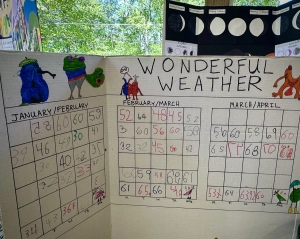
I am a lifelong student of weather, climate, atmospheric physics,and the dynamic envelope of atmosphere that surrounds, protects, and sustains us. I’ve been keeping weather records since elementary school. Sunny skies, persisten rain, wild thunderstorms, or wind-driven snow, I loved every dimension, mood, or effect. I embraced the science and artistry of understanding, appreciating, and relishing weather and its interplay with Place, Life, and Nature. As my life and career tracked along a forestry vector, wonderful weather trekked along every step of my incredible journey. If only a single LMFS enrollee catches a mere germ of my deep weather fascination and incurable addiction, my investment serving on the LMFS Board is amply rewarded.


I neglected to photograph the scientific rain gauge that staff recently placed near the outdoor classroom. It’s the real thing. I still recall with memory-giddiness many years ago when Mom gifted young me a rain gauuge. A high quality scientific instrument? Through today’s lens it was cheap plastic, but to very young Steve…priceless! And now, to very old Steve, tears are suddenly blearing the keyboard, as I realize the momentous impact left by thoughtful, caring, and knowing educators, including parents.

I recorded this 52-second video to capture the mood and moment of the Learning Showcase.


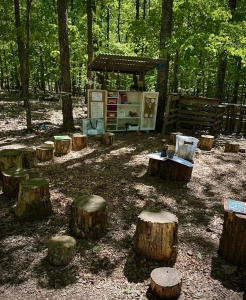
Students designed and fashioned the festive classroom entryway.


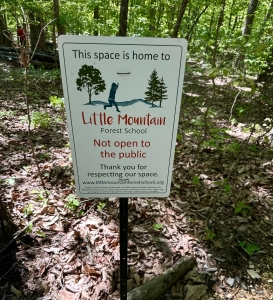
I sub-titled my third book, Stories of Passion for Place and Everyday Nature. This sign speaks volumes of this Special Place…Thank You for Respecting Our Space!


And, what a very SPECIAL Land Acknowledgement!


John Muir would have appreciated the LMFS classroom.

Everybody needs beauty as well as bread, places to play in and pray in, where Nature may heal and cheer and give strength to body and soul alike.


Such a great place to hide and abide…and not a molecule of plastic or a line of digital code! Richard Louv observed:

Nature is imperfectly perfect, filled with loose parts and possibilities, with mud and dust, nettles and sky, transcendent hands-on moments and skinned knees.


I see limitless beauty, magic, wonder, awe, and inspiration in the mundane and common of everyday Nature.


My former Antioch University New England colleague David Sobel remarked,

You can’t bounce off the walls If there are no walls: outdoor schools make kids happier—and smarter.


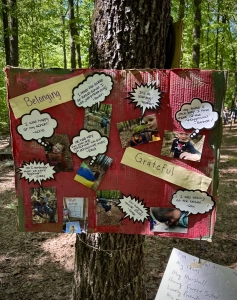
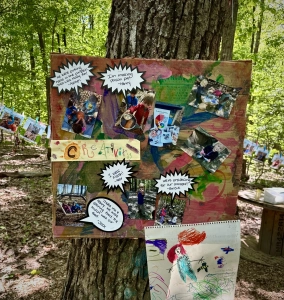
Signs proclain Belonging and Grateful (left) and Creative (right).


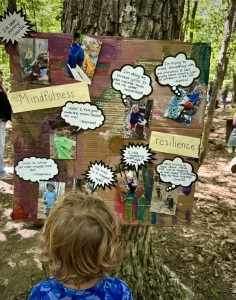
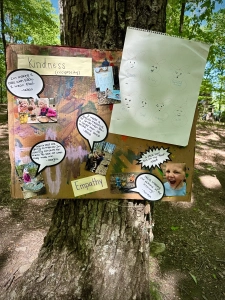
Mindfulness and Resilience (left) and Kindness, Reciprocity, and Empathy (right).


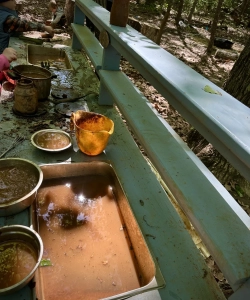
An artists’ workbench keeps essentials (soil, dirt, water, measuring flasks, buckets…) at the ready. No need to worry about messing up the floor!


This is an all-weather classroom for more than sixty kids. Richard Louv heralded a movement:

Humans are hard-wired to love and need exposure to the natural world. Researchers have found that regardless of culture people gravitate to images of nature, especially the savannah. Our inborn affiliation for nature may explain why we prefer to live in houses with particular views of the natural world.

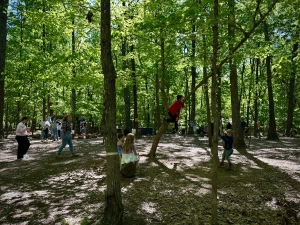
Just beyond the woods at left, an overlook provides a vista to the E/NE into a valley 800 feet below the Monte Sano plateau summit. A youngster in the frameat right chooses to gain another three feet!


I recorded a 60-second video sweeping through the forest.


I would have loved learning in such an outdoor setting!


Alabama State Parks Foundation

Thoughts and Reflections


I offer these observations:

  • You can’t bounce off the walls If there are no walls: outdoor schools make kids happier—and smarter. (David Sobel)
  • Nature is imperfectly perfect, filled with loose parts and possibilities, with mud and dust, nettles and sky, transcendent hands-on moments and skinned knees. (Richard Louv)
  • Everybody needs beauty as well as bread, places to play in and pray in, where Nature may heal and cheer and give strength to body and soul alike. (John Muir)

Inhale and absorb Nature’s elixir. May Nature Inspire, Inform, and Reward you!


Note: All blog post images created & photographed by Stephen B. Jones unless otherwise noted. Please circulate images with photo credit: “©2026 Steve Jones, Great Blue Heron LLC. All Rights Reserved.”

I am available for Nature-Inspired Speaking, Writing, and Consulting — contact me at steve.jones.0524@gmail.com

Subscribe to my free weekly photo essays (like this one) at: http://eepurl.com/cKLJdL


Reminder of my Personal and Professional Purpose, Passion, and Cause

If only more of us viewed our precious environment through the filters I employ. If only my mission and vision could be multiplied untold orders of magnitude:

Mission: Employ writing and speaking to educate, inspire, and enable readers and listeners to understand, appreciate, and enjoy Nature… and accept and practice Earth Stewardship.

Vision:

  • People of all ages will pay greater attention to and engage more regularly with Nature… and will accept and practice informed and responsible Earth Stewardship.
  • They will see their relationship to our natural world with new eyes… and will understand more clearly their Earth home.

Tagline/Motto: Steve (Great Blue Heron) encourages and seeks a better tomorrow through Nature-Inspired Living!


Steve’s Four Books


I wrote my books Nature Based Leadership (2016), Nature-Inspired Learning and Leading (2017), Weaned Seals and Snowy Summits: Stories of Passion for Place and Everyday Nature (2019; co-authored with Dr. Jennifer Wilhoit), and Dutton Land & Cattle: A Land Legacy Story (2023) to encourage all citizens to recognize and appreciate that every lesson for living, learning, serving, and leading is either written indelibly in or is powerfully inspired by Nature. All four of my books present compilations of personal experiences expressing my deep passion for Nature. All four books offer observations and reflections on my relationship with the natural world… and the broader implications for society. Order any from your local indie bookstore, or find them on IndieBound or other online sources such as Amazon and LifeRich.

I began writing books and Posts for several reasons:

  • I love hiking and exploring Nature
  • I see images I want to (and do) capture with my trusty iPhone camera
  • I enjoy explaining those images — an educator at heart
  • I don’t play golf!
  • I do love writing — it’s the hobby I never needed when my career consumed me
  • Judy suggested my writing is in large measure my legacy to our two kids, our five grandkids, and all the unborn generations beyond
  • And finally, perhaps my books and Blogs could reach beyond family and touch a few other lives… sow some seeds for the future
 

I was just six days past left shoulder replacement revision surgey when Judy drove us to the the LMFS Annual Learning Showcase.


Red Buckeye, a Colony of Aphids, and a Swarm of Tadpoles: Spring in Our Midst!

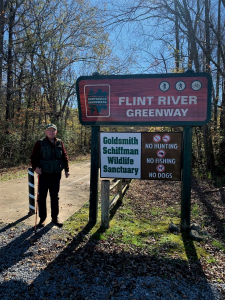
I met with friends Chris Stuhlinger, Marian Moore Lewis, Bill and Becky Heslip, and Ben Hoksbergen on the morning of March 26, at the Taylor Road entrance to Huntsville, Alabama’s Goldsmith-Schiffman Wildlife Sanctuary. The five of us wanted to learn more from archaeologist Ben about the Native American history he gleaned from a prior survey he conducted on the Sanctuary. Rather than share the fascinating history, I offer you our never-disappointing ecological saunter through the Sanctuary, revealing seasonal spring discoveries.

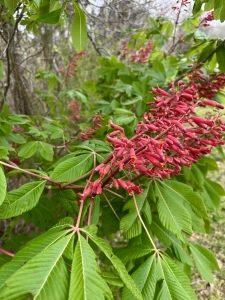
Red buckeye showed its colors amid the morning vapors above Hidden Spring.


I recorded this 59-second red buckeye video.


Hidden Spring lies 30-feet below the entrance deck and shelter. Something within the deepness beckoned me, but the steep descent and the vegetative jungle compelled me to stay at the bluff to capture the Hidden Spring magic from above. What would have been a quick descent, brief exploration, and return scamper to the brim at age 45, is now daunting 30 years hence. Such a possibiliy is now reduced to a Southern term: “usedtocould“!


A still photograph and my 59-second video will have to satisfy my curiosity for a closer look.


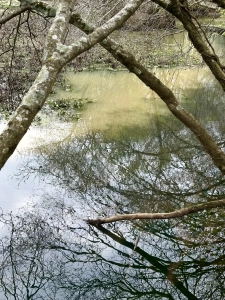
Hidden Spring Brook collects and channels the Hidden Spring flow, beginning its jorney to the Flint River.


Here’s my video of Hidden Spring Brook.


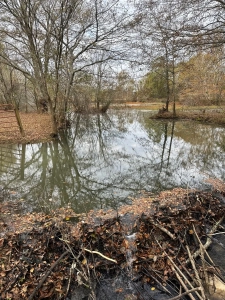
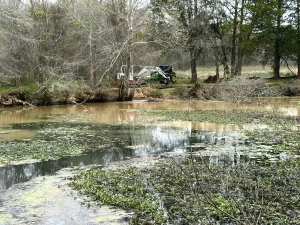
Approaching Jobala Pond, Hidden Brook is terraced by a beaverdam. Ever the habitat-modifying stream engineers, beavers insist on having it their way!


A city crew rectifying a drainage issue temporarily muddied Jobala Pond with sediment inflow.


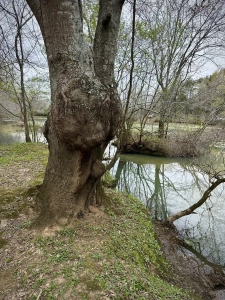
I’ve been monitoring a large and rapidly expanding burl five feet above ground on a water oak at the Jobala Pond outlet for eight years. I always snap a photo, wondering what is the endgame for this unusual growth.


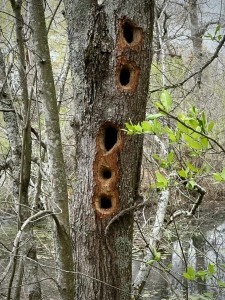
Nearby, a pileated woodpecker is creating a high-rise apartment complex. I could not get close enough to see whether there are different unique compartments…or separate entrances to the tree’s hollow interior. The woodpecker’s excavations serve a self interest. Does the bird know/understand/care that in pecking away to secure food (insects and grubs) that it is performing a valuable ecosysten function? How many mammals, birds, reptiles, insects, fungi, and other lifeforms interact with the bird’s ratta-tat-tat drumming?


John Muir appreciated the essential interdpendency of all things earthly:

When we try to pick out anything by itself, we find it hitched to everything else in the Universe.

AND

When we contemplate the whole globe as one great dewdrop, striped and dotted with continents and islands, flying through space with other stars all singing and shining together as one, the whole universe appears as an infinite storm of beauty.


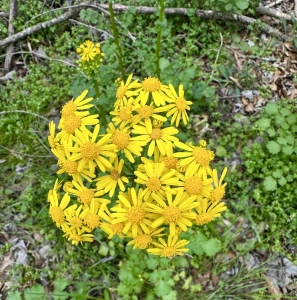
Butterweed’s season exalts across three glorious early spring weeks. She tends her stored sunshine secretively through our southern winter. Suddenly after the requisite threshold of degree days, she lets loose, explosively…from drab dormancy to lasered brilliance emanately from roadside ditches.


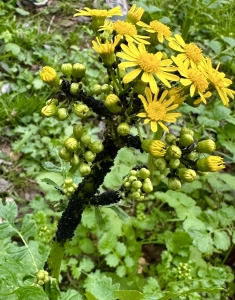
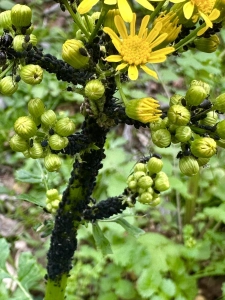
Most specimens along the main sanctuary trail were pest free, this heavily black-bean-aphid-infested plant an exception.


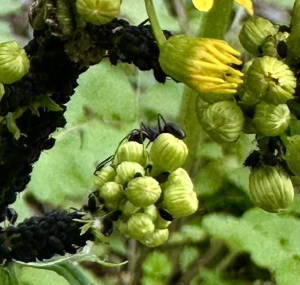
Oh, the ecological lessons in plain sight on a three-hour spring saunter, like this silky field ant tending black bean aphids! Ants and aphids share a well-documented symbiotic relationship, which means they both benefit mutually from their working relationship. Aphids produce a sugary food for the ants, in exchange, ants care for and protect the aphids from predators and parasites.


A small flowered buttercup expressed spring’s urgent call to action. Summer’s rampant vegetative growth will rapidly smother this harbinger of spring. Her call is to get it done now, while the gettin’ is good!


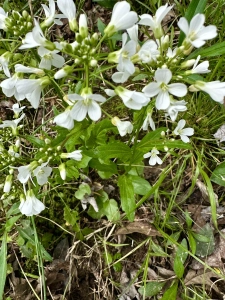
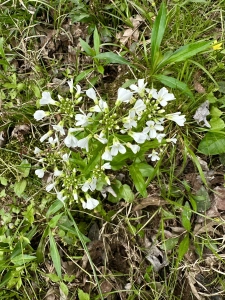
Bulbous cress is another early spring ephemeral whose window will soon close.


We puzzled a few minutes over the streamside identity of buckthorn bully. I love the interplay of enthusiastic Nature enthusiasts clamoring, researching digitally, testing with iNaturalist, and even arguing (good naturedly) to see who can claim the identity summit. The competition was so savagely engaged that I already forget who prevailed!


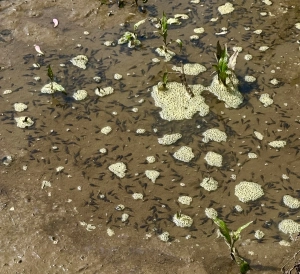
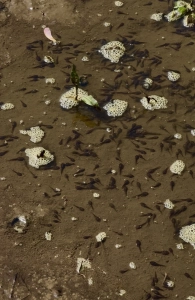
One of us noticed a roadside puddle thick with tadpoles. I recorded this 60-second tadpole video.


I pondered the fate of the tadpoles. Did rain replenish the puddle long enough for frogs or toads to emerge? Will predators prevail?


We proceeded to the wetland mitigation area, where I recorded a video.


The project’s intent is to restore the agricultural fields to their original hydrology and to restore bottomland hardwood forest species. The tree shelters protect planted wetland hardwood seedlings.

I’ll close this post with a repeat from a prior recent photo essay. I’m drafting this narrative 25 days after major left shoulder replacement revision surgery. Recovery includes lots of physical therapy and encourages walking. Walking on the sidewalk and greenway variety! Woodland excursions are weeks away for a less-than-sure-footed 75-year-old. My Doc discourages falling, jarring, and stressing the prosthesis! I chose to once again employ the closing. I’m not yet at the end of my forest hiking/sauntering, but one day we all will reach that juncture when we’ll hike again with old friends, long gone. Until then, I will trek my haunts while I have the chanceuntil I can’t.

Closing


I recalled and reflected upon the lyrics of a beautiful, haunting, sobering song written by Cody Johnson and recently re-released by Kid Rock:

If you got a chance take it
Take it while you got a chance
If you got a dream chase it
‘Cause a dream won’t chase you back
If you’re gonna love somebody
Hold ’em as long and as strong and as close as you can
‘Til you can’t

Here’s Kid Rock’s performance: https://video.search.yahoo.com/search/video?fr=mcafee&p=kid+rock%27s+til+you+can%27t&type=E210US752G91913#id=1&vid=65bad198429e2f998a60294e98819e09&action=view


After wandering forests for three-quarters of a century, I was struck with the notion that I intend to continue doing so…until I can’t. A day will come when I can’t. I look at my wife, kids, grandkids, friends, and colleagues through the same reality filter. A day will come… when I can’t.

I recall the dawn…my dawn…from a growing distance. I sense the evening gloam approaching. I ask myself, do I want to invest a single woods venture by racing with a group from one place, through the woods, to another, with virtually no time for inter-personal, social intercourse? And certainly too little time to harvest photo essay fodder. I relish each step at my own pace, embracing the beauty, magic, wonder, awe, and inspiration?

I shall remain a dedicated servant of encouraging informed and responsible Earth stewardship...Until I can’t…


Thoughts and Reflections


I offer these observations:

  • When we try to pick out anything by itself, we find it hitched to everything else in the Universe. (John Muir)

  • I shall remain a dedicated servant of encouraging informed and responsible Earth stewardship…Until I can’t… (Steve Jones)

  • Imagination is more important than knowledge. Knowledge is limited. Imagination encircles the world. (Albert Einstein)

Inhale and absorb Nature’s elixir. May Nature Inspire, Inform, and Reward you!


Note: All blog post images created & photographed by Stephen B. Jones unless otherwise noted. Please circulate images with photo credit: “©2026 Steve Jones, Great Blue Heron LLC. All Rights Reserved.”

I am available for Nature-Inspired Speaking, Writing, and Consulting — contact me at steve.jones.0524@gmail.com

Subscribe to my free weekly photo essays (like this one) at: http://eepurl.com/cKLJdL


Reminder of my Personal and Professional Purpose, Passion, and Cause

If only more of us viewed our precious environment through the filters I employ. If only my mission and vision could be multiplied untold orders of magnitude:

Mission: Employ writing and speaking to educate, inspire, and enable readers and listeners to understand, appreciate, and enjoy Nature… and accept and practice Earth Stewardship. Until I can’t!

Vision:

  • People of all ages will pay greater attention to and engage more regularly with Nature… and will accept and practice informed and responsible Earth Stewardship.
  • They will see their relationship to our natural world with new eyes… and will understand more clearly their Earth home.

Tagline/Motto: Steve (Great Blue Heron) encourages and seeks a better tomorrow through Nature-Inspired Living!


Steve’s Four Books


I wrote my books Nature Based Leadership (2016), Nature-Inspired Learning and Leading (2017), Weaned Seals and Snowy Summits: Stories of Passion for Place and Everyday Nature (2019; co-authored with Dr. Jennifer Wilhoit), and Dutton Land & Cattle: A Land Legacy Story (2023) to encourage all citizens to recognize and appreciate that every lesson for living, learning, serving, and leading is either written indelibly in or is powerfully inspired by Nature. All four of my books present compilations of personal experiences expressing my deep passion for Nature. All four books offer observations and reflections on my relationship with the natural world… and the broader implications for society. Order any from your local indie bookstore, or find them on IndieBound or other online sources such as Amazon and LifeRich.

I began writing books and Posts for several reasons:

  • I love hiking and exploring Nature
  • I see images I want to (and do) capture with my trusty iPhone camera
  • I enjoy explaining those images — an educator at heart
  • I don’t play golf!
  • I do love writing — it’s the hobby I never needed when my career consumed me
  • Judy suggested my writing is in large measure my legacy to our two kids, our five grandkids, and all the unborn generations beyond
  • And finally, perhaps my books and Blogs could reach beyond family and touch a few other lives… sow some seeds for the future


Curiosities, Oddities, Mysteries, and Seasonal Features on The N AL Land Trust’s Oak Park Trail!

I co-led a North Alabama Land Trust Nature Hike on December 13, 2025, at Monte Sano Nature Preserve. I had never trekked the Oak Park Trail, which climbs ~300 feet up the north side of Monte Sano Mountain. We returned via a counter-clockwise circuit to the trailhead. I didn’t know what to expect, but my focus on woodland curiosities, oddities, mysteries, and seasonal features yielded plenty to cover in this photo essay!


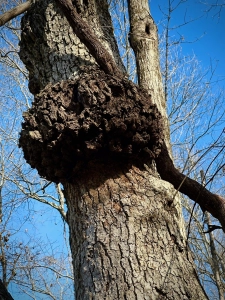
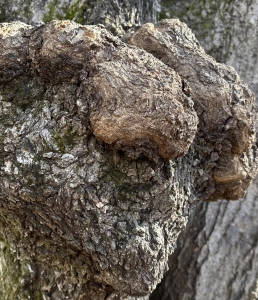
Always alert for unusual tree forms and features, I spotted this agrobacterial crown gall about 20 feet up the trunk of a yellow buckeye.

Oak Park Trail


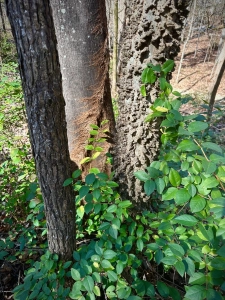
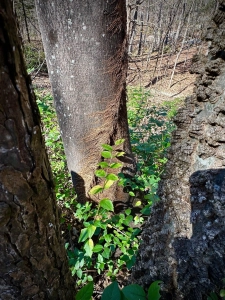
This triad of pole-size hickory, paulownia, and hackberry (left to right) struck me as peculiar with three distinct species clustered so tightly. Winter honeysuckle serves as basal greenery. A Virginia creeper vine, with air roots clinging to the stem, grows diagonally along the paulownia.

Oak ParkOak Park


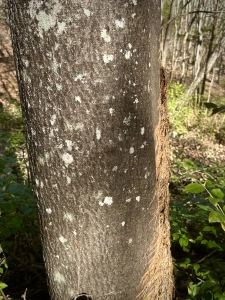
Paulownia is native to east Asia. Common names for paulownia include princess tree, royal paulownia, and butterfly tree. Its bark, flowers, and leaves are distinct.

Oak Park


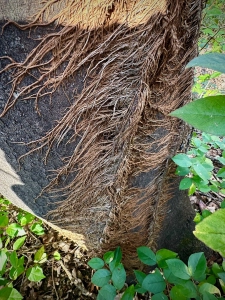
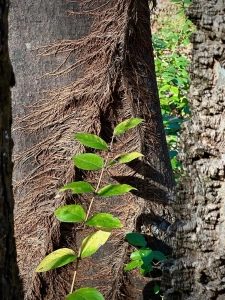
People often see Virginia creeper’s prominent air roots and mistake the vine for poison ivy, which has finer, more hair-like air roots.

Oak ParkOak Park


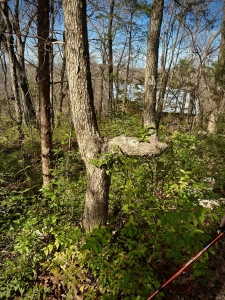
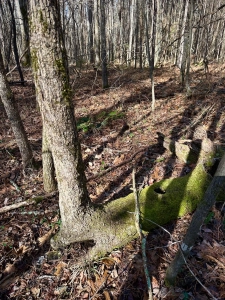
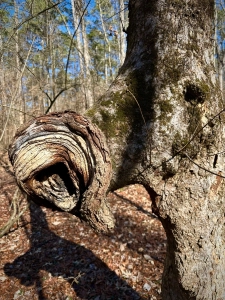
An Indian marker tree? No, this white oak was an acorn long after resident Native Americans were wildland residents in what is now Huntsville. Instead, something from above crashed upon the oak when just a sapling, bending its stem to 90 degrees at three feet above ground. The crushed stem sent a shoot vertically and another at the stub end of the bent and broken top. Sure, the bent stem points to something, but only coincidentally.

Oak Park


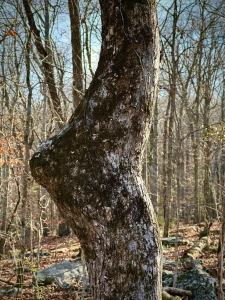
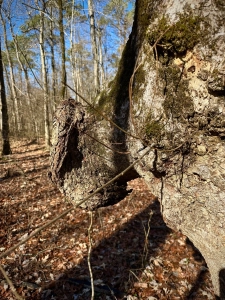
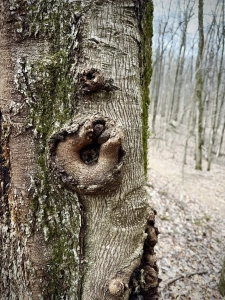
This elbow-bent white oak likewise suffered injury from above. My imagination, ofttimes a little too vivid, sees a deer face glancing to my left.

Oak Park


Perhaps it is I, rather than these curious tree form features, who is the anomaly…the oddity. I seldom meet other Nature enthusiasts so enamored with woodland mysteries as I.

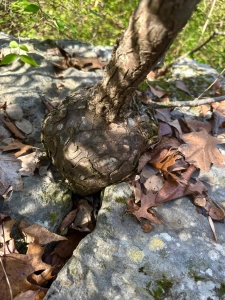
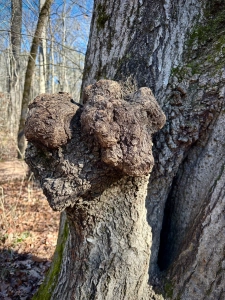
Let’s call this a sweetgum war club! Emerging from a limestone crevice, the tree sports a burl seeming to rest at its base, secured by the stone fissure. Burls result from fungal, bacterial, or viral infection, alone or in combination, triggering physiological abnormalities, much like a benign tumor in humans or other animals.

Oak Park


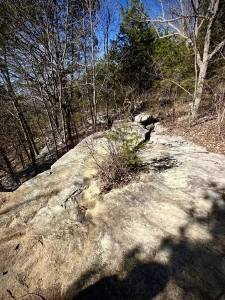
Known as Buzzards’ Roost, this exposed limestone ledge overlooks the cove and its wet season stream below. The ledge hosts a terrarium depression holding moisture, mosses, and shallow soil, and supporting a colony of herbaceous and woody plants. Does the scant isolated growth meet my criteria for oddity, curiosity, or mystery? I suppose that Nature sets no limits for standard, normal, and possible. Because I write the rules for these weekly Posts, if it catches my eye or piques my interest, a vegetated rock ledge depression qualifies.

Oak Park


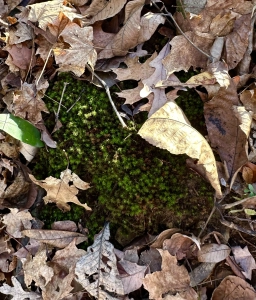
There’s nothing unusual about a moss-covered stone bedded in a brown leaf carpet, yet it did catch my eye and encourage a seasonally appropriate image. This is winter in our North Alabama woods. Don’t wait for a snowy forest floor scene. We average only two inches of snow annually. A warm sunny next day afternoon will not spoil this visual expression!

Oak Park


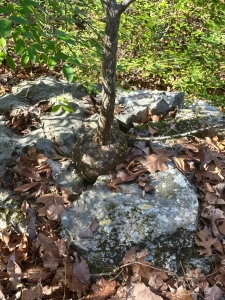
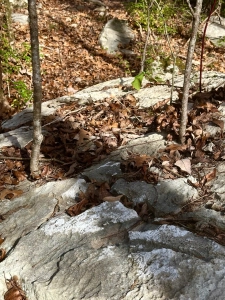
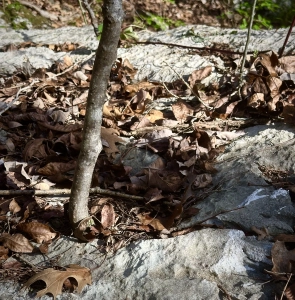
Any port in a storm may best account for these saplings finding suitable anchorage and succor atop a limestone outcrop. The storm consists of high seed predation, mice and other nibblers consuming germinants, physical stressors (desiccation, freezing, sunscald), insects, and diseases. Will these seedlings secure sustenance by extending roots to exploit mineral soil beyond the barren stone surface?

Oak Park


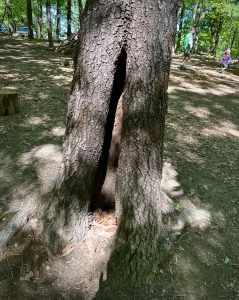
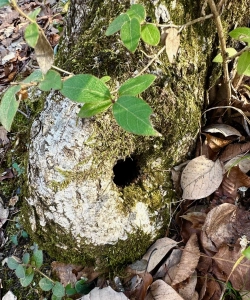
Speaking of ports in a storm, what self-respecting chipmunk would not welcome the shelter of a near-ground white oak cavity, which likely extends into the trunk many feet above?

Oak Park


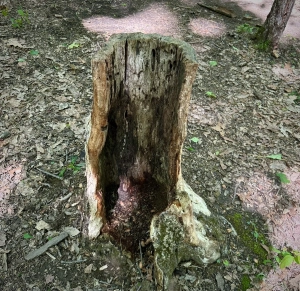
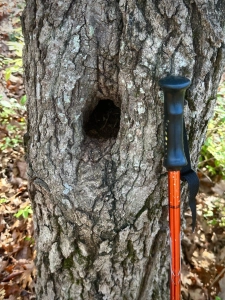
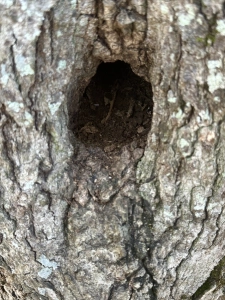
Peek into this three-feet-high red oak hollow. Soft interior debris evidences that critters have made a home. Reptile, bird, or mammal? Does it matter? I remind you that a tree does not a forest make. A tree is just one element of the entire ecosystem.

Oak Park


John Muir made the vast global life system complexity and interdependence clear:

When we try to pick out anything by itself, we find it hitched to everything else in the Universe.

Just as all living things are interconnected, life and death are a continuum. The labelled pignut hickory’s life has thrived in part on the decayed organic remains of prior life. Likewise, the fungal-hollowed tree’s decaying wood is already nurturing vegetation surrounding it. The carbon cycle spins without end.

Oak ParkOak Park


Our woodland roaming 12 days before Christmas revealed many hidden mysteries and delights. Some anticipated…some not!

Oak Park


John Muir distilled Nature into one succinct observation on a grand scale:

When we contemplate the whole globe as one great dewdrop, striped and dotted with continents and islands, flying through space with other stars all singing and shining together as one, the whole universe appears as an infinite storm of beauty.


Thoughts and Reflections


I offer these observations:

  • Just as all living things are interconnected, life and death are a continuum. (Steve Jones)
  • Perhaps it is I, rather than these curious tree form features, who is the anomaly…the oddity. (Steve Jones)
  • When we contemplate the whole globe as one great dewdrop, striped and dotted with continents and islands, flying through space with other stars all singing and shining together as one, the whole universe appears as an infinite storm of beauty. (John Muir)

Inhale and absorb Nature’s elixir. May Nature Inspire, Inform, and Reward you!


Note: All blog post images created & photographed by Stephen B. Jones unless otherwise noted. Please circulate images with photo credit: “©2026 Steve Jones, Great Blue Heron LLC. All Rights Reserved.”

I am available for Nature-Inspired Speaking, Writing, and Consulting — contact me at steve.jones.0524@gmail.com

Subscribe to these free weekly Nature Blogs (photo essays) at: http://eepurl.com/cKLJdL


Reminder of my Personal and Professional Purpose, Passion, and Cause

If only more of us viewed our precious environment through the filters I employ. If only my mission and vision could be multiplied untold orders of magnitude:

Mission: Employ writing and speaking to educate, inspire, and enable readers and listeners to understand, appreciate, and enjoy Nature… and accept and practice Earth Stewardship.

Vision:

  • People of all ages will pay greater attention to and engage more regularly with Nature… and will accept and practice informed and responsible Earth Stewardship.
  • They will see their relationship to our natural world with new eyes… and will understand more clearly their Earth home.

Tagline/Motto: Steve (Great Blue Heron) encourages and seeks a better tomorrow through Nature-Inspired Living!


Steve’s Four Books


I wrote my books Nature Based Leadership (2016), Nature-Inspired Learning and Leading (2017), Weaned Seals and Snowy Summits: Stories of Passion for Place and Everyday Nature (2019; co-authored with Dr. Jennifer Wilhoit), and Dutton Land & Cattle: A Land Legacy Story (2023) to encourage all citizens to recognize and appreciate that every lesson for living, learning, serving, and leading is either written indelibly in or is powerfully inspired by Nature. All four of my books present compilations of personal experiences expressing my deep passion for Nature. All four books offer observations and reflections on my relationship with the natural world… and the broader implications for society. Order any from your local indie bookstore, or find them on IndieBound or other online sources such as Amazon and LifeRich.

I began writing books and Posts for several reasons:

  • I love hiking and exploring Nature
  • I see images I want to (and do) capture with my trusty iPhone camera
  • I enjoy explaining those images — an educator at heart
  • I don’t play golf!
  • I do love writing — it’s the hobby I never needed when my career consumed me
  • Judy suggested my writing is in large measure my legacy to our two kids, our five grandkids, and all the unborn generations beyond
  • And finally, perhaps my books and Blogs could reach beyond family and touch a few other lives… sow some seeds for the future
 

Oak Park


Early Signs of Spring on the Goldsmith-Schiffman Wildlife Sanctuary!

I co-taught a Huntsville, Alabama LearningQuest session on America’s National Parks on the morning of February 12, 2026, at the Hampton Cove WellPoint Senior Community. Afterward, an exquisite early spring afternoon beckoned me to explore the eastern half of the nearby Goldsmith-Schiffman Wildlife Sanctuary. Walk with me as I share some early signs of wildland spring within the 400-acre reserve in the bottomlands along the Flint River.

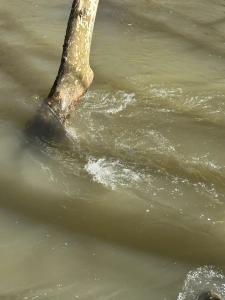
The Flint generally runs high with winter rains. On this day, the river is shy of bank-full, yet is high enough to submerge this sycamore’s base.


Here is my 48-second video of the main channel a few hundred yards from the Sanctuary’s east side entrance.


I’ve scheduled a prior winter season hike at the Sanctuary following several days of winter rains, only to be turned back by the Flint River overflowing its banks and sending floodwaters to within a hundred feet of the gravel parking lot.


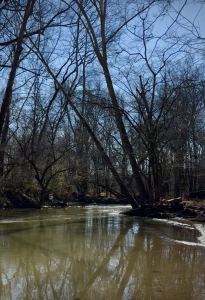
I recorded this 58-second video of side channel with narration, at a point opposite the cut-off island one-half mile from the lot.


The main river channel lies just downstream from where I stood.


Here’s the same view (51-second video) without my annoying narration.


The bottomland forests and meadows were saturated. Soaked areas welcomed male frogs already intent on attracting females. All critters are single-minded. Life is all about reproduction…sustaining the species…whether amphibian, reptile, bird, mammal, fish, human, or fungus.


This little guy is of lone voice, yet persistent. Is some lonely girl frog listening…tempted, lured, and approaching?

My 42-second video recorded the lone male calling plaintively.


I like the rustic signage, slowly yielding to time and decay, reminiscent of Sleepy Hollow!


Old agricultural fields, populated with sedges and various other meadow species are transitioning to forest courtesy of natural tree and shrub regeneration, as well as trees planted in seedling shelters, many of which are protecting seedlings that died when planted during an extended fall drought two years ago.


Here is my 60-second video of wetland mitigation efforts in the meadows.


The trail passes east from the mitigation fields through this meadow that is regenerating with volunteer, now shoulder-high sweetgum trees.


I recorded this 60-second video as I strolled along the trail.


Ironweed (left) and sweetgum line the trail.


Mature hardwood borders the meadow.


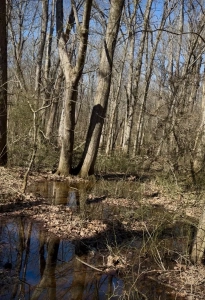
I repeat often that every tree tells a story. This American beech along the trail in the dense bottomland hardwood forest within hearing distance of Highway 431 traffic noise, supplies life-sustaining sustenance via root grafts to three living stumps, including the one below right at the tree’s base.


I reecorded this 61-second video with explanatory narrative of the beech and the three adjacent stumps.


Although still six weeks from the spring equinox, our peeper friend evidenced that spring was in the air. That’s a far cry from our time living in the far North.


Early Spring Ephemeral Bonus


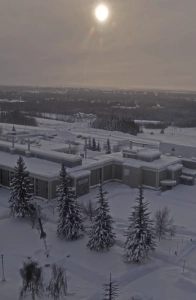
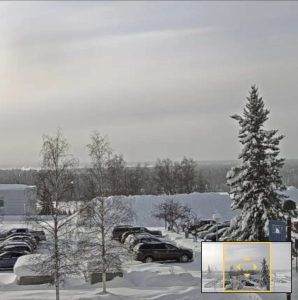
I’m drafting my photo essay prose on February 26. This morning at 5:00 AM Central Time, when our Madison, Alabama temperature was 58 degrees, I checked the temperature in Fairbanks, AK, my home from 2004-2008. It was negative 37; that’s 95 degrees colder. The snowpack was 40 inches. I copied these images at 11:00 AM local time from the University of Alaska Fairbanks webcam atop the Geophysical Institute.


The Fairbanks ground will not be absent snow cover through most of April. Spring flowers may not appear until mid-May.

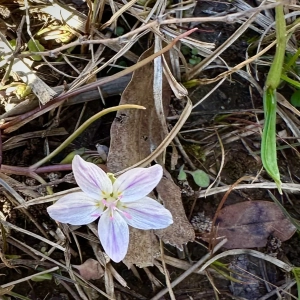
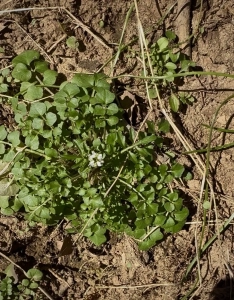
I’ve adjusted my calendar here in the South. Within the regenerating meadow, in mid-February, I spotted two Virginia spring beauty blossoms (one at left). The flowering cress (right) presented itself on the sandy shore across from the island.


I loved our four-year Alaska venture, even the deep winters. I could have stayed for many years, but both of our adult children blessed us then with our first two grandkids, who this May will graduate high school! Life itself is a rewarding adventure, enriched many fold by our time in The Last Frontier — The Big Broad Land Way Up Yonder!


Thoughts and Reflections


I offer these observations:

  • Life is all about reproduction…sustaining the species…whether amphibian, reptile, bird, mammal, fish, human, or fungal. (Steve Jones)
  • Spring work is going on with joyful enthusiasm. (John Muir)

  • Life is either a daring adventure or nothing. (Helen Keller)

Inhale and absorb Nature’s elixir. May Nature Inspire, Inform, and Reward you!


Note: All blog post images created & photographed by Stephen B. Jones unless otherwise noted. Please circulate images with photo credit: “©2026 Steve Jones, Great Blue Heron LLC. All Rights Reserved.”

I am available for Nature-Inspired Speaking, Writing, and Consulting — contact me at steve.jones.0524@gmail.com

Subscribe to my free weekly photo essays (like this one) at: http://eepurl.com/cKLJdL


Reminder of my Personal and Professional Purpose, Passion, and Cause

If only more of us viewed our precious environment through the filters I employ. If only my mission and vision could be multiplied untold orders of magnitude:

Mission: Employ writing and speaking to educate, inspire, and enable readers and listeners to understand, appreciate, and enjoy Nature… and accept and practice Earth Stewardship.

Vision:

  • People of all ages will pay greater attention to and engage more regularly with Nature… and will accept and practice informed and responsible Earth Stewardship.
  • They will see their relationship to our natural world with new eyes… and will understand more clearly their Earth home.

Tagline/Motto: Steve (Great Blue Heron) encourages and seeks a better tomorrow through Nature-Inspired Living!


Steve’s Four Books


I wrote my books Nature Based Leadership (2016), Nature-Inspired Learning and Leading (2017), Weaned Seals and Snowy Summits: Stories of Passion for Place and Everyday Nature (2019; co-authored with Dr. Jennifer Wilhoit), and Dutton Land & Cattle: A Land Legacy Story (2023) to encourage all citizens to recognize and appreciate that every lesson for living, learning, serving, and leading is either written indelibly in or is powerfully inspired by Nature. All four of my books present compilations of personal experiences expressing my deep passion for Nature. All four books offer observations and reflections on my relationship with the natural world… and the broader implications for society. Order any from your local indie bookstore, or find them on IndieBound or other online sources such as Amazon and LifeRich.

I began writing books and Posts for several reasons:

  • I love hiking and exploring Nature
  • I see images I want to (and do) capture with my trusty iPhone camera
  • I enjoy explaining those images — an educator at heart
  • I don’t play golf!
  • I do love writing — it’s the hobby I never needed when my career consumed me
  • Judy suggested my writing is in large measure my legacy to our two kids, our five grandkids, and all the unborn generations beyond
  • And finally, perhaps my books and Blogs could reach beyond family and touch a few other lives…sow some seeds for the future


November 2020

Me at right from a prior visit.


Brief-Form Post #60: Oddities, Curiosities, and Mysteries in a Wheeler National Wildlife Refuge Bottomland Hardwood Forest

I am pleased to add the 60th of my GBH Brief-Form Posts (Less than five minutes to read!) to my website. I get wordy with my routine Posts. I don’t want my enthusiasm for thoroughness and detail to discourage readers. So, I will occasionally publish these brief Posts.

I once again entered the Wheeler National Wildlife Refuge bottomland hardwood forest south of HGH Road on January 15, 2026. I sought a break from writing, reading, and preparing for the two courses I’ll be teaching in the winter term at the Osher Lifelong Learning Institute at the University of Alabama in Huntsville and at LearningQuest, a similar program offered through the Madison County Huntsville Library. Each time I explore this extraordinarily fertile and rich WNWR forest, I seek the beauty, magic, wonder, and awe that I always find hidden in plain sight.

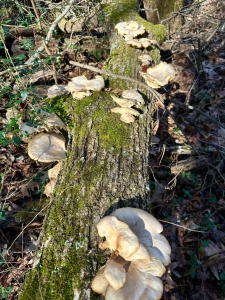
Temperature still in the upper twenties; these oyster mushrooms are frozen solid, adorning a downed hickory trunk, their mycelia decomposing the cellulose within. I’ve found that oysters are early saprophytes, flourishing within three years of tree mortality. I know nothing about cultivating oysters with home kits, much less commercial production. I harvested a few of these for omeletts, the first time I gathered frozen specimens.


Nearby I recorded this 59-second video within the forest,  including a big oak.


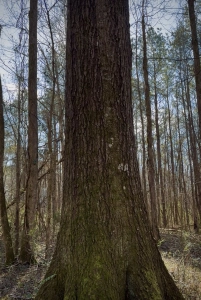
The oak’s diameter breast height (4.5-feet above ground; DBH) exceeded three feet.


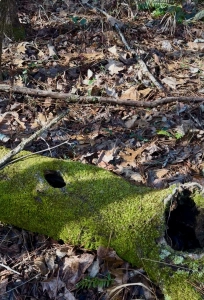
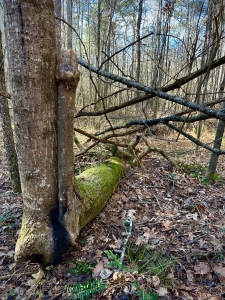
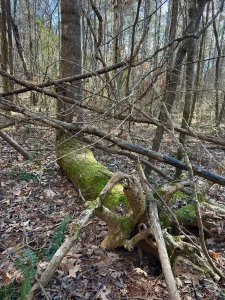
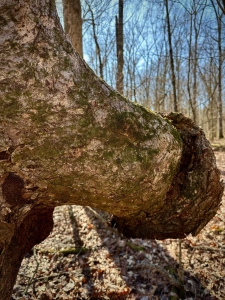
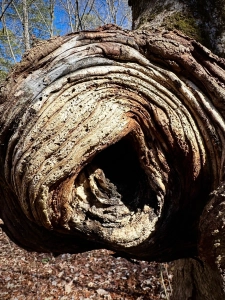
When still a supple sapling, this sweetgum suffered an impact from above, slamming it to the ground, yet maintaining its roots’ connectivity to the soil. The concussive force broke the now horizontal stem, where the gaping mouth remains today. A doramt bud erupted, sending a new stem/trunk vertically (left). The entire horizontal portion is hollowed by decay. The larger opening (right) is where the sapling roots still reach downward. The blowhole 18 inches from the severed topside root basal opening adds character and mystery to this woodland ogre.


I recorded this 59-second video of the fallen and somewhat recovered sweetgum and the similary tortured yellow poplar just 30 feet beyond.


The same toppled signature and fate. Both trees survive through natural resilience. Forest objects have been crashing onto hardwood saplings for thousands of generations of sweetgum and yellow poplar. Evolution has prepared both species (and many others) for striving beyond catastrophe to ensure seed production to extend the individual’s gene pool. The poplar at left fell toward the photo point. The other view is from the root end.


A peculiar red oak burl watched me approach. All of us, I posit, have playfully identified cloud shapes on spring and summer afternoons. I admit to engaging in the same pursuit with tree oddities. Can you do better than a praying mantis head with this one?


I may some day venture forth to capture images of these obscure, startling, and potentially evil growths in the dark of night…if I can get the nerve!


Washington Irving mused about the menace of darkness in The Legend of Sleepy Hollow:

There is nothing like the silence and loneliness of night to bring dark shadows over the brightest mind.

This sweetgum appendage matches the oak burl’s menacing scale! Shift the view angle by 90 degrees and get a completely different creature.


Subtle perspective shifts yield seeming endless varieties, especially when viewed through lenses of imagination. Again, try it in the dark!


Once again, Washington Irving (The Legend of Sleepy Hollow) saw the macabre and horror in such tree embodiments:

In the dark shadow of the grove, on the margin of the brook, he beheld something huge, misshapen, black, and towering. It stirred not, but seemed gathered up in the gloom, like some gigantic monster ready to spring upon the traveller.

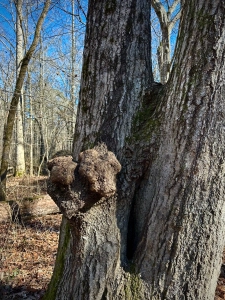
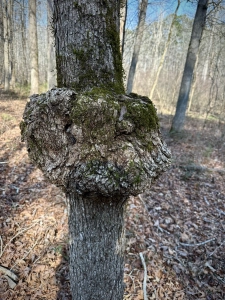
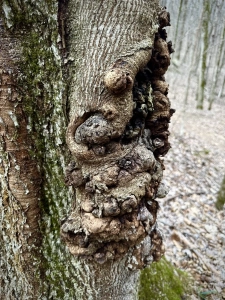
This eight-inch DBH eastern hophornbeam (Ostrya virginiana) sports an impressive waist-high burl, a spherical benign tumorous growth triggered by viral, bacterial, or fungal (or a combination) infectuous agents. If I stretch my imagination, I see a full frontal countenance with two eyes, pug nose, puffy cheeks, and a closed, slightly frowing mouth.

HGH


Albert Einstein was a tireless proponent of both imagination and good humor!

Imagination is more important than knowledge. Knowledge is limited. Imagination encircles the world.

The only thing that interferes with my learning is my education.

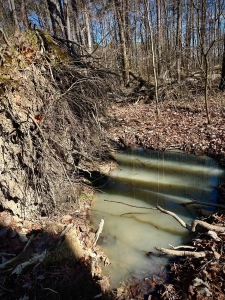
The bottomlands have shallow winter water tables. Windthrow is common, creating hummocks and hollows, mounds and pits, and pillows and cradles, colloquial expressions for the resultant microtopography. The hollows hold water until spring when evaporation and transporation increase to lower the water table. Many hold clear water. Critters are keeping this one muddy. Frogs?


Closing Observations


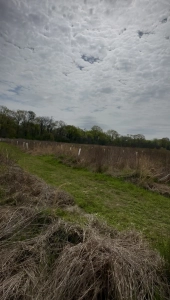
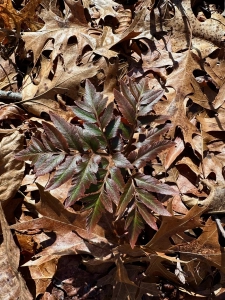
I spotted just a single cutleaf grapefern plant, fresh and colorful amid the stark brown leaves.


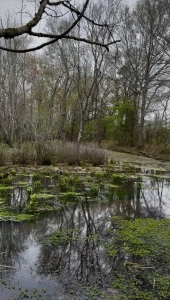
Before departing the refuge, I stopped by Blackwell Swamp along Jolly B Road. I leave you to enjoy the beauty of a sunny WNWR winter morning.


There is nothing dark, menacing, or gloomy about my morning Wheeler National Wildlife Refuge saunter.


Closing


I accept the challenge of distilling these Brief-Form Posts into a single distinct reflection, a task far more elusive than assembling a dozen pithy statements.

I cannot offer a quote more apropos than Washington Irving’s observation from The Legend of Sleepy Hollow:

In the dark shadow of the grove, on the margin of the brook, he beheld something huge, misshapen, black, and towering. It stirred not, but seemed gathered up in the gloom, like some gigantic monster ready to spring upon the traveler.


Nature’s special treats await our discovery, our understanding, and our interpretation!


Subscribe to my free weekly photo essays (like this one) at: http://eepurl.com/cKLJdL


Brief-Form Post #58: Forest Discoveries While Measuring Tree Heights on Monte Sano State Park

I am pleased to add the 58th of my GBH Brief-Form Posts (Less than five minutes to read!) to my website. I get wordy with my routine Posts. I don’t want my enthusiasm for thoroughness and detail to discourage readers. So, I will occasionally publish these brief Posts.


Alabama State Parks Northwest District Naturalist Amber Coger, fellow retired forester Chris Stuhlinger, and I measured selected tree heights on the morning of February 10, 2026, at Monte Sano State Park. We chose the exceptionally fertile lower, concave, northeast-facing slopes along the Sinks Trail. The soils are limestone-derived, deep, and well-watered. I visit the area several times annually… and marvel at the diversity of hardwood species, the towering heights of the trees, and the straight boles. I refer to this stand as a cathedral grove.

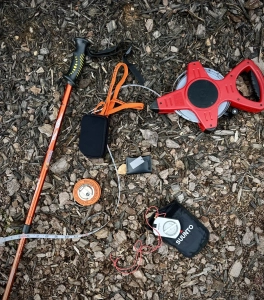
I brought my measurement tools for the tasks, positioned below with my trekking pole for scale: a 100-foot reel; a diameter tape; a 10-factor basal area prism; and a clinometer. Don’t look for a detailed exposition on their use. We used the reel to measure 100 feet horizontally from the tree base. At 100 feet, the clinometer percent scale translates directly to vertical feet below and above eye level. The diameter tape measures the tree diameter at breast height (DBH). The prism estimates the square feet of basal area per acre (at breast height).


Amber quickly learned the fine art and skill of employing these basic forestry instruments, in this case tallying basal area.

Monte SSP


A Magnificent Chestnut Oak

From my exhaustive experience in New York, Pennsylvania, Maryland, West Virginia, Virginia, and here in Alabama, chestnut oak commonly dominates ridgetops and upper slopes, poorer sites with shallow rocky soils that can be drouthy and of low fertility. Here’s a particularly gnarled ridgetop chestnut oak, squatty and mishapen, on the Rainbow Mountain Nature Preserve in nearby Madison, Alabama.


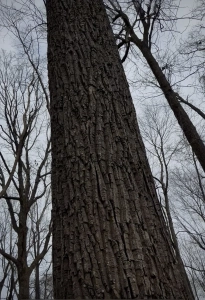
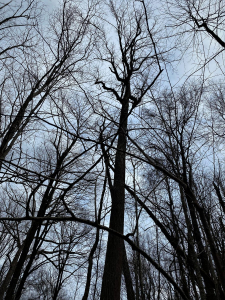
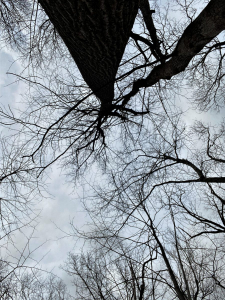
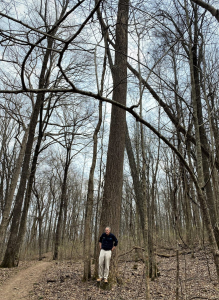
My chestnut oak stigma paints chestnut oak unfavorably. On better quality sites, chestnut oak doesn’t compete effectively with faster growing species like yellow polar, basswood, northern and southern red oak, and hickories. This chestnut oak along the Sinks Trail had caught my eye on previous visits. Stately, straight, and fat, this individual is 35.8″ DBH, and stands a remarkable 122 feet tall. Across the 53 years since earning a forestry bachelors degree, I don’t recall seeing such a superb chestnut oak. Monte SSP


But low and behold, my search of the Alabama Forestry Commission’s 2025 State Champion Tree List revealed a different image than the one I’ve held for years. The Commission lists 32 oak species, including the chestnut oak champion, which stands at 147 feet, 25 feet taller than the Monte Sano specimen. Only the champion cherrybark oak is taller at 156 feet.

I pledge to adjust my chestnut oak stigma. I assure you that this is not the first time I have altered an impression based on knowledge, experience, and time, whether it be of people, places, or things. Another teachable moment surfaced during the morning. I have known this species as Quercus prinus since taking Dendrology in 1970, more than a half-century ago. Amber and Chris informed me that the esteemed gods of systematic botany and plant classification have recently (RECENT to me alone perhaps!) changed the species from prinus to montana. The Missouri Botanical Garden online reference reduced my chagrin:

Quercus montana, commonly called chestnut oak (also commonly called basket oak, rock oak and rock chestnut oak) is a medium to large sized deciduous oak of the white oak group that typically grows 50-70’ (less frequently to 100’) tall with a rounded crown. It is native to wooded slopes in dry upland areas, often with poor soils, from Maine to Indiana south to South Carolina and Alabama. It grows tallest in rich, well-drained soils.

The old timber beast occasionally resurfaces within me. This baby is a beauty: veneer log quality to at least 32 feet. Clear lumber all the way to the live crown. The thought just as quickly faded. Come on, Steve…for God’s sake, this is a State Park you old fool! Yet, I can’t shake the aroma of fresh sawdust and the rich patina of finished oak furniture. Or the heavenly warmth of a fine whiskey aged in a white oak barrel!

Monte SSP


Whether commercial forest product or State Park forest treasure, its value is high wherever it grows. Measured and noted, the tree will stand as a lesson within the park’s information and interpretation portfolio. Why is this specimen special? What site factors (soil, slope position, nutrients, moisture, aspect) enable this individual to succeed?


Yellow Poplar Reaching Skyward


A few hundred feet downslope, I made note of the cathedral grove of primarily yellow poplar when I entered the stand near the lowermost signatory sink on the trail five years ago (March 12, 2021).

Monte Sano


I photographed Jerry Weisenfeld, Alabama State Parks Advertising and Marketing Manager, standing beside the very same specimen that Amber, Chris, and I measured this February.

Monte Sano


The prominent sink captures all surface water within the karst basin, directing it to subsurface. I have not encountered anyone who can tell me where the subterranean flow surfaces.

I have told many groups that some of these poplars exceed 140 feet.


The state champion yellow poplar stands at 172 feet. The three of us measured DBH at 28.1″ and height at 155 feet, 17 feet short of the champion! Keep in mind the champion designation is based on three measures: height, crown width, and bole cicumference. There may be, and often are, trees of the same species that are taller than the winner.


Two complementary Delights


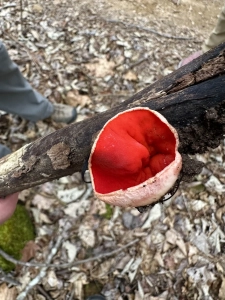
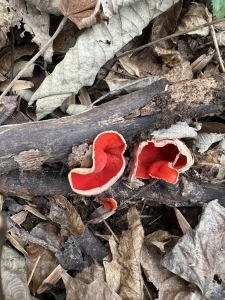
We found a colony of scarlet elf cup mushrooms near the yellow polar. I love the moniker, the cup shape, and its spectacular scarlet and white.


Here is my 57-second video of the elf cup forest floor population.


Within the sheltered poplar stand, I found a cankered hickory, a tree form curiosity posing near the poplar.


Leonardo da Vinci studied Nature’s forms and shapes:

To such an extent does nature delight and abound in variety that among her trees there is not one plant to be found which is exactly like another.

Nature is the source of all true knowledge.


Closing


I accept the challenge of distilling these Brief-Form Posts into a single distinct reflection.

I often observe that every tree, every stand, and every forest tells a story. Sometimes we can’t discern the individual tree’s tale while we are distracted by the forest. We chose to focus our attention on two trees. We know them now as individuals. We hope that Amber and future park naturalists will share their stories and the lessons drawn from them.

Leonardo da Vinci would have appreciated our intent:

To such an extent does nature delight and abound in variety that among her trees there is not one plant to be found which is exactly like another.


Brief-Form Post #56: Quick Circuit of the Dallas Fanning Nature Preserve

I am pleased to add the 56th of my GBH Brief-Form Posts (Less than five minutes to read!) to my website. I don’t want my enthusiasm for thoroughness and detail to discourage readers. So, I will occasionally publish these brief Posts.


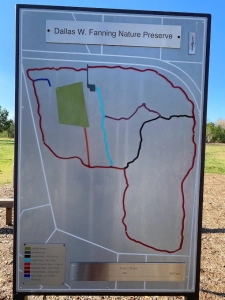
I returned to the Dallas Fanning Nature Preserve in Huntsville, AL, on January 4, 2026. I sought a taste of Nature near home. I had previously described the preserve as a 58-acre wounded landscape, a remnant product of associated industrial development. I sauntered along the preserve’s 1.5 miles of flat trails, intent on finding what Nature lessons lie hidden in plain sight. The preserve does not protect pristine wilderness from imminent threats in our rapidly urbanizing region. Instead, its designation reserves the property for immediate low-intensity nature-based recreation and for its long-term natural transition to wildness.

I first visited the preserve on November 28, 2022. My January 11, 2023, Great Blue Heron Post summarized my impression: https://stevejonesgbh.com/2023/01/11/dallas-fanning-nature-preserve/

The preserve is well-marked within a light industrial zone. I circuited all trails in 90 minutes, at a leisurely pace, pausing frequently for photographs and brief videos.


The trails are gentle well-surfaced, and flat. The only challenge I encountered was mental — trying to reconstruct the story of the past use that created the tortured land, most of which through preservation is destined to recover naturally to brush and forest.

My 60-second video captures the most severely disturbed area.


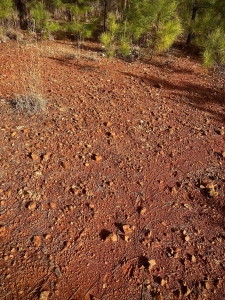
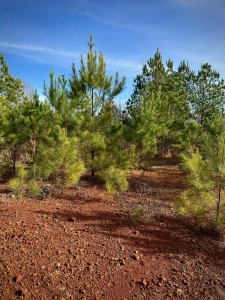
The associated industrial development stripped and leveled at least 20 percent of the tract, since planted to loblolly pine. This is raw subsoil…course, stony, absent organic matter, infertile, and xeric. The pine are chlorotic, stunted, and doomed to at least decades of insufficient nutrients and moisture.


Dark green foliage and much larger trees signal pockets of lesser disturbance. Imagine standing at this location in 2126 at a photoboard showing vegetation progression in ten-year increments since 2026!


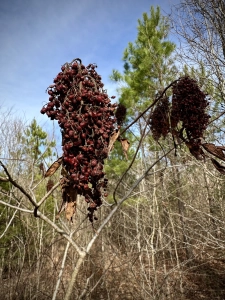
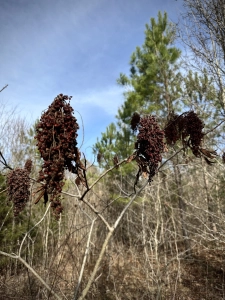
Less harshly disturbed sections beyond the planted pine, where some modicum of residual topsoil remains, are converting to brush and hardwood trees. Shining sumac is flourishing. Nature is adept at reclaiming abused land. A new forest is emerging.


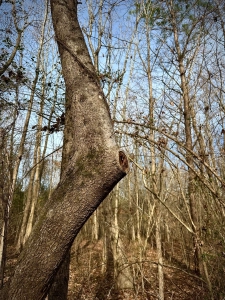
The trails also transect a 30-50 year old forest. Always alert for tree form curiosities, I spotted this black cherry tree that some force (falling branch or tree, an ice storm, wind, or machine) bent and broke the then saping-size stem. The tree sent a shoot skyward at the break, retaining its bent lower trunk and the break-point stub. Every tree has a story to tell.


Here is my 60-second video of the preserve’s 3.5-acre greenspace adjacent to the ample parking lot.


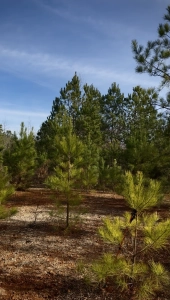
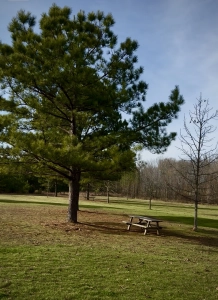
I stopped near a loblolly pine destined to provide summer shelter for a picnic table.


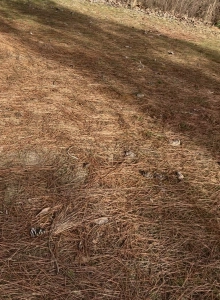
Already its crown is depositing pine straw mulch, yet another example of Nature’s insistence on healing the insults from past disturbance.


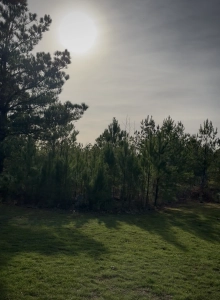
Taken from near the green space pine tree, this photo shows the emerging forest surrounding the green space.


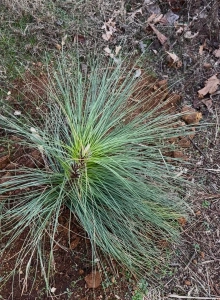
Preserve managers have recently planted longleaf pine along the field edge. The seedlings will require supplemental watering during dry periods over the initial 2-3 summers.


I view the Dallas Fanning NP as a novelty variety of preserve. I’m accustomed to seeing wildland preserves. I view this one as an outlier, in effect a former wasteland…an afterthought…attempting to steward its transition to a desired future condition. Additionally, I see it as a cause worthy of monitoring, documenting (permanent photo-points), and celebrating. I plan to visit every 2-3 years. I’ll keep you posted.


Closing


I accept the challenge of distilling these Brief-Form Posts into a single distinct reflection, a task far more elusive than assembling a dozen pithy statements.

I cannot offer a quote more apropos than an observation I made in the text above:

Nature is adept at reclaiming abused land. A new forest is emerging.


Nature’s special treats await our discovery, our understanding, and our interpretation!


Subscribe to my free weekly photo essays (like this one) at: http://eepurl.com/cKLJdL


Mid-December Saunter on Monte Sano Oak Park Trail

I co-led a North Alabama Land Trust Nature Hike on December 13, 2025, at Monte Sano Nature Preserve. I had never trekked the Oak Park Trail, which climbs ~300 feet up the north side of Monte Sano Mountain, returning via a counterclockwise circuit to the trailhead. Like so many of my first-time treks, I didn’t know what to expect. Join me as I share my reflections, observations, a few images, and one brief video.

The trail is within the city of Huntsville, just 25 minutes from my home. My career took Judy and me through thirteen interstate moves in this sequence: Cumberland, MD to Syracuse, NY; Franklin, VA; Savannah, GA; Prattville, AL; Syracuse, NY; State College, PA; Auburn, AL; Cary, NC; Fairbanks, AK; Urbana, OH; West Chesterfield, NH; Fairmont, WV; Madison, AL. We learned that we prefer wrinkled land, where a 25-minute drive can take me from 800 feet on the Tennessee Valley to the Cumberland Plateau’s Monte Sano, 1,600! I enjoy exploring the wrinkled terrain of northern Alabama and its rich forests. Wrinkled is different from mountainous. From our 1,000-foot elevation University of Alaska at Fairbanks, we could see Denali (aka Mount McKinley; 20,310 feet) on a clear day. The White Mountains rose 3,176 feet within 20 miles to our north. At the tender age of nearly 75 years, with two knee replacements, chest scars from triple bypass surgery, fully recovered from a minor stroke, and a few continuing aches and pains, wrinkled is sufficient to sate my woodland exploration appetite!

I recently saw a relevant meme:


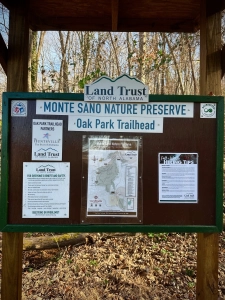
The Land Trust’s signage welcomes, orients, and directs visitors.

Oak Park


I borrow from an online descriptor of the trail, here is the route we followed: Climb up the north side of Monte Sano! One of the favorite trails of our trail running groups is Oak Park, which you’ll follow until you get to the northern fork of the Buzzard’s Roost Trail, which features a small waterfall at the wetter times of the year. Take the loop of Buzzard’s Roost back down across the Dallas Branch Spring to the lower section of Oak Park, and climb back down to the parking lot for a short but vigorous hike.

Even this old forester, who knows most of our main canopy species by sight, appreciates tree identification plaques. It’s always nice to confirm my skills. Two old favorites, yellow poplar and northern red oak, shouted their greeting long before I read their name tags.


Sugar maple and American basswood likewise are easy to identify based on nearly 60 years of familiarity!

Oak ParkOak Park


The trail presented no difficulty to our group. Mostly gentle grades, smooth surface, and well-marked.

Oak Park


A yellow buckeye stands beside a red oak (left). An identified black oak is at right.


Nearby are a pignut hickory (left) and paulownia (right).

Oak Park


The rock formation below resembled a dry waterfall, yet there was no evidence that surface water flows even during heavy rains. Does it under special conditions, less frequently than annually, carry water? Decadal floods? One hundred-year events?

Oak Park


A minor wooden bridge crosses a ravine, currently dry.


A trailside marker describes another footbridge, this one constructed using “no power tools, only saws, hammers, wedges, etc. over a period of 3.5 days in April 2017.”

Oak Park


Here is the referenced video of a hand-built black locust bridge:


Black locust wood is disease resistant, renowned for use as fence posts.

We chose the Buzzards Roost Trail to continue our counter clockwise citcuit, eventually returning us to Oak Park Trail at an intersection where we had earlier passed to the left.

Oak Park


Buzzards Roost provided a nice place to rest and enjoy the clear beauty, a place that gave me a feeling that we were far higher than 1,300 or so feet.

Oak Park


We looked downhill from the Roost. A crooked green ash tree, at the base of the ledge, drew closer with the telephoto lens.

Oak Park


Further magnified, a pool of water reflecting branches above it hints that even in a dry autumn, moisture is present. I can accept that were I to return in a period of mid-winter rains, the Roost would feature a small waterfall at the wetter times of the year!

Oak Mountain NP


We descended the limestone slabs working our way to Dallas Branch Spring below the Roost. We passed a large gnarly white oak fronted by a tortured looking eastern redcedar.

Oak Park


There’s little soil and only seasonally abundant water to sustain forest cover.

Oak Park


Dallas Spring greeted us with surface water among the rocks.

Oak Park


Meager flow hinted of the wet season to come.

Oak ParkOak Park


Hidden beyond the trees, Buzzard’s Roost stands above the photo point (left). Water trickles downstream (right).

Oak ParkOak Park


The winter sky, soft cirrus and pale blue, drifts past beyond the canopy. This time of year we don’t need to distract ourselves with those pesky rising cumulus and 30 percent chances of afternoon showers…capable of drenching us with frog-strangling rains, gale force microbursts, and tree-slamming lightning bolts!

Oak Park


Okay, to be honest, I enjoy summer’s pop-up thundershowers. They add variety and spice to our long hot summers. They give us most of the rainfall that sustains the lush forests where I hike, explore, study, celebrate, and find spiritual renewal across the seasons. Winter rains, contrary to summer’s hit and miss downpours, are predictable days in advance.


Thoughts and Reflections


I offer these observations:

  • At my age, wrinkled land is sufficient to sate my woodland exploration appetite! (Steve Jones)
  • Like so many of my first-time treks, I had no expectation beyond knowing that I would find more than I sought! (Steve Jones)
  • All men are created equal; only the best can still go hiking in their seventies! (Anonymous meme)

Inhale and absorb Nature’s elixir. May Nature Inspire, Inform, and Reward you!


Note: All blog post images created & photographed by Stephen B. Jones unless otherwise noted. Please circulate images with photo credit: “©2026 Steve Jones, Great Blue Heron LLC. All Rights Reserved.”

I am available for Nature-Inspired Speaking, Writing, and Consulting — contact me at steve.jones.0524@gmail.com

Subscribe to my free weekly photo essays (like this one) at: http://eepurl.com/cKLJdL


Reminder of my Personal and Professional Purpose, Passion, and Cause

If only more of us viewed our precious environment through the filters I employ. If only my mission and vision could be multiplied untold orders of magnitude:

Mission: Employ writing and speaking to educate, inspire, and enable readers and listeners to understand, appreciate, and enjoy Nature… and accept and practice Earth Stewardship.

Vision:

  • People of all ages will pay greater attention to and engage more regularly with Nature… and will accept and practice informed and responsible Earth Stewardship.
  • They will see their relationship to our natural world with new eyes… and will understand more clearly their Earth home.

Tagline/Motto: Steve (Great Blue Heron) encourages and seeks a better tomorrow through Nature-Inspired Living!


Steve’s Four Books


I wrote my books Nature Based Leadership (2016), Nature-Inspired Learning and Leading (2017), Weaned Seals and Snowy Summits: Stories of Passion for Place and Everyday Nature (2019; co-authored with Dr. Jennifer Wilhoit), and Dutton Land & Cattle: A Land Legacy Story (2023) to encourage all citizens to recognize and appreciate that every lesson for living, learning, serving, and leading is either written indelibly in or is powerfully inspired by Nature. All four of my books present compilations of personal experiences expressing my deep passion for Nature. All four books offer observations and reflections on my relationship with the natural world… and the broader implications for society. Order any from your local indie bookstore, or find them on IndieBound or other online sources such as Amazon and LifeRich.

I began writing books and Posts for several reasons:

  • I love hiking and exploring Nature
  • I see images I want to (and do) capture with my trusty iPhone camera
  • I enjoy explaining those images — an educator at heart
  • I don’t play golf!
  • I do love writing — it’s the hobby I never needed when my career consumed me
  • Judy suggested my writing is in large measure my legacy to our two kids, our five grandkids, and all the unborn generations beyond
  • And finally, perhaps my books and Blogs could reach beyond family and touch a few other lives… sow some seeds for the future
 

Oak Park