Late August Query at Nearby Wheeler National Wildlife Refuge — Is It Really Old Growth?
NOTE: Some of my GBH photo essays were not routinely distributed from mid-February through mid-June. I will resend those one by one, beginning the first week of July. Here is my Post from June 16 (https://stevejonesgbh.com/2026/06/16/brief-form-post-62-bringing-the-outside-in-at-nashvilles-gaylord-resort/)
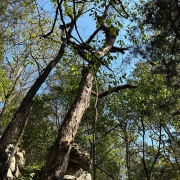
Since establishing a permanent retirement residence in Madison, Alabama, in 2018, I’ve explored the Wheeler National Wildlife Refuge bottomland hardwood forest west of Jolly B Road and south of HGH Road two to four times every year. Search my GBH Blog website (for Wheeler National Wildlife Refuge) to locate the dozens of related weekly photo essays. I’ve debated whether this particular stand meets old-growth criteria. I am declaring certainty! Yes, this is old-growth forest!!! Join me as I share observations, reflections, photos, and brief videos from my exploration of the stand on the morning of August 27, 2026. Again, the subject stand is old-growth, but I do not suggest it is original growth.
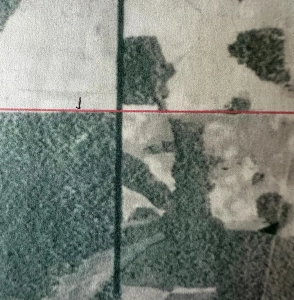
The 1937 aerial photograph (below) shows the HGH Road as a red line; the dark vertical mark separates Limestone (left) and Madison County (east). The penned vertical hash on the HGH Road denotes the area I discuss in this Post. The photo shows a fully developed hardwood forest 89 years ago. Individual crowns are apparent even then, indicating trees older than juvenile. I believe the stand in 1937 was at least 40-50 years old and is now 130+ years old, meeting one generally accepted criterion for old-growth.
Let’s review what the US Forest Service published three years ago that should have cleared up any doubt I may have had about whether the subject stand is old-growth.
USDA Forest Service Mature and Old-Growth Definition
April 2023 (https://www.fs.usda.gov/sites/default/files/mature-and-old-growth-forests-tech.pdf)
Mature and Old-Growth Forests: Definition, Identification, and Initial Inventory on Lands Managed by
the Forest Service and Bureau of Land Management
Old-Growth Forest Narrative Framework
1). Old-growth forests are dynamic systems distinguished by old trees and related structural attributes. Old-growth encompasses the later stages of stand development that typically differ from earlier stages in a variety of characteristics, which may include tree size, accumulations of large dead woody material, number of canopy layers, species composition, and ecosystem function (USDA Forest Service 1989).
2). In addition to their ecological attributes, old-growth forests are distinguished by their ecosystem services and social, cultural, and economic values. Old-growth forests have place-based meanings tied to cultural identity and heritage; local economies and ways of life; traditional and subsistence uses; aesthetic, spiritual, and recreational experiences; and Tribal and Indigenous histories, cultures, and practices. Dialogue with stakeholders and Tribal Nations, and the integration of local and Indigenous Knowledge with evolving scientific understanding, are critical to identifying and stewarding old-growth forests.
Paragraph one offers some insight but falls short of providing incontrovertible criteria. The second paragraph may assist managers of Federal lands. It does nothing to help me wrestle with the stand in question.
In broad summary, the new USFS publication doesn’t help. If you can tolerate a wee bit of sarcasm, the report’s author (Captain Obvious?) wrote, “Mature forests are delineated ecologically as the stage of forest development immediately before old-growth.”
Relying Upon My Time-tested Knowledge of Forestry
The relevant table in the report’s appendix identifies generalized minimum old-growth criteria for southeastern bottomland hardwood forests:
Stand Age — >100-120 years
Basal Area — >40 square feet
Large Tree Diameter — >20″ DBH
The subject stand is at least 120 years old. Basal area ranges from 60 to greater than 110 square feet per acre. Large trees exceed three feet DBH. Dominant tree heights reach above 110 feet. Dead and down woody debris is heavy. Some large downed trees are recent; others have been prostrate long enough to be decayed beyond species identification.
These bottomland soils are nutrient-rich and naturally well-watered. Site quality is high. Areas east of the subject stand, with no visible forest development in 1937, are now populated by what I characterize as mature hardwood and mixed pine/hardwood forest. Nature quickly takes possession, rapidly developing a new forest from abandoned agricultural fields.
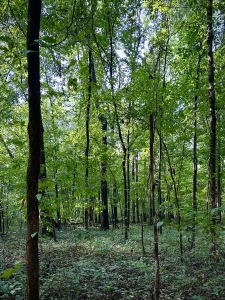
The subject stand has complex canopy tiers and variable understory.
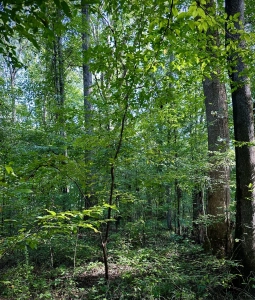
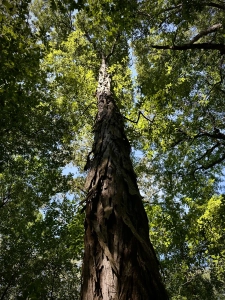
This shagbark hickory is nearly 30 inches DBH.
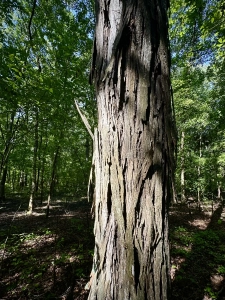
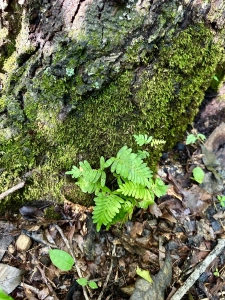
Its basal bark appears old, thick, and coarse. It hosts a small colony of resurrection fern and a thick covering of basal tree moss.
It commands a dominant canopy position well over 100 feet above the forest floor.
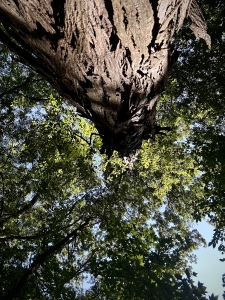
Nearby, former upper-canopy sentinels have fallen and are now decomposing on the ground. Nature is recycling biomass. The structure is tiered. Stems and foliage fill the frames from ground cover to overstory.
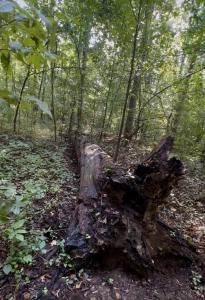
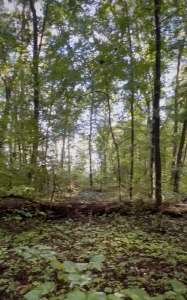
My 58-second video of the downed trees.
Oaks greater than 30 inches DBH are common.
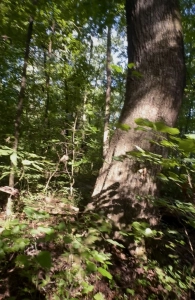
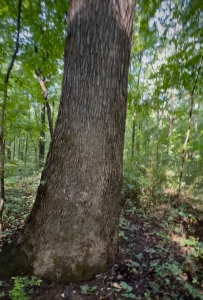
I am concerned that so many of the largest trees are scarred and diseased. Is this 30-inch-plus sweetgum attempting to tell me a story? Is it a damaged residual from a mid- to late 19th-century logging operation? Was it an operation that delivered massive original old-growth timber to market? The sweetgum would have been too small.
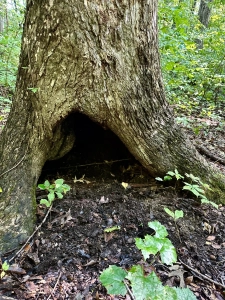
This 30-inch yellow poplar has prospered. Note the profusion of bird peck marks.
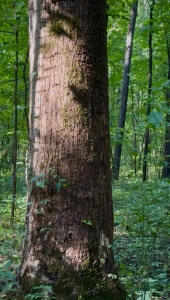
This massive red oak (species?) is thoroughly butt-diseased and probably hollowed. See the 3.5-4.00′ burl ten feet above the base.
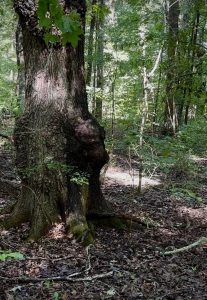
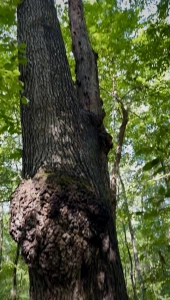
My 58-second video of the old burled oak.
This cherry bark oak is tall, straight, and apparently sound, showing no signs of injury or decay. I like the image of it reaching high into the canopy, backlit by the sun.
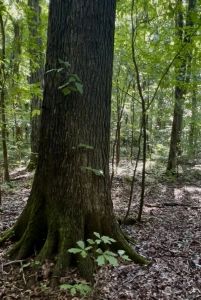
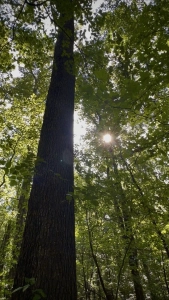
It photographed so nicely that I convinced it to star in a short video production.
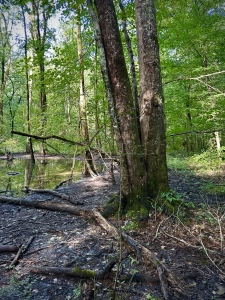
I wandered nearby into a ponded depression where a springhead maintains surface water year-round. The shade seemed to deepen. Even the mood darkened. This was not a light and airy place. I snapped a few photos and recorded the brief video.
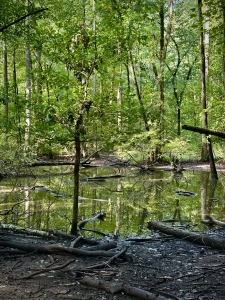
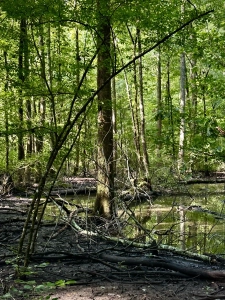
The mosquitoes pestered me to move on, discouraging me from a cursory review of the video. I recorded this 58-second video at the ponded depression.
I didn’t expect to see standing water, yet it contributed to the foreboding gloom.
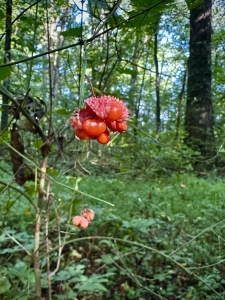
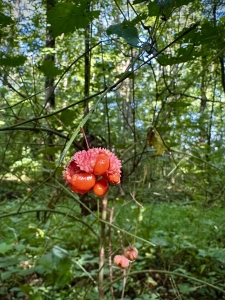
An American Euonymus (AKA hearts-a-bustin or strawberry bush) lifted the gloom.
An Amanita mushroom was one of the very few fungi I found. I carried a foraging bucket as I trekked. Perhaps if I had left it in my car, I would have spotted an abundance of edibles!
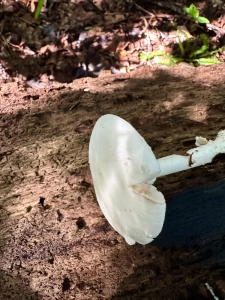
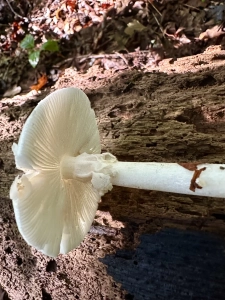
Ever mindful of encountering the slithering variety of reptilian life, I photographed an eastern box turtle. This fellow sports a handsome carapace, appearing freshly polished.
The mosquitoes pestered me to move on, discouraging me from a cursory review of the video.
Thoughts and Reflections
I offer these observations:
- I am declaring certainty! Yes, this is old-growth forest!!! (Steve Jones)
- If you can tolerate a wee bit of sarcasm, the report’s author (Captain Obvious?) wrote, “Mature forests are delineated ecologically as the stage of forest development immediately before old-growth.” (Steve Jones)
Inhale and absorb Nature’s elixir. May Nature inspire, inform, and reward you!
Note: All blog post images created & photographed by Stephen B. Jones unless otherwise noted. Please circulate images with photo credit: “©2026 Steve Jones, Great Blue Heron LLC. All Rights Reserved.”
I am available for Nature-Inspired Speaking, Writing, and Consulting — contact me at steve.jones.0524@gmail.com
Subscribe to my free weekly photo essays (like this one) at: http://eepurl.com/cKLJdL
Reminder of my Personal and Professional Purpose, Passion, and Cause
If only more of us viewed our precious environment through the filters I employ. If only my mission and vision could be multiplied untold orders of magnitude:
Mission: Employ writing and speaking to educate, inspire, and enable readers and listeners to understand, appreciate, and enjoy Nature… and accept and practice Earth Stewardship.
Vision:
- People of all ages will pay greater attention to and engage more regularly with Nature… and will accept and practice informed and responsible Earth Stewardship.
- They will see their relationship to our natural world with new eyes… and will understand more clearly their Earth home.
Tagline/Motto: Steve (Great Blue Heron) encourages and seeks a better tomorrow through Nature-Inspired Living!
Steve’s Four Books
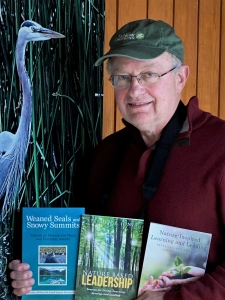
I wrote my books Nature-Based Leadership (2016), Nature-Inspired Learning and Leading (2017), Weaned Seals and Snowy Summits: Stories of Passion for Place and Everyday Nature (2019; co-authored with Dr. Jennifer Wilhoit), and Dutton Land & Cattle: A Land Legacy Story (2025) to encourage all citizens to recognize and appreciate that every lesson for living, learning, serving, and leading is either written indelibly in or is powerfully inspired by Nature. All four of my books compile personal experiences expressing my deep passion for Nature. They offer observations and reflections on my relationship with the natural world… and the broader implications for society. Order any from your local indie bookstore, or find them on IndieBound or other online sources such as Amazon and LifeRich.
I began writing books and Posts for several reasons:
- I love hiking and exploring Nature
- I see images I want to (and do) capture with my trusty iPhone camera
- I enjoy explaining those images — an educator at heart
- I don’t play golf!
- I do love writing — it’s the hobby I never needed when my career consumed me
- Judy suggested my writing is in large measure my legacy to our two kids, our five grandkids, and all the unborn generations beyond
- And finally, perhaps my books and Blogs could reach beyond family and touch a few other lives… sow some seeds for the future