Brief-Form Post #55: Auburn University’s College of Forestry, Wildlife, and Environment Crooked Oaks Nature Resort
I am pleased to add the 55th of my GBH Brief-Form Posts (Less than five minutes to read!) to my website. I don’t want my enthusiasm for thoroughness and detail to discourage readers. So, I will occasionally publish these brief Posts.
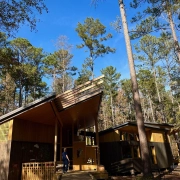
Arriving in Auburn on the evening of November 13, 2026, fellow retired forester (and Auburn University forestry graduate) Chris Stuhlinger, my grandson Jack (18), and I visited the College of Forestry, Wildlife, and Environment’s (CFWE) Crooked Oaks Lodge and Quail Hollow Gardens, the former estate of the university’s revered 1980s football coach, Pat Dye. The 415-acre preserve lies about 15 miles WSW of the university near Notasulga.
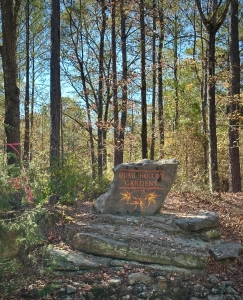
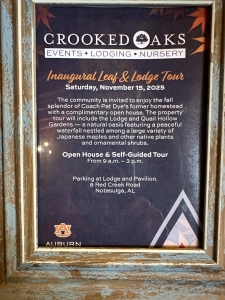
We did not know in advance that our visit coincided with the Crooked Oaks Open House. We modified our Saturday plans to include stopping by to see this exquisite addition to the CFWE, and assess its potential for integrating the property into the College’s education, research, and extension mission. Two old foresters with Auburn ties welcomed the chance to stroll the central trails, ponds, and infrastructure. Chris is a graduate and supporter of the College. I held a tenured full professor appointmentat in the College (then a School) from 1996-2001, when I served as Director, Alabama Cooperative Extension System.
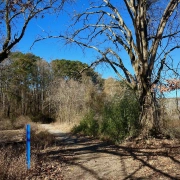
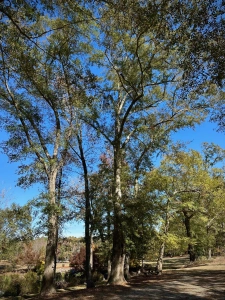
My intent with this Brief-Form Post is to offer a glimpse of Crooked Oaks, a delightful slice of the Old South charm of a traditional hunting and entertainment property, Lodge, and Gardens. I offer a few photographs. Two crooked oaks stand along the pathway from the Lodge to the former Dye residence.
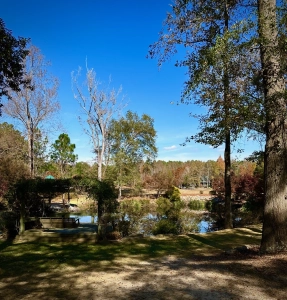
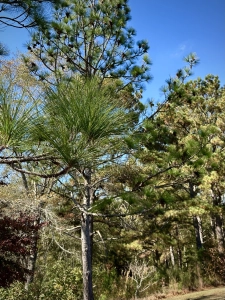
A 35-foot longleaf pine tree stands along the pathway beyond the foreground longleaf pine branch and needles to the my left as I snapped the photo. Loblolly pine dominates the evergreen component of the property.
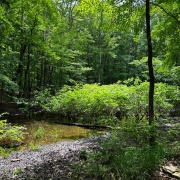
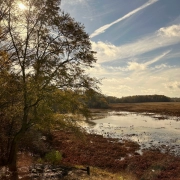
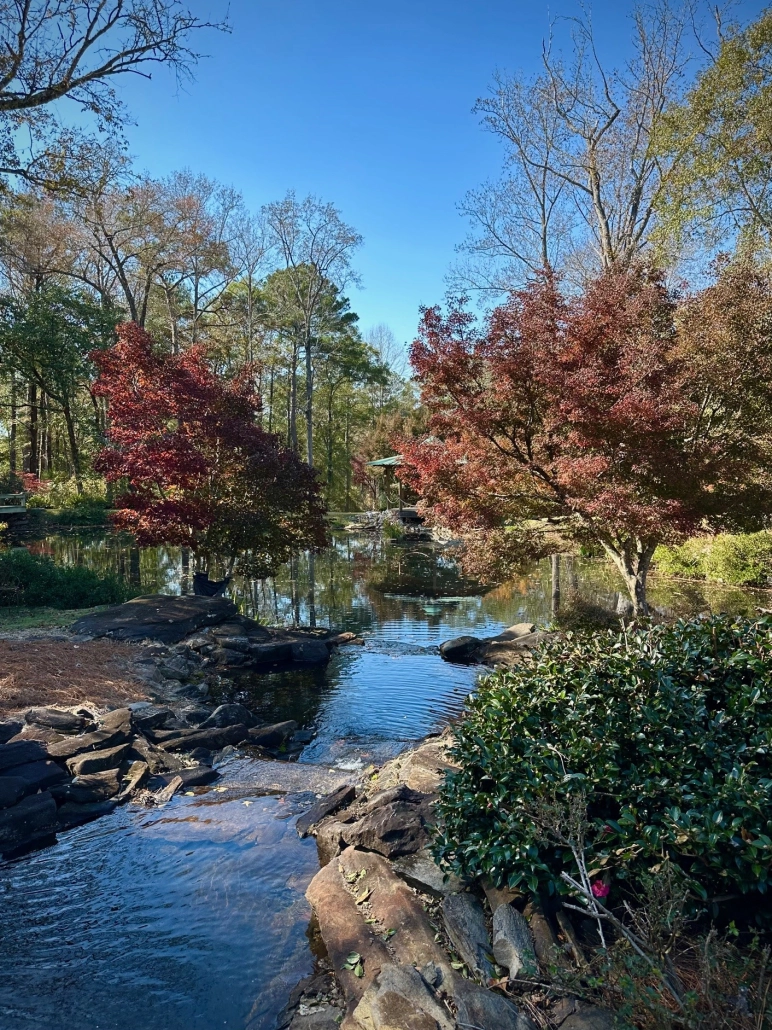
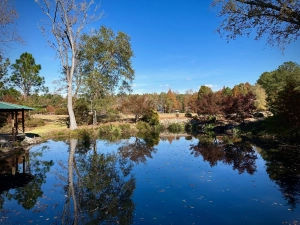
I (and the pond) reflected on the brilliant azure sky…not a cloud across the firmament, matching the open house with open sky.
I recorded this 58-second video to capture the essence of Crooked Oaks in a manner not attainable with still photos and my feeble written prose.
The former Dye residence overlooks the pond, amid the peace, quiet, tranquility, and comfort of Nature, far removed in time, distance, and dimension from the competive autumn Saturday maelstrom in Jordan-Hare Stadium and Pat Dye Field. I know that Nature is soothing, calming, and regenerative. Coach Dye expressed love for his farm in rural Notasulga. No wonder he sought refuge among the crooked oaks, and the Japanese maples he cultivated there.
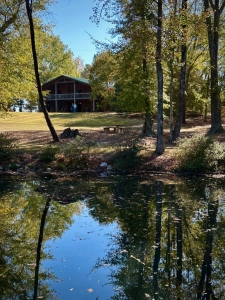
Like his Hall of Fame footall career, he established an Earth Stewardship legacy at Crooked Oaks Hunting Preserve and Quail Hollow Gardens Japanese Maple Farm & Nursery.
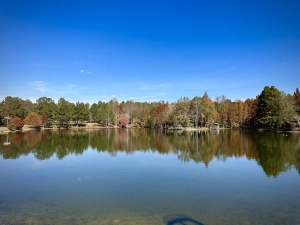
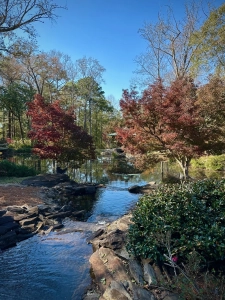
I imagine that the people coach Dye shaped and inspired and the lifeblood of the university he loved, flow metaphorically with the gentle stream tracing through the landscaped garden bordered by several of his cherished autumn-red Japanese maples.
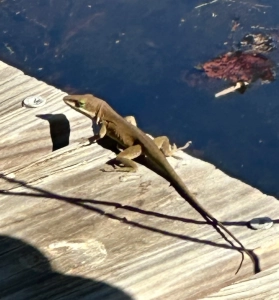
An Alabama native green anole proudly expressed ownership of a pondside deck. The lizard reluctantly allowed me to snap a photo, but seemed perturbed and impatient for me to continue walking.
I arrived at Auburn University as ACES Director in 1996. Dye coached his final footbal season in 1992. He resided on the farm for another 19 years after I left for the next step of my career in 2001. During my ACES tenure I knew only that Dye had been a football and athletics institution at AU. Dealing with establishing a Court-Ordered unified state extension system (combining the separate programs at AU and Alabama A&M), I had no time to learn more about Coach Dye, his Nature interests, or the property. Now retired in Alabama since 2018, I am intrigued. I want to know more about Crooked Oaks and the man who created it. I want to return, walk the 400+ acres, and peer into the Stewardship drive that fueled Dye’s passion for the land, the College, and the distant future.
Closing
I accept the challenge of distilling these Brief-Form Posts into a single distinct reflection, a task far more elusive than assembling a dozen pithy statements. I can only speculate on Coach Dye’s motives for creating the Crooked Oaks legacy and placing it in perpetuity with CFWE.
I step backward 80 years to Louis Bromfield’s non-fiction Pleasant Valley (1945), his tale of passion for rehabilitating the old worn out Ohio farm, Malabar, he purchased in 1938. Perhaps my favorite conservation statements among all the great observations by the Who’s Who of conservation greats is Bromfield’s:
The adventure at Malabar is by no means finished… The land came to us out of eternity and when the youngest of us associated with it dies, it will still be here. The best we can hope to do is to leave the mark of our fleeting existence upon it, to die knowing that we have changed a small corner of this earth for the better by wisdom, knowledge and hard work.
That is all any of us who care pasionately about earth stewardship can do. I dedicate my writing, teaching, speaking, and leading Nature tours to changing a small corner of this earth for the better by wisdom, knowledge and hard work.