Posts

Fungi and Other Discoveries along the Hickory Cove Nature Preserve’s Legacy Loop Trail

July 30, 2024, my two Alabama grandsons accompanied me on my first visit to the Land Trust of North Alabama’s Hickory Cove Nature Preserve northeast of Huntsville. We sauntered along the 1.75-mile Legacy Loop. I set the slow pace making observations and snapping photographs of mushrooms and other interesting features along the trail. They alternately surged ahead and fell behind, mostly the former.

Hickory Grove


Every north Alabama trail is rich with human history. Native Americans occupied these lands for 13 millennia, leaving few obvious traces. European settlers left their mark more visibly and indelibly. A few hundred feet into the forest, a side trail directed us to the spring house, a sure indication of prior domestication, and a clear suggestion that Hickory Cove is not wilderness by the untrammled by the hand of man definition. Wildness, certainly; wilderness, no.

Hickory Grove


Sam stands at the old spring house foundation, likely an early 19th Century refrigeration construct for surviving here in the deep south prior to electricity and modern food preservation. The concrete trough (right) sits 100 feet downhill, still at brimful. I wondered whether our Native antecedents tapped this natural water source.

Hickory Grove


Trailside Fungi


I repeat often my observation that death is an essential facet of life in the forest. Sometimes an agent of tree death and always a primary decomposer, fungi are ubiquitous in our north Alabama forests. Usually invisible inside wood, among ground-level organic matter, and within forest soils, fungi hyphae are active year-round. They periodically manifest as mushrooms, their reproductive organs, spewing billions of spores to generate new colonies.  A curry bolete drew our attention, its red cap waving a banner.

Hickory GroveHickory Grove


Most boletes are mycorhizal, sprouting from hyphae within the soil adjacent to roots (ectomycorrhizae) or alternatively within tree roots (endomycorrhizae), often symbiotically engaged with fine roots and root hairs of trees. This group of fungi includes neither pathogens or decomposers.

Hickory Grove


We also identified violet-grey boletes.

Hickory GroveHickory Grove


Six inches across, wood mushrooms demanded that we stop to examine and photograph.

Hickory Grove


Pale yellow Amanita had begun to fade and break apart; even decomposing fungi produce mushrooms subject, as are all organisms, to biological breakdown. It’s the common tale of ashes to ashes, dust to dust.

Hickory Grove  


Examining the photo above right, I spotted a rock-critter lurking behind the Amanita. What is this woodland denizen? I asked my immediate family. They saw a bear, dog, bighorn sheep, and turtle. Such it is with clouds, forest limestone rocks, and oddly shaped trees!


I’m reminded once again of Albert Einstein’s delightful fascination with imagination:

Imagination is more important than knowledge. For knowledge is limited to all we now know and understand, while imagination embraces the entire world, and all there ever will be to know and understand.

Fairy parachute mushrooms encircle the base of this dead cedar tree. An invasionary airborne fairy battalion dropped in the night prior, now huddled around the cedar awaiting a call to action.

Hickory Grove


My iNaturalist hesitantly identified these as turkey tail mushrooms (Trametes versicolor), also listing several species from the Stereum genus as possibilities. Rather than declare turkey tail, I will go with genus Stereum. This colony appears to be thriving on a recently fallen red oak.

Hickory Grove


Toothed crust mushrooms coat this mature hickory. A single deer mushroom stands at the edge. Tree moss clings to the trunk at the far left margin. I recall hiking within the rain forests of southeat Alaska, where nary a forest surface is absent some kind growth. We do not qualify as rain forest, albeit 55 inches annually is a lot of rain.

Hickory Grove


A closer look at the crust mushroom corroborates its moniker.

Hickory Grove


We found Trametes cubensis growing among tree moss on the deeply furrowed bark of a chestnut oak.

Hickory Grove


An edible mushroon, white-pored chicken of the woods visually decried its presence near the trail. The Land Trust prohibits collecting anything on its preserves. The boys and I made our observations, snapped a photograph, and left the mushroom behind.


Many of our native vines (muscadine, scuppernog, Virgina creeper, and poison ivy) ascend into the upper canopy by attaching their air roots to  rising tree stems and branches. Supplejack instead climbs by spiraling with companion vines or woody branches of trees and shrubs. I love the weakly striped perennially green stems.

Hickory Grove


Sam found two whitelips snails flourishing along the trail. We stopped to examine them. They continued along their merry way, at what we assessed as faster than a snail’s pace!

Hickory Grove

Hickory Grove


Many trees in our second (or third) growth forests are survivors from the prior generation. Imagine a prior landowner harvesting firewood, fenceposts, pulpwood, and scattered sawlogs around the time of the Second World War. The operation did not remove every tree, leaving hollow snags such as this red oak. It survived until this spring when its thin wood rind could no longer resist the forces of wind and gravity. Sam stands at left beside the hollow shell stump, which half-houses the accumulation of composted organic matter collected over a century or more. Just across the trail, Sam poses at the tree’s top where it leans almost vertically against another tree.


I took delight when Sam discovered the carcas and understood its story. I recorded this 58-second video at the scene. I’ve observed previously in these photo essays that a picture is worth a thousand words, and a brief video is priceless!


Nearly every north Alabama forest I explore dates its origins back 80-90 years. This 12-inch diameter green ash fell across the trail this summer. Crews made a clean chainsaw cut to remove it. Ash rings are very easy to discern and count. This cross-section, just a foot or two above the root collar, reads 86 years!

Hickory Grove


There are many stories revealed by a walk through the woods with grandsons. Knowing that Pap was scheduled for knee replacement surgery on August 20, the boys tried to stay within sight. My right knee hobbled me, subjecting me to unsteadiness and an inability to recover when and if I stumbled. About halfway, I did lose my balance and go down…it seemed to happen in slow motion. I’ve been stumbling in the woods for 70 years. I was unruffled; they were concerned. It seems just a few turns of the years that I was introducing their Mom (daughter Katy) to woodland wanders, then a few years when I carried these young men as babes when hiking, and now it is they who helped me back on my feet and offered assistence when the footing looked tenuous.

Einstein’s wisdom extended far beyond theoretical physics. Relative to my musings on my relationship to chldren and grandchildren, he observed:

Our death is not an end if we can live on in our children and the younger generation. For they are us; our bodies are only wilted leaves on the tree of life.


Thoughts and Reflections


I offer these observations:

  • Imagination is more important than knowledge. For knowledge is limited to all we now know and understand, while imagination embraces the entire world, and all there ever will be to know and understand. (Albert Einstein)
  • Our death is not an end if we can live on in our children and the younger generation. For they are us; our bodies are only wilted leaves on the tree of life. (Albert Einstein)
  • Death and decomposition are a big part of life in the forest.

Inhale and absorb Nature’s elixir. May Nature Inspire, Inform, and Reward you!


Note: Unless otherwise noted, all blog post images are created & photographed by Stephen B. Jones. Please circulate images with photo credit: “©2024 Steve Jones, Great Blue Heron LLC. All Rights Reserved.”

And Third: I am available for Nature-Inspired Speaking, Writing, and Consulting — contact me at steve.jones.0524@gmail.com


A reminder of my Personal and Professional Purpose, Passion, and Cause

If only more of us viewed our precious environment through the filters I employ. If only my mission and vision could be multiplied by untold orders of magnitude:

Mission: Employ writing and speaking to educate, inspire, and enable readers and listeners to understand, appreciate, and enjoy Nature… and accept and practice Earth Stewardship.

Vision:

  • People of all ages will pay greater attention to and engage more regularly with Nature… and will accept and practice informed and responsible Earth Stewardship.
  • They will see their relationship to our natural world with new eyes… and understand their Earth home more clearly.

Tagline/Motto: Steve (Great Blue Heron) encourages and seeks a better tomorrow through Nature-Inspired Living!


Steve’s Four Books


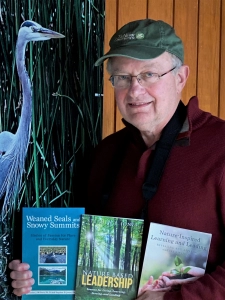
I wrote my books Nature Based Leadership (2016), Nature-Inspired Learning and Leading (2017), Weaned Seals and Snowy Summits: Stories of Passion for Place and Everyday Nature (2019; co-authored with Dr. Jennifer Wilhoit), and Dutton Land & Cattle: A Land Legacy Story (2023) to encourage all citizens to recognize and appreciate that every lesson for living, learning, serving, and leading is either written indelibly in or is powerfully inspired by Nature. All four of my books present compilations of personal experiences expressing my deep passion for Nature. All four books offer observations and reflections on my relationship with the natural world… and the broader implications for society. Order any from your local indie bookstore, or find them on IndieBound or other online sources such as Amazon and LifeRich.

I began writing books and Posts for several reasons:

  • I love hiking and exploring Nature
  • I see images I want to (and do) capture with my trusty iPhone camera
  • I enjoy explaining those images — an educator at heart
  • I don’t play golf!
  • I do love writing — it’s the hobby I never needed when my career consumed me
  • Judy suggested my writing is in large measure my legacy to our two kids, our five grandkids, and all the unborn generations beyond
  • And finally, perhaps my books and Blogs could reach beyond family and touch a few other lives… sow some seeds for the future


Hickory Grove


Steve’s Four Books


I wrote my books Nature Based Leadership (2016), Nature-Inspired Learning and Leading (2017), Weaned Seals and Snowy Summits: Stories of Passion for Place and Everyday Nature (2019; co-authored with Dr. Jennifer Wilhoit), and Dutton Land & Cattle: A Land Legacy Story (2023) to encourage all citizens to recognize and appreciate that every lesson for living, learning, serving, and leading is either written indelibly in or is powerfully inspired by Nature. All four of my books present compilations of personal experiences expressing my deep passion for Nature. All four books offer observations and reflections on my relationship with the natural world… and the broader implications for society. Order any from your local indie bookstore, or find them on IndieBound or other online sources such as Amazon and LifeRich.


Trees of the Hickory Cove Nature Preserve’s Legacy Loop Trail

On July 30, 2024, my two Alabama grandsons accompanied me on my first visit to the Land Trust of North Alabama’s Hickory Cove Nature Preserve northeast of Huntsville. We trekked along the 1.75-mile Legacy Loop. I set a slow pace making observations and snapping photographs. They alternately surged ahead and fell behind, mostly the former.

Hickory GroveHickory Grove


So much mystery and magic lie hidden in plain sight. I’ve confirmed from leading dozens of Nature hikes that most people observe little without someone drawing their attention to the unseen. Even Jack and Sam, the frequent objects of my badgering them to look, look, and look, walked past this trailside honey locust and its multiforked thorns until I halted them to LOOK! The compound thorns are unique to this species. I’ve heard from farmers that the spikes can penetrate and flatten a tractor tire. The honey locust’s rigid platy bark is another distinctive feature.

Hickory Grove


Near the trailhead, this hickory (the trail bears this species’ name) delivered three messages: the diamond trail sign; a fuzzy poison ivy vine, saying ‘stay alert’; and a softball-plus sized burl, encouraging me to look for tree form oddities and peculiarities. I have friends who turn gorgeous bowls from such burls!

Hickory Grove


We found fallen hickory nuts frequently along the trail. Somehow, in a flash, we’ve gone from spring’s bursting to mature hickory nuts. I’m reminded of my maternal grandmothers’ timeless wisdom, which from my then young perspective seemed absurd, “The older I get, the faster time goes.” Oh, how true…how painfully valid!

Hickory Grove


Another observation derives from this simple image of the boys (Sam is hidden by Jack’s larger body). I wanted to photograph the trail as they surged ahead. The symbolic meaning is poignant and rich with meaning. The trail and these young men will travel more deeply into the future than I. I am not ready to cease my woods-wanderings, yet I know I am slowing, and in time the boys will trek beyond my final loop. The best I can do is ensure that the memories of these days will accompany them. I’m reminded and comforted by Einstein’s relevant observation:

Our death is not an end if we can live on in our children and the younger generation. For they are us; our bodies are only wilted leaves on the tree of life.

Hickory Grove


I recorded this 58-second video that begins with the boys trekking along the trail.


The burl did remind me to be ever alert to forest treasures. To the extent time allowed, I thrilled at the ways of glaciers during my four years in Alaska. Few people sauntering the forests of north Alabama would have seen what appeared to me in the forked white oak image below. The green moss glacier is spilling from the gap between the two towering peaks. I imagine a vast green icefield beyond the gap. But then a mosquito whined, jerking me back to latitude 36-degrees North, 1,100 feet above sea level. Shamelessly again borrowing from Albert Einstein:

Imagination is more important than knowledge. For knowledge is limited to all we now know and understand, while imagination embraces the entire world, and all there ever will be to know and understand.

Hickory Grove


I am sure that a nether world lies within this shrinking three-inch diameter hickory portal, not one of evil spirit, but a dimension alive with the timeless entities that have dwelled within the forests of old and will populate future forests until the last leaf drops. Returning to the objective world of science, I am puzzled that no critter, neither bird nor mammal, is laboring to prevent the tree from completing its efforts to callous over the portal.

Hickory Grove


Neither oddity or curiosity, tree bark is distinctive enough that AI apps like iNaturalist can identify species somewhat reliably. I have spent enough time woods-wandering that I, too, do reasonably well. I love the foolproof pattern of shagbark hickory (left) and green ash. People who do not possess learned woodland savvy marvel at those of us who spout off species names with just a glance at a tree trunk. Seventy-three years can familiarize even a big dummy with species peculiarities. When my car engine light flashes or I hear unusual engine noises, I open the latch and lift the hood, peering into the threatening morass of wires, hoses, and bolts. I am as lost as the engineer in the woods who can’t tell oak from maple.

Hickory GroveHickory Grove


The Hickory Cove property is dense with cedars, a north Alabama early successional species, that courtesy of birds consuming cedar berries and disseminating the scarified seeds, colonized this site 90 years ago. Below is one of the more handsome cedars we encountered, standing tall and reaching into the main canopy.

Hickory Grove


Most of its cohorts have long since succumbed to hardwood competitors that now dominate this evolving forest. Resistant to decay, the old cedar stems remain visible, evidencing their place in stand succession.

Hickory GroveHickory Grove


Other cedars have died more recently, their slowly decaying stems still standing as understory and intermediate canopy snags.

Hickory Grove


Others are clinging to life, gathering only enough sunlight to hang on with a barely surviving living branch or two.

Hickory Grove


I recorded this 57-second cedar-centered video, examining a stand surrounding a remnant eastern red cedar sentry along the trail:


I spotted just this one cedar seedling. Unless some catastrophic event (fire, wind, ice, or harvest) brings widespread sunlight to the forest floor, cedar will not succeed itself.

Hickory Grove


The forest has many stories to tell. This cedar sported a strand of barbed wire, long since grown over by the tree. Its story? Someone used the living tree as a fence post many years ago, perhaps marking a boundary or unimproved pasture. The abundance of cedar suggests that much of this evolving forest succeeded from abandoned pasture. Not all forest stories are easy to read. Were it my land, I would devote more time to reading its forested landscape.

Hickory GroveHickory Grove


This old cedar and its neighboring hickory grew for decades side by side. A cedar fork reached across the hickory trunk, agitating the hickory, which did what any vibrant and rapidly growing tree would do…grow around the cedar invading its space!

Hickory Grove


Like a snake attempting to swallow a hapless frog, the hickory, in decades-long slow motion, appears to be consuming the now dead cedar branch. Now this certainly qualifies as a tree form oddity and curiosity!

Hickory Grove


Gravity is in fact a persistent, powerful, and abiding force. Two natural and oppositional forces help guide the direction of tree growth. Some species, like our common sourwood are predominately positively phototropic. They often adopt a corkscrew posture as they seek sunlight. Most of our forest main canopy species are negatively geotropic, strict adherents to growing opposite the pull of gravity. Regardless of what guides their vertical growth, gravity eventually pulls them down. Like time, gravity is undefeated. In this case, a large adjacent tree halted the oak’s fall at about 30-degrees from vertical.

Hickory GroveHickory Grove


I consider this a different class of tree form oddity. Its days as a leaner are numbered. As in all elements of Nature, nothing is static. Gravity has never lost a contest.

Hickory Grove


I remain a big fan of forest bridges…for two reasons. First, my bum right knee prefers that I not scramble down and back up this steep and stony gully. Second, I admire the aesthetic of a wooden crossing.

Hickory Grove


I recorded this 40-second video at the bridge, beginning with the boys crossing it.


At age 73, I find reward in where my forest wanderings take me. Decades ago, I demanded thrill, rugged terrain, spectacular vistas, and special features. I recall trails I will never again venture. Among them, ascending Mount Verstovia above Sitka, Alaska; circuiting Jenny Lake at the east base of Grand Teton; and attempting Mount Washington mid-winter. Approaching midway into my eighth decade, I find beauty, magic, wonder, awe, inspiration, and reward in a 1.75-mile loop close to home.


Thoughts and Reflections


I offer these observations:

  • My criteria for hiking adventure, daring, and reward relax with my age.
  • Our death is not an end if we can live on in our children and the younger generation. For they are us; our bodies are only wilted leaves on the tree of life. (Albert Einstein)
  • Every tree and forest has a story to tell; my goal is to read every forested landscape.

Inhale and absorb Nature’s elixir. May Nature Inspire, Inform, and Reward you!


Note: Unless otherwise noted, all blog post images are created & photographed by Stephen B. Jones. Please circulate images with photo credit: “©2024 Steve Jones, Great Blue Heron LLC. All Rights Reserved.”

Another Note: If you came to this post via a Facebook posting or by another route, please sign up now (no cost… no obligation) to receive my Blog Post email alerts: http://eepurl.com/cKLJdL

And Third: I am available for Nature-Inspired Speaking, Writing, and Consulting — contact me at steve.jones.0524@gmail.com


A reminder of my Personal and Professional Purpose, Passion, and Cause

If only more of us viewed our precious environment through the filters I employ. If only my mission and vision could be multiplied by untold orders of magnitude:

Mission: Employ writing and speaking to educate, inspire, and enable readers and listeners to understand, appreciate, and enjoy Nature… and accept and practice Earth Stewardship.

Vision:

  • People of all ages will pay greater attention to and engage more regularly with Nature… and will accept and practice informed and responsible Earth Stewardship.
  • They will see their relationship to our natural world with new eyes… and understand their Earth home more clearly.

Tagline/Motto: Steve (Great Blue Heron) encourages and seeks a better tomorrow through Nature-Inspired Living!


Steve’s Four Books


I wrote my books Nature Based Leadership (2016), Nature-Inspired Learning and Leading (2017), Weaned Seals and Snowy Summits: Stories of Passion for Place and Everyday Nature (2019; co-authored with Dr. Jennifer Wilhoit), and Dutton Land & Cattle: A Land Legacy Story (2023) to encourage all citizens to recognize and appreciate that every lesson for living, learning, serving, and leading is either written indelibly in or is powerfully inspired by Nature. All four of my books present compilations of personal experiences expressing my deep passion for Nature. All four books offer observations and reflections on my relationship with the natural world… and the broader implications for society. Order any from your local indie bookstore, or find them on IndieBound or other online sources such as Amazon and LifeRich.

I began writing books and Posts for several reasons:

  • I love hiking and exploring Nature
  • I see images I want to (and do) capture with my trusty iPhone camera
  • I enjoy explaining those images — an educator at heart
  • I don’t play golf!
  • I do love writing — it’s the hobby I never needed when my career consumed me
  • Judy suggested my writing is in large measure my legacy to our two kids, our five grandkids, and all the unborn generations beyond
  • And finally, perhaps my books and Blogs could reach beyond family and touch a few other lives… sow some seeds for the future


Hickory Grove


Goldsmith-Schiffman Wildlife Sanctuary Exploration with My Alabama Grandsons!

On November 22, 2023, my Alabama grandsons (Jack, age 16, and Sam, age nine) accompanied me to Huntsville, Alabama’s Goldsmith-Schiffman Wildlife Sanctuary. We enjoyed an unusually mild late-November mid-morning through early afternoon, entering from the east side, exploring the riparian hardwood forest, walking along the Flint River shoreline, and visiting the adjacent tupelo swamp. I offer observations, reflections, 27 photos, and four videos.

You can access 26 previous Great Blue Heron Posts from prior trips I’ve made to the Sanctuary. Search Goldsmith under the Blog banner at my website: https://stevejonesgbh.com/


Forest Wonder Potpourri


We discovered a potpourri of forest wonders. I’m grateful any time that the boys come along with me. Their lives and interests will in time diverge from their aging Pap’s. I am pleased that they still appreciate and learn from our forest wanderings. The Sanctuary remains one of our favorite destinations.

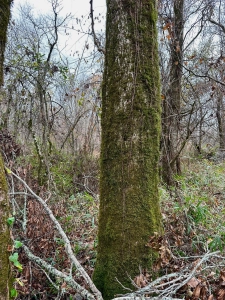
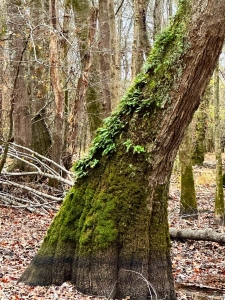
I never tire of finding a forest trunk draped in tree moss. This hickory, just 100 feet from the Flint River, evidences our moist temperate climate and its proximity to the morning fogs and heightened humidity along the river.


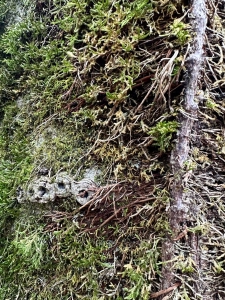
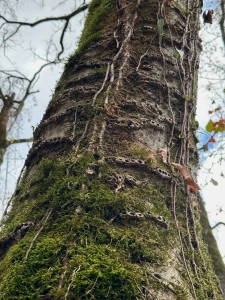
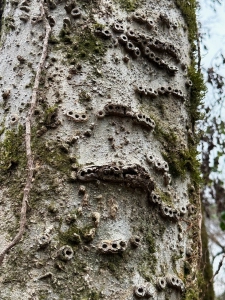
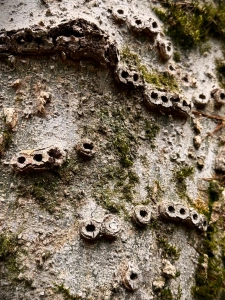
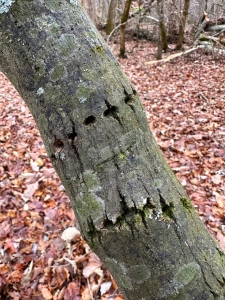
A nearby sugarberry trunk teems with life. Dense tree moss and a Virginia creeper vine adorn the stem below left. At the lower center of the photo at left and up the entire trunk within the photo at right, horizontal rows of yellow bellied sapsucker birdpecks portray a history of woodpecker insect foraging.


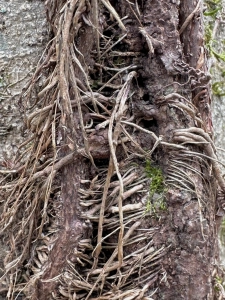
Virginia creeper literally clings to life on this sugarberry tree, its air roots grasping the trunk, assuring lifetime anchorage on its tree trunk lift to the upper canopy rich with direct sun to fuel life-sustaining photosynthesis. It bears repeating that Virginia creeper, wild grapevines, and supplejack do not climb trees. Instead, they grow up with the supporting tree. Imagine this Virginia Creeper germinating beside the sugarberry geminate. The creeper grew vertically at the same rate as the seedling, its leaves with each season remaining in full sunlight.


As with many organisms coexisting in Nature, Virginia creeper and sugarberry seem to have achieved some balance. That is, evolutionarily, the creeper has learned not to overgrow and suffocate the tree, for doing so would kill the vine’s highway to the sky. The vine enjoys a direct, full sunlight benefit from the tree. I am unsure of the reciprocal benefit to the tree from providing a lift to the vine. Without exploring the ecological literature for verification, I can only muse that the vine provides cover and access for birds and small mammals that feed on insects that consume sugarberry leaves. The vines might also ensure a canopy microclimate that deters fungi, viral agents, mold, and bacteria potentially harmful to the tree.

I am smitten by the cylindrical sugarberry birdpeck scars. So much of Nature’s beauty, magic, wonder, and awe is hidden in plain sight.


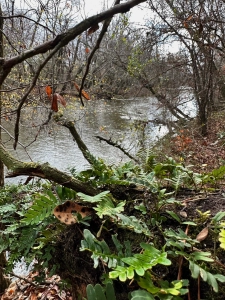
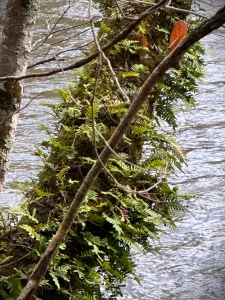
Resurrection fern, no longer in its drought-induced desiccated state, overhhangs the Flint River.


I recorded this 32-second video along the Flint River, amplifying the mood of peace and tranquility:


How can a naturalist not be attracted to such a beauty as this farkleberry (AKA sparkleberry), the largest member of our native blueberries (genus Vaccinium (arboreum)). Even its common names evoke mystery.


Nearby another handsome shrub drew us closer, a rusty blackhaw. I borrowed this description from an NC State University Extension online reference:

Rusty blackhaw is a deciduous multi-stemmed shrub or small single-stemmed tree in the Viburnaceae (haw) family.  It is native to eastern and central USA and is found in most areas of NC growing in rocky or dry woodlands and forests, along streams and valleys. The name comes from the rusty brown hairs on the undersides of leaves, buds and stems.

Rusty blackhaw grows in dry to moist loams in full sun to partial shade slowly reaching a height and width of 10 to 20 feet. Clusters of small, white flowers mature in early spring followed by a blue drupe that matures in fall. The leaves have excellent fall color. 


I love the dormant season with full understory visibility, no biting insects, and comfortable temperatures!


Tupelo Swamp


I recorded this 57-second video in the water tupelo swamp on the Sanctuary’s northeast quadrant. Recent rains were just beginning to rewater the swamp.


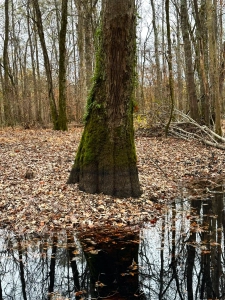
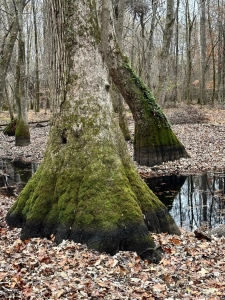
Tree moss skirts, clinging vines, buttressed trunks, swamp stain lines, and a forest floor bereft of vegetation characterize the Sanctuary’s tupelo stands. I am tempted to refer to these stands as special places, yet I could just as logically term dozens of other elements of the Sanctuary as special places.


Note the swamp water stain lines (on the tree at left) suggesting normal winter water depth). I wear my calf-high rubber boots when I visit mid-winter.


I recorded this 17-second video within the swamp. I am intent on making these grandson forays meaningful, educational, and fun.


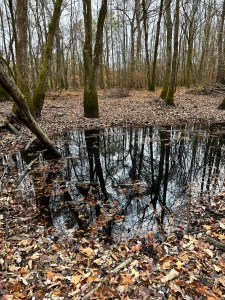
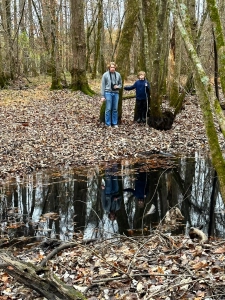
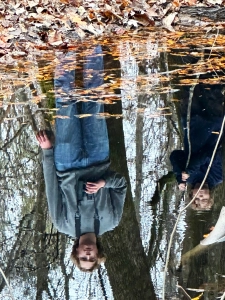
I seek to inspire mindful reflection, even as I remain alert to Nature’s reflections. Both of these photographs express the purpose and realization of that goal.


I can’t add anything to the power of this photo essays by adding to the verbal narrative.


Here’s a 36-second video from the same location.


These graceful swamp residents pose dutifully, seeming intent to reward our visit with their majestic form and rhythm.


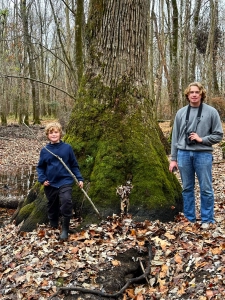
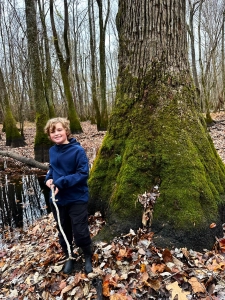
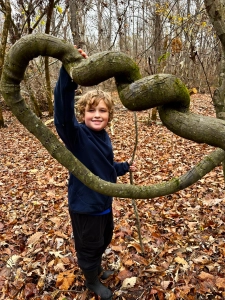
Back to the riparian forest, Sam poses with a hefty supplejack vine. The stem it had once wrapped is long since dead and decayed, leaving only the vine corkscrew. Yellow-bellied sapsucker birdpeck scars encircle the supplejack at right.


A Few Living Critters!


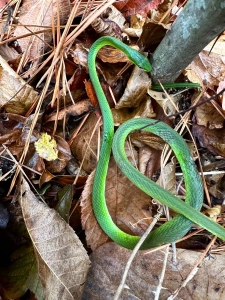
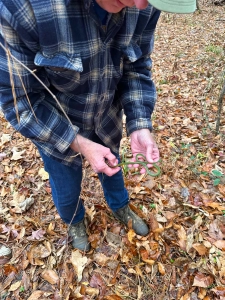
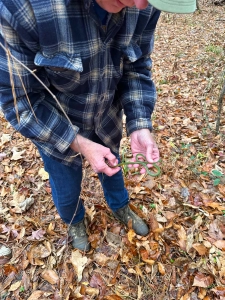
A mild late fall day, a rough greensnake surprised us, accommodating our disturbance and gentle handling. We anticipated we might see deer or squirrels, but did not expect to see a coldblooded critter. We bid the snake adieu.


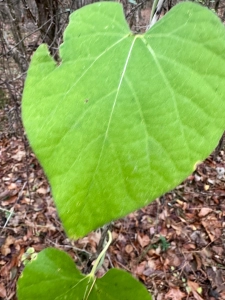
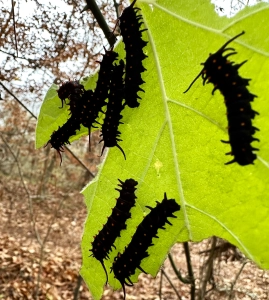
As we examined the snake, I noticed a few still-green pipevine leaves nearby. Knowing the plant’s exclusive hosting relationship to the pipevine swallowtail, I looked more closely, discovering a troop of the butterfly’s caterpillars. Online literature suggests that the larvae will soon form a chrysalis suspended several feet above the ground.


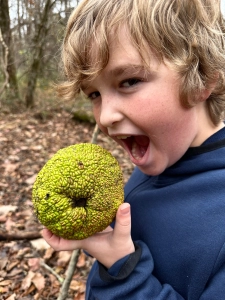
I’ll bring closure with this image of Sam feigning a bite from the fruit (some call it a hedge apple) of an osage orange.


We three boys enjoyed a great morning and early afternoon. I can only hope that they will remember these Nature outings as highlights of their young lives, and that the experiences yield a lasting relationship with Nature.

Thoughts and Reflections


I offer these observations:

  • I am intent on making these grandson forays meaningful, educational, and fun.
  • I love the dormant season with full understory visibility, no biting insects, and comfortable temperatures!
  • The Sanctuary, as do most wild areas of my acquaintance, hosts many special places.

Inhale and absorb Nature’s elixir. May Nature Inspire, Inform, and Reward you!


Note: Unless otherwise noted, all blog post images are created & photographed by Stephen B. Jones. Please circulate images with photo credit: “©2024 Steve Jones, Great Blue Heron LLC. All Rights Reserved.”

Another Note: If you came to this post via a Facebook posting or by another route, please sign up now (no cost… no obligation) to receive my Blog Post email alerts: http://eepurl.com/cKLJdL

And Third: I am available for Nature-Inspired Speaking, Writing, and Consulting — contact me at steve.jones.0524@gmail.com


A reminder of my Personal and Professional Purpose, Passion, and Cause

If only more of us viewed our precious environment through the filters I employ. If only my mission and vision could be multiplied by untold orders of magnitude:

Mission: Employ writing and speaking to educate, inspire, and enable readers and listeners to understand, appreciate, and enjoy Nature… and accept and practice Earth Stewardship.

Vision:

  • People of all ages will pay greater attention to and engage more regularly with Nature… and will accept and practice informed and responsible Earth Stewardship.
  • They will see their relationship to our natural world with new eyes… and understand their Earth home more clearly.

Tagline/Motto: Steve (Great Blue Heron) encourages and seeks a better tomorrow through Nature-Inspired Living!


Steve’s Three Books


I wrote my books Nature Based Leadership (2016), Nature-Inspired Learning and Leading (2017), and Weaned Seals and Snowy Summits: Stories of Passion for Place and Everyday Nature (2019; co-authored with Dr. Jennifer Wilhoit) to encourage all citizens to recognize and appreciate that every lesson for living, learning, serving, and leading is either written indelibly in or is powerfully inspired by Nature.

I began writing books and Posts for several reasons:

  • I love hiking and exploring Nature
  • I see images I want to (and do) capture with my trusty iPhone camera
  • I enjoy explaining those images — an educator at heart
  • I don’t play golf!
  • I do love writing — it’s the hobby I never needed when my career consumed me
  • Judy suggested my writing is in large measure my legacy to our two kids, our five grandkids, and all the unborn generations beyond
  • And finally, perhaps my books and Blogs could reach beyond family and touch a few other lives… sow some seeds for the future


All three of my books (Nature Based Leadership; Nature-Inspired Learning and Leading; Weaned Seals and Snowy Summits) present compilations of personal experiences expressing my (and co-author Dr. Wilhoit for Weaned Seals and Snowy Summits) deep passion for Nature. All three books offer observations and reflections on my relationship with the natural world… and the broader implications for society. Order any from your local indie bookstore, or find them on IndieBound or other online sources such as Amazon and LifeRich.

I now have a fourth book, published by Dutton Land and Cattle Company, Dutton Land & Cattle: A Land Legacy Story. Available for purchase directly from me. Watch for details in a future Post.