The Meadow at Pennsylvania’s Wolf Creek Narrows Natural Area
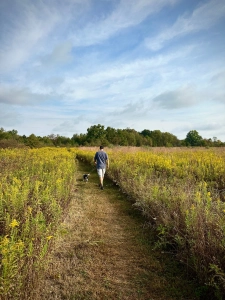
Wolf Creek Narrows Natural Area, owned and managed by the Western Pennsylvania Conservancy (WPC), is located in northwestern Butler County, Pennsylvania, just 30 minutes from where my son and his family reside north of Pittsburgh. Matt, his dog Oakley, and I circuited the 2.35-mile trail on the morning of September 22, the first day of autumn. My heart soared at the prospect of returning to an ecosystem shaped by a continental ice sheet just 13 millennia ago. This Post focuses on our passages (out from the trailhead and back) through a goldenrod-dominated autumn meadow.
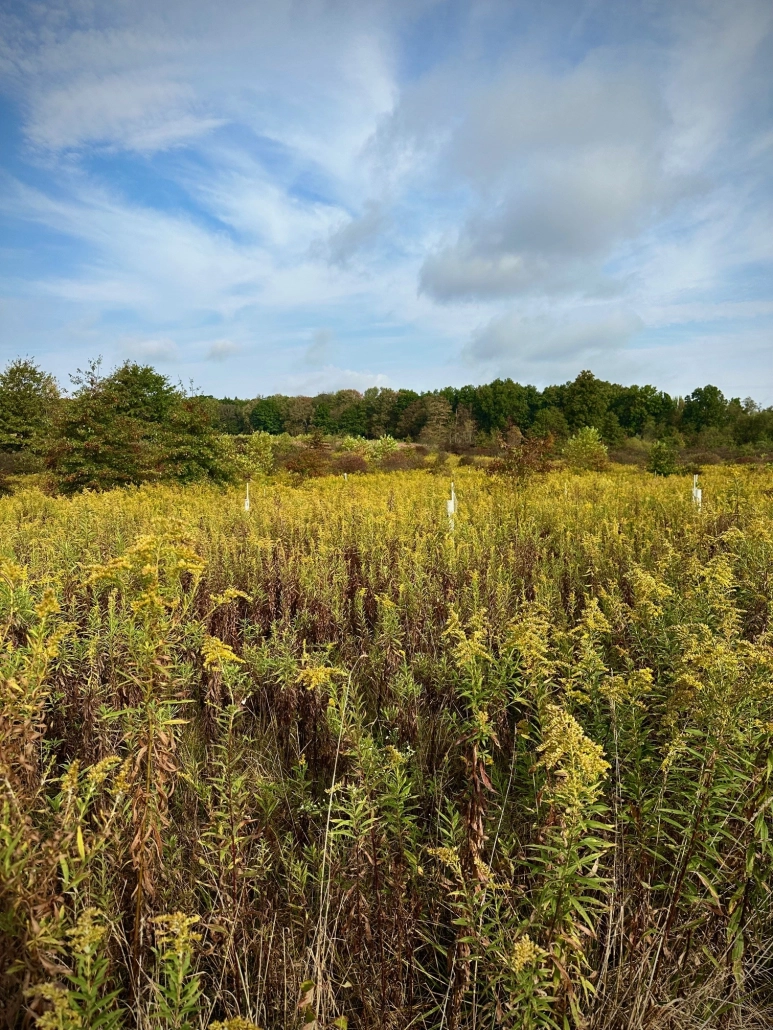
The 243 acre Natural Area includes several distinct ecosystems: meadow; forest/field ecotone; upland forest, forested riparian zone; and the immediate Slippery Rock Creek. I like the openess of the meadow, accenting the vibrant autumn sky above. Meadows are temporary landscape features unless managed to short-circuit the natural successional impetus to transition to forest cover. I am not sure whether the ash sapling in the photo at right was planted or is a volunteer.
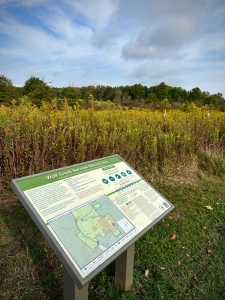
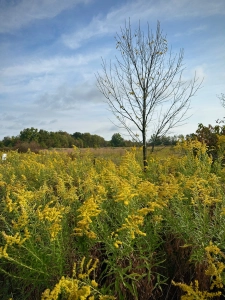
The perennial herbacious cover is dense, ideal for songbirds, small mammals, snakes, and other critters. As I drafted this text on December 2, 2025, western Pennsylvania was reporting several inches of fresh snow. I imagine diverse wildlife hunkered in the tangled vegetation beneath the snow.
I recorded this 58-second video in the luscious goldenrod meadow.
I can’t resist the image of goldenrod backdropped by the fall sky. The air, comfortable and clear, cut through my North Alabama mental fatigue with a long summer and a September dry spell. This a meadow still fresh, blooming, and vibrant, awaiting a first freeze, autumn rains, and an impending deep winter rest.
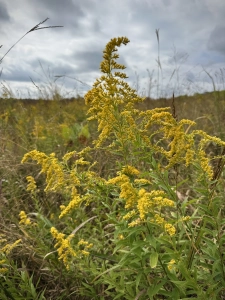
Hiking the meadow with Matt, sharing the autumn sunshine and exploration, reminded me of Einstein’s view of extending our life-reach beyond our own fleeting existence:
Our death is not an end if we can live on in our children and the younger generation. For they are us; our bodies are only wilted leaves on the tree of life. (Albert Einstein)
Some videos express the essence of a special place better without narration. I recorded this 59-second video focusing on the sounds of autumn breezes and late season insects.
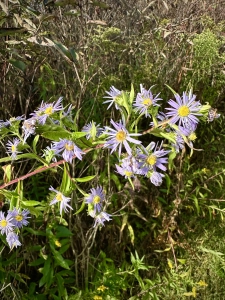
An ideal stage for late season bloomers, the meadow celebrates the end of a full summer of generous meadow sunshine with goldenrod, New England aster, and smooth blue aster. Bright flowers will greet the icy fingers certain to come.
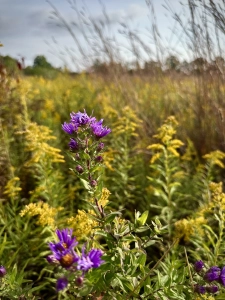
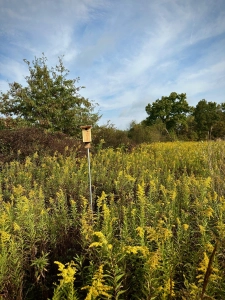
Supplemental wildlife accoutrements (a bluebird nesting box) enrich the meadow bird habitat.
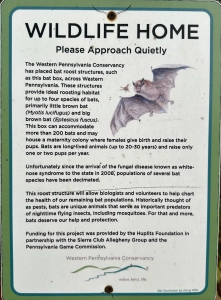
As does the bat house at the meadow/forest edge.
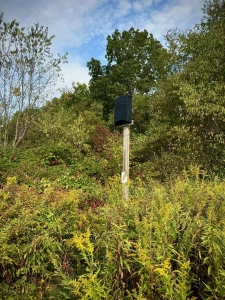
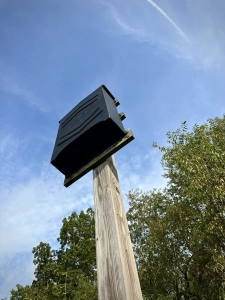
I compliment the LConservancy for both the artificial nesting structures and the excellent interpretive signage.
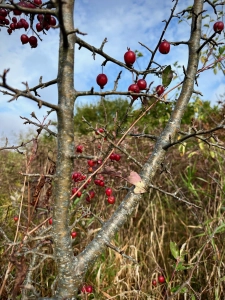
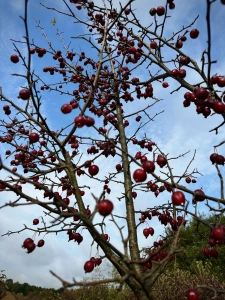
Pear leaf crabapple is both an excellent wildlife food source and an early meadow colonizer in the successional steps toward natural forest regeneration.
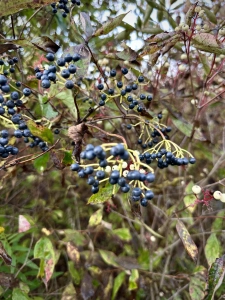
The same is true of northern arrowwood. Both species are prolific producers of fruit that wildlife consumes, digestively scarifies its seeds, and disseminates to enable further colonization.
Two red oaks (left) and numerous sycamore saplings represent the advancing forest along the meadow’s north flank, which is a separate ecotone, neither meadow or forest. View the oak and sycamore saplings as scouts from the advancing forest army. Imagine a squierrel caching an acorn in rich soil under the goldenrod, and then losing track of it. The acorn sprouts with spring’s warmth. The seedling oak flourishes in full sunlight, partially protected by the 4-6-foot-high meadow vegetation from deer and rabbit browsing. The oaks are now out of easy reach of the hungry mammals. This day’s northwesterly breezes may be carrying windborne sycamore seed, potentially extending the forest deeper into the meadow.
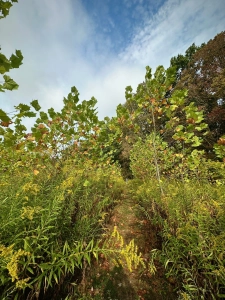
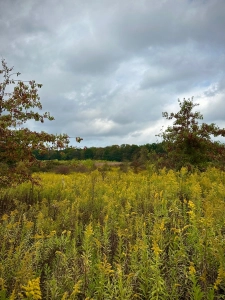
The scouts will give way to an outright forest invasion. This isn’t the forest successionary army’s first rodeo. Just 13,000 years ago, the vast continental ice sheet yielded to a warming climate. Hundreds of millions of acres of once fertile and forested land emerged from the deep icepack barren and stark, stretching from the former ice edge near here far into the sub-Arctic Canadian Shield. That wild expanse, now ruchly forested, attests to Nature’s capacity to reclaim devastated territory, whether blasted by Mt. Saint Helens (1980), incinerated by the Big Burn (1910 in Washington, Idaho, and Montana), or savagely innundated by tropical storm remnants flushing western North Carolina river bottomland forests (The Great Flood of 1916). A beautiful postage stamp upland meadow in modern day Butler County Pennsylvania is just a bump in the road for an advancing vegetative front intent on expanding a forest.
I recorded this 59-second video at the meadow/woodland edge ecotone.
The real challenge falls to the Western Pennsylvania Conservancy managers. How do they hold the forest at bay, if indeed that is their objective, which I hope it is. I appreciate and value ecosystem diversity. I won’t attempt to recommend a treatment scenario. I have little relevant expertise, beyond thinking that fire may be among the alternatives.
I do know that the common garter snake we spotted in the meadow depends on the meadow ecotype, as do many other wildlife species.
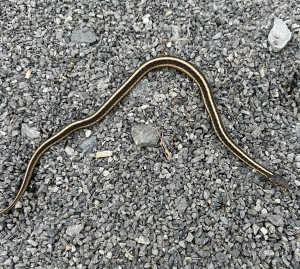
How long will the meadow survive as a unique ecosystem without management practices, like bush-hogging, prescribed fire, selective herbicide treatments, and other alternatives? No matter where my Nature wanderings take me, I discover a constant: Nothing in Nature is Static. Nothing remains the same. In this case, human intervention will be necessary to keep the meadow…a meadow.
I often turn to John Muir for words that succinctly capture my sentiments…far better than my own feelings. Of my passion for the meadow, I turn to Muir:
Everybody needs beauty as well as bread, places to play in and pray in, where nature may heal and give strength to body and soul.
Thoughts and Reflections
I offer these observations:
- Nothing in Nature is Static. Nothing remains the same. (Steve Jones)
- Everybody needs beauty as well as bread, places to play in and pray in, where nature may heal and give strength to body and soul. (John Muir)
- Our death is not an end if we can live on in our children and the younger generation. For they are us; our bodies are only wilted leaves on the tree of life. (Albert Einstein)
Inhale and absorb Nature’s elixir. May Nature Inspire, Inform, and Reward you!
Note: All blog post images created & photographed by Stephen B. Jones unless otherwise noted. Please circulate images with photo credit: “©2025 Steve Jones, Great Blue Heron LLC. All Rights Reserved.”
I am available for Nature-Inspired Speaking, Writing, and Consulting — contact me at steve.jones.0524@gmail.com
Subscribe to these free weekly Nature Blogs (photo essays) at: http://eepurl.com/cKLJdL
Reminder of my Personal and Professional Purpose, Passion, and Cause
If only more of us viewed our precious environment through the filters I employ. If only my mission and vision could be multiplied untold orders of magnitude:
Mission: Employ writing and speaking to educate, inspire, and enable readers and listeners to understand, appreciate, and enjoy Nature… and accept and practice Earth Stewardship.
Vision:
- People of all ages will pay greater attention to and engage more regularly with Nature… and will accept and practice informed and responsible Earth Stewardship.
- They will see their relationship to our natural world with new eyes… and will understand more clearly their Earth home.
Tagline/Motto: Steve (Great Blue Heron) encourages and seeks a better tomorrow through Nature-Inspired Living!
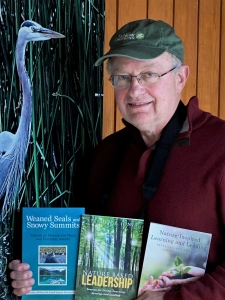
Steve’s Four Books
I wrote my books Nature Based Leadership (2016), Nature-Inspired Learning and Leading (2017), Weaned Seals and Snowy Summits: Stories of Passion for Place and Everyday Nature (2019; co-authored with Dr. Jennifer Wilhoit), and Dutton Land & Cattle: A Land Legacy Story (2023) to encourage all citizens to recognize and appreciate that every lesson for living, learning, serving, and leading is either written indelibly in or is powerfully inspired by Nature. All four of my books present compilations of personal experiences expressing my deep passion for Nature. All four books offer observations and reflections on my relationship with the natural world… and the broader implications for society. Order any from your local indie bookstore, or find them on IndieBound or other online sources such as Amazon and LifeRich.
I began writing books and Posts for several reasons:
- I love hiking and exploring Nature
- I see images I want to (and do) capture with my trusty iPhone camera
- I enjoy explaining those images — an educator at heart
- I don’t play golf!
- I do love writing — it’s the hobby I never needed when my career consumed me
- Judy suggested my writing is in large measure my legacy to our two kids, our five grandkids, and all the unborn generations beyond
- And finally, perhaps my books and Blogs could reach beyond family and touch a few other lives… sow some seeds for the future