NOTE: Some of my GBH photo essays were not routinely distributed from mid-February through mid-June. I will resend those one by one, beginning the first week of July. Here is my Post from May 27, 2026 (https://stevejonesgbh.com/2026/05/27/early-signs-of-spring-on-the-goldsmith-schiffman-wildlife-sanctuary/)
I am pleased to add the 67th of my GBH Brief-Form Posts (Less than five minutes to read!) to my website. I get wordy with my routine Posts. I don’t want my enthusiasm for thoroughness and detail to discourage readers. So, I will occasionally publish these brief Posts.
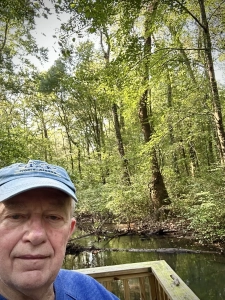
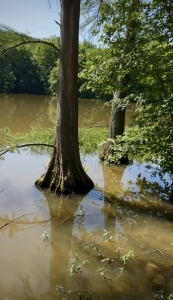
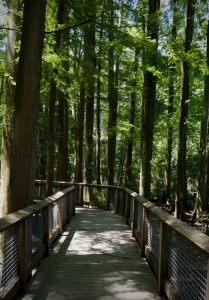
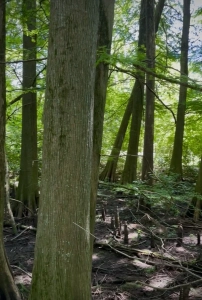
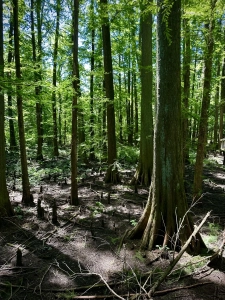
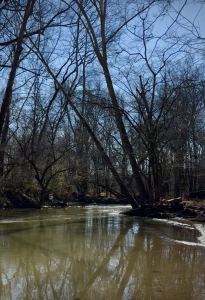
I’ve mentioned often that I’m blessed to live within 10 miles of northern Alabama’s world-class 35,000-acre Wheeler National Wildlife Refuge. On Saturday morning, September 19, 2026, I slipped south to the Beaverdam Creek Swamp Boardwalk, a National Natural Landmark water tupelo forest along Beaverdam Creek. By 9:00 AM, the temperature was 78 degrees, the dew point 70, and the relative humidity 79 percent. Although I exited the forest by 11:00, the afternoon high reached 98 degrees! In contrast to the brutal mid-summer conditions, the forest was already exhibiting signs of autumn. Nature knows!
Here is my 60-second video noting the forest’s awareness of impending autumn. My video narrative says September 18; I was a day behind!
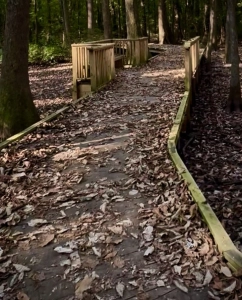
I shuffled more noisily than the weather suggested. Dry leaves covered the boardwalk.
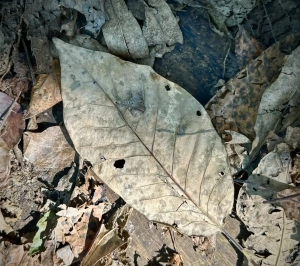
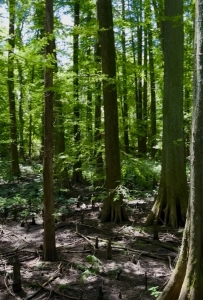
One would expect tupelo leaves under the canopy of northern Alabama’s largest water tupelo forest.
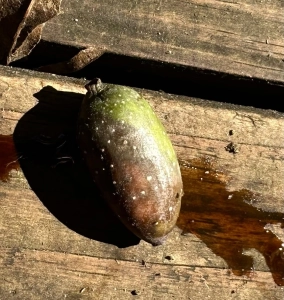
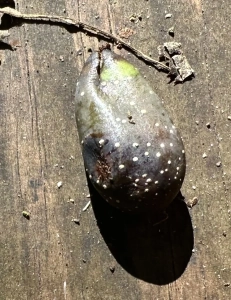
Tupelo seedfall was beginning. I’ve visited during the dormant season, when water fills the swamp, and large mats of floating seed cover the surface.
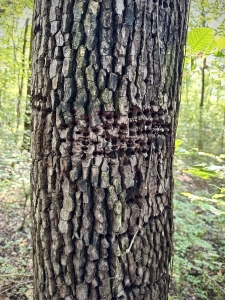
A persimmon leaf lies in fall color near the delightfully patterned parent tree.
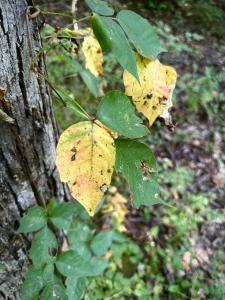
Virginia creeper’s greens are fading to yellow.
The same holds for roundleaf green brier.
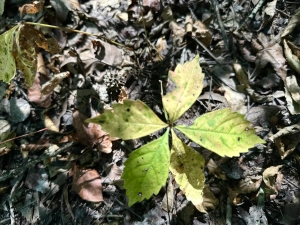
Poison ivy’s leaves-of-three signal that reliably cooler weather is at hand. Please bring it on… and soon!
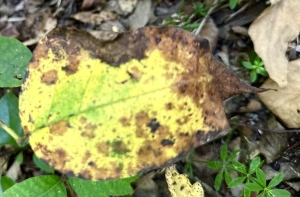
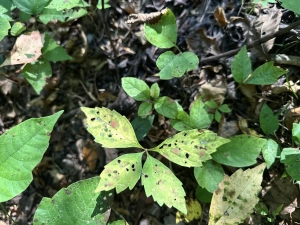
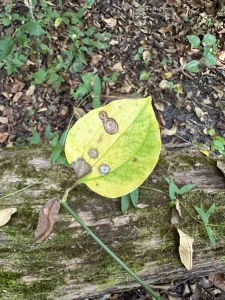
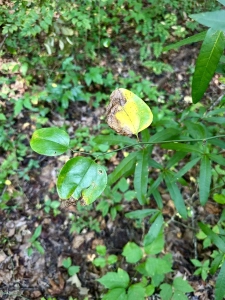
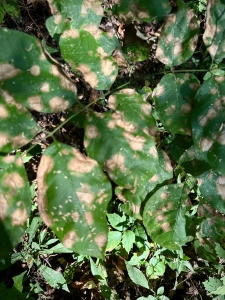
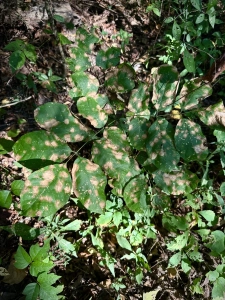
Ash seedlings (either green or white ash) were senescing, exhibiting leaf blemishes that iNaturalist identifies as gray mold spot. Molds often begin to infect multiple hardwood species’ leaves at season’s end.
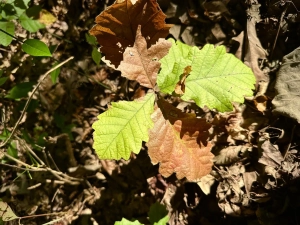
Ground cover swamp chestnut oak has turned off its leaf factories.
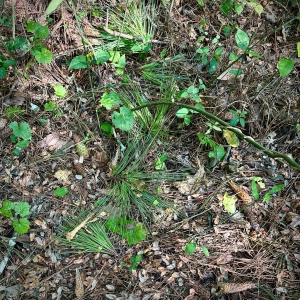
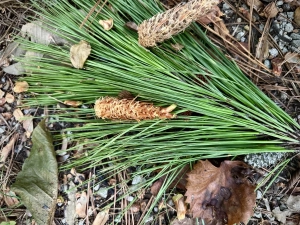
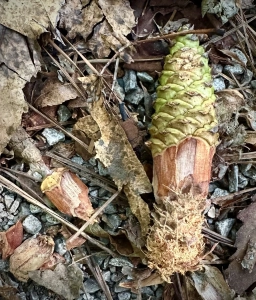
Resident squirrels registered another clear sign of summer shifting to fall. Loblolly pine cones high in the forest canopy are ripe enough late in their second summer to attract the aerial rodents. They tooth-chisel the foliar twigs holding the cones, dropping them to the forest floor, or in this case, the trail surface.
The squirrels peel scales one at a time from the cones to expose and harvest the pine nuts. They either eat the nuts on the spot or transport them to a larder.
Yogi Berra once said, It sure gets late early around here! I suppose one could say the same of the season’s apparent hot-weather autumn advance in the tupelo swamp. I wish someone had informed the pesky mosquitoes that followed me to Beaverdam Creek and back.
Once again, I’m reminded of John Muir, who oft repeated:
In every walk with nature, one receives far more than he seeks.
In Summary
I invested two Saturday-morning hours sauntering along the boardwalk. I could have slept in, read a book, watched cartoons, edited a Great Blue Heron photo essay, played online solitaire, or countless other mind-numbing activities on a too-hot late summer (or early autumn) morning. I thank my lucky stars that I chose otherwise… and wisely.
The return on my two-hour informed woods-ramble: this brief-form GBH Post; three additional Posts to compile and draft… watch for them; seven 60-second videos (three already posted on my YouTube channel: Steve Jones Great Blue Heron@stevejonesgreatblueheron); and scores of photos! Lest you deem this effort burdensome, keep in mind that this IS my golf. I enjoy practicing my five essential verbs of woodland venturing:
Believe, Look, See, Feel, and Act. I begin within the forest and extend to writing and publishing the weekly photo essay.
Believe — I find Nature’s Lessons because I know they lie hidden within view — belief enables me to look and see
Look — Really look, with eyes open to my surroundings, external to electronic devices and the distractions of meaningless noise and data
See — Be alert to see deeply, beyond the superficial
Feel — See clearly, with comprehension, to find meaning and evoke feelings
Act — Feel emphatically enough to spur action
My weekly photo essays encapsulate all five into a comprehensive, sometimes compact and succinct statement of passion for place and everyday Nature.
Closing
I accept the challenge of distilling these Brief-Form Posts into a single distinct reflection. John Muir nailed it:
In every walk with nature, one receives far more than he seeks.
.
Nature’s special treats await our discovery, our understanding, and our interpretation!
Subscribe to my free weekly photo essays (like this one) at: http://eepurl.com/cKLJdL
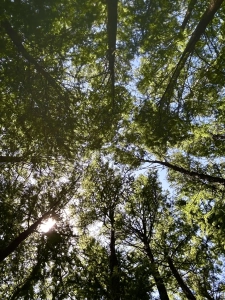
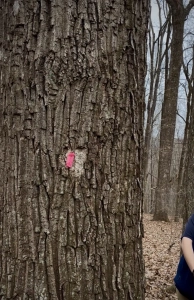
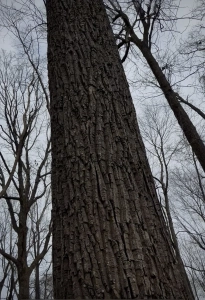
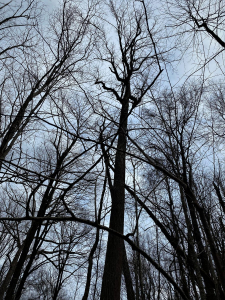
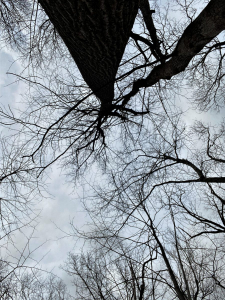
P.S. Along Beaverdam Creek, the canopy evidenced a general yellowing, even as the old forester’s crown showed its stark whitening!
https://stevejonesgbh.com/wp-content/uploads/2026/09/IMG_2720.jpeg-09.19.26-Beaverdam-Swamp-Swamp-CO.webp9001200Steve Joneshttp://stevejonesgbh.com/wp-content/uploads/2017/01/gbhweblogo.pngSteve Jones2026-09-25 09:17:262026-09-25 09:17:26Brief-Form Post #67: Autumn Signals on A 90+ Degree Mid-September Day in Beaverdam Swamp
NOTE: Some of my GBH photo essays were not routinely distributed from mid-February through mid-June. I will resend those one by one, beginning the first week of July. Here is my Post from May 17, 2026 (https://stevejonesgbh.com/2026/05/17/lawson-branch-loop-shoal-creek-preserve-spring-2026/)
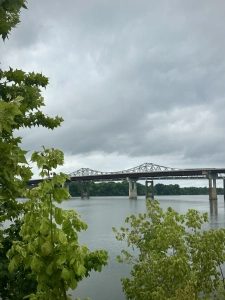
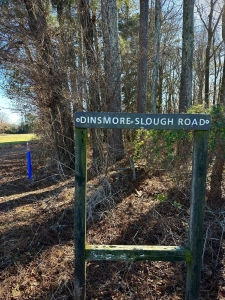
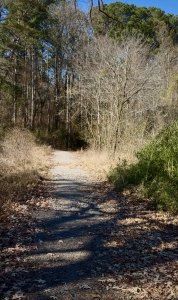
A friend requested transportation to and from a hospital in Huntsville, Alabama, for a diagnostic test that would take 3 hours from admission to release on July 14, 2026. I had no time to go home and no desire to sit in a waiting room, so I drove ten miles south of Huntsville to Ditto Landing Marina on the Tennessee River (Lake Wheeler). I was curious to see what I might find hidden in plain sight along the gravel road on the waterway’s north side downstream. This trail (west of the Highway 231 bridge) is within the easternmost extent of the 35,000-acre Wheeler National Wildlife Refuge. Come along with me virtually as I kill two hours within the wilds of what is technically the City of Huntsville, Alabama!
The River
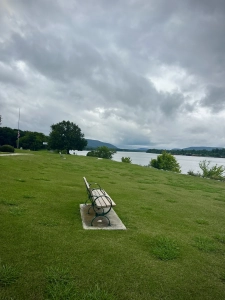
I recorded this 53-second video from the park bench at Ditto Landing Marina.
I wanted to luxuriate longer after my trek, but I didn’t want to keep my friend waiting in the recovery room.
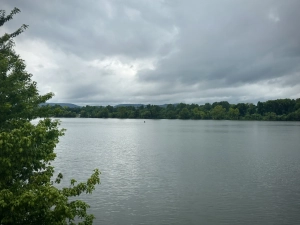
I find an undeniable magnetism in rivers, lakes, skies, and the great outdoors. Although traffic over the bridge consumed any silence and overwhelmed Nature’s music (breezes, soft-wave sloshing, birds, and even children laughing and playing), the distance softened the distraction to an acceptable soothing.
Yes, I would prefer a more isolated natural setting absent a busy highway, a marina behind me, and a modern bridge spanning the river. However, I remind myself that I am within 40 minutes of my residence in Alabama’s largest metropolitan area. Also, I must keep in mind that the Tennessee River is not some wild and scenic waterway. I am viewing Lake Wheeler, one of the necklace of TVA impoundments (Nickajack, Guntersville, Wheeler, Wilson, and Pickwick are the five dams stretching from Chattanooga downstream through Florence and beyond. I can’t both celebrate that I live within an hour of the Wheeler National Wildlife Refuge, a national treasure, and lament that being here doesn’t provide a wilderness experience… pristine and untrammeled by man.
I recorded this 59-second video within earshot of the highway. I accept and salute it for what it is, and for the fulfillment the place and its special Nature awards a lifelong outdoor enthusiast.
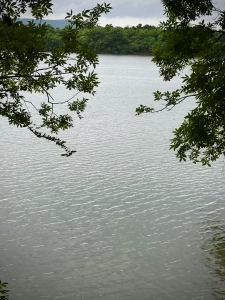
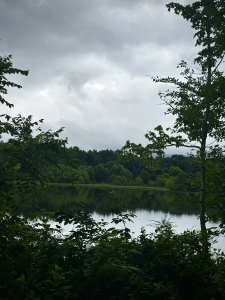
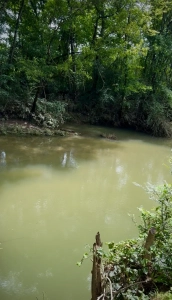
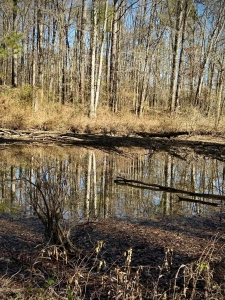
The main channel is alongside the gravel road (left). An adjacent backwater (a slough) is situated beyond the riverway on the inland side of the trail.
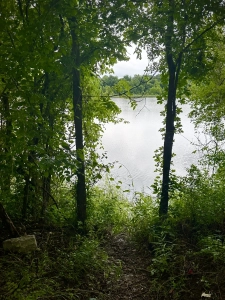
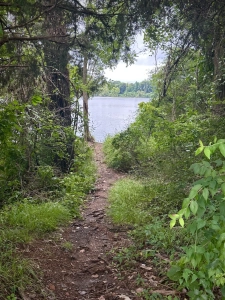
At several spots along the road, secret pathways and visual portals reach through the forested buffer to favorite fishing spots at the river’s edge.
The Forest
I recorded this 63-second video along the gravel road about one mile downstream from where I parked.
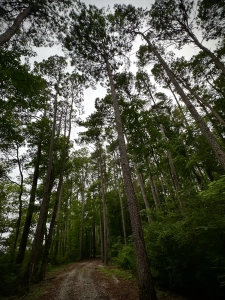
Loblolly pine trees grow luxuriously on agricultural land abandoned and planted when the TVA or COE purchased the property to be inundated and adjoining buffer lands tied to the same owners. These floodplain fields are extraordinarily fertile.
Here is my 60-second video of these ~90-year-old forests.
A planted row of loblollies lines the road.
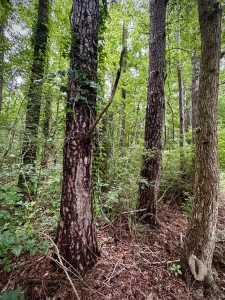
A heavy summer shower wetted the forest the prior evening. Stem flow reached the ground, leaving a patterned trunk as the bark plates began to dry.
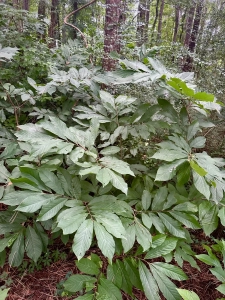
A lush understory paw paw patch caught my eye.
Roadside Summer Flowers and Plants
A longtime enthusiast of spring ephemeral wildflowers, I’ve grown fond of our prolific summer bloomers. The spring flowers arrive when dormant woodlands are otherwise grey and drab. I suppose my vernal exuberance for the new blossoms is owed to living further north, where winters were more serious and relief more deeply appreciated. My appreciation now stretches from emerging spring into continuing summer. Here’s a brief catalog of the beauties I photographed along the trail.
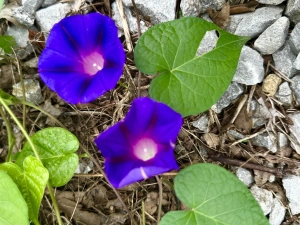
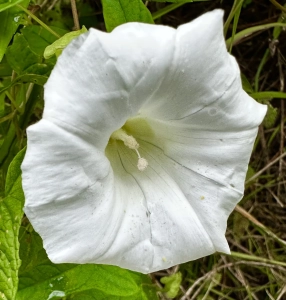
Common morning-glory and large bindweed.
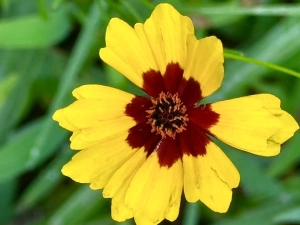
Plains coreopsis, a magnificent portrayal of mid-season grandeur.
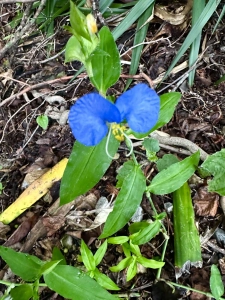
Dayflower’s cerulean majesty.
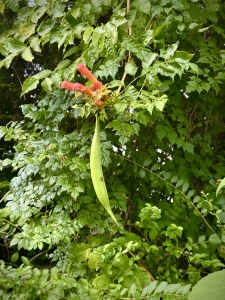
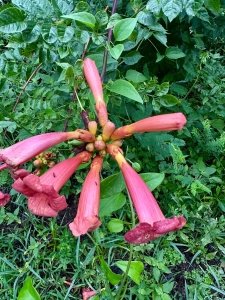
American trumpet vine blossoms and seed pod.
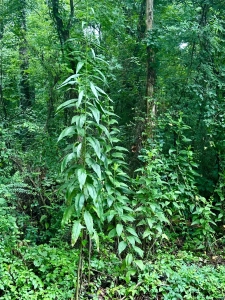
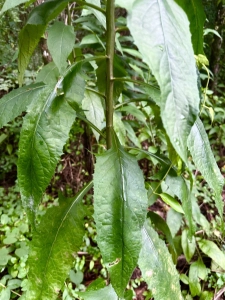
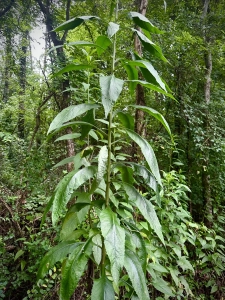
Not yet blooming, this hollow Joe-Pye weed is nearly as tall as a basketball hoop.
Its base and top represent a single season’s growth. A perennial, it will die back to ground level in the autumn, and then loft again to ten feet next year.
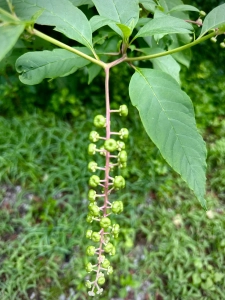
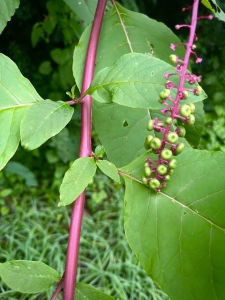
American pokeweed is another perennial that will produce a tremendous amount of biomass.
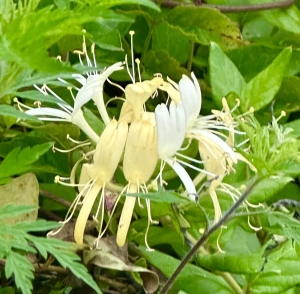
Although I allow myself to enjoy the beauty and fragrance of Japanese honeysuckle, I refuse to celebrate the success of the aggressive Asian invasive.
This overwhelmingly successful and particularly combative legume arrived in the US from Japan and China in 1876 at the Centennial Exposition in Philadelphia. In 1953, the USDA stopped advocating the use of kudzu for erosion control, and in 1972 the agency officially designated the plant a weed. Just imagine how our poor native pokeweed feels bearing an official common moniker of American pokeweed!
I celebrate what something as simple as Two Hours to Kill can reveal and return as satisfaction and fulfillment!
Thoughts and Reflections
I offer these observations:
I can’t both celebrate that I live within an hour of the Wheeler National Wildlife Refuge, a national treasure, and lament that being here doesn’t provide a wilderness experience…pristine and untrammeled by man. (Steve Jones)
I am pleased that something as simple as Two Hours to Kill can reveal and return as Nature’s satisfaction and fulfillment! (Steve Jones)
Inhale and absorb Nature’s elixir. May Nature inspire, inform, and reward you!
Note: Unless otherwise noted, all blog post images are created & photographed by Stephen B. Jones.
I am available for Nature-Inspired Speaking, Writing, and Consulting — contact me at steve.jones.0524@gmail.com
Subscribe to my free weekly photo essays (like this one) at: http://eepurl.com/cKLJdL
A reminder of my Personal and Professional Purpose, Passion, and Cause
If only more of us viewed our precious environment through the filters I employ. If only my mission and vision could be multiplied by untold orders of magnitude:
Mission: Employ writing and speaking to educate, inspire, and enable readers and listeners to understand, appreciate, and enjoy Nature… and accept and practice Earth Stewardship.
Vision:
People of all ages will pay greater attention to and engage more regularly with Nature… and will accept and practice informed and responsible Earth Stewardship.
They will see their relationship to our natural world with new eyes… and understand their Earth home more clearly.
Tagline/Motto: Steve (Great Blue Heron) encourages and seeks a better tomorrow through Nature-Inspired Living!
Steve’s Four Books
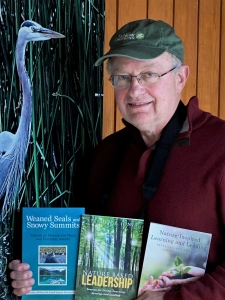
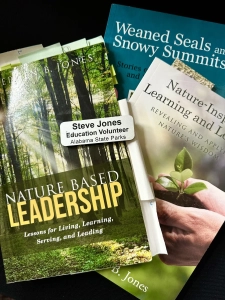
I wrote my books Nature-Based Leadership (2016), Nature-Inspired Learning and Leading (2017), Weaned Seals and Snowy Summits: Stories of Passion for Place and Everyday Nature (2019; co-authored with Dr. Jennifer Wilhoit), and Dutton Land & Cattle: A Land Legacy Story (2025) to encourage all citizens to recognize and appreciate that every lesson for living, learning, serving, and leading is either written indelibly in or is powerfully inspired by Nature. All four of my books compile personal experiences expressing my deep passion for Nature. They offer observations and reflections on my relationship with the natural world… and the broader implications for society. Order any from your local indie bookstore, or find them on IndieBound or other online sources such as Amazon and LifeRich.
I began writing books and Posts for several reasons:
I love hiking and exploring Nature
I see images I want to (and do) capture with my trusty iPhone camera
I enjoy explaining those images — an educator at heart
I don’t play golf!
I do love writing — it’s the hobby I never needed when my career consumed me
Judy suggested my writing is in large measure my legacy to our two kids, our five grandkids, and all the unborn generations beyond
And finally, perhaps my books and Blogs could reach beyond family and touch a few other lives… sow some seeds for the future
https://stevejonesgbh.com/wp-content/uploads/2026/07/IMG_2146.jpeg-07.14.26-Ditto-Mid-morn.webp1200900Steve Joneshttp://stevejonesgbh.com/wp-content/uploads/2017/01/gbhweblogo.pngSteve Jones2026-09-23 05:13:152026-09-23 05:13:15A Couple of Mid-Summer Hours to Kill at Huntsville’s Gateway to the Majestic Tennessee River!
NOTE: Some of my GBH photo essays were not routinely distributed from mid-February through mid-June. I will resend those one by one, beginning the first week of July. Here is my Post from April 29 (https://stevejonesgbh.com/2026/04/29/brief-form-post-58-forest-discoveries-while-measuring-tree-heights-on-monte-sano-state-park/)
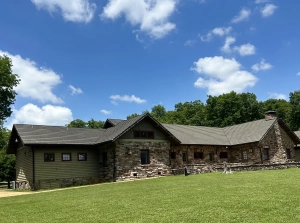
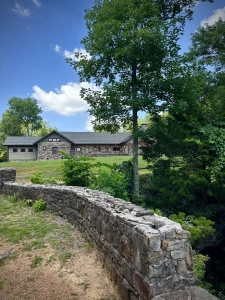
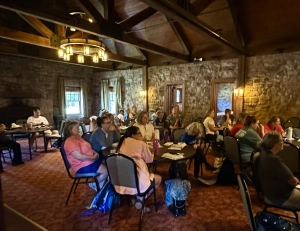
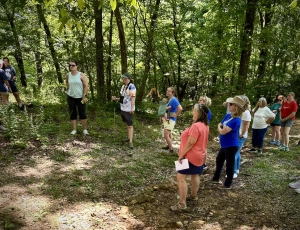
I assisted the Alabama State Park staff in delivering the Teaching Beyond the Walls: Alabama’s Ecology In Action educators’ workshop at Monte Sano State Park on June 30, 2026. Funded by BlueCross BlueShield of Alabama, the ~30 participants enjoyed diverse sessions over the nine-hour program, including: Alabama’s biodiversity; immersion in forest ecology; student-centered science; place-based teaching and learning; water cycle and stream ecology; asking the right questions; seeking insight from others; and learning through Nature. Join me as I accompany the registered learning community participants at the State Park Lodge and its plateau-edge surroundings.
The State Park System education and interpretation obiectives align with my professional retirement mission: Employ writing and speaking to educate, inspire, and enable readers and listeners to understand, appreciate, and enjoy Nature… and accept and practice Earth Stewardship. I find fullfillment in partnering with the park system to educate, inspire, and enable visitors to embrace Earth Stewardship. What better way than through educator workshops!
We learned indoors (blessed air conditioning) and out (welcome breezes and deep woods shade).
I recorded a 54-second video showcasing the lodge and its immediate woodland outdoor laboratory.
I suppose that spending my youth in family Nature-based recreation, four years in forestry school (1973 BS), 12 years employed by a Fortune-500 paper and allied products manufacturing company, three years earning a doctoral degree in Applied Forest Ecology (1987 Ph.D.), and 35 years in higher education teaching, research,and administration at nine universities, positioned me to know all the answers. Not so! The more I learn, the less I know. Sure, I am pretty comfortable with how I can handle a day of learning and sharing in a northern Alabama forest. Just the same, it is I who benefit most from interacting with eager, inquisitive, and dedicated educators intent on sharpening their craft, deepening their knowledge, and fueling their environmental education passion.
Understanding and Appreciating Alabama’s Biodiversity
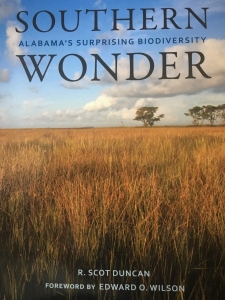
Dr. Scott Duncan’s SouthernWonder is a perfect launching pad for such a course. Alabama is the fourth most biologically diverse state in the country. Each participant exited the workshop with a copy for use as an invaluable environmental education resource.
Finding Inhabitant Wonder in a Plateau-top Brook
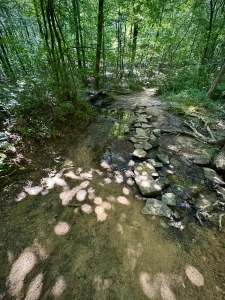
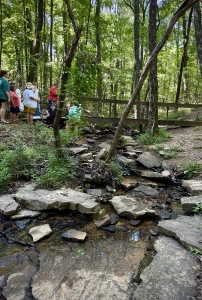
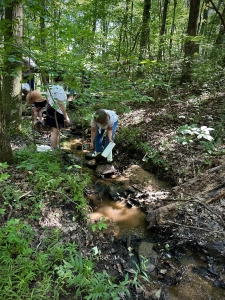
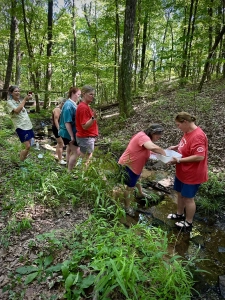
Environmental learning is a contact sport. The educators leaped into investigating abundant life (biodiversity) in the plateau-top brook near the lodge.
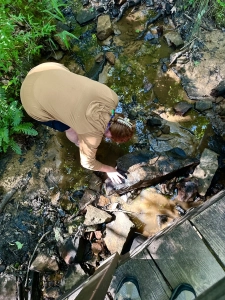
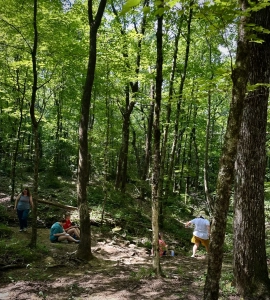
Participants turned over rocks, screened the water, and gathered nearby to share discoveries and compare observations.
There is excitement and celebration in learning, a demonstrable contact sport with feet in the water, knees in the mud, and hands on the tiny critters.
Here is my 25-second video of learning in action, which is anything but learning inaction!
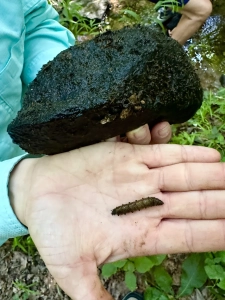
Amber Coger, the Alabama State Park NW District Naturalist, shares the caddis fly larva she found under a rock mid-brook. She may not have been more thrilled finding a gold nugget.
Here’s my 59-second video recorded where the plateau-top brook exits at a ledge to depart for the Huntsville valley floor.
There is palpable magic in learning, sharing, understanding, and appreciating.
Seeing What Lies Hidden in Plain Sight
I often observe that I invest most of my time in forest wanderings discovering what wonders lie hidden in plain sight.
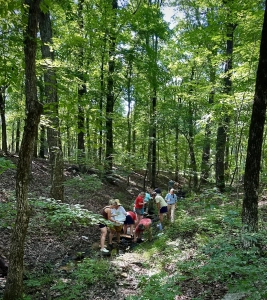
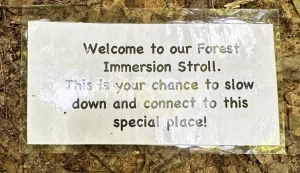
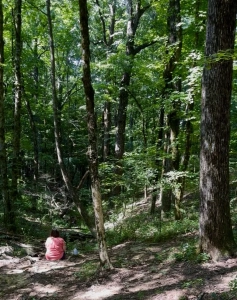
I recordeed this 58-second video of the workshop’s forest immersion experience, a designed quiet period to listen, relax, and absorb through all five human portals: mind, body, heart, soul, and spirit. Here’s the location where instructors released students one at a time to facilitate solitary immersion.
Instructors placed guidance along the way to help focus and implore deep thinking and full immersion.
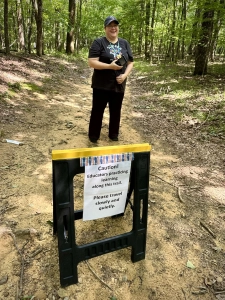
An instrucor cautioned participants and bikers to watch out for each other.
Teacher-students followed forest immersion practitice guidelines. I reminded myself that I need to be a more disciplined practitioner. I don’t sit quietly long enough. Come on, Steve, practice what you preach!
One station suggested that students look into the crown, a perspective that forces us to think about the engine, Old Sol, that fuels forest energy flow.
Although I seldon pause for a full forest immersion, I abhor wasting my time blindly hiking through Nature, intent on the destination… not the journey.
John Muir advocated sauntering in Nature, as an online biographer source noted:
One day as I was resting in the shade Mr. Muir overtook me on the trail and began to chat in that friendly way in which he delights to talk with everyone he meets. I said to him: “Mr. Muir, someone told me you did not approve of the word ‘hike.’ Is that so?” His blue eyes flashed, and with his Scotch accent he replied: “I don’t like either the word or the thing. People ought to saunter in the mountains – not hike!”
John Muir lived up to his doctrine. He was usually the last man to reach camp. He never hurried. He stopped to get acquainted with individual trees along the way. He would hail people passing by and make them get down on hands and knees if necessary to see the beauty of some little bed of almost microscopic flowers. Usually he appeared at camp with some new flowers in his hat and a little piece of fir bough in his buttonhole.
Discovering Special Oddity, Curiosity, and Delight in Everyday Nature
Forest oddities, curiosities, and mysteries fascinate, puzzle, and entertain me on my forest excursions. I kept my eyes open as I wandered during the workshop. This chestnut oak stood in plain view where I recorded the start of the forest immersion video. I wondered how many noticed?
A contorted sugar maple displayed clear evidence of some past physical battery (falling branch or tree, logging equipment damage, or some less-obvious injury). Nature is remarkably resilient.
Naturally curious in its manner of growth, sparkleberry or farkleberry grows however it wishes, without apparent disciplinary rules.
I love it for its mirthful common names and for its whimsical growth.
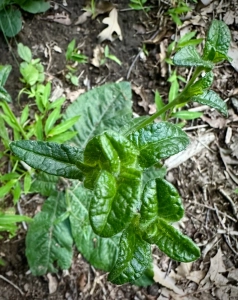
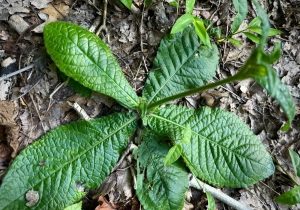
I learned a new plant: leafy elephant’s-foot, a moniker worthy of inclusion in this listing of notable features in everyday Nature.
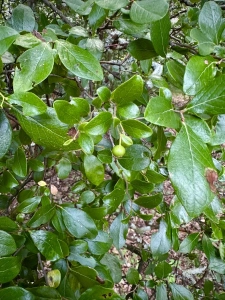
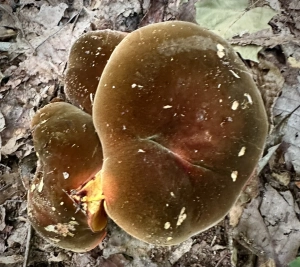
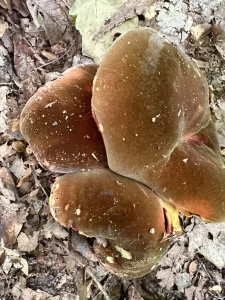
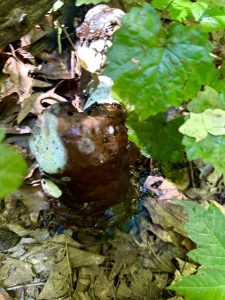
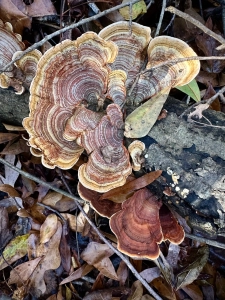
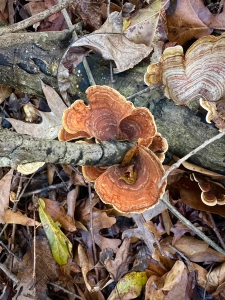
I consider myself a neophyte mycophile… a fungi enthusiast. I’m gaining confidence in identifying regional edibles. iNaturalist identified this mushroom as Neoboletus sp. ‘varietstibus. Its velvety brown, stocky appearance drew me closer. I saw no other individuals and because of its scarcity, I did not disturb it to capture a complete set of photo images: top, bottom, and side. Therefore I am not confident in the iNaturalist identification. I’ll consider whether this species is edible or not when I find a patch large enough to be certain.
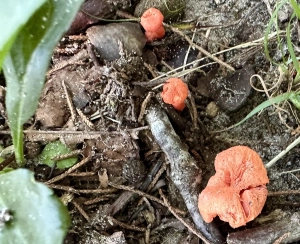
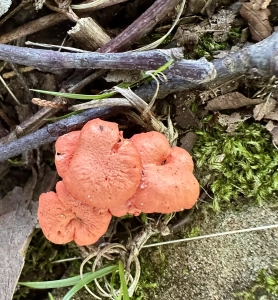
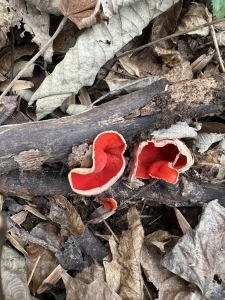
Red chanterelle mushrooms are edible, but are too diminutive to bother. I do forage larger chanterelles, but not from our State Parks.
I recorded this 60-second red chanterelles video during the workshop.
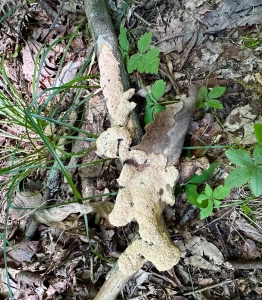
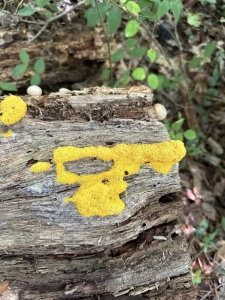
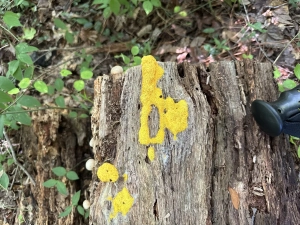
I present this final oddity, curiosity, and delight: dog vomit slime mold, which presented itself along the trail at the intersection where we launched individuals for their solitary immersions. So much lies hidden in plain sight.
Like John Muir, I believe:
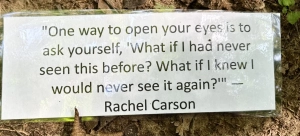
In every walk with Nature one receives far more than he seeks.
The Wonder of My Retirement Role
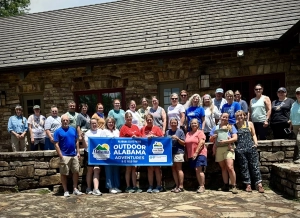
Here’s our contingent of ardent learners.
One of the educators (Shelly, employed in Tennessee) said to me after sharing a table during the indoor sessions, “You have the greatest volunteer retirement role I could ever imagine.” She nailed it:
Alabama State Parks Foundation
I’ll remind you that although I serve on the Alabama State Parks Foundation Board (Secretary), in part because of my love of Nature and in recognition for my writing many prior Posts about visiting and experiencing the Parks, any positions or opinions expressed in these Posts are mine alone and do not in any manner represent the Foundation or its Board.
I urge you to take a look at the Foundation website and consider ways you might help steward these magical places: https://asparksfoundation.org/ Perhaps you might think about supporting the Parks System education and interpretation imperative: https://asparksfoundation.org/give-today#a444d6c6-371b-47a2-97da-dd15a5b9da76
The Foundation exists for the sole purpose of providing incremental operating and capital support for enhancing our State parks… and your enjoyment of them.
We are blessed in Alabama to have our Park System. Watch for future Great Blue Heron Posts as I continue to explore and enjoy these treasures that belong to us. I urge you to discover the Alabama State Parks near you. Follow the advice of John Muir:
And into the forest I go, to lose my mind and find my soul.
In every walk with Nature one receives far more than he seeks.
I only went out for a walk and finally concluded to stay out till sundown, for going out, I found, was really going in.
Between every two pines is a doorway to a new world.
Thoughts and Reflections
I offer these observations:
Mr. Muir, someone told me you did not approve of the word ‘hike.’ Is that so?” His blue eyes flashed, and with his Scotch accent he replied: “I don’t like either the word or the thing. People ought to saunter in the mountains – not hike!”(Muir biographer)
There is excitement and celebration in learning, again, a demonstrable contact sport. (Steve Jones)
There is palpable magic in learning, sharing, understanding, and appreciating. (Steve Jones)
Inhale and absorb Nature’s elixir. May Nature Inspire, Inform, and Reward you!
I am available for Nature-Inspired Speaking, Writing, and Consulting — contact me at steve.jones.0524@gmail.com
Subscribe to my free weekly photo essays (like this one) at: http://eepurl.com/cKLJdL
Reminder of my Personal and Professional Purpose, Passion, and Cause
If only more of us viewed our precious environment through the filters I employ. If only my mission and vision could be multiplied untold orders of magnitude:
Mission: Employ writing and speaking to educate, inspire, and enable readers and listeners to understand, appreciate, and enjoy Nature… and accept and practice Earth Stewardship.
Vision:
People of all ages will pay greater attention to and engage more regularly with Nature… and will accept and practice informed and responsible Earth Stewardship.
They will see their relationship to our natural world with new eyes… and will understand more clearly their Earth home.
Tagline/Motto: Steve (Great Blue Heron) encourages and seeks a better tomorrow through Nature-Inspired Living!
Steve’s Four Books
I wrote my books Nature Based Leadership (2016), Nature-Inspired Learning and Leading (2017), Weaned Seals and Snowy Summits: Stories of Passion for Place and Everyday Nature (2019; co-authored with Dr. Jennifer Wilhoit), and Dutton Land & Cattle: A Land Legacy Story (2023) to encourage all citizens to recognize and appreciate that every lesson for living, learning, serving, and leading is either written indelibly in or is powerfully inspired by Nature. All four of my books present compilations of personal experiences expressing my deep passion for Nature. All four books offer observations and reflections on my relationship with the natural world… and the broader implications for society. Order any from your local indie bookstore, or find them on IndieBound or other online sources such as Amazon and LifeRich.
I began writing books and Posts for several reasons:
I love hiking and exploring Nature
I see images I want to (and do) capture with my trusty iPhone camera
I enjoy explaining those images — an educator at heart
I don’t play golf!
I do love writing — it’s the hobby I never needed when my career consumed me
Judy suggested my writing is in large measure my legacy to our two kids, our five grandkids, and all the unborn generations beyond
And finally, perhaps my books and Blogs could reach beyond family and touch a few other lives… sow some seeds for the future
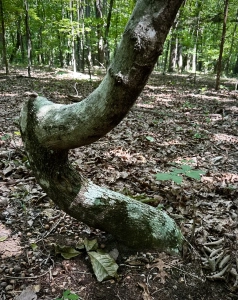
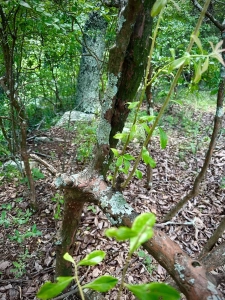
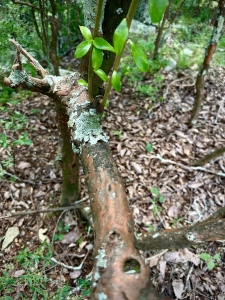
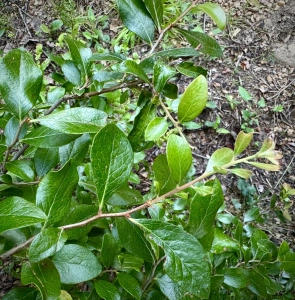
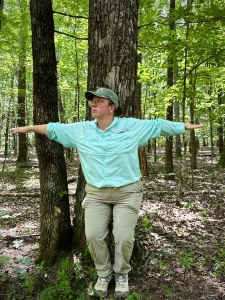
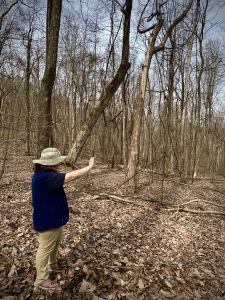
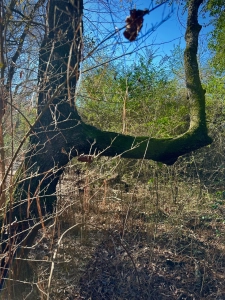
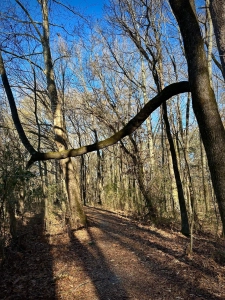
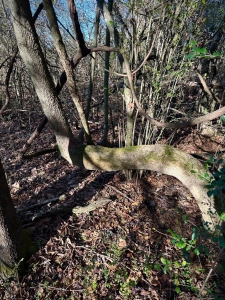
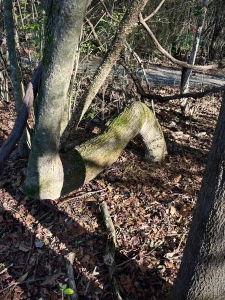
[Workshop facilitator Amber Coger depicting the right-angle branching character of black gum (the smaller tree at her right forearm).]
https://stevejonesgbh.com/wp-content/uploads/2026/07/IMG_2021.jpeg-06.30.26-MSSP-Teacher-Workshop.webp8731200Steve Joneshttp://stevejonesgbh.com/wp-content/uploads/2017/01/gbhweblogo.pngSteve Jones2026-09-02 10:12:462026-09-02 10:12:46Teaching Beyond the Walls: An Alabama State Parks Workshop at Monte Sano State Park
NOTE: Some of my GBH photo essays were not routinely distributed from mid-February through mid-June. I will resend those one by one, beginning the first week of July. Here is my Post from April 9 (https://stevejonesgbh.com/2026/04/09/mid-december-delights-and-mysteries-on-the-wnwr-hiking-and-bicycling-trail/)
I am pleased to add the 63rd of my GBH Brief-Form Posts (Less than five minutes to read!) to my website. I get wordy with my routine Posts. I don’t want my enthusiasm for thoroughness and detail to discourage readers. So, I will occasionally publish these brief Posts.
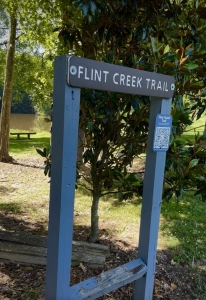
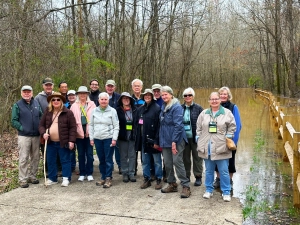
Fellow retired forester Chris Stuhlinger and I co-led an OLLI (Osher Lifelong Learning Institute, University of Alabama in Huntsville) Nature walk on June 13, 2026, at the Wheeler National Wildlife Refuge in Decatur, Alabama. We planned to saunter through the rich bottomland forest along the Flint Creek Trail, slowly exploring the beauty, magic, awe, and inspiration of Nature hidden in plain sight. Three of us appropriately dallied, immersed in wonder, wandering within the forest, truly focusing on the intended discovery and learning. The other dozen or so participants yielded to resident bottomland blood-sucking mosquitoes. As a result, the three of us were persuaded to abandon the trek and head to the nearby Refuge Visitors Center instead. I’ll take you there with me.
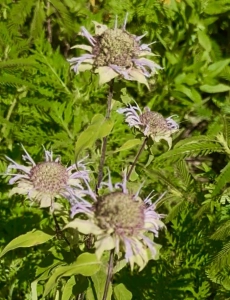
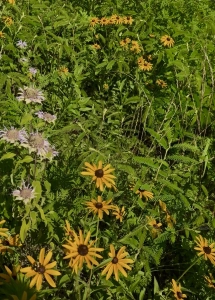
I had arrived at the trailhead early enough to examine the parking area Refuge buffer of sowed wildflower mix. Bergamots were among the plants already flowering.
I recorded this 53-second video of the beds dominated at the moment by bergamots and black-eyed Susans.
Black-eyed Susans are among my favorite summer natives.
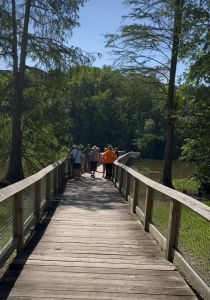
We began our trek within sight of the beds, by crossing the boardwalk, which carried us across a sunny, breezy, mosquito-free (a relevant point as I will soon reveal) passage into the forest.
I recorded this 59-second video as we approached the trail via the boardwalk.
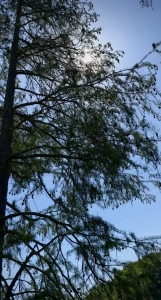
Pond cypress, a water-tolerant deciduous conifer, stood in the Flint Creek inlet at the boardwalk trailhead.
My Musings on What Warrants Doing as Time Wanes
We entered the forest where wonders awaited some of us… and two-winged, six-legged terrorists inflicted intolerable annoyance on the others. Summer passage through certain northern Alabama ecotypes exacts a toll. The circumstances of this day lead me to pledge (to self) that I will heretofore exercise greater caution in agreeing to which particular OLLI (or any other) missions I shall choose/decide to accept.
None of us knows how many woodland excursions lie ahead. I do know that the window eventually closes. The clock continues ticking. I love my deliberate, succinct retirement mission:
Employ writing and speaking to educate, inspire, and enable readers, and listeners to understand, appreciate, and enjoy Nature… and accept and practice Earth Stewardship.
Mightn’t I have been better advised to persue a Nature jaunt of my own design, intent, passion, purpose, and ken, rather than one where the participants are easily dissuaded from the effort? As I draft this text, I will enter my fourth quarter of a century in two days. Chances are slim (to none) that a fifth awaits me (Well, maybe it’s with partaking a fifth of Old Forester that my chance improves!).
Without belaboring my disappointment, allow me to point out that at least eight of our 14 participants wore short-sleeve shirts/blouses, despite our advance suggestion to avoid attracting unwanted insect attention and voracious feeding.
An Abbreviated Woodland Exploration
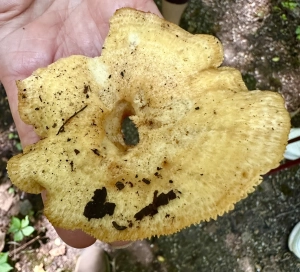
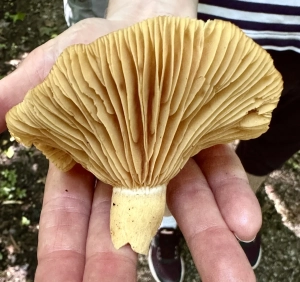
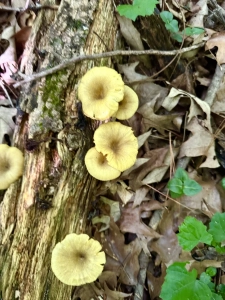
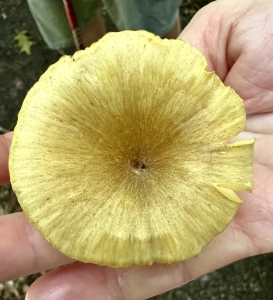
The bottomland forest presented abundant mushrooms for those of us not flushed ahead by the pesky skeeters. Rather than escort you with deep narrative, allow me to introduce our welcoming fungi. Lactarius psammicola gave us palm-size shrooms.
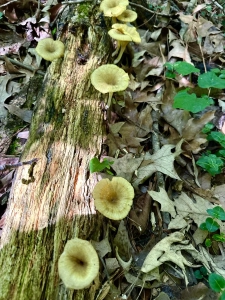
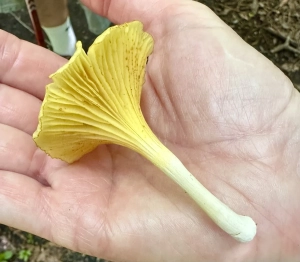
Golden-gilled gerronema showed their characteristic biege funnels.
Although very attractive, the species is not considered edible.
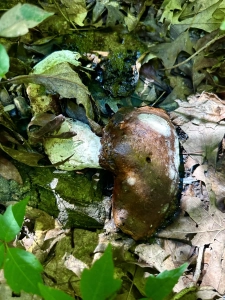
Bolete mushrooms are a group of fungi with spongy pores under their caps instead of gills, including some edible species. I’ve reached a point in my foraging where I’m gaining enough knowledge and confidence to begin selecting certain boletes. This individual is in an advanced state of decay, rotting with a bolete mould.
Nearby we spotted dog vomit slime mold, a fungus that has a moniker that, even if it were edible, would discouraged human consumers.
I spotted an unfamiliar understory plant, whitenymph. By this point of progress, the mosquito-spurred group had raced way ahead of us.
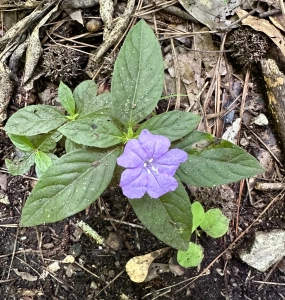
I felt compelled to photograph Carolina ruellia, a lovely little ground-hugging early summer wildflower.
Quick Trip across the Highway to the Visitors Center Cypress Pond
The larger group hailed us before we had traversed half the distance they covered. We agreed to return to our vehicles, and then leave to the visitors center about a mile away, across the highway, where we anticipated far fewer human-blood-consuming insects. Some of the original group did not transfer to the visitors center.
I’ll touch briefly on our mosquito-abatement alternative. I always enjoy the bald cypress pond and boardwalk near the visitors center.
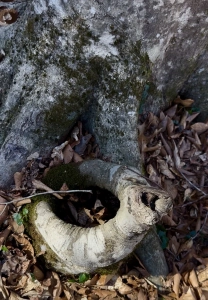
Stems are packed tightly and reach high. Cypress knees perform their function, whether securing incremental anchorage or assisting in gaseous exchange.
I recorded this 60-second video within the cypress pond, adding a little Righteous Brothers accompaniment.
I always glance heavenward from the boardwalk. The dense trunk-stocking suggests crowded, intersecting and overlapping crowns. Instead, cypress expresses crown shyness… faithfully, maintaining space-margins and no-touch zones separating one crown from another! Is it my own certifiable introvert personality that explains my admiration of sylvan crown shyness?
Perhaps I overreacted to our change in plans; perhaps not. However, in no small part owing to my seminal life benchmark (75 years!), my angst and pique were real… and persist. I shall be recalibrating priorities. From a time-of-life-dawn, the brim-full hour glass left plenty of room for judgement error. Today, with a setting sun ahead, the sand grains rush unceasingly. The relative cost of each one amplifies. My maternal grandmother, a country girl from Appalachian-region West Virginia, said as much: “The older I get, the faster time goes!”
Closing
I accept the challenge of distilling these Brief-Form Posts into a single distinct reflection, this one cut, modified, and pasted from above:
None of us knows how many woodland excursions lie ahead. I do know that the window eventually closes. The clock continues ticking. I love my deliberate, succinct retirement mission:
Employ writing and speaking to educate, inspire, and enable readers and listeners to understand, appreciate, and enjoy Nature… and accept and practice Earth Stewardship.
Mightn’t I have been better advised to pursue a Nature jaunt of my own design, intent, passion, purpose, and ken?
Nature’s special treats await our discovery, our understanding, and our interpretation!
Subscribe to my free weekly photo essays (like this one) at: http://eepurl.com/cKLJdL
https://stevejonesgbh.com/wp-content/uploads/2026/06/IMG_1785.jpeg-06.13.26-WNWR-Flint-Creek-Trail-Trailhead-Boardwalk.webp1200839Steve Joneshttp://stevejonesgbh.com/wp-content/uploads/2017/01/gbhweblogo.pngSteve Jones2026-08-19 09:49:082026-08-19 09:52:06Brief-Form Post #63: Mid-Summer Osher Lifelong Learning Institute Nature Walk at the Wheeler National Wildlife Refuge!
[Some of my GBH photo essays were not routinely distributed from mid-February through mid-June. I will resend those one by one, beginning the first week of July. Here is my Post from March 24 (https://stevejonesgbh.com/2026/03/24/mid-december-above-ground-exploration-at-cathedral-caverns-state-park/)]
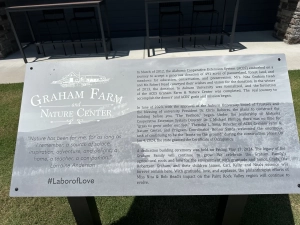
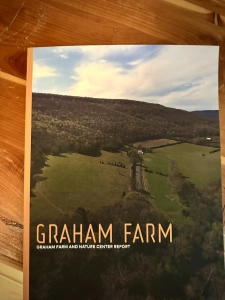
I toured the Alabama Cooperative Extension System (ACES) Jackson County Graham Farm and Nature Center on June 24, 2026, with friends Chris Stuhlinger, Bill and Becky Heslip, and Roxanne Pennington. I served as ACES Director from 1996 to 2001, leading the unification of Auburn University and A&M University’s distinct extension programs under a Federal Court Order that settled a long-standing legal dispute involving both institutions and the state of Alabama. I had looked forward to seeing the 491-acre outdoor education, conservation, and preservation enterprise borne of a dedicated joint endeavor. Come along with me for my initial observations, reflections, photographic images, and brief videos.
Doorway to a Special Place: Wisps of Memories and Vapors of Possibilities
I had driven past the Center on prior trips through the valley to visit a waterfall owned by friends about two miles beyond. I saw the GF&NC signage, but knew only enough to whet my curiosity and prompt me to arrange a tour and orientation, which led to scheduling this visit. I felt a deep connection, sentimental I suppose in part, from my intimate role in forging and leading the inter-university, involuntary (Federal Court-ordered) cooperative venture that stood during the era of my tenure in the national spotlight. My purpose is not to focus on what we then termed The Unification. The ACES directorship was the toughest role of my university administrative career. I’ll mention only that Auburn University President Bill Muse said, “We asked Steve to do the impossible, and he damned near did it!”
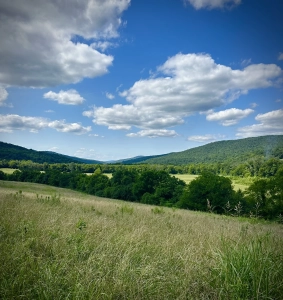
Driving onto the property, the Paint Rock Valley and surrounding Cumberland Plateau terrain beguiled and bewitched me. I reflected on my third book, Weaned Seals and Snowy Summits: Stories of Passion for Place and Everyday Nature, co-authored with Dr. Jennifer Wilhoit (published in 2019). My book Introduction included:
Awakening to nature does not require a trip to the Grand Canyon or a trek across the Gobi. Nature is in our backyard, a trip to a nearby city park, or a state park just down the road. Anyone can develop a relationship with nature wherever you are, a point I reiterate in each and every nature-inspired life and living address I deliver. My relationship with nature is spiritual. I view my engagement as a calling, and a noble cause to sow seeds so that others might do their own part to change some small corner of this Earth for the better.
I awakened to the Nature of this special place when I entered the Graham Farm and Nature Center. The sense and spirit beckoned me, pulled me into its magic. It was real and palpable, strengthening with each moment during our six hours on the property, seeing and inhaling its essence, meeting and getting to know staff, and sharing ideas and dreams. Wisps of memories and vapors of possibilities infused my vision of a potential volunteer niche role for me, an admittedly self-satisfying venture for yet another chapter of my retirement. I recently crossed my 75th birthday threshold, entering my 4th quarter of a century of life on Earth. A senior former forestry faculty colleague remarked in response to my fourth quarter of a century comment, “Remember that in football, in the 4th quarter, every play counts!”
I share a relevant excerpt from Notes from the Field: Paint Rock and the New Nation (July 4, 2026) by Bill Finch, Founding Director, Paint Rock Forest Research Center, located in the same valley and ecosystem as GF&NC:
Paint Rock appears to have escaped the worst of 19th and 20th century deforestation and plowing. But the modern forest is a dim reflection of what it was in the 18th century. Mountainsides then as now likely supported the most diverse assembly of deciduous trees and shrubs in the United States, in some places so tall and dense they blocked the sun for much of the year. But the slopes may have been less uniformly covered in trees. Fragments of sun-loving, summer blooming sunflowers, tall green gentians, lilies, moon-flowered silphiums, and warm season grasses still dot the slopes, the remnants of what must have been extensive nearly treeless glades. Plants that are now rare in that forest, like smoketrees and the federally threatened Morefield’s clematis vine, are struggling to find the light they once knew.
I have no doubt that this Paint Rock Valley is a Special Place. I recorded this 60-second video as a brief introduction to Graham Farm and Nature Center.
I will not burden you with tireless narrative based only upon a preliminary superficial reconnaissance. I’m hooked enough to return to get to know her better, and share what I learn, both the obvious and the mystery.
The Center
As Chancellor, the University of Alaska Fairbanks, America’s Arctic University, I fell in love with America’s Last Frontier. Alaska is not just a vast place…it’s a spirit, an abiding spirit. Robert Service, a Brit who spent several years in the Yukon during the turn of the prior century goldrush days, expressed the Far North essence more clearly than any I’ve read. Excerpting from his The Spell of the Yukon:
There’s a land — oh, it beckons and beckons,
And I want to go back — and I will.
It’s the great, big, broad land ‘way up yonder,
It’s the forests where silence has lease;
It’s the beauty that thrills me with wonder,
It’s the stillness that fills me with peace.
Granted, Alaska is unmatched. It’s also not within an hour and 15 minute drive of my house! I welcome a Nature affair with a special place of beauty, magic, wonder, awe, and inspiration… where I want to go back — and I can… and I will. Graham Farm and Nature Center fits the bill!
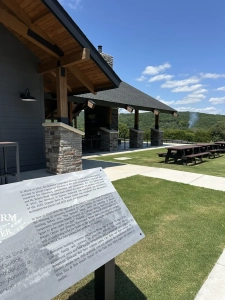
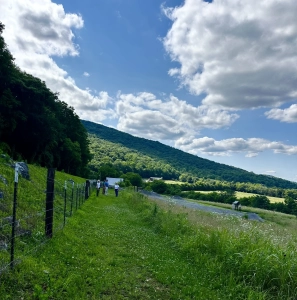
Allow me to rely upon selected photos and brief videos to present a GF&NC overview. I pledge to develop focused photo essays from future visits. The pavilion and operational hub occupy a commanding knoll at the valley core of the 491-acre property.
An old photograph of the pre-ACES Graham farm is among exhibits that reach back into the farm and valley’s rich history.
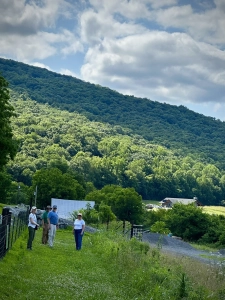
Our June 24, 2026 contingent consisted of Bill and Becky Heslip, me in the rear echelon, Center Director Themika L. “Mike” Sims, Chris Stuhlinger, Roxanne Pennington, and Administrative Support Specialist II Donna Sands behind the camera.
Although we didn’t have an opportunity to visit this charming woods-edge cottage, we understood that it will see future use as an overnight accommodation.
We visited the trailhead of a mountain forest trail. When summer’s heat abates I will return to explore this and many other trails.
The valley does indeed beckon.
Even the open land near the creeks promises discoveries in ecotype transition from field to meadow to brush to forest to wetland to stream channel.
Meadowland transitioning to brush then to forest will afford learning and discovery to Center visitors for the ages.
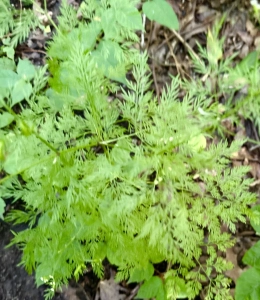
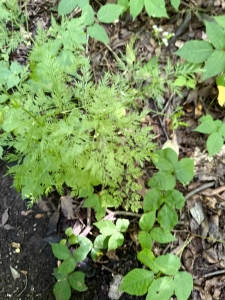
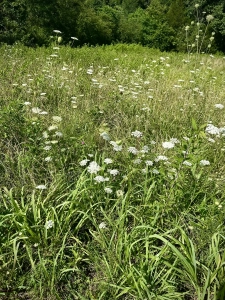
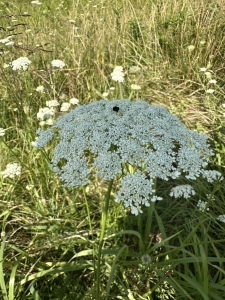
Wild carrot presented its lacy blossoms in the lower meadows.
I’m eager to follow and admire the Center’s changing seasonal faces. Multiply the one-hour-of-one-afternoon a hundred fold to anticipate the Nature-magic that lies ahead.
Larkin Creek enters Paint Rock River at this juncture on the property. I look forward to seeing the flow when it is not turbid from recent flooding, and also when the streams are at overflow. This landscape feature lies 1,000 vertical feet below the property’s highest. Spring at the union arrives more than a week in advance of the peak; autumn a week later. The place and its seasons are complex, varied, and exhilarating.
I recorded this 60-second video of the Larkin Creek juncture with Paint Rock River.
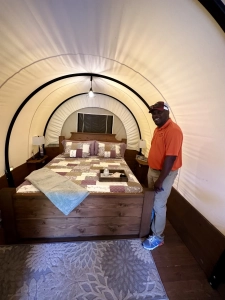
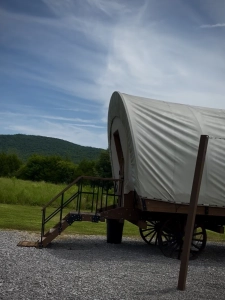
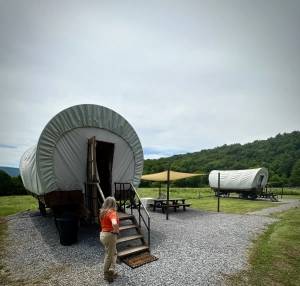
Perhaps I will find reason to stay overnight in the Connestoga Wagon Pampering Accommodations!
Here is my 60-second video of the overnight pampering wagons.
Chris and I are returning to GF&NC on July 30 to scout a tree and shrub identification trail, providing fodder for a subsequent Great Blue Heron GF&NC photo essay.
Thoughts and Reflections
I offer these observations:
I view my engagement (with Graham Farm and Nature Center) as a calling, and a noble cause to sow seeds so that others might do their own part to change some small corner of this Earth for the better. (Steve Jones)
The sense and spirit of this special place beckoned me, pulled me into its magic! (Steve Jones)
Remember that in football, in the 4th quarter, every play counts! (Dr. Russell Briggs)
Awakening to Nature does not require a trip to the Grand Canyon or a trek across the Gobi. (Steve Jones)
Inhale and absorb Nature’s elixir. May Nature Inspire, Inform, and Reward you!
Note: Unless otherwise noted, all blog post images are created & photographed by Stephen B. Jones.
I am available for Nature-Inspired Speaking, Writing, and Consulting — contact me at steve.jones.0524@gmail.com
Subscribe to my free weekly photo essays (like this one) at: http://eepurl.com/cKLJdL
A reminder of my Personal and Professional Purpose, Passion, and Cause
If only more of us viewed our precious environment through the filters I employ. If only my mission and vision could be multiplied by untold orders of magnitude:
Mission: Employ writing and speaking to educate, inspire, and enable readers and listeners to understand, appreciate, and enjoy Nature… and accept and practice Earth Stewardship.
Vision:
People of all ages will pay greater attention to and engage more regularly with Nature… and will accept and practice informed and responsible Earth Stewardship.
They will see their relationship to our natural world with new eyes… and understand their Earth home more clearly.
Tagline/Motto: Steve (Great Blue Heron) encourages and seeks a better tomorrow through Nature-Inspired Living!
Steve’s Four Books
I wrote my books Nature Based Leadership (2016), Nature-Inspired Learning and Leading (2017), Weaned Seals and Snowy Summits: Stories of Passion for Place and Everyday Nature (2019; co-authored with Dr. Jennifer Wilhoit), and Dutton Land & Cattle: A Land Legacy Story (2025) to encourage all citizens to recognize and appreciate that every lesson for living, learning, serving, and leading is either written indelibly in or is powerfully inspired by Nature. All four of my books present compilations of personal experiences expressing my deep passion for Nature. All four books offer observations and reflections on my relationship with the natural world… and the broader implications for society. Order any from your local indie bookstore, or find them on IndieBound or other online sources such as Amazon and LifeRich.
I began writing books and Posts for several reasons:
I love hiking and exploring Nature
I see images I want to (and do) capture with my trusty iPhone camera
I enjoy explaining those images — an educator at heart
I don’t play golf!
I do love writing — it’s the hobby I never needed when my career consumed me
Judy suggested my writing is in large measure my legacy to our two kids, our five grandkids, and all the unborn generations beyond
And finally, perhaps my books and Blogs could reach beyond family and touch a few other lives… sow some seeds for the future
https://stevejonesgbh.com/wp-content/uploads/2026/07/IMG_1969-2.jpeg-06.24.26-Nitas-View.webp12001132Steve Joneshttp://stevejonesgbh.com/wp-content/uploads/2017/01/gbhweblogo.pngSteve Jones2026-08-05 10:03:182026-08-05 10:03:18First Time Visit to Graham Farm and Nature Preserve
I met with friends Chris Stuhlinger, Marian Moore Lewis, Bill and Becky Heslip, and Ben Hoksbergen on the morning of March 26, at the Taylor Road entrance to Huntsville, Alabama’s Goldsmith-Schiffman Wildlife Sanctuary. The five of us wanted to learn more from archaeologist Ben about the Native American history he gleaned from a prior survey he conducted on the Sanctuary. Rather than share the fascinating history, I offer you our never-disappointing ecological saunter through the Sanctuary, revealing seasonal spring discoveries.
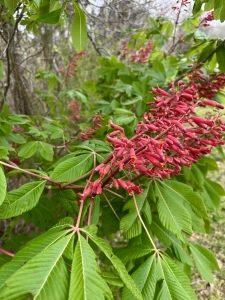
Red buckeye showed its colors amid the morning vapors above Hidden Spring.
I recorded this 59-second red buckeye video.
Hidden Spring lies 30-feet below the entrance deck and shelter. Something within the deepness beckoned me, but the steep descent and the vegetative jungle compelled me to stay at the bluff to capture the Hidden Spring magic from above. What would have been a quick descent, brief exploration, and return scamper to the brim at age 45, is now daunting 30 years hence. Such a possibiliy is now reduced to a Southern term: “usedtocould“!
A still photograph and my 59-second video will have to satisfy my curiosity for a closer look.
Hidden Spring Brook collects and channels the Hidden Spring flow, beginning its jorney to the Flint River.
Here’s my video of Hidden Spring Brook.
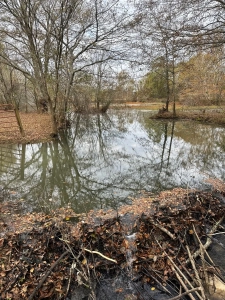
Approaching Jobala Pond, Hidden Brook is terraced by a beaverdam. Ever the habitat-modifying stream engineers, beavers insist on having it their way!
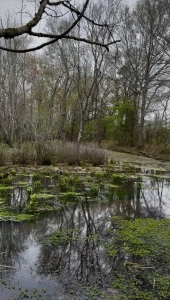
A city crew rectifying a drainage issue temporarily muddied Jobala Pond with sediment inflow.
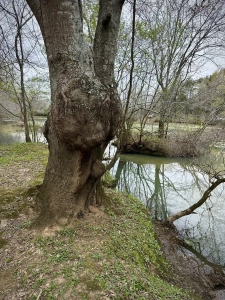
I’ve been monitoring a large and rapidly expanding burl five feet above ground on a water oak at the Jobala Pond outlet for eight years. I always snap a photo, wondering what is the endgame for this unusual growth.
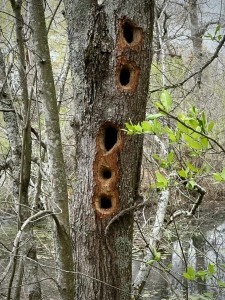
Nearby, a pileated woodpecker is creating a high-rise apartment complex. I could not get close enough to see whether there are different unique compartments…or separate entrances to the tree’s hollow interior. The woodpecker’s excavations serve a self interest. Does the bird know/understand/care that in pecking away to secure food (insects and grubs) that it is performing a valuable ecosysten function? How many mammals, birds, reptiles, insects, fungi, and other lifeforms interact with the bird’s ratta-tat-tat drumming?
John Muir appreciated the essential interdpendency of all things earthly:
When we try to pick out anything by itself, we find it hitched to everything else in the Universe.
AND
When we contemplate the whole globe as one great dewdrop, striped and dotted with continents and islands, flying through space with other stars all singing and shining together as one, the whole universe appears as an infinite storm of beauty.
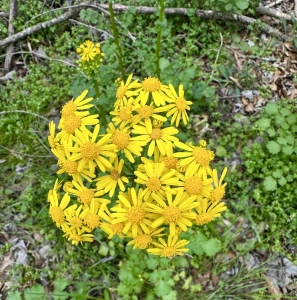
Butterweed’s season exalts across three glorious early spring weeks. She tends her stored sunshine secretively through our southern winter. Suddenly after the requisite threshold of degree days, she lets loose, explosively…from drab dormancy to lasered brilliance emanately from roadside ditches.
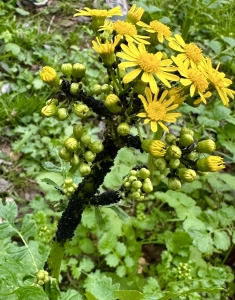
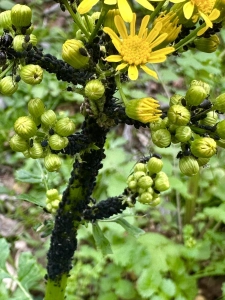
Most specimens along the main sanctuary trail were pest free, this heavily black-bean-aphid-infested plant an exception.
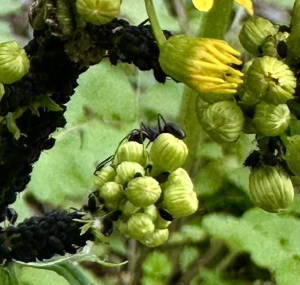
Oh, the ecological lessons in plain sight on a three-hour spring saunter, like this silky field ant tending black bean aphids! Ants and aphids share a well-documented symbiotic relationship, which means they both benefit mutually from their working relationship. Aphids produce a sugary food for the ants, in exchange, ants care for and protect the aphids from predators and parasites.
A small flowered buttercup expressed spring’s urgent call to action. Summer’s rampant vegetative growth will rapidly smother this harbinger of spring. Her call is to get it done now, while the gettin’ is good!
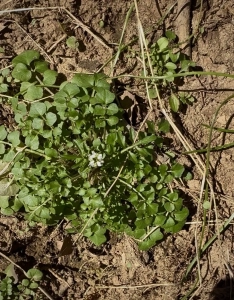
Bulbous cress is another early spring ephemeral whose window will soon close.
We puzzled a few minutes over the streamside identity of buckthorn bully. I love the interplay of enthusiastic Nature enthusiasts clamoring, researching digitally, testing with iNaturalist, and even arguing (good naturedly) to see who can claim the identity summit. The competition was so savagely engaged that I already forget who prevailed!
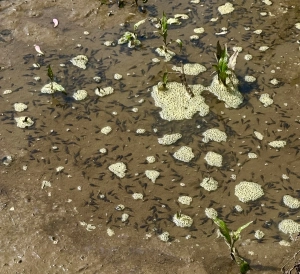
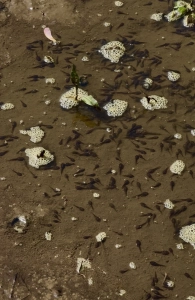
One of us noticed a roadside puddle thick with tadpoles. I recorded this 60-second tadpole video.
I pondered the fate of the tadpoles. Did rain replenish the puddle long enough for frogs or toads to emerge? Will predators prevail?
We proceeded to the wetland mitigation area, where I recorded a video.
The project’s intent is to restore the agricultural fields to their original hydrology and to restore bottomland hardwood forest species. The tree shelters protect planted wetland hardwood seedlings.
I’ll close this post with a repeat from a prior recent photo essay. I’m drafting this narrative 25 days after major left shoulder replacement revision surgery. Recovery includes lots of physical therapy and encourages walking. Walking on the sidewalk and greenway variety! Woodland excursions are weeks away for a less-than-sure-footed 75-year-old. My Doc discourages falling, jarring, and stressing the prosthesis! I chose to once again employ the closing. I’m not yet at the end of my forest hiking/sauntering, but one day we all will reach that juncture when we’ll hike again with old friends, long gone. Until then, I will trek my haunts while I have the chance…until I can’t.
Closing
I recalled and reflected upon the lyrics of a beautiful, haunting, sobering song written by Cody Johnson and recently re-released by Kid Rock:
If you got a chance take it Take it while you got a chance If you got a dream chase it ‘Cause a dream won’t chase you back If you’re gonna love somebody Hold ’em as long and as strong and as close as you can ‘Til you can’t
After wandering forests for three-quarters of a century, I was struck with the notion that I intend to continue doing so…until I can’t. A day will come when I can’t. I look at my wife, kids, grandkids, friends, and colleagues through the same reality filter. A day will come… when I can’t.
I recall the dawn…my dawn…from a growing distance. I sense the evening gloam approaching. I ask myself, do I want to invest a single woods venture by racing with a group from one place, through the woods, to another, with virtually no time for inter-personal, social intercourse? And certainly too little time to harvest photo essay fodder. I relish each step at my own pace, embracing the beauty, magic, wonder, awe, and inspiration?
I shall remain a dedicated servant of encouraging informed and responsible Earth stewardship...Until I can’t…
Thoughts and Reflections
I offer these observations:
When we try to pick out anything by itself, we find it hitched to everything else in the Universe. (John Muir)
I shall remain a dedicated servant of encouraging informed and responsible Earth stewardship…Until I can’t… (Steve Jones)
Imagination is more important than knowledge. Knowledge is limited. Imagination encircles the world. (Albert Einstein)
Inhale and absorb Nature’s elixir. May Nature Inspire, Inform, and Reward you!
I am available for Nature-Inspired Speaking, Writing, and Consulting — contact me at steve.jones.0524@gmail.com
Subscribe to my free weekly photo essays (like this one) at: http://eepurl.com/cKLJdL
Reminder of my Personal and Professional Purpose, Passion, and Cause
If only more of us viewed our precious environment through the filters I employ. If only my mission and vision could be multiplied untold orders of magnitude:
Mission: Employ writing and speaking to educate, inspire, and enable readers and listeners to understand, appreciate, and enjoy Nature… and accept and practice Earth Stewardship. Until I can’t!
Vision:
People of all ages will pay greater attention to and engage more regularly with Nature… and will accept and practice informed and responsible Earth Stewardship.
They will see their relationship to our natural world with new eyes… and will understand more clearly their Earth home.
Tagline/Motto: Steve (Great Blue Heron) encourages and seeks a better tomorrow through Nature-Inspired Living!
Steve’s Four Books
I wrote my books Nature Based Leadership (2016), Nature-Inspired Learning and Leading (2017), Weaned Seals and Snowy Summits: Stories of Passion for Place and Everyday Nature (2019; co-authored with Dr. Jennifer Wilhoit), and Dutton Land & Cattle: A Land Legacy Story (2023) to encourage all citizens to recognize and appreciate that every lesson for living, learning, serving, and leading is either written indelibly in or is powerfully inspired by Nature. All four of my books present compilations of personal experiences expressing my deep passion for Nature. All four books offer observations and reflections on my relationship with the natural world… and the broader implications for society. Order any from your local indie bookstore, or find them on IndieBound or other online sources such as Amazon and LifeRich.
I began writing books and Posts for several reasons:
I love hiking and exploring Nature
I see images I want to (and do) capture with my trusty iPhone camera
I enjoy explaining those images — an educator at heart
I don’t play golf!
I do love writing — it’s the hobby I never needed when my career consumed me
Judy suggested my writing is in large measure my legacy to our two kids, our five grandkids, and all the unborn generations beyond
And finally, perhaps my books and Blogs could reach beyond family and touch a few other lives… sow some seeds for the future
https://stevejonesgbh.com/wp-content/uploads/2026/03/IMG_1089.jpeg-03.25.26-GSWS-Red-Buckeye.webp1200900Steve Joneshttp://stevejonesgbh.com/wp-content/uploads/2017/01/gbhweblogo.pngSteve Jones2026-06-25 13:26:112026-06-25 13:26:11Red Buckeye, a Colony of Aphids, and a Swarm of Tadpoles: Spring in Our Midst!
I co-taught a Huntsville, Alabama LearningQuest session on America’s National Parks on the morning of February 12, 2026, at the Hampton Cove WellPoint Senior Community. Afterward, an exquisite early spring afternoon beckoned me to explore the eastern half of the nearby Goldsmith-Schiffman Wildlife Sanctuary. Walk with me as I share some early signs of wildland spring within the 400-acre reserve in the bottomlands along the Flint River.
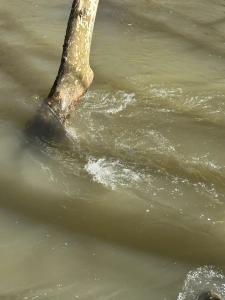
The Flint generally runs high with winter rains. On this day, the river is shy of bank-full, yet is high enough to submerge this sycamore’s base.
Here is my 48-second video of the main channel a few hundred yards from the Sanctuary’s east side entrance.
I’ve scheduled a prior winter season hike at the Sanctuary following several days of winter rains, only to be turned back by the Flint River overflowing its banks and sending floodwaters to within a hundred feet of the gravel parking lot.
I recorded this 58-second video of side channel with narration, at a point opposite the cut-off island one-half mile from the lot.
The main river channel lies just downstream from where I stood.
Here’s the same view (51-second video) without my annoying narration.
The bottomland forests and meadows were saturated. Soaked areas welcomed male frogs already intent on attracting females. All critters are single-minded. Life is all about reproduction…sustaining the species…whether amphibian, reptile, bird, mammal, fish, human, or fungus.
This little guy is of lone voice, yet persistent. Is some lonely girl frog listening…tempted, lured, and approaching?
My 42-second video recorded the lone male calling plaintively.
I like the rustic signage, slowly yielding to time and decay, reminiscent of Sleepy Hollow!
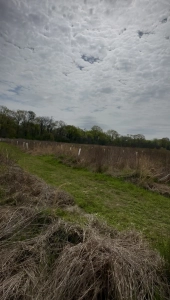
Old agricultural fields, populated with sedges and various other meadow species are transitioning to forest courtesy of natural tree and shrub regeneration, as well as trees planted in seedling shelters, many of which are protecting seedlings that died when planted during an extended fall drought two years ago.
Here is my 60-second video of wetland mitigation efforts in the meadows.
The trail passes east from the mitigation fields through this meadow that is regenerating with volunteer, now shoulder-high sweetgum trees.
I recorded this 60-second video as I strolled along the trail.
Ironweed (left) and sweetgum line the trail.
Mature hardwood borders the meadow.
I repeat often that every tree tells a story. This American beech along the trail in the dense bottomland hardwood forest within hearing distance of Highway 431 traffic noise, supplies life-sustaining sustenance via root grafts to three living stumps, including the one below right at the tree’s base.
I reecorded this 61-second video with explanatory narrative of the beech and the three adjacent stumps.
Although still six weeks from the spring equinox, our peeper friend evidenced that spring was in the air. That’s a far cry from our time living in the far North.
Early Spring Ephemeral Bonus
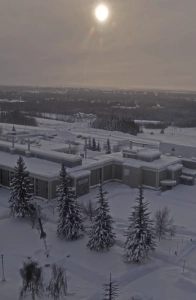
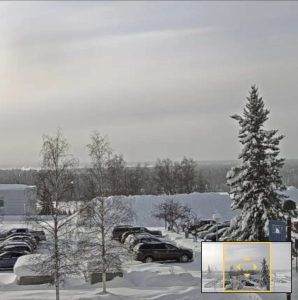
I’m drafting my photo essay prose on February 26. This morning at 5:00 AM Central Time, when our Madison, Alabama temperature was 58 degrees, I checked the temperature in Fairbanks, AK, my home from 2004-2008. It was negative 37; that’s 95 degrees colder. The snowpack was 40 inches. I copied these images at 11:00 AM local time from the University of Alaska Fairbanks webcam atop the Geophysical Institute.
The Fairbanks ground will not be absent snow cover through most of April. Spring flowers may not appear until mid-May.
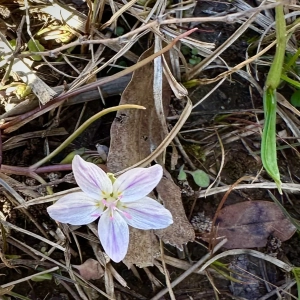
I’ve adjusted my calendar here in the South. Within the regenerating meadow, in mid-February, I spotted two Virginia spring beauty blossoms (one at left). The flowering cress (right) presented itself on the sandy shore across from the island.
I loved our four-year Alaska venture, even the deep winters. I could have stayed for many years, but both of our adult children blessed us then with our first two grandkids, who this May will graduate high school! Life itself is a rewarding adventure, enriched many fold by our time in The Last Frontier — The Big Broad Land Way Up Yonder!
Thoughts and Reflections
I offer these observations:
Life is all about reproduction…sustaining the species…whether amphibian, reptile, bird, mammal, fish, human, or fungal. (Steve Jones)
Spring work is going on with joyful enthusiasm. (John Muir)
Life is either a daring adventure or nothing. (Helen Keller)
Inhale and absorb Nature’s elixir. May Nature Inspire, Inform, and Reward you!
I am available for Nature-Inspired Speaking, Writing, and Consulting — contact me at steve.jones.0524@gmail.com
Subscribe to my free weekly photo essays (like this one) at: http://eepurl.com/cKLJdL
Reminder of my Personal and Professional Purpose, Passion, and Cause
If only more of us viewed our precious environment through the filters I employ. If only my mission and vision could be multiplied untold orders of magnitude:
Mission: Employ writing and speaking to educate, inspire, and enable readers and listeners to understand, appreciate, and enjoy Nature… and accept and practice Earth Stewardship.
Vision:
People of all ages will pay greater attention to and engage more regularly with Nature… and will accept and practice informed and responsible Earth Stewardship.
They will see their relationship to our natural world with new eyes… and will understand more clearly their Earth home.
Tagline/Motto: Steve (Great Blue Heron) encourages and seeks a better tomorrow through Nature-Inspired Living!
Steve’s Four Books
I wrote my books Nature Based Leadership (2016), Nature-Inspired Learning and Leading (2017), Weaned Seals and Snowy Summits: Stories of Passion for Place and Everyday Nature (2019; co-authored with Dr. Jennifer Wilhoit), and Dutton Land & Cattle: A Land Legacy Story (2023) to encourage all citizens to recognize and appreciate that every lesson for living, learning, serving, and leading is either written indelibly in or is powerfully inspired by Nature. All four of my books present compilations of personal experiences expressing my deep passion for Nature. All four books offer observations and reflections on my relationship with the natural world… and the broader implications for society. Order any from your local indie bookstore, or find them on IndieBound or other online sources such as Amazon and LifeRich.
I began writing books and Posts for several reasons:
I love hiking and exploring Nature
I see images I want to (and do) capture with my trusty iPhone camera
I enjoy explaining those images — an educator at heart
I don’t play golf!
I do love writing — it’s the hobby I never needed when my career consumed me
Judy suggested my writing is in large measure my legacy to our two kids, our five grandkids, and all the unborn generations beyond
And finally, perhaps my books and Blogs could reach beyond family and touch a few other lives…sow some seeds for the future
Me at right from a prior visit.
https://stevejonesgbh.com/wp-content/uploads/2026/02/IMG_0522.jpeg-02.12.26-GSWS-Flint-River.webp1200828Steve Joneshttp://stevejonesgbh.com/wp-content/uploads/2017/01/gbhweblogo.pngSteve Jones2026-05-27 07:56:162026-05-27 07:56:16Early Signs of Spring on the Goldsmith-Schiffman Wildlife Sanctuary!
I hiked the Lawson Branch Loop Trail of Shoal Creek Preserve on March 6, 2026, with fellow retired forester Chris Stuhlinger and retired videographer Bill Heslip. Chris and I had previously circuited the Jones Branch Loop Trail (https://stevejonesgbh.com/2025/02/26/early-december-circuit-of-jones-branch-trail-at-shoal-creek-nature-preserve/). We sauntered a counterclockwise loop through the second-growth hardwood forest, noting the view above the Wilson Lake Shoal Creek Inlet, the tumbling Lawson Branch, and other notable natural features along the route.
Mixed oak, hickory, and other upland hardwoods populated the hillsides.
We enjoyed the winter, foliage-free video of the inlet.
Summer’s full canopy will obscure the view when leaves return.
Here is my 58-second video from above the inlet.
Chris (left) and Bill provide scale.
Mountain laurel graced the hilltop. I cut my youthful Ridge-and-Valley hiking teeth in the Central Appalachians, thick with this beautiful evergreen shrub. The valley view and the laurel transported me six decades aft temporally, to a period when I knew I would hike the trails, ascend the bluffs, and log the miles without end. A couple of months shy of 75 years, I am blessed to still cover Nature’s gentle woodland pathways, immersed in her endless beauty, magic, wonder, awe, and inspiration.
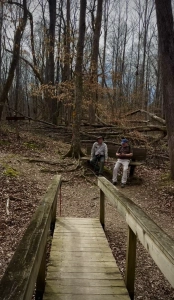
How could I possibly want for more than a spring stream, a wooden bridge, and a rustic bench for three seasoned seniors to rest a spell among the trees.
I recorded this 59-second video along Lawson Branch, referring to it incorrectly in the narrative as Jones Branch.
Spring sky, fresh waters, and absolute serenity and tranquility streamside are beyond compare.
I recorded this 40-second video of Lawson Branch.
Tumbling, gurgling, and singing require only an investment of time, energy expended, and woodland conversation. I’ve never played golf, but I sense that it breeds frustration, encourages drinking fermented beverages, provides exercise entailing getting on and off of a motorized cart, and leads to betting foolish sums of money. I know golf is referred to as a game that grownups play. I’ve witnessed too many miserable golfers to believe it is better than woodland rambling!
I recorded this 58-second video along Lawson Branch.
Golf courses are lovely summer places at dawn and after the daytime heat abates at gloaming. Otherwise, give me late summer woodland shade, preferably streamside!
Tree Form Oddities and Curiosities
I like scouting the forest rough for oddities and curiosities, not searching the brambles, vines, and snakepits for little white balls!
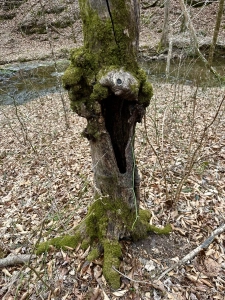
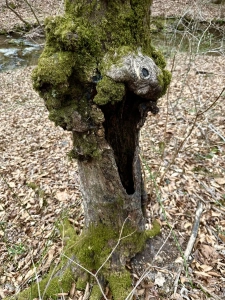
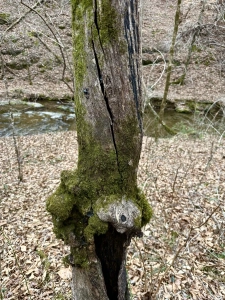
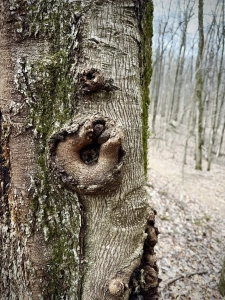
I am seldom disappointed when I seek strange critters like this dead snag with gaping maw, contorted jaw, and a single eye, daring the three old guys to approach the creek below.
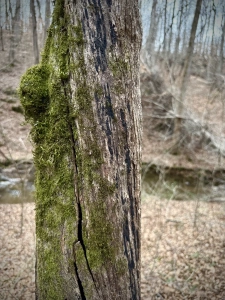
I can never get enough of bizarre tree countenances, pattererned surfaces, and mossy complexions.
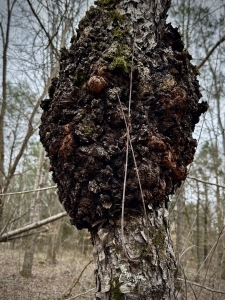
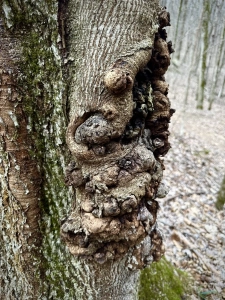
An imtermediate canopy black cherry with a prominent agrobacterial crown gall beckoned us to take a closer look.
Our Planet’s Most Essential Epidermis
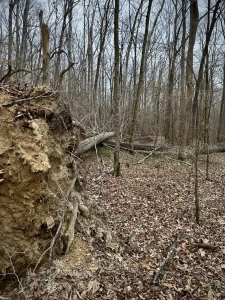
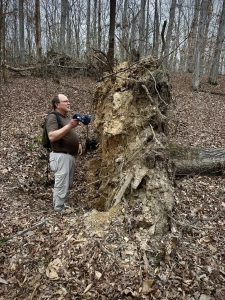
I took two undergraduate courses in forest soils. As a practicing industrial forester in the southeastern US, I served 1975-79 as Project Leader for Tree Nutrition and Fertilization for our company’s 2.2 million forested acres (VA; NC; SC; GA; FL: and AL). My subsequent PhD explored soil-site relationships in the Allegheny Plateau of NE Pennsylvania and SW New York. I consider myself a forest soil scientist. Soil, whether forest, agriculture, urban, or anywhere is Earth’s essential membrane…all terrestrial life on our planet depends on this living and life-giving veneer. I seldom enter a forest where I don’t encounter a mature wind-toppled tree…having lifted its rooting mass and accompanying soil.
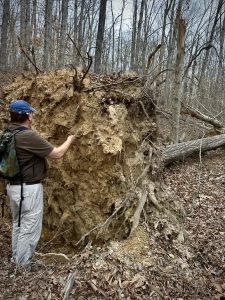
Bill is standing by an oak root ball lifted within the past few months. Although the regolith (the unconsolidated, loose, heterogenous superficial deposits covering solid rock) extends variously deeper below this lifted three-foot layer, this mantle is the essential stuff of life. Root penetration even on this large oak, ended at this depth. The exposed soil profile consists of a surface organic layer; an ‘A’ horizon of mixed mineral and organic matter (AKA topsoil); a zone of accumulation of leached organic and mineral components, the ‘B’ horizon. The root ball lifted at the boundary between the ‘B’ horizon and the ‘C’ layer of unweathered regolith.
Such is the simplistic equation of life in the woods…the magic of chemistry and physics. The soil holds, recycles, and processes through its rich association of living organisms, moisture, and thermal fluctuations everything needed for life. As we walk along wooded byways, our attention is focused above ground and high into the canopy, where it’s easy to assume that biological activity concentrates. However, I recall from my extensive and exhaustive dissertaion literature search that 75 percent of carbon turnover (biological activity) occurs below ground, within the soil. Watch yourself, that biological hotbed may reach out and grab you!
Near the fallen oak, a handsome green ash reaches far into the canopy. I wonder whether it realizes that while its essentail life-energy derives from its solar partner, the real life action takes place below in the permanent darkness of its rooting zone. Is there a human parallel? An essential dimension of our human fulfillment that derives hidden from plain sight…a spiritual dimension that too often we shelter in darkness? I know I am guilty of reaching under the basket far too infrequently. I worry that the day will come when its too late to open the shutter.
I recorded this fifty-eight-second video near this green ash. I refer erroneously to the stream as Jones Branch. It is Lawson Branch.
Northern spicebush flowers early in the season, a delightful forebearer of spring ready to launch.
Spicebush seems a good place to close the narrative.
Thoughts and Reflections
I offer these observations:
I worry that the day will come when it’s too late to open the shutter to the things I hold dear. (Steve Jones)
Such is the simplistic equation of life in the woods…the magic of chemistry and physics. (Steve Jones)
Soil, whether forest, agriculture, urban, or anywhere, is Earth’s essential membrane…all terrestrial life on our planet depends on this living and life-giving veneer. (Steve Jones)
Inhale and absorb Nature’s elixir. May Nature Inspire, Inform, and Reward you!
I am available for Nature-Inspired Speaking, Writing, and Consulting — contact me at steve.jones.0524@gmail.com
Subscribe to my free weekly photo essays (like this one) at: http://eepurl.com/cKLJdL
Reminder of my Personal and Professional Purpose, Passion, and Cause
If only more of us viewed our precious environment through the filters I employ. If only my mission and vision could be multiplied untold orders of magnitude:
Mission: Employ writing and speaking to educate, inspire, and enable readers and listeners to understand, appreciate, and enjoy Nature… and accept and practice Earth Stewardship.
Vision:
People of all ages will pay greater attention to and engage more regularly with Nature… and will accept and practice informed and responsible Earth Stewardship.
They will see their relationship to our natural world with new eyes… and will understand more clearly their Earth home.
Tagline/Motto: Steve (Great Blue Heron) encourages and seeks a better tomorrow through Nature-Inspired Living!
Steve’s Four Books
I wrote my books Nature Based Leadership (2016), Nature-Inspired Learning and Leading (2017), Weaned Seals and Snowy Summits: Stories of Passion for Place and Everyday Nature (2019; co-authored with Dr. Jennifer Wilhoit), and Dutton Land & Cattle: A Land Legacy Story (2023) to encourage all citizens to recognize and appreciate that every lesson for living, learning, serving, and leading is either written indelibly in or is powerfully inspired by Nature. All four of my books present compilations of personal experiences expressing my deep passion for Nature. All four books offer observations and reflections on my relationship with the natural world… and the broader implications for society. Order any from your local indie bookstore, or find them on IndieBound or other online sources such as Amazon and LifeRich.
I began writing books and Posts for several reasons:
I love hiking and exploring Nature
I see images I want to (and do) capture with my trusty iPhone camera
I enjoy explaining those images — an educator at heart
I don’t play golf!
I do love writing — it’s the hobby I never needed when my career consumed me
Judy suggested my writing is in large measure my legacy to our two kids, our five grandkids, and all the unborn generations beyond
And finally, perhaps my books and Blogs could reach beyond family and touch a few other lives… sow some seeds for the future
https://stevejonesgbh.com/wp-content/uploads/2026/03/IMG_0664.jpeg-Shoal-Creek-Preserve-Lawson-Branch-03.06.26.webp1200681Steve Joneshttp://stevejonesgbh.com/wp-content/uploads/2017/01/gbhweblogo.pngSteve Jones2026-05-17 17:43:252026-05-17 17:43:25Lawson Branch Loop; Shoal Creek Preserve Spring 2026!
I am pleased to add the 58th of my GBH Brief-Form Posts (Less than five minutes to read!) to my website. I get wordy with my routine Posts. I don’t want my enthusiasm for thoroughness and detail to discourage readers. So, I will occasionally publish these brief Posts.
Alabama State Parks Northwest District Naturalist Amber Coger, fellow retired forester Chris Stuhlinger, and I measured selected tree heights on the morning of February 10, 2026, at Monte Sano State Park. We chose the exceptionally fertile lower, concave, northeast-facing slopes along the Sinks Trail. The soils are limestone-derived, deep, and well-watered. I visit the area several times annually… and marvel at the diversity of hardwood species, the towering heights of the trees, and the straight boles. I refer to this stand as a cathedral grove.
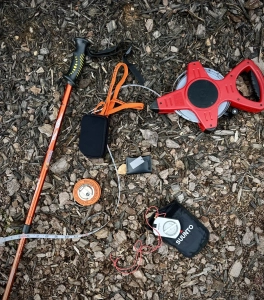
I brought my measurement tools for the tasks, positioned below with my trekking pole for scale: a 100-foot reel; a diameter tape; a 10-factor basal area prism; and a clinometer. Don’t look for a detailed exposition on their use. We used the reel to measure 100 feet horizontally from the tree base. At 100 feet, the clinometer percent scale translates directly to vertical feet below and above eye level. The diameter tape measures the tree diameter at breast height (DBH). The prism estimates the square feet of basal area per acre (at breast height).
Amber quickly learned the fine art and skill of employing these basic forestry instruments, in this case tallying basal area.
A Magnificent Chestnut Oak
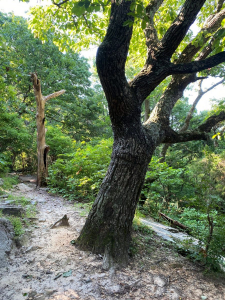
From my exhaustive experience in New York, Pennsylvania, Maryland, West Virginia, Virginia, and here in Alabama, chestnut oak commonly dominates ridgetops and upper slopes, poorer sites with shallow rocky soils that can be drouthy and of low fertility. Here’s a particularly gnarled ridgetop chestnut oak, squatty and mishapen, on the Rainbow Mountain Nature Preserve in nearby Madison, Alabama.
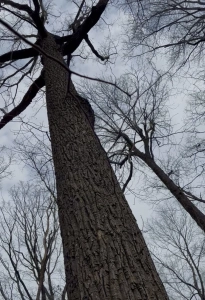
My chestnut oak stigma paints chestnut oak unfavorably. On better quality sites, chestnut oak doesn’t compete effectively with faster growing species like yellow polar, basswood, northern and southern red oak, and hickories. This chestnut oak along the Sinks Trail had caught my eye on previous visits. Stately, straight, and fat, this individual is 35.8″ DBH, and stands a remarkable 122 feet tall. Across the 53 years since earning a forestry bachelors degree, I don’t recall seeing such a superb chestnut oak.
But low and behold, my search of the Alabama Forestry Commission’s 2025 State Champion Tree List revealed a different image than the one I’ve held for years. The Commission lists 32 oak species, including the chestnut oak champion, which stands at 147 feet, 25 feet taller than the Monte Sano specimen. Only the champion cherrybark oak is taller at 156 feet.
I pledge to adjust my chestnut oak stigma. I assure you that this is not the first time I have altered an impression based on knowledge, experience, and time, whether it be of people, places, or things. Another teachable moment surfaced during the morning. I have known this species as Quercus prinus since taking Dendrology in 1970, more than a half-century ago. Amber and Chris informed me that the esteemed gods of systematic botany and plant classification have recently (RECENT to me alone perhaps!) changed the species from prinus to montana. The Missouri Botanical Garden online reference reduced my chagrin:
Quercus montana, commonly called chestnut oak (also commonly called basket oak, rock oak and rock chestnut oak) is a medium to large sized deciduous oak of the white oak group that typically grows 50-70’ (less frequently to 100’) tall with a rounded crown. It is native to wooded slopes in dry upland areas, often with poor soils, from Maine to Indiana south to South Carolina and Alabama. It grows tallest in rich, well-drained soils.
The old timber beast occasionally resurfaces within me. This baby is a beauty: veneer log quality to at least 32 feet. Clear lumber all the way to the live crown. The thought just as quickly faded. Come on, Steve…for God’s sake, this is a State Park you old fool! Yet, I can’t shake the aroma of fresh sawdust and the rich patina of finished oak furniture. Or the heavenly warmth of a fine whiskey aged in a white oak barrel!
Whether commercial forest product or State Park forest treasure, its value is high wherever it grows. Measured and noted, the tree will stand as a lesson within the park’s information and interpretation portfolio. Why is this specimen special? What site factors (soil, slope position, nutrients, moisture, aspect) enable this individual to succeed?
Yellow Poplar Reaching Skyward
A few hundred feet downslope, I made note of the cathedral grove of primarily yellow poplar when I entered the stand near the lowermost signatory sink on the trail five years ago (March 12, 2021).
I photographed Jerry Weisenfeld, Alabama State Parks Advertising and Marketing Manager, standing beside the very same specimen that Amber, Chris, and I measured this February.
The prominent sink captures all surface water within the karst basin, directing it to subsurface. I have not encountered anyone who can tell me where the subterranean flow surfaces.
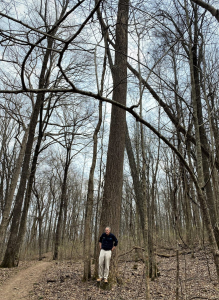
I have told many groups that some of these poplars exceed 140 feet.
The state champion yellow poplar stands at 172 feet. The three of us measured DBH at 28.1″ and height at 155 feet, 17 feet short of the champion! Keep in mind the champion designation is based on three measures: height, crown width, and bole cicumference. There may be, and often are, trees of the same species that are taller than the winner.
Two complementary Delights
We found a colony of scarlet elf cup mushrooms near the yellow polar. I love the moniker, the cup shape, and its spectacular scarlet and white.
Here is my 57-second video of the elf cup forest floor population.
Within the sheltered poplar stand, I found a cankered hickory, a tree form curiosity posing near the poplar.
Leonardo da Vinci studied Nature’s forms and shapes:
To such an extent does nature delight and abound in variety that among her trees there is not one plant to be found which is exactly like another.
Nature is the source of all true knowledge.
Closing
I accept the challenge of distilling these Brief-Form Posts into a single distinct reflection.
I often observe that every tree, every stand, and every forest tells a story. Sometimes we can’t discern the individual tree’s tale while we are distracted by the forest. We chose to focus our attention on two trees. We know them now as individuals. We hope that Amber and future park naturalists will share their stories and the lessons drawn from them.
Leonardo da Vinci would have appreciated our intent:
To such an extent does nature delight and abound in variety that among her trees there is not one plant to be found which is exactly like another.
Nature’s special treats await our discovery, our understanding, and our interpretation!
Subscribe to my free weekly photo essays (like this one) at: http://eepurl.com/cKLJdL
https://stevejonesgbh.com/wp-content/uploads/2026/02/IMG_0480.jpeg-02.10.26-Sinks-CO-35.8-inches-122-feet.webp1200818Steve Joneshttp://stevejonesgbh.com/wp-content/uploads/2017/01/gbhweblogo.pngSteve Jones2026-04-29 08:52:452026-04-29 08:52:45Brief-Form Post #58: Forest Discoveries While Measuring Tree Heights on Monte Sano State Park
I visited the Wheeler National Wildlife Refuge Visitors Center and Observation Building on December 19, 2025. See my Post on welcoming the sandhill cranes (https://stevejonesgbh.com/2026/01/27/theyre-back-sandhill-cranes-return-to-alabamas-wheeler-national-wildlife-refuge/). I then hiked the refuge’s nearby Hiking and Bicycling Trail, a 5.5-mile trek south through woodland, agricultural fields, and waterfowl impoundments, and along the Flint Creek arm of Lake Wheeler. As with all of my wildland saunters, I discovered Nature’s delights and mysteries, many of them hidden in plain sight.
Hardwood and pine intermix in the patchwork of forest, farm, and wetland. I love winter’s sharp contrast of evergreen and deciduous. Contrary to most of my fellow deep-south neighbors, I am in no rush for the return of what I view as a too-long summer.
Give me the dormant greys and subtle hues of winter…and the distant crane calls…absent the irritating hum of hungry mosquitoes.
I recorded this 59-second video of a field commercially farmed to produce soybeans and leave a designated portion for winter wildlife consumption.
Residual soybeans (left) and ponded rainwater (right) attract diverse wildlife.
The WNWR website succinctly describes this richly diverse property blessedly located within 30 minutes drive of my home:
Although designated as a waterfowl refuge, the 35,000 acre refuge provides for a wide spectrum of wildlife. Its great diversity of habitat includes deep river channels, tributary creeks, tupelo swamps, open backwater embayments, bottomland hardwoods, pine uplands, and agricultural fields. This rich mix of habitats provides places for over 295 bird species to rest, nest and winter, including over 30 species of waterfowl and an increasing population of Sandhill cranes and a small number of Whooping cranes.
The refuge is also home to 115 species of fish, 74 species of reptiles and amphibians, 47 species of mammals, 38 species of freshwater mussels, and 26 species of freshwater snails. Other animals such as the endangered Gray bat and Whooping crane benefit from the protection of the National Wildlife Refuge System, and the care of dedicated refuge staff and other friends of wildlife, like you.
An Alabama Cooperative Extension System online brochure introduces 69 of the most common native trees found in Alabama. Some of the 69 common tree species do not reach this far north. However, many Alabama tree species are not considered common. Where am I heading? I know, I’m hedging on my own wild guess of how many species of native trees and woody shrubs inhabit the refuge’s 55 square miles? Given the rich tapestry of wetlands and uplands, and the fertile overlay of bottomland and alluvial soils, I am going for broke, aiming high. I estimate 150 species of native trees and woody shrubs. If you know, please send me a reliable citation.
Tree Form Curiosities and Oddities
I relentlessly peruse woodland haunts for tree form oddities and curiosities. Spotting them only accomplishes part of the task. It falls to me next to explain the form. Leonardo da Vinci astutely observer that cause generates result:
There is no result in nature without a cause; understand the cause and you will have no need of the experiment.
My 60-second video introduces the first of four curiosities I encountered.
I recalled the multiple times that someone conjectured that a navigationally-motivated Native American bent a young tree to show the way to a game blind, water source, trade route, or the nearest coffee shop. However, this black cherry is a mere youth, 60-70 years old at most. Eastern Woodlands Indians of the Southeast region no longer dwelled naturally in this area since their forced relocation to the West in the 1830s…along the Trail of Tears
I imagined an extra point or field goal piercing the uprights to win the game!
This example still retains the stub at the broken branch end, from where an adventious bud shot a branch vertically.
Such tortured stems are common in our forests. This one tells its own story. A branch fell from the overstory canopy, crushed a sapling and snapped the top, leaving the young tree permanently bent. A new stem grew at the break point.
The broken point now shows a clear snout as the tree callouses over the broken end scar.
Two water oak saplings grew side by side, just six feet apart,close enough that their roots touched and grafted, a form of below ground inosculation. Some falling object snapped the nearer tree 30 inches above the ground. The larger oak provided nourishment to the broken tree, sustaining it, adding growth increments to the stem, and callousing the wounds. I call this phenomenon a ghost stump, kept alive after a fatal incident. I’ve seen, photographed, and cataloged other examples.
Here is my 59-second ghost stump video.
The ghost stump is a macbre ogre dwarfed by its mature cousin behind it.
Woodland Decay as a Life-Force
Life in our forests is not an idealic Disney-like utopia. Nature is rife with scars, weaknesses, sickness, rot, falling (and fallen) objects. Death is a powerful and ubiquitous part of forest life. Had I passed by this former willow oak three-trunk cluster two or three years ago, without close inspection, I may have marveled at its massive dimension, vigor, and vitality. However, the near-view stem crashed unceremoniously away from the photo point within the past two years, showing its remarkably hollow interior and revealing the hollowed bases of the other two. The falling tree knocked the top out of the right stem.
A decay mushroom cluster lines the crater of the fallen stem. Their mycelium are consuming cellulose and lignin of the dead and dying three-stem giant, assuring that the carbon cycle is continuous. The old saw holds — don’t judge a book by its cover.
I found this dead lichen-encrusted oak branch on the trail. Somewhere high in the canopy, American amber jelly mycelia were decomposing the branch, until autumn breezes sent the organic matter home to the soil.
I stumbled across a particularly photogenic colony of false turkeytail mushrooms trailside. When I entered college (1969), fungi were classified within the plant kingdom. Shortly thereafter they elevated into their own kingdom. I neither celebrated nor took note of the epic reclassification. I was too busy with education, life, and career. Today, such things mean more to me.
I recorded this 54-second video at the impressive mushroom cluster.
I marvel at Nature’s cycles and fractiles. More than a century ago a willow oak acorn sprouted along a field edge within the rich bottomland destined to become part of the Wheeler National Wildlife Refuge in 1938. A rabbit nibbled the seedling to ground level. Because oak evolved in a world occupied by rabbits and other grazers, the seedling tapped its root reserves and issued three shoots that shot beyond the reach of rabbits and deer. The three oak stems prospered despite some physical injury (a farm kid with a penknife; a deer scraping velvet from antlers; a beaver gnawing; mechanical farm equipment), openimg an infection court for decay fungi. The decay worked within the trunks for 50-70 years, slowly, inexorably the ratio of solid wood rind to tree diameter decreased. Eventually, gravity and wind exceeded tree stength. Decay fungi have mastered the end game. Ironically, this fungus produces mushrooms that are wood-like. They, too, will yield to other fungal decomposers. In time, an acorn will sprout from the aggregated organic debris and mineral soil composite. A nature enthusiast may rediscover the magic in 2175, a century and a half hence.
Necessarily, the food chain extends from microbes to invertebrates to fungi to plants and to animals, large and small.
Powerful Food Chain Impoundment Water Enters Flint Creek
I was fortunate, last winter and this, to make this trek and witness s freshwater food chain spectacle. The water control mechanism below enables WNWR managers to block and maintain winter water levels in flooded areas for overwintering faunal residents. The area beyond the gate is flooded.
The Flint Creek arm of Wheeler Lake reflects the midday sun.
The bubbles (lower left) indicate the discharge from the impoundment entering Flint Creek.
The discharge plume is teeming with small fish feeding on what I supporse is organic debris suspended in the flow. Clouds of tiny fish (up to 2-3″ in length fill the flow. Occasionally a larger predator fish exploded into the school.
Here is my 58-second video (note snake entering for a fish-snack!).
Although mid-December, this brown water snake was warm enough to catch a snack-fish.
Others like this great white egret, stayed withing reach of the fish-chain feeding frenzy. I also saw several great blue herons and belted kingfishers.
All good things must come to an end, yet another apropos idiom!
I recorded this 61-second end-of-trail video.
An ancient white oak stands as a fitting trail end totem.
I lead or co-lead many local hikes and Nature santers. I relish sharing my Nature knowledge, passion, and curiosity with others. That said the certifiably introverted scientist filled with youthful exuberance still cherishes occassional ventures alone. I can endulge my pace, my interests, my mood; my imagination; my mental pursuits; my mysteries. I’ve learned that alone in Nature is often all the company I want or need!
Thoughts and Reflections
I offer these observations:
There is no result in nature without a cause; understand the cause and you will have no need of the experiment. (da Vinci)
Death is a powerful and ubiquitous part of forest life. (Steve Jones)
Look deep into nature, and then you will understand everything better. (Einstein)
I’ve learned that alone in Nature is often all the company I want or need! (Steve Jones)
Inhale and absorb Nature’s elixir. May Nature Inspire, Inform, and Reward you!
Note: Unless otherwise noted, all blog post images are created & photographed by Stephen B. Jones.
I am available for Nature-Inspired Speaking, Writing, and Consulting — contact me at steve.jones.0524@gmail.com
Subscribe to my free weekly photo essays (like this one) at: http://eepurl.com/cKLJdL
A reminder of my Personal and Professional Purpose, Passion, and Cause
If only more of us viewed our precious environment through the filters I employ. If only my mission and vision could be multiplied by untold orders of magnitude:
Mission: Employ writing and speaking to educate, inspire, and enable readers and listeners to understand, appreciate, and enjoy Nature… and accept and practice Earth Stewardship.
Vision:
People of all ages will pay greater attention to and engage more regularly with Nature… and will accept and practice informed and responsible Earth Stewardship.
They will see their relationship to our natural world with new eyes… and understand their Earth home more clearly.
Tagline/Motto: Steve (Great Blue Heron) encourages and seeks a better tomorrow through Nature-Inspired Living!
Steve’s Four Books
I wrote my books Nature Based Leadership (2016), Nature-Inspired Learning and Leading (2017), Weaned Seals and Snowy Summits: Stories of Passion for Place and Everyday Nature (2019; co-authored with Dr. Jennifer Wilhoit), and Dutton Land & Cattle: A Land Legacy Story (2025) to encourage all citizens to recognize and appreciate that every lesson for living, learning, serving, and leading is either written indelibly in or is powerfully inspired by Nature. All four of my books present compilations of personal experiences expressing my deep passion for Nature. All four books offer observations and reflections on my relationship with the natural world… and the broader implications for society. Order any from your local indie bookstore, or find them on IndieBound or other online sources such as Amazon and LifeRich.
I began writing books and Posts for several reasons:
I love hiking and exploring Nature
I see images I want to (and do) capture with my trusty iPhone camera
I enjoy explaining those images — an educator at heart
I don’t play golf!
I do love writing — it’s the hobby I never needed when my career consumed me
Judy suggested my writing is in large measure my legacy to our two kids, our five grandkids, and all the unborn generations beyond
And finally, perhaps my books and Blogs could reach beyond family and touch a few other lives… sow some seeds for the future
https://stevejonesgbh.com/wp-content/uploads/2025/12/IMG_0160.jpg-12.19.25-WNWR-Hike-and-Bike.webp20161512Steve Joneshttp://stevejonesgbh.com/wp-content/uploads/2017/01/gbhweblogo.pngSteve Jones2026-04-09 13:08:342026-04-09 13:08:34Mid-December Delights and Mysteries on the WNWR Hiking and Bicycling Trail