Posts

Brief-Form Post #67: Autumn Signals on A 90+ Degree Mid-September Day in Beaverdam Swamp

NOTE: Some of my GBH photo essays were not routinely distributed from mid-February through mid-June. I will resend those one by one, beginning the first week of July. Here is my Post from May 27, 2026 (https://stevejonesgbh.com/2026/05/27/early-signs-of-spring-on-the-goldsmith-schiffman-wildlife-sanctuary/)


I am pleased to add the 67th of my GBH Brief-Form Posts (Less than five minutes to read!) to my website. I get wordy with my routine Posts. I don’t want my enthusiasm for thoroughness and detail to discourage readers. So, I will occasionally publish these brief Posts.

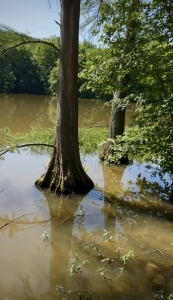
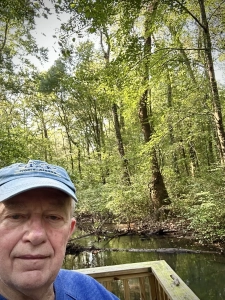
I’ve mentioned often that I’m blessed to live within 10 miles of northern Alabama’s world-class 35,000-acre Wheeler National Wildlife Refuge. On Saturday morning, September 19, 2026, I slipped south to the Beaverdam Creek Swamp Boardwalk, a National Natural Landmark water tupelo forest along Beaverdam Creek. By 9:00 AM, the temperature was 78 degrees, the dew point 70, and the relative humidity 79 percent. Although I exited the forest by 11:00, the afternoon high reached 98 degrees! In contrast to the brutal mid-summer conditions, the forest was already exhibiting signs of autumn. Nature knows!

Here is my 60-second video noting the forest’s awareness of impending autumn. My video narrative says September 18; I was a day behind!


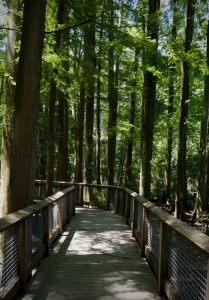
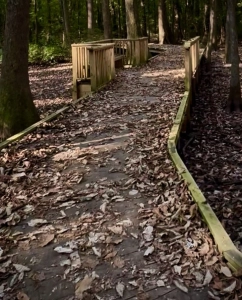
I shuffled more noisily than the weather suggested. Dry leaves covered the boardwalk.
Beaverdam


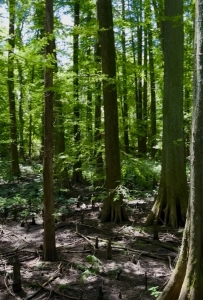
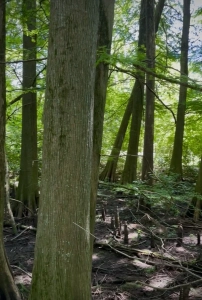
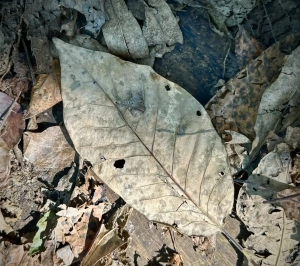
One would expect tupelo leaves under the canopy of northern Alabama’s largest water tupelo forest.
Beaverdam


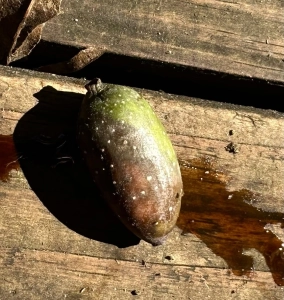
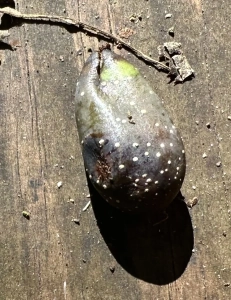
Tupelo seedfall was beginning. I’ve visited during the dormant season, when water fills the swamp, and large mats of floating seed cover the surface.
Beaverdam


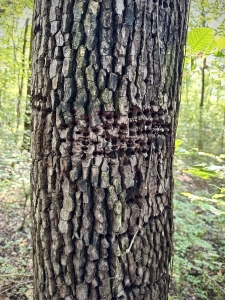
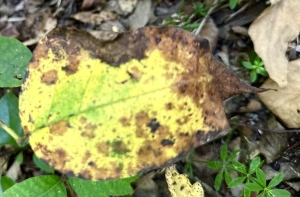
A persimmon leaf lies in fall color near the delightfully patterned parent tree.
Beaverdam

Beaverdam


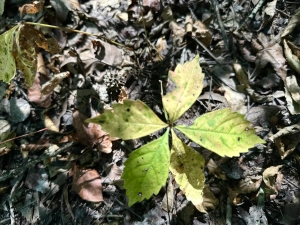
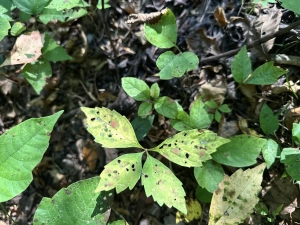
Virginia creeper’s greens are fading to yellow.
BeaverdamBeaverdam


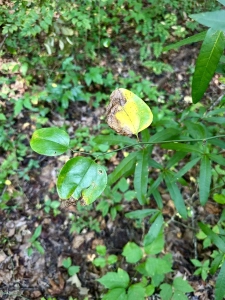
The same holds for roundleaf green brier.
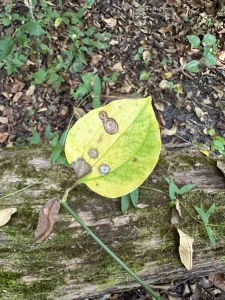
Beaverdam


Poison ivy’s leaves-of-three signal that reliably cooler weather is at hand. Please bring it on… and soon!
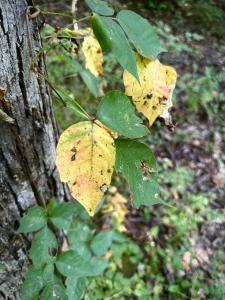
Beaverdam


Ash seedlings (either green or white ash) were senescing, exhibiting leaf blemishes that iNaturalist identifies as gray mold spot. Molds often begin to infect multiple hardwood species’ leaves at season’s end.
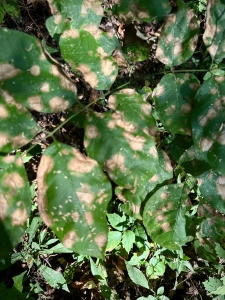
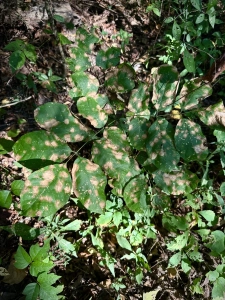
Beaverdam


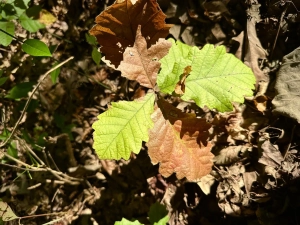
Ground cover swamp chestnut oak has turned off its leaf factories.
Beaverdam


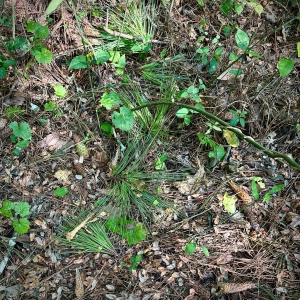
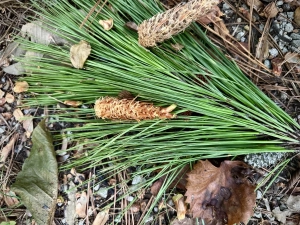
Resident squirrels registered another clear sign of summer shifting to fall. Loblolly pine cones high in the forest canopy are ripe enough late in their second summer to attract the aerial rodents. They tooth-chisel the foliar twigs holding the cones, dropping them to the forest floor, or in this case, the trail surface.
Beaverdam


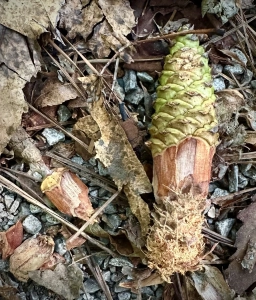
The squirrels peel scales one at a time from the cones to expose and harvest the pine nuts. They either eat the nuts on the spot or transport them to a larder.
Beaverdam


Yogi Berra once said, It sure gets late early around here! I suppose one could say the same of the season’s apparent hot-weather autumn advance in the tupelo swamp. I wish someone had informed the pesky mosquitoes that followed me to Beaverdam Creek and back.

Once again, I’m reminded of John Muir, who oft repeated:

In every walk with nature, one receives far more than he seeks.


In Summary


I invested two Saturday-morning hours sauntering along the boardwalk. I could have slept in, read a book, watched cartoons, edited a Great Blue Heron photo essay, played online solitaire, or countless other mind-numbing activities on a too-hot late summer (or early autumn) morning. I thank my lucky stars that I chose otherwise… and wisely.

The return on my two-hour informed woods-ramble: this brief-form GBH Post; three additional Posts to compile and draft… watch for them; seven 60-second videos (three already posted on my YouTube channel: Steve Jones Great Blue Heron@stevejonesgreatblueheron); and scores of photos! Lest you deem this effort burdensome, keep in mind that this IS my golf. I enjoy practicing my five essential verbs of woodland venturing:

Believe, Look, See, Feel, and Act. I begin within the forest and extend to writing and publishing the weekly photo essay.

    • Believe — I find Nature’s Lessons because I know they lie hidden within view — belief enables me to look and see
    • Look — Really look, with eyes open to my surroundings, external to electronic devices and the distractions of meaningless noise and data
    • See — Be alert to see deeply, beyond the superficial
    • Feel — See clearly, with comprehension, to find meaning and evoke feelings
    • Act — Feel emphatically enough to spur action

My weekly photo essays encapsulate all five into a comprehensive, sometimes compact and succinct statement of passion for place and everyday Nature.


Closing


I accept the challenge of distilling these Brief-Form Posts into a single distinct reflection. John Muir nailed it:

In every walk with nature, one receives far more than he seeks.

.

Nature’s special treats await our discovery, our understanding, and our interpretation!


Subscribe to my free weekly photo essays (like this one) at: http://eepurl.com/cKLJdL


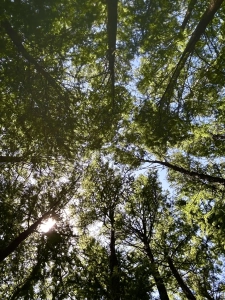
P.S. Along Beaverdam Creek, the canopy evidenced a general yellowing, even as the old forester’s crown showed its stark whitening!
Beaverdam

A Couple of Mid-Summer Hours to Kill at Huntsville’s Gateway to the Majestic Tennessee River!

NOTE: Some of my GBH photo essays were not routinely distributed from mid-February through mid-June. I will resend those one by one, beginning the first week of July. Here is my Post from May 17, 2026 (https://stevejonesgbh.com/2026/05/17/lawson-branch-loop-shoal-creek-preserve-spring-2026/)

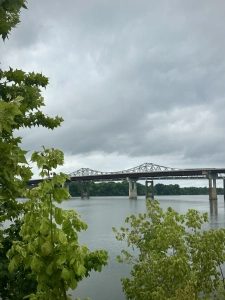
A friend requested transportation to and from a hospital in Huntsville, Alabama, for a diagnostic test that would take 3 hours from admission to release on July 14, 2026. I had no time to go home and no desire to sit in a waiting room, so I drove ten miles south of Huntsville to Ditto Landing Marina on the Tennessee River (Lake Wheeler). I was curious to see what I might find hidden in plain sight along the gravel road on the waterway’s north side downstream. This trail (west of the Highway 231 bridge) is within the easternmost extent of the 35,000-acre Wheeler National Wildlife Refuge. Come along with me virtually as I kill two hours within the wilds of what is technically the City of Huntsville, Alabama!


The River


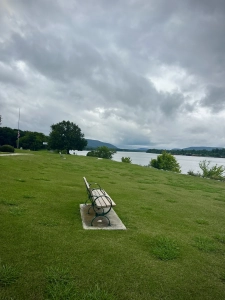
I recorded this 53-second video from the park bench at Ditto Landing Marina.


I wanted to luxuriate longer after my trek, but I didn’t want to keep my friend waiting in the recovery room.


I find an undeniable magnetism in rivers, lakes, skies, and the great outdoors. Although traffic over the bridge consumed any silence and overwhelmed Nature’s music (breezes, soft-wave sloshing, birds, and even children laughing and playing), the distance softened the distraction to an acceptable soothing.


Yes, I would prefer a more isolated natural setting absent a busy highway, a marina behind me, and a modern bridge spanning the river. However, I remind myself that I am within 40 minutes of my residence in Alabama’s largest metropolitan area. Also, I must keep in mind that the Tennessee River is not some wild and scenic waterway. I am viewing Lake Wheeler, one of the necklace of TVA impoundments (Nickajack, Guntersville, Wheeler, Wilson, and Pickwick are the five dams stretching from Chattanooga downstream through Florence and beyond. I can’t both celebrate that I live within an hour of the Wheeler National Wildlife Refuge, a national treasure, and lament that being here doesn’t provide a wilderness experience… pristine and untrammeled by man.

I recorded this 59-second video within earshot of the highway. I accept and salute it for what it is, and for the fulfillment the place and its special Nature awards a lifelong outdoor enthusiast.


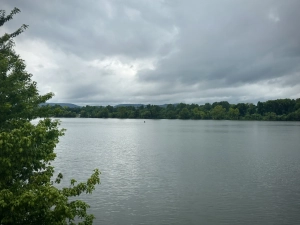
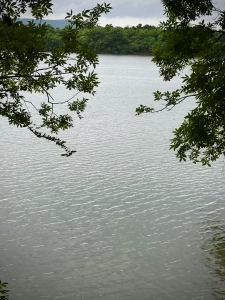
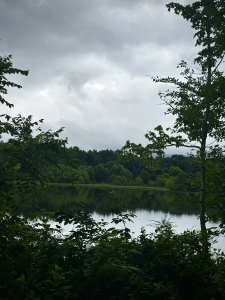
The main channel is alongside the gravel road (left). An adjacent backwater (a slough) is situated beyond the riverway on the inland side of the trail.


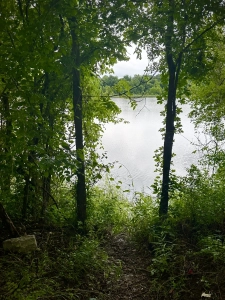
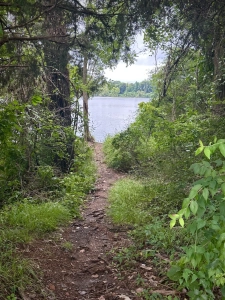
At several spots along the road, secret pathways and visual portals reach through the forested buffer to favorite fishing spots at the river’s edge.


The Forest


I recorded this 63-second video along the gravel road about one mile downstream from where I parked.


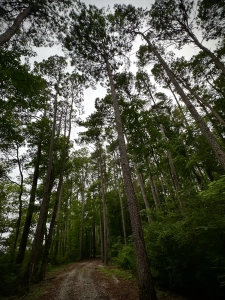
Loblolly pine trees grow luxuriously on agricultural land abandoned and planted when the TVA or COE purchased the property to be inundated and adjoining buffer lands tied to the same owners. These floodplain fields are extraordinarily fertile.


Here is my 60-second video of these ~90-year-old forests.


A planted row of loblollies lines the road.

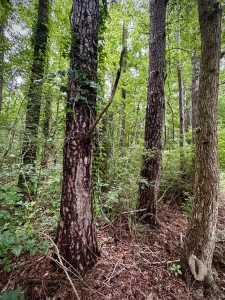
A heavy summer shower wetted the forest the prior evening. Stem flow reached the ground, leaving a patterned trunk as the bark plates began to dry.


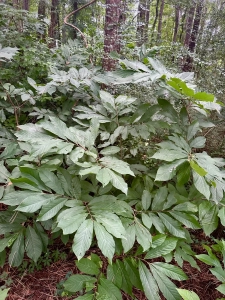
A lush understory paw paw patch caught my eye.


Roadside Summer Flowers and Plants


A longtime enthusiast of spring ephemeral wildflowers, I’ve grown fond of our prolific summer bloomers. The spring flowers arrive when dormant woodlands are otherwise grey and drab. I suppose my vernal exuberance for the new blossoms is owed to living further north, where winters were more serious and relief more deeply appreciated. My appreciation now stretches from emerging spring into continuing summer. Here’s a brief catalog of the beauties I photographed along the trail.

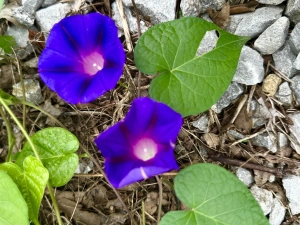
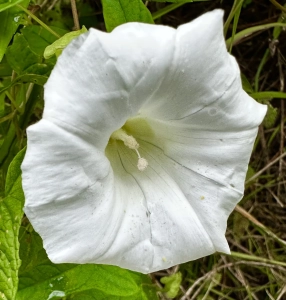
Common morning-glory and large bindweed.


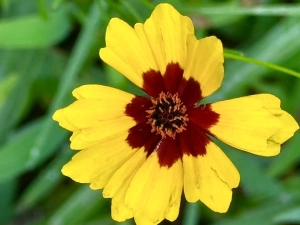
Plains coreopsis, a magnificent portrayal of mid-season grandeur.


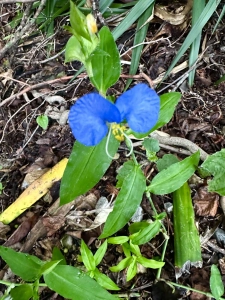
Dayflower’s cerulean majesty.


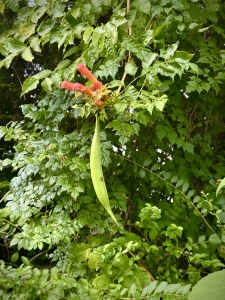
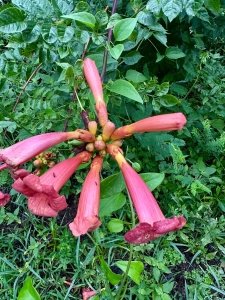
American trumpet vine blossoms and seed pod.


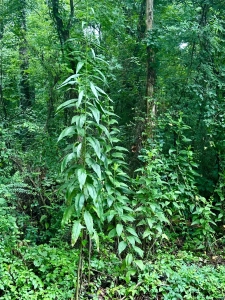
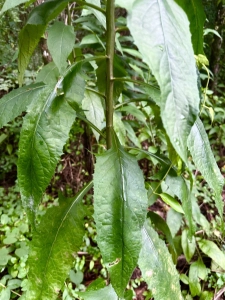
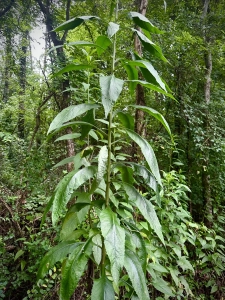
Not yet blooming, this hollow Joe-Pye weed is nearly as tall as a basketball hoop.


Its base and top represent a single season’s growth. A perennial, it will die back to ground level in the autumn, and then loft again to ten feet next year.


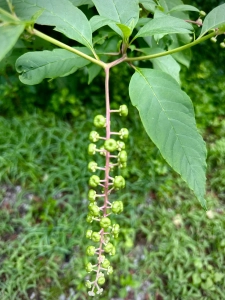
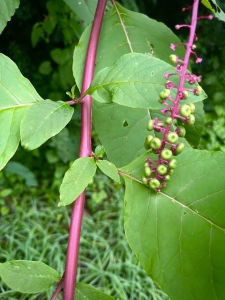
American pokeweed is another perennial that will produce a tremendous amount of biomass.


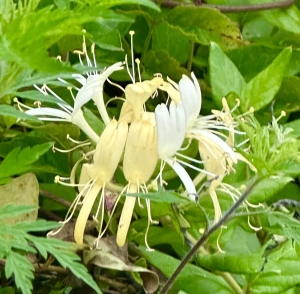
Although I allow myself to enjoy the beauty and fragrance of Japanese honeysuckle, I refuse to celebrate the success of the aggressive Asian invasive.


This overwhelmingly successful and particularly combative legume arrived in the US from Japan and China in 1876 at the Centennial Exposition in Philadelphia. In 1953, the USDA stopped advocating the use of kudzu for erosion control, and in 1972 the agency officially designated the plant a weed. Just imagine how our poor native pokeweed feels bearing an official common moniker of American pokeweed!


I celebrate what something as simple as Two Hours to Kill can reveal and return as satisfaction and fulfillment!


Thoughts and Reflections


I offer these observations:

  • I can’t both celebrate that I live within an hour of the Wheeler National Wildlife Refuge, a national treasure, and lament that being here doesn’t provide a wilderness experience…pristine and untrammeled by man. (Steve Jones)

  • I am pleased that something as simple as Two Hours to Kill can reveal and return as Nature’s satisfaction and fulfillment! (Steve Jones)

Inhale and absorb Nature’s elixir. May Nature inspire, inform, and reward you!

Note: Unless otherwise noted, all blog post images are created & photographed by Stephen B. Jones.

Please circulate images with photo credit: “©2026 Steve Jones, Great Blue Heron. All Rights Reserved.”


I am available for Nature-Inspired Speaking, Writing, and Consulting — contact me at steve.jones.0524@gmail.com


Subscribe to my free weekly photo essays (like this one) at: http://eepurl.com/cKLJdL


A reminder of my Personal and Professional Purpose, Passion, and Cause

If only more of us viewed our precious environment through the filters I employ. If only my mission and vision could be multiplied by untold orders of magnitude:

Mission: Employ writing and speaking to educate, inspire, and enable readers and listeners to understand, appreciate, and enjoy Nature… and accept and practice Earth Stewardship.

Vision:

  • People of all ages will pay greater attention to and engage more regularly with Nature… and will accept and practice informed and responsible Earth Stewardship.
  • They will see their relationship to our natural world with new eyes… and understand their Earth home more clearly.

Tagline/Motto: Steve (Great Blue Heron) encourages and seeks a better tomorrow through Nature-Inspired Living!
 

Steve’s Four Books


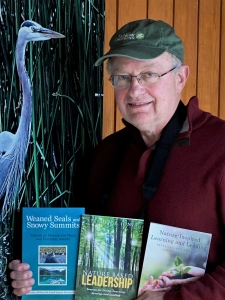
I wrote my books Nature-Based Leadership (2016), Nature-Inspired Learning and Leading (2017), Weaned Seals and Snowy Summits: Stories of Passion for Place and Everyday Nature (2019; co-authored with Dr. Jennifer Wilhoit), and Dutton Land & Cattle: A Land Legacy Story (2025) to encourage all citizens to recognize and appreciate that every lesson for living, learning, serving, and leading is either written indelibly in or is powerfully inspired by Nature. All four of my books compile personal experiences expressing my deep passion for Nature. They offer observations and reflections on my relationship with the natural world… and the broader implications for society. Order any from your local indie bookstore, or find them on IndieBound or other online sources such as Amazon and LifeRich.

I began writing books and Posts for several reasons:

  • I love hiking and exploring Nature
  • I see images I want to (and do) capture with my trusty iPhone camera
  • I enjoy explaining those images — an educator at heart
  • I don’t play golf!
  • I do love writing — it’s the hobby I never needed when my career consumed me
  • Judy suggested my writing is in large measure my legacy to our two kids, our five grandkids, and all the unborn generations beyond
  • And finally, perhaps my books and Blogs could reach beyond family and touch a few other lives… sow some seeds for the future


Brief-Form Post #63: Mid-Summer Osher Lifelong Learning Institute Nature Walk at the Wheeler National Wildlife Refuge!

NOTE: Some of my GBH photo essays were not routinely distributed from mid-February through mid-June. I will resend those one by one, beginning the first week of July. Here is my Post from April 9 (https://stevejonesgbh.com/2026/04/09/mid-december-delights-and-mysteries-on-the-wnwr-hiking-and-bicycling-trail/)

_________________________________________________________________________________________


I am pleased to add the 63rd of my GBH Brief-Form Posts (Less than five minutes to read!) to my website. I get wordy with my routine Posts. I don’t want my enthusiasm for thoroughness and detail to discourage readers. So, I will occasionally publish these brief Posts.


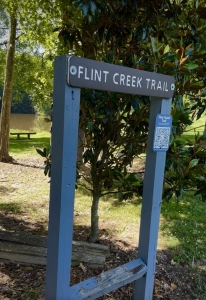
Fellow retired forester Chris Stuhlinger and I co-led an OLLI (Osher Lifelong Learning Institute, University of Alabama in Huntsville) Nature walk on June 13, 2026, at the Wheeler National Wildlife Refuge in Decatur, Alabama. We planned to saunter through the rich bottomland forest along the Flint Creek Trail, slowly exploring the beauty, magic, awe, and inspiration of Nature hidden in plain sight. Three of us appropriately dallied, immersed in wonder, wandering within the forest, truly focusing on the intended discovery and learning. The other dozen or so participants yielded to resident bottomland blood-sucking mosquitoes. As a result, the three of us were persuaded to abandon the trek and head to the nearby Refuge Visitors Center instead. I’ll take you there with me.


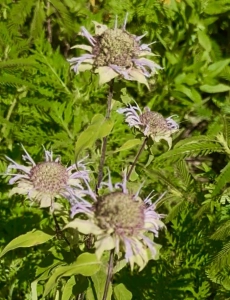
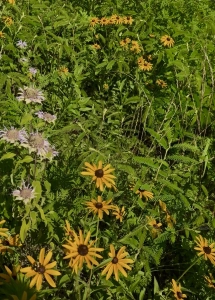
I had arrived at the trailhead early enough to examine the parking area Refuge buffer of sowed wildflower mix. Bergamots were among the plants already flowering.


I recorded this 53-second video of the beds dominated at the moment by bergamots and black-eyed Susans.


Black-eyed Susans are among my favorite summer natives.


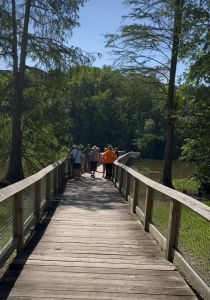
We began our trek within sight of the beds, by crossing the boardwalk, which carried us across a sunny, breezy, mosquito-free (a relevant point as I will soon reveal) passage into the forest.


I recorded this 59-second video as we approached the trail via the boardwalk.


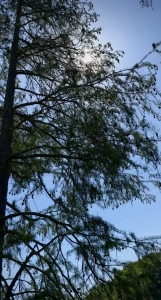
Pond cypress, a water-tolerant deciduous conifer, stood in the Flint Creek inlet at the boardwalk trailhead.

Flint CrFlint Cr


My Musings on What Warrants Doing as Time Wanes


We entered the forest where wonders awaited some of us… and two-winged, six-legged terrorists inflicted intolerable annoyance on the others. Summer passage through certain northern Alabama ecotypes exacts a toll. The circumstances of this day lead me to pledge (to self) that I will heretofore exercise greater caution in agreeing to which particular OLLI (or any other) missions I shall choose/decide to accept. 

None of us knows how many woodland excursions lie ahead. I do know that the window eventually closes. The clock continues ticking. I love my deliberate, succinct retirement mission:

Employ writing and speaking to educate, inspire, and enable readers, and listeners to understand, appreciate, and enjoy Nature… and accept and practice Earth Stewardship.

Mightn’t I have been better advised to persue a Nature jaunt of my own design, intent, passion, purpose, and ken, rather than one where the participants are easily dissuaded from the effort? As I draft this text, I will enter my fourth quarter of a century in two days. Chances are slim (to none) that a fifth awaits me (Well, maybe it’s with partaking a fifth of Old Forester that my chance improves!).

Without belaboring my disappointment, allow me to point out that at least eight of our 14 participants wore short-sleeve shirts/blouses, despite our advance suggestion to avoid attracting unwanted insect attention and voracious feeding.


An Abbreviated Woodland Exploration


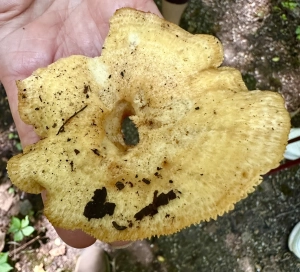
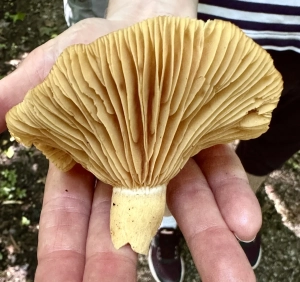
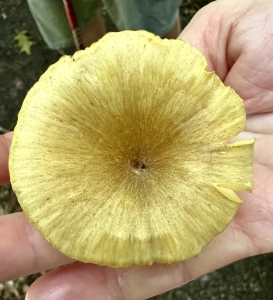
The bottomland forest presented abundant mushrooms for those of us not flushed ahead by the pesky skeeters. Rather than escort you with deep narrative, allow me to introduce our welcoming fungi. Lactarius psammicola gave us palm-size shrooms.

Flint Cr


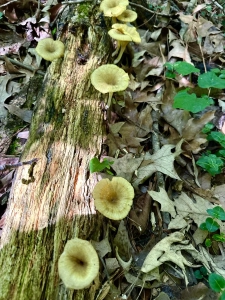
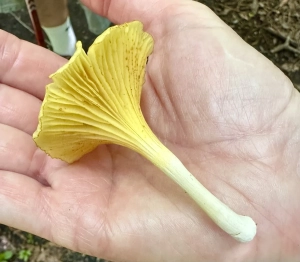
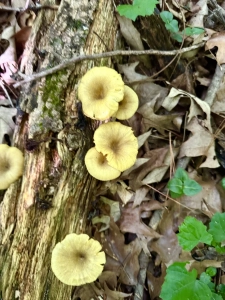
Golden-gilled gerronema showed their characteristic biege funnels.

Flint Cr


Although very attractive, the species is not considered edible.

Flint Cr


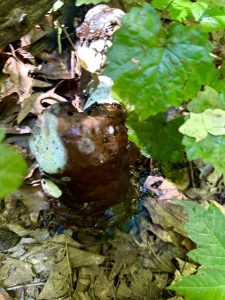
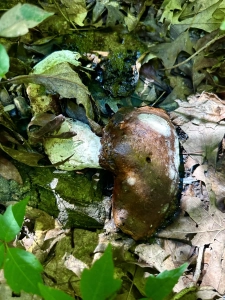
Bolete mushrooms are a group of fungi with spongy pores under their caps instead of gills, including some edible species. I’ve reached a point in my foraging where I’m gaining enough knowledge and confidence to begin selecting certain boletes. This individual is in an advanced state of decay, rotting with a bolete mould.

Flint CrFlint Cr


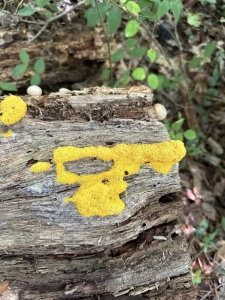
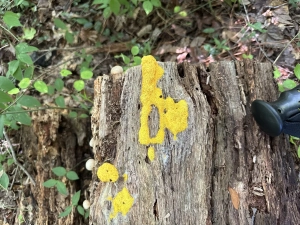
Nearby we spotted dog vomit slime mold, a fungus that has a moniker that, even if it were edible, would discouraged human consumers.

Flint CrFlint Cr


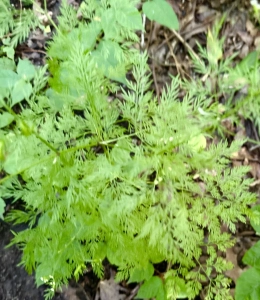
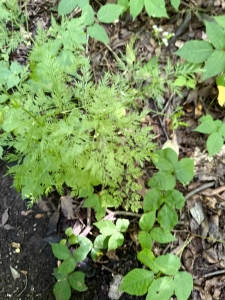
I spotted an unfamiliar understory plant, whitenymph. By this point of progress, the mosquito-spurred group had raced way ahead of us.

Flint Cr


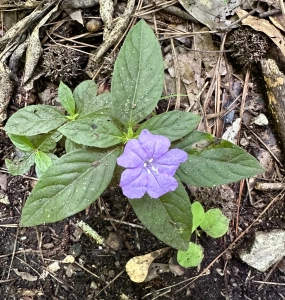
I felt compelled to photograph Carolina ruellia, a lovely little ground-hugging early summer wildflower.

Flint Cr


Quick Trip across the Highway to the Visitors Center Cypress Pond


The larger group hailed us before we had traversed half the distance they covered. We agreed to return to our vehicles, and then leave to the visitors center about a mile away, across the highway, where we anticipated far fewer human-blood-consuming insects. Some of the original group did not transfer to the visitors center.

I’ll touch briefly on our mosquito-abatement alternative. I always enjoy the bald cypress pond and boardwalk near the visitors center.

Cypress Pond


Stems are packed tightly and reach high. Cypress knees perform their function, whether securing incremental anchorage or assisting in gaseous exchange.

Cypress Pond


I recorded this 60-second video within the cypress pond, adding a little Righteous Brothers accompaniment.


I always glance heavenward from the boardwalk. The dense trunk-stocking suggests crowded, intersecting and overlapping crowns. Instead, cypress expresses crown shyness… faithfully, maintaining space-margins and no-touch zones separating one crown from another! Is it my own certifiable introvert personality that explains my admiration of sylvan crown shyness?

Cypress


Perhaps I overreacted to our change in plans; perhaps not. However, in no small part owing to my seminal life benchmark (75 years!), my angst and pique were real… and persist. I shall be recalibrating priorities. From a time-of-life-dawn, the brim-full hour glass left plenty of room for judgement error. Today, with a setting sun ahead, the sand grains rush unceasingly. The relative cost of each one amplifies. My maternal grandmother, a country girl from Appalachian-region West Virginia, said as much: “The older I get, the faster time goes!”


Closing


I accept the challenge of distilling these Brief-Form Posts into a single distinct reflection, this one cut, modified, and pasted from above:

None of us knows how many woodland excursions lie ahead. I do know that the window eventually closes. The clock continues ticking. I love my deliberate, succinct retirement mission:

Employ writing and speaking to educate, inspire, and enable readers and listeners to understand, appreciate, and enjoy Nature… and accept and practice Earth Stewardship.

Mightn’t I have been better advised to pursue a Nature jaunt of my own design, intent, passion, purpose, and ken?


Nature’s special treats await our discovery, our understanding, and our interpretation!


Subscribe to my free weekly photo essays (like this one) at: http://eepurl.com/cKLJdL


Flint Cr