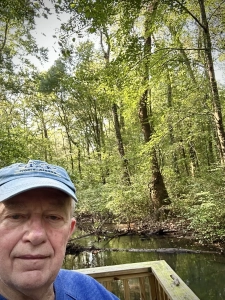
Brief-Form Post #67: Autumn Signals on A 90+ Degree Mid-September Day in Beaverdam Swamp
NOTE: Some of my GBH photo essays were not routinely distributed from mid-February through mid-June. I will resend those one by one, beginning the first week of July. Here is my Post from May 27, 2026 (https://stevejonesgbh.com/2026/05/27/early-signs-of-spring-on-the-goldsmith-schiffman-wildlife-sanctuary/)
I am pleased to add the 67th of my GBH Brief-Form Posts (Less than five minutes to read!) to my website. I get wordy with my routine Posts. I don’t want my enthusiasm for thoroughness and detail to discourage readers. So, I will occasionally publish these brief Posts.
I’ve mentioned often that I’m blessed to live within 10 miles of northern Alabama’s world-class 35,000-acre Wheeler National Wildlife Refuge. On Saturday morning, September 19, 2026, I slipped south to the Beaverdam Creek Swamp Boardwalk, a National Natural Landmark water tupelo forest along Beaverdam Creek. By 9:00 AM, the temperature was 78 degrees, the dew point 70, and the relative humidity 79 percent. Although I exited the forest by 11:00, the afternoon high reached 98 degrees! In contrast to the brutal mid-summer conditions, the forest was already exhibiting signs of autumn. Nature knows!
Here is my 60-second video noting the forest’s awareness of impending autumn. My video narrative says September 18; I was a day behind!
I shuffled more noisily than the weather suggested. Dry leaves covered the boardwalk.
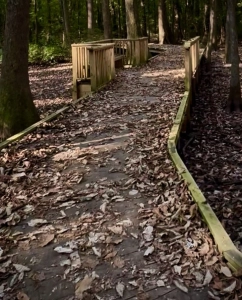
One would expect tupelo leaves under the canopy of northern Alabama’s largest water tupelo forest.
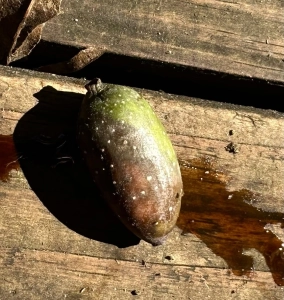
Tupelo seedfall was beginning. I’ve visited during the dormant season, when water fills the swamp, and large mats of floating seed cover the surface.
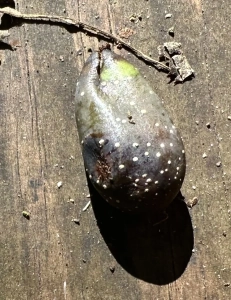
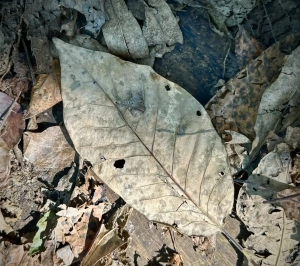
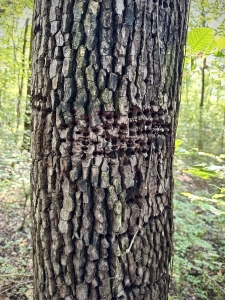
A persimmon leaf lies in fall color near the delightfully patterned parent tree.
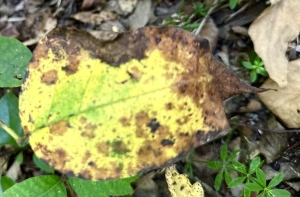
Virginia creeper’s greens are fading to yellow.
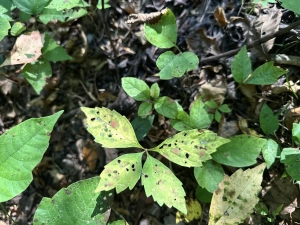
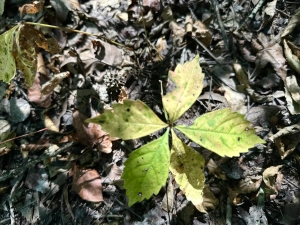
The same holds for roundleaf green brier.
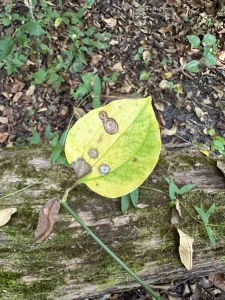
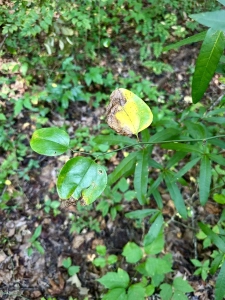
Poison ivy’s leaves-of-three signal that reliably cooler weather is at hand. Please bring it on… and soon!
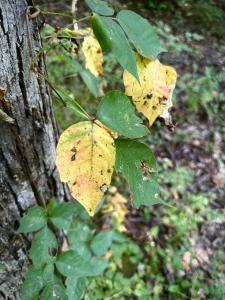
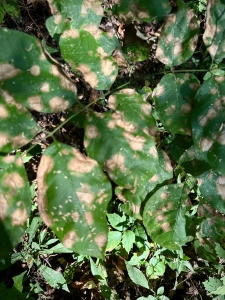
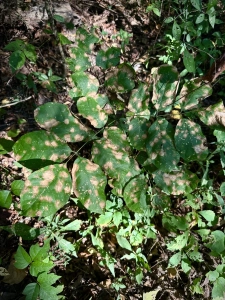
Ash seedlings (either green or white ash) were senescing, exhibiting leaf blemishes that iNaturalist identifies as gray mold spot. Molds often begin to infect multiple hardwood species’ leaves at season’s end.
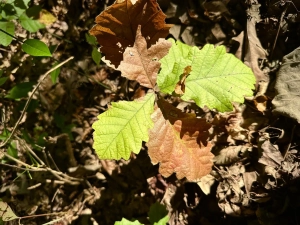
Ground cover swamp chestnut oak has turned off its leaf factories.
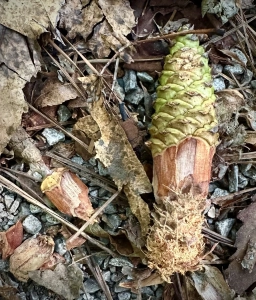
Resident squirrels registered another clear sign of summer shifting to fall. Loblolly pine cones high in the forest canopy are ripe enough late in their second summer to attract the aerial rodents. They tooth-chisel the foliar twigs holding the cones, dropping them to the forest floor, or in this case, the trail surface.
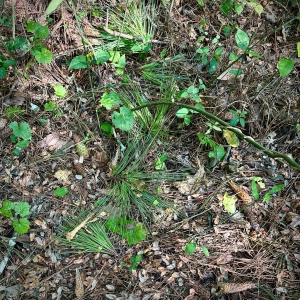
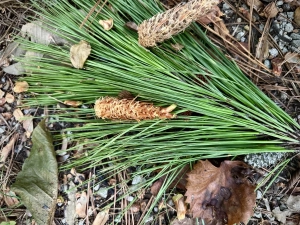
The squirrels peel scales one at a time from the cones to expose and harvest the pine nuts. They either eat the nuts on the spot or transport them to a larder.
Yogi Berra once said, It sure gets late early around here! I suppose one could say the same of the season’s apparent hot-weather autumn advance in the tupelo swamp. I wish someone had informed the pesky mosquitoes that followed me to Beaverdam Creek and back.
Once again, I’m reminded of John Muir, who oft repeated:
In every walk with nature, one receives far more than he seeks.
In Summary
I invested two Saturday-morning hours sauntering along the boardwalk. I could have slept in, read a book, watched cartoons, edited a Great Blue Heron photo essay, played online solitaire, or countless other mind-numbing activities on a too-hot late summer (or early autumn) morning. I thank my lucky stars that I chose otherwise… and wisely.
The return on my two-hour informed woods-ramble: this brief-form GBH Post; three additional Posts to compile and draft… watch for them; seven 60-second videos (three already posted on my YouTube channel: Steve Jones Great Blue Heron@stevejonesgreatblueheron); and scores of photos! Lest you deem this effort burdensome, keep in mind that this IS my golf. I enjoy practicing my five essential verbs of woodland venturing:
Believe, Look, See, Feel, and Act. I begin within the forest and extend to writing and publishing the weekly photo essay.
-
- Believe — I find Nature’s Lessons because I know they lie hidden within view — belief enables me to look and see
- Look — Really look, with eyes open to my surroundings, external to electronic devices and the distractions of meaningless noise and data
- See — Be alert to see deeply, beyond the superficial
- Feel — See clearly, with comprehension, to find meaning and evoke feelings
- Act — Feel emphatically enough to spur action
My weekly photo essays encapsulate all five into a comprehensive, sometimes compact and succinct statement of passion for place and everyday Nature.
Closing
I accept the challenge of distilling these Brief-Form Posts into a single distinct reflection. John Muir nailed it:
In every walk with nature, one receives far more than he seeks.
.
Nature’s special treats await our discovery, our understanding, and our interpretation!
Subscribe to my free weekly photo essays (like this one) at: http://eepurl.com/cKLJdL
P.S. Along Beaverdam Creek, the canopy evidenced a general yellowing, even as the old forester’s crown showed its stark whitening!