
Brief-Form Post #68: Special Features above the Center Farmhouse at Graham Farm and Nature Center
[Some of my GBH photo essays were not routinely distributed from mid-February through mid-June. I will resend those one by one, beginning the first week of July. Here is my Post from June 10 (https://stevejonesgbh.com/2026/06/10/curiosities-oddities-mysteries-and-seasonal-features-on-the-n-al-land-trusts-oak-park-trail/)]
I am pleased to add the 68th of my GBH Brief-Form Posts (Less than five minutes to read!) to my website. I get wordy with my routine Posts. I don’t want my enthusiasm for thoroughness and detail to discourage readers. So, I will occasionally publish these brief Posts.
Fellow retired forester Chris Stuhlinger and I returned to the Alabama Cooperative Extension System’s Graham Farm and Nature Center on July 30, 2026, to scope and lay out a Tree and Shrub Identification Route. I previously reported that venture (https://stevejonesgbh.com/2026/09/29/scoping-a-tree-identification-trail-on-the-waterfall-loop-at-graham-farm-and-nature-center/). Join me virtually as we ascend to the proposed Tree, Shrub, and Vine Identification Trailhead. I collected additional photographs, a video, reflections, and observations distinct from the I.D. trail.
I appreciate the location and interpretive signage across the Center property. The I.D. lies 200 feet above the quaint cottage being prepared for overnight guest accommodation.
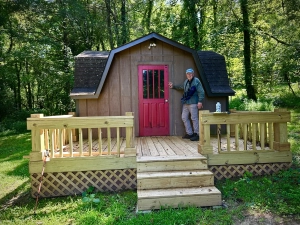
Nita’s View looks over the Larkin Creek and Paint Rock River Valleys from the cottage porch.
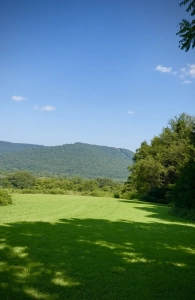
The Center property is indeed a special place!
Enamored with Tree Seed Production
The mowed grass trail ascends to the cottage from the farmhouse, residence of the family who transferred the farmland and adjoining mountain forest to ACES. It is now used as an historic GF&NC feature, along the edge of a naturally regenerated forest.
My undergraduate silviculture text, The Practice of Silviculture (1962, David Martyn Smith), describes the critical forestry sub-science:
Silviculture has been variously defined as: the art of producing and tending a forest; the application of the knowledge of silvics in the treatment of a forest; the theory and practice of controlling forest establishment, composition, and growth.
I thrill at contemplating tree seed production and forest regeneration, which after all is critical to the practice of silviculture. I include this quote from Robert Louis Stevenson (1850-1894) in my salutation, closing every email I send:
Don’t judge each day by the harvest you reap but by the seeds that you plant.
This young black walnut tree extended its branches to us as we passed. Walnut is among our nation’s most valued hardwood species, its beautiful wood treasured for the high-quality furniture and paneling. Every eastern USA-trained forester feels heart rate surging when encountering a well-formed walnut tree or, in this case, a healthy young walnut tree already producing fruit, a walnut nearly at eye-level.
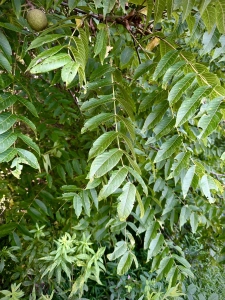
An osage orange tree stood nearby, its crown filled with softball-size hedge apples.
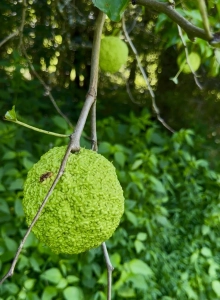
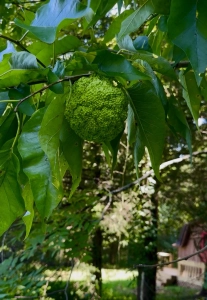
I recorded this 58-second video of osage orange fruit near the Nita’s View cabin.
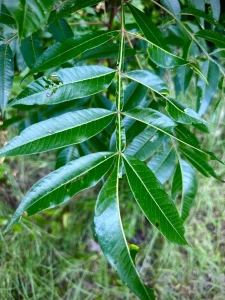
Shining sumac also grows at the edge of the emerging woods adjacent to the mowed grass. Also known as winged sumac, dwarf sumac, and flameleaf sumac, the tree’s foliage is true to its name. The petioles are prominently winged. Could the green be any deeper?! The leaves shinier? The young seedheads more promising? Their current light burgundy hints at the impending stark red of autumn.
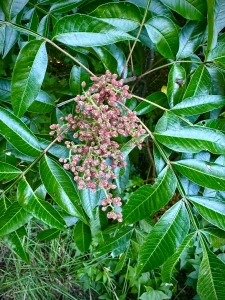
Carolina buckthorn, another shrub species common in naturally regenerating forests, sported similar glossy green leaves and red berries.
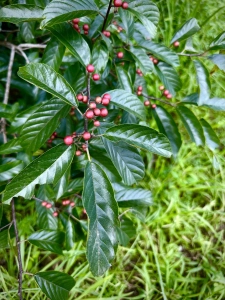
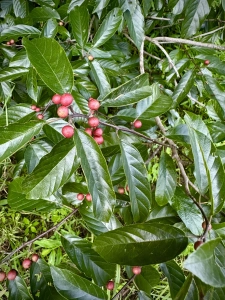
All living organisms, from the perspective of evolutionary biology, share a common, primary purpose of existence: survival and reproduction. Each species’ genes strive, through the machinery of bodies, to copy themselves into the future. It’s basic, fundamental, and primal, whether a primitive bacterium or a yellow poplar tree… or a Graham Farm and Nature Center black walnut, osage orange, shining sumac, or Carolina buckthorn.
A Wildlife Sidebar
I love Nature’s mysteries. Along the same wood-edge trail, I spotted two very distinct bare-soil depressions. I puzzled momentarily, and then an old synapse fired. Driving along the valley road within two miles of GF&NC, I spotted a few adult turkeys leading several poults at field edge. I recognized the depressions as an American turkey dust bath.
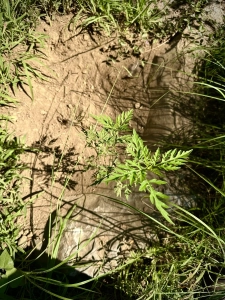
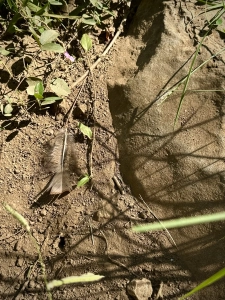
From online Wild Turkey Lab:
This Turkey Tuesday is about an interesting behavior wild turkeys use, that sometimes gets spiced up with the inclusion of common insects. As spring turns to summer, dust bathing is something that all wild turkeys do – adults and poults alike. These baths are a form of self-maintenance, as they help maintain the condition of feathers, particularly as birds are growing new feathers. Dusting often happens in the same places each day, with the bird laying down where they press their wings and tails onto the ground. Once on the ground, the bird just lays on its breast and flaps its wings, which throws dirt all over the body – sometimes they will also use their head to sling dirt onto the back and wings. And if you’ve ever been blessed enough to watch turkeys dust bath, some of them really get into it! Interestingly, turkeys will also dust in ant mounds – intentionally, termed anting. By doing so, the bird provokes the ants to bite feathers and release compounds that are toxicants – a natural form of pest control. In fact, there’s evidence that some birds preen the ants into their feathers, which crushes them and wipes the compounds on their feathers. This behavior is believed to be a way for turkeys to help mitigate issues with feather mites and lice, but there may be other explanations as well. The take home is wild turkeys have behaviors such as dust bathing and anting that serve purposes ranging from self-maintenance to comfort, and likely some purposes that are entirely unknown – regardless, who doesn’t love wallowing around in the dirt?
Closing
I accept the challenge of distilling these Brief-Form Posts into a single distinct reflection. I include this quote from Robert Louis Stevenson (1850-1894) in my salutation closing every email I send:
Don’t judge each day by the harvest you reap but by the seeds that you plant.
Nature’s special treats await our discovery, our understanding, and our interpretation!
Subscribe to my free weekly photo essays (like this one) at: http://eepurl.com/cKLJdL