Scoping a Tree Identification Trail on the Waterfall Loop at Graham Farm and Nature Center!
[Some of my GBH photo essays were not routinely distributed from mid-February through mid-June. I will resend those one by one, beginning the first week of July. Here is my Post from June 3, 2026 (https://stevejonesgbh.com/2026/06/03/brief-form-post-61-mid-february-olli-eagle-safari-at-lake-guntersville-state-park/)]
Fellow retired forester Chris Stuhlinger and I returned to the Alabama Cooperative Extension System’s Graham Farm and Nature Center on July 30, 2026, to scope and lay out a Tree and Shrub Identification Route on the Waterfall Loop Trail. Come along as we traverse the route, note special features, snap photographs, record two brief videos, and locate and catalog 33 species of trees, shrubs, and even a large vine. As is my custom in these Great Blue Heron weekly photo essays, take what you might from my observations and reflections… my musings, which 250 years ago in Ben Franklin’s time, would have been termed Natural Philosophy.
The Center, its setting, and its cause, where Conservation, Preservation, and Education Come Together, are special.
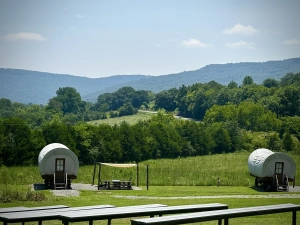
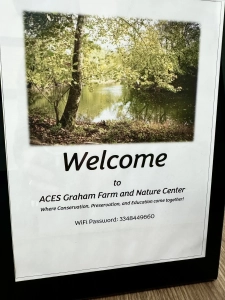
The trailhead lies on the lower Maxwell Mountain slope above the cabin at Nita’s View.
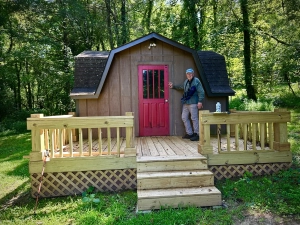
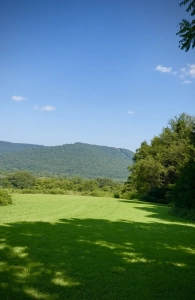
We departed on Bob’s Ledges Trail, then proceeded the full 1.31 miles on the Waterfall Loop Trail, returning us to the trailhead.
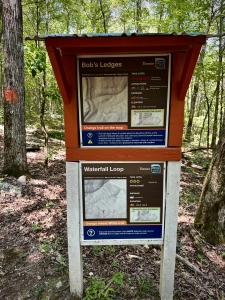
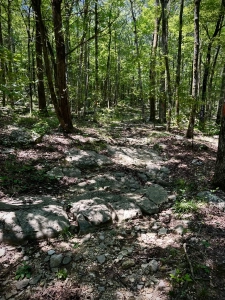
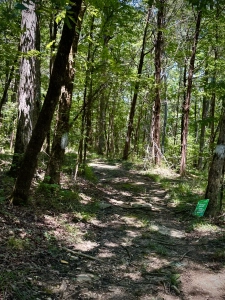
Bob’s Ledges Trail rose on a bouldered surface (below left). Waterfall Loop (see white blazes) returned us to the trailhead (below right).
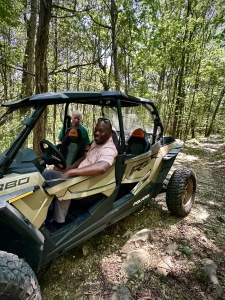
Center Director, Themika (Mike) Sims, transported us on the all-terrain vehicle to Bob’s intersection with Waterfall Loop. We will walk that section with our autumn return visit to finalize the tree and shrub identification route. I feel certain that an additional species or two will enter the tally. I believe that Mike’s sly smile was attributable to his foreknowledge of how rough (terrifying; death-defying!) the ATV ascent to Waterfall Loop was about to be for Chris and me!
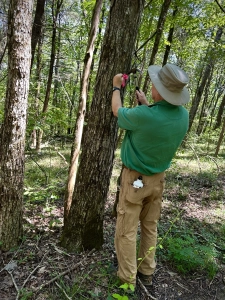
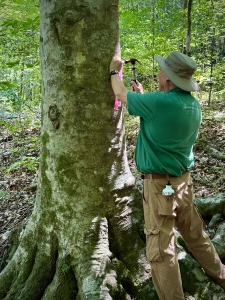
I won’t burden you with photographs of Chris tagging each specimen with a nail and red/pink flagging. Our division of labor was simple: he carried the hammer; I gave him a nail and a strip of flagging at each tree. As he so often does when identifying tree species, he nailed it! Here he is hammering the nail on the trailside face of a shagbark hickory.
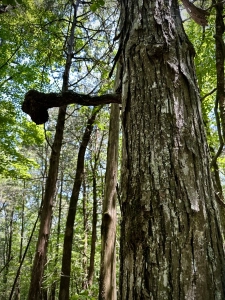
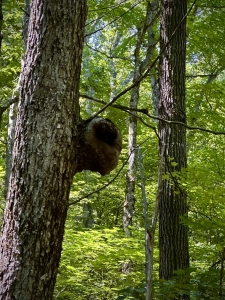
Nearby, another shagbark hickory sported what my younger Alabama grandson would have termed a Native American war club, a branch stub sustained with living cambium by the tree. Ah, a topic for another photo essay. I casually spotted another half dozen or so such shagbark phenomena on our circuit. Five hundred years ago, Leonardo da Vinci observed:
There is no result in nature without a cause.
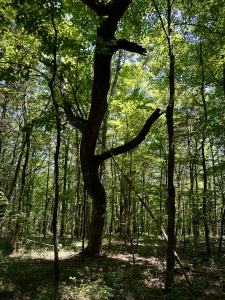
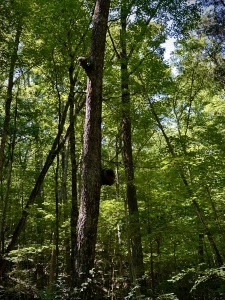
Every tree, stand, and forest has a story to tell. This massive sugar maple, leaning at 30 degrees toward the trail and the camera, seems a generation more senior than its sylvan neighbors. I’ll introduce other examples of individual elders we encountered within what otherwise appears to be an even-aged stand. This sugar maple has a sinister aspect, its crooked trunk’s threatening arms outstretched, reaching for the hapless, inattentive trekker ambling along Waterfall Loop. Might GF&NC staff want to consider caution (Beware: the trees are reaching out to grab you!) signs interspersed with the tree i.d. plaques!?
We passed the Guardian Angels trailhead a few hundred feet after Mike dropped us on Waterfall Loop. The map places us at an elevation of 1,060′. Guardian Angels would have elevated us to 1,520′ in 0.67 miles, where it rejoins Bob’s Ledges Trail.
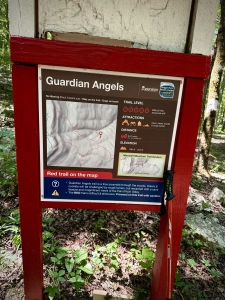
The sign sobered me. I am eager to establish a long-term affair with GF&NC. My personal profile features the following: 2022 — left shoulder replacement; 2023 — minor stroke and transient ischemic attack; July 2023 — triple bypass surgery; January 2024 — right knee total replacement; August 2024 — left knee total replacement; 2025 — bilateral inguinal hernia surgery; April 2026 — left shoulder reconstruction reversal/revision. So, what sobered me? Waterfall Loop is rated Level 3, Moderate Difficulty, which I handled. Guardian Angels earns a Level Five:
A difficult hike with steep elevation changes; hikers should know their limitations and proceed on the trail with caution!
A former marathoner, a dedicated athlete in younger years, I am not ready to yield easily to what my Alaska friends would refuse to call a mountain. Yet I shall test my limits. I’m getting better at learning when to go… and when to stay. Friends and loved ones care… and don’t trust my knowing when to cry Uncle (i.e., to admit defeat or plead for mercy, especially in an informal physical contest of some kind)!
A large shattered American beech represents another affirmation of senior citizens, a second age class, in a younger forest. This tree had reached a physical strength threshold, hollow with a solid wood rind less than one-third of its diameter. Wind toppled it; gravity is undefeated!
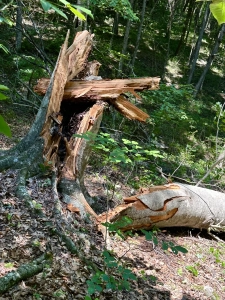
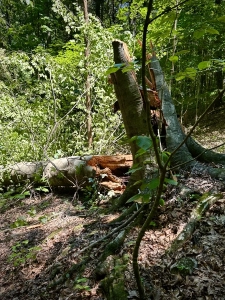
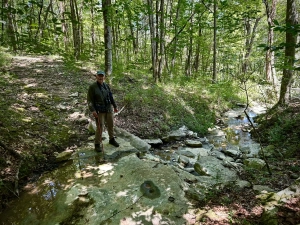
The beech stood just a hundred feet from this dry wash. A trickle passes across the limestone slab. I want to return when I can challenge my boot waterproofing.
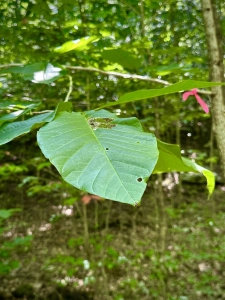
We flagged a stem of this cucumbertree sapling. We subsequently located a mature representative of the species. In addition to distinctive leaf and bud characteristics, trunk and canopy form, bark, and preferred slope, soil conditions, and aspect are important identification criteria. We seek mature specimens for tree identification purposes.
For American beech, we need little more than its unique bark, yet numerous other distinguishing features assist identification.
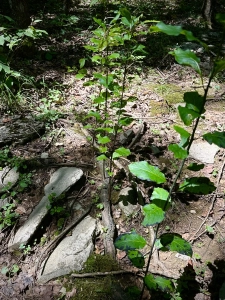
‘Twas a perfect time of year to locate persimmon trees. Shed fruit littered the trail under a mature, mid-story persimmon tree. I photographed a line of persimmon sprouting from a mother-tree root crossing the trail.
A hickory eye socket protruded from a main-trunk branch stub, like the war club. The tree, I suppose, has its reasons for keeping the stub alive. In this case, as perhaps in the other, the tree is attempting to callous over the stub to prevent disease infection. Higher on the trunk (right), another war club faces the camera.
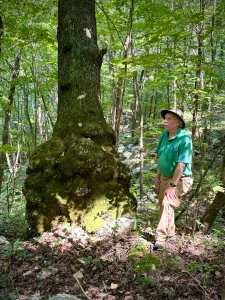
We encountered another sylvan senior citizen within a younger stand. This ancient white oak evidences severe basal decay and infection. The deformed, swollen base suggests a hollowed hulk. In my years as an industrial forester, I would have designated the tree as a commercial cull. However, wildlife species treasure its mast (acorns), covet its den shelter, and relish its spreading canopy and deep shade.
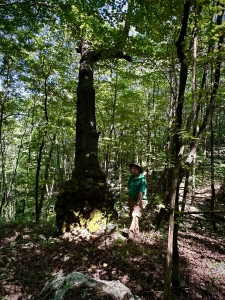
I recorded this 58-second video at the gnarled white oak. It sits at the base of the cascade descent, where Eastern redcedar guardrails aid hikers.
A massive limestone block carries the waterfall in wet weather. The quaint cedar rails helped me descend.
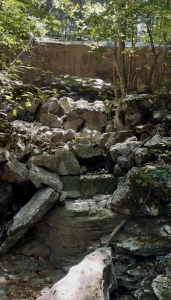
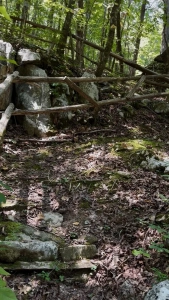
The view downhill attests to Maxwell Mountain’s rugged profile.
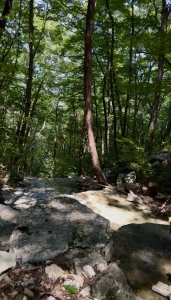
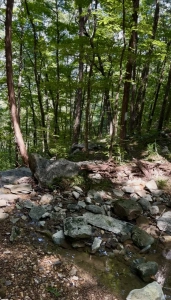
We finally found a mature yellow poplar, the only one we spotted along the entire trail.
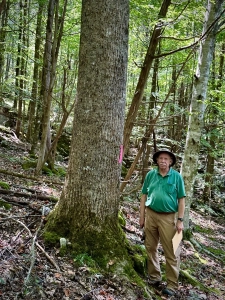
A Unique Trail Maintenance Treatment
GF&NC crews blow fallen leaves from all trail surfaces 2-3 times annually. Because leaf-fall can smother any vegetation attempting to grow on the trail, the blown surface in places encourages a mossy (American tree moss), carpet-like trail surface. I had not seen this practice elsewhere.
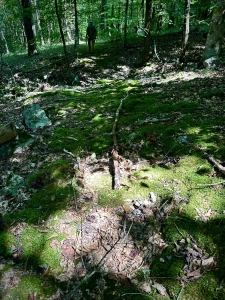
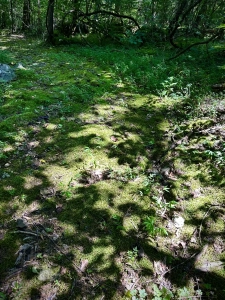
I wonder, once GF&NC trails see more traffic, will the moss carpet persist?
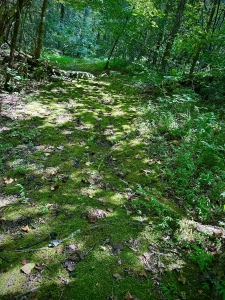
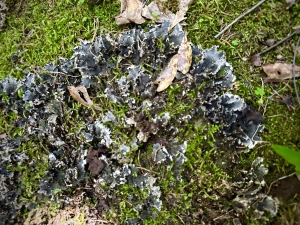
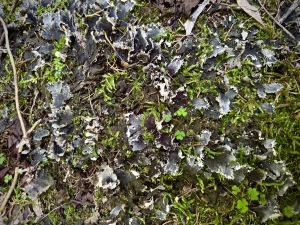
Intermixed with the moss, we encountered dense patches of dog pelt lichen, one I don’t recall previously seeing.
Chris and I marked 33 species. Here is our working list of tree, shrub, and vine species:
Tree Species (Common Names Only) Found Along the White Trail at Graham Farm
Tree of heaven; American beautyberry; American beech; American holly; Basswood; Blackgum; Black walnut; Boxelder; Carolina buckthorn; Chinkapin oak; Cucumbertree; Eastern redcedar; Flowering dogwood; Hackberry; Honeylocust; Mockernut hickory; Muscadine vine; Northern red oak; Osage-orange; Pawpaw; Persimmon; Red buckeye; Redbud; Shagbark hickory; Shining sumac (Green trail); Slippery elm; Spicebush; Sugar maple; Sweetgum (Green trail); Water oak; White ash; Yellow buckeye; Yellow-poplar
We consider our initial foray successful. We’ll return as summer temperatures yield to autumn, to refine the list, add species we may have missed, select better examples, record GPS coordinates for final selections, and confirm identification for all individuals. I view this, again, as a long-term relationship with Graham Farm and Nature Center. Like all human relationships, I see my affair with the Center property akin to what Aldo Leopold viewed as a necessary facet of his Land Ethic:
That land is a community is the basic concept of ecology, but that land is to be loved and respected is an extension of ethics.
So far, so good!
Thoughts and Reflections
I offer these observations:
-
That land is a community is the basic concept of ecology, but that land is to be loved and respected is an extension of ethics. (Aldo Leopold)
-
There is no result in nature without a cause. (Leonardo da Vinci)
- What I see, feel, discover, and ponder ignites my passion, fuels my wanderings (and wonderings), and leads me to add a little new wood each year, even if at a reduced pace. (Steve Jones)
Inhale and absorb Nature’s elixir. May Nature inspire, inform, and reward you!
Note: Unless otherwise noted, all blog post images are created & photographed by Stephen B. Jones.
Please circulate images with photo credit: “©2026 Steve Jones, Great Blue Heron. All Rights Reserved.”
I am available for Nature-Inspired Speaking, Writing, and Consulting — contact me at steve.jones.0524@gmail.com
Subscribe to my free weekly photo essays (like this one) at: http://eepurl.com/cKLJdL
A reminder of my Personal and Professional Purpose, Passion, and Cause
If only more of us viewed our precious environment through the filters I employ. If only my mission and vision could be multiplied by untold orders of magnitude:
Mission: Employ writing and speaking to educate, inspire, and enable readers and listeners to understand, appreciate, and enjoy Nature… and accept and practice Earth Stewardship.
Vision:
- People of all ages will pay greater attention to and engage more regularly with Nature… and will accept and practice informed and responsible Earth Stewardship.
- They will see their relationship to our natural world with new eyes… and understand their Earth home more clearly.
Tagline/Motto: Steve (Great Blue Heron) encourages and seeks a better tomorrow through Nature-Inspired Living!
Steve’s Four Books
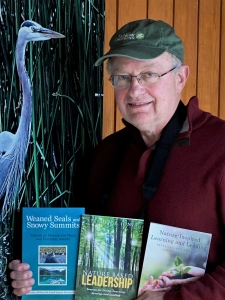
I wrote my books Nature-Based Leadership (2016), Nature-Inspired Learning and Leading (2017), Weaned Seals and Snowy Summits: Stories of Passion for Place and Everyday Nature (2019; co-authored with Dr. Jennifer Wilhoit), and Dutton Land & Cattle: A Land Legacy Story (2025) to encourage all citizens to recognize and appreciate that every lesson for living, learning, serving, and leading is either written indelibly in or is powerfully inspired by Nature. All four of my books compile personal experiences expressing my deep passion for Nature. They offer observations and reflections on my relationship with the natural world… and the broader implications for society. Order any from your local indie bookstore, or find them on IndieBound or other online sources such as Amazon and LifeRich.
I began writing books and Posts for several reasons:
- I love hiking and exploring Nature
- I see images I want to (and do) capture with my trusty iPhone camera
- I enjoy explaining those images — an educator at heart
- I don’t play golf!
- I do love writing — it’s the hobby I never needed when my career consumed me
- Judy suggested my writing is in large measure my legacy to our two kids, our five grandkids, and all the unborn generations beyond
- And finally, perhaps my books and Blogs could reach beyond family and touch a few other lives… sow some seeds for the future