A Chilly, Saturated Late May Morning at a Butler County, PA Horse Barn!
[Some of my GBH photo essays were not routinely distributed from mid-February through mid-June. I will resend those one by one, beginning the first week of July. Here is my Post from April 1 (https://stevejonesgbh.com/2026/04/01/squeezing-a-90-minute-woodland-saunter-into-four-hours/)]
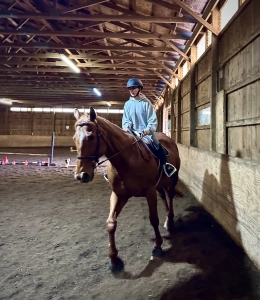
Our 18-year-old granddaughter, Hannah, graduated from high school the week of May 18, 2026, in Butler County, Pennsylvania, north of Pittsburgh. Judy and I enjoyed five days with our son Matt and his family. The three PA grandkids attended school on the weekdays of our visit. Judy and I accompanied Matt and 15-year-old granddaughter Mallory on Saturday to the horse barn, 20 miles north of their Cranberry Township home, where Mallory rides and tends the stables. Although still wearing a sling/brace from April 13, 2026, shoulder replacement/revision surgery, I gathered Nature observations and reflections based on wandering the grounds, snapping photographs, and recording brief videos.
Overview of Barn and Grounds
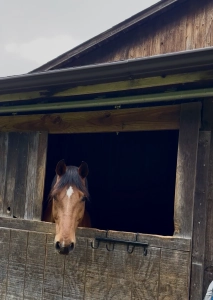
The temperature on the unseasonably cold late spring midday barely topped 50 degrees. This stoic equine seemed content to remain indoors. To the contrary, I was elated to embrace weather conditions I will not see again in northern Alabama until October.
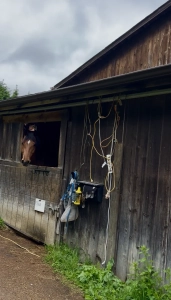
I recorded this 40-second video of Mallory riding indoors, verifying that I appended my Nature-Inspired Life and Living field research to a genuine grandfatherly pursuit!
I’m a glutton for springtime, flush with new greenery, borderline cold breezes, surface runoff, deep mud, and low clouds skudding across hillsides adorned with white fences.
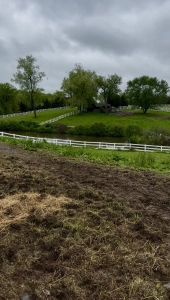
Here’s my 59-second video of the farmstead residence, entrance road, and pond I recorded from the front side of the horse barn and arena.
I grew up just 150 miles SSE of this location on the east side of the Allegheny Front in western Maryland, a landscape peppered with valley farmsteads similar to this. I am a student and champion of special places and everyday Nature.
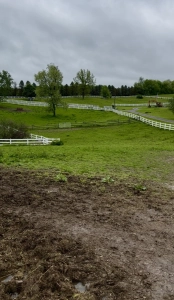
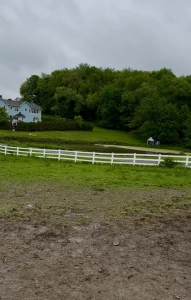
Ascending pastureland behind the barn, I came to a fenced outdoor riding track and performance ground, where Mallory will train and exercise the horses in the pleasant months ahead.
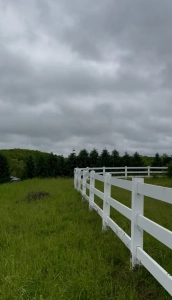
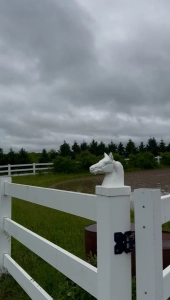
The riding track lies beyond the decorative horse-head post top.
I recorded this 59-second video of the surrounding landscape, capturing the seasonal essence of this special place.
Over an inch of rain soaked the barn grounds overnight.
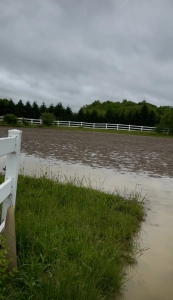
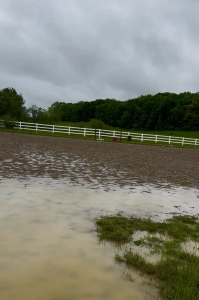
I’ve often observed that the spring-green pallette may be as rich with shades, hues, and moods worthy of comparison to the colors of autumn.
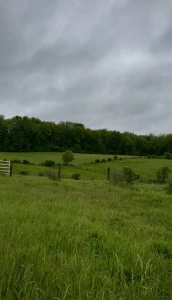
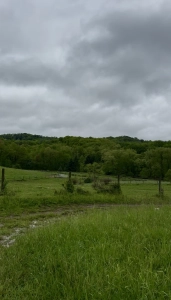
I admit that I miss the depth of seasonal fluxes evident here at 40.86 degrees north latitude, relative to the 34.71 at my Madison, Alabama home. My many years residing in cold weather regions leave me occasionally aching for a deep winter, epic snow, blow, and several days of homebound isolation. Even rows of planted Norway spruce reminded me of the mantle of snow that will grace the lane and out-building behind the barn. Although I failed to snap a photo, wind trembled the leaves on a nearby hilltop quaking aspen tree, another reminder of northern forests that sets my heart aflutter (i.e. in a state of tremulous excitement)!
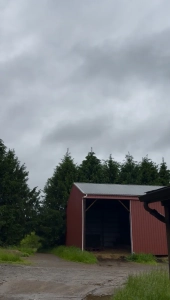
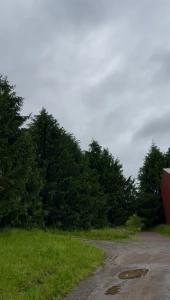
So, too, does a working farmstead lift my soul. I love the wildness of forests, yet I am in love with the grandeur of a land and its owner/caretaker committed to informed and responsible Earth stewardship, generating intentional ends through applied means. Conservation entails wise use and management, applying scientific principles and practices to yield desired outcomes, whether forest products, productive pasture, baled hay, or the compelling essence of a well-managed landscape.
The Norway spruce edging the barn is one element of the landscape magic. I recorded this 58-second video of the Norway spruce hedgerow.
Shingle Oak and Bacterial Crown Galls!
Shingle oak is a deciduous tree in the red oak group. It is native primarily to the Midwestern and Upper South regions of North America.
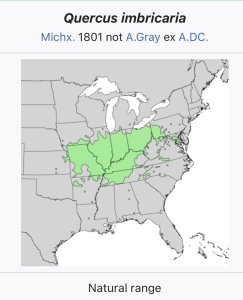
I don’t see the species often in my Alabama wanderings, although I did chronicle the demise of the Alabama State Champion shingle oak on Joe Wheeler State Park (https://stevejonesgbh.com/2022/10/19/a-state-champion-yields-to-decay-and-gravity/). I found this unusual shingle oak specimen just 300 feet from the barn. This individual drew me closer. Standing pondside, promising delightful summer shade weeks ahead, the tree carried a heavy load I could not identify until I came closer.
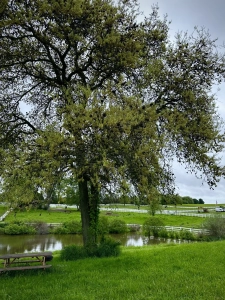
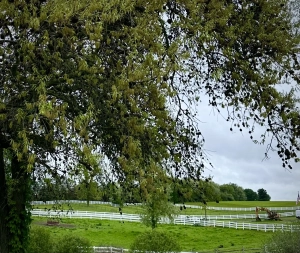
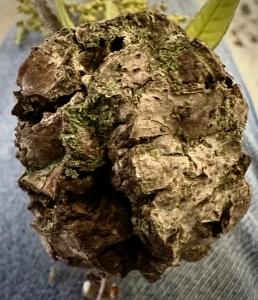
The tree was laden with a heavy burden of woody bacterial crown galls.
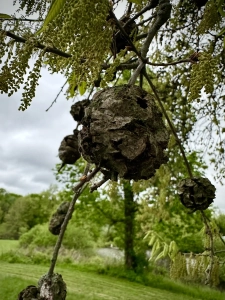
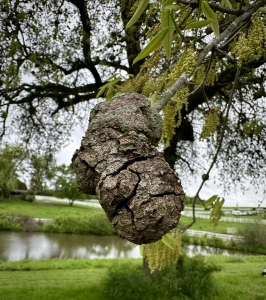
An online Missouri Botanical Garden reference describes the condition for many ornamental plants of the rose family:
Crown gall is a plant disease caused by the soil-inhabiting bacterium, Agrobacterium tumefaciens. The bacterium causes abnormal growths or galls on roots, twigs, and branches. The bacterium stimulates the rapid growth of plant cells that result in the galls. In addition to being unsightly, the galls weaken and stunt the growth of the plant. Although galls can disrupt the flow of water and nutrients up the roots and branches, they usually do not cause total plant death. The disease can spread to other susceptible plants through contaminated soil and tools. Most chemical treatments are not effective.
However, the same online reference suggests a different causal agent for these similar galls on oaks:
The galls on forsythia, viburnum, highbush blueberry, American elm, hickory, maple, oak, and privet are believed to be caused by a fungus, Phomopsis sp.
I am confident that the oak is diseased, perhaps by fungal…or maybe bacterial agents. Fatal? Probably not. The tree appears robust, with a emerging full foliar canopy, and a tremendous flower crop. A curiosity? Absolutely! A tree condition oddity worthy of highlighting for readers of these Great Blue Heron weekly photo essays!
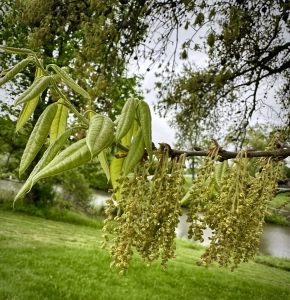
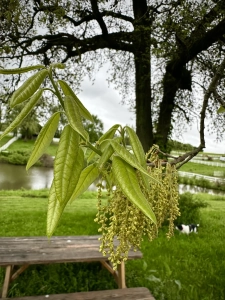
Shingle oaks are what during my forest industry years (1973-1985) I termed ELROs, entire-leaf red oaks (without lobes). The leaves are much like the willow oak leaves of the tree in my Alabama backyard. I admire the appearance of the newly emerged leaves, fresh flowers, and a woody gall against the bakdrop of the weathered-wood picnic table.
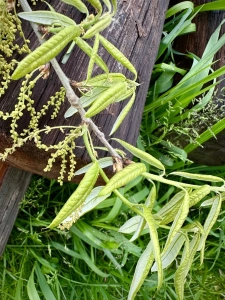
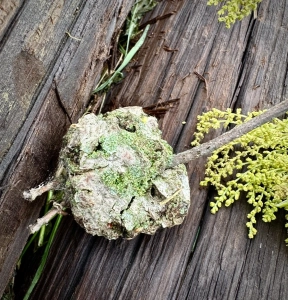
The galls portray character, each one a distinct size and shape. One might expect a mishappen product of disease to look a little less mirthful!
A Farm Pond Celebration of Life and Living
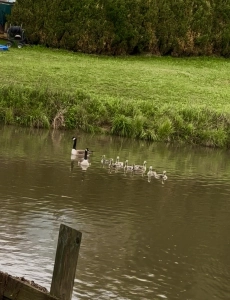
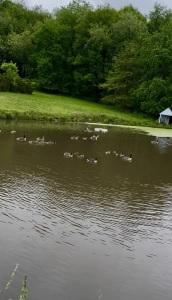
I wondered whether these Canada geese are recent arrivales from the southland 0r, like those on my Alabama neighborhood pond, are they year-round residents. If so, how do they survive a pond frozen for many weeks of bitter winter and shrouding snow?
Aldo Leopold knew geese well, yet he spoke of the magic of their mystery:
What a dull world if we knew all about geese!
One swallow does not make a summer, but one skein of geese, cleaving the murk of a March thaw, is the spring.
So sad that our Madison, Alabama geese know nothing of cleaving the murk of a March thaw. I love them just the same.
I recorded this 57-second video at the horse barn pond.
A single frame expressing Nature-Inspired Life and Living!
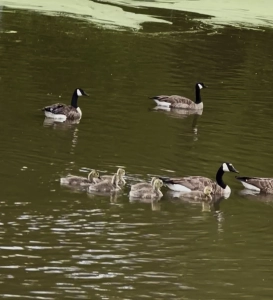
I spent 35 years at nine different universities, rising through faculty ranks to serving senior adminstrative positions to holding the presidency at four institutions and chairing the governing board at the University of the Arctic, a consortium of 110 northern circumpolar colleges and universities enrolling 800,000 students. Throughout my academic career, I shared a fundamental concern that academic conservationist Aldo Leopold so elequently expressed:
Is education possibly a process of trading awareness for things of lesser worth? The goose who trades his is soon a pile of feathers.
Thoughts and Reflections
I offer these observations:
-
Is education possibly a process of trading awareness for things of lesser worth? The goose who trades his is soon a pile of feathers. (Aldo Leopold)
-
One swallow does not make a summer, but one skein of geese, cleaving the murk of a March thaw, is the spring. (Aldo Leopold)
- Sadly, our Madison, Alabama geese know nothing of cleaving the murk of a March thaw. (Steve Jones)
Inhale and absorb Nature’s elixir. May Nature Inspire, Inform, and Reward you!
Note: All blog post images created & photographed by Stephen B. Jones unless otherwise noted. Please circulate images with photo credit: “©2026 Steve Jones, Great Blue Heron LLC. All Rights Reserved.”
I am available for Nature-Inspired Speaking, Writing, and Consulting — contact me at steve.jones.0524@gmail.com
Subscribe to my free weekly photo essays (like this one) at: http://eepurl.com/cKLJdL
Reminder of my Personal and Professional Purpose, Passion, and Cause
If only more of us viewed our precious environment through the filters I employ. If only my mission and vision could be multiplied untold orders of magnitude:
Mission: Employ writing and speaking to educate, inspire, and enable readers and listeners to understand, appreciate, and enjoy Nature… and accept and practice Earth Stewardship. Until I can’t!
Vision:
- People of all ages will pay greater attention to and engage more regularly with Nature… and will accept and practice informed and responsible Earth Stewardship.
- They will see their relationship to our natural world with new eyes… and will understand more clearly their Earth home.
Tagline/Motto: Steve (Great Blue Heron) encourages and seeks a better tomorrow through Nature-Inspired Living!
Steve’s Four Books
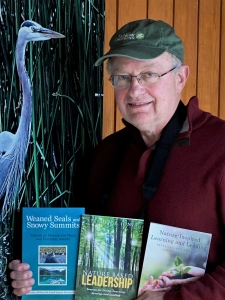
I wrote my books Nature Based Leadership (2016), Nature-Inspired Learning and Leading (2017), Weaned Seals and Snowy Summits: Stories of Passion for Place and Everyday Nature (2019; co-authored with Dr. Jennifer Wilhoit), and Dutton Land & Cattle: A Land Legacy Story (2023) to encourage all citizens to recognize and appreciate that every lesson for living, learning, serving, and leading is either written indelibly in or is powerfully inspired by Nature. All four of my books present compilations of personal experiences expressing my deep passion for Nature. All four books offer observations and reflections on my relationship with the natural world… and the broader implications for society. Order any from your local indie bookstore, or find them on IndieBound or other online sources such as Amazon and LifeRich.
I began writing books and Posts for several reasons:
- I love hiking and exploring Nature
- I see images I want to (and do) capture with my trusty iPhone camera
- I enjoy explaining those images — an educator at heart
- I don’t play golf!
- I do love writing — it’s the hobby I never needed when my career consumed me
- Judy suggested my writing is in large measure my legacy to our two kids, our five grandkids, and all the unborn generations beyond
- And finally, perhaps my books and Blogs could reach beyond family and touch a few other lives… sow some seeds for the future