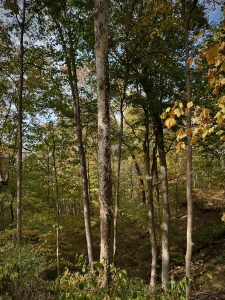
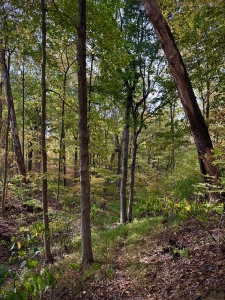
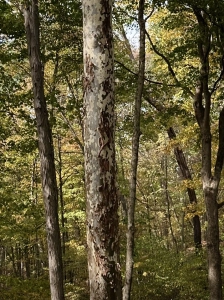
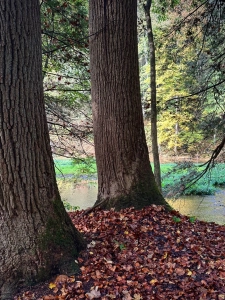
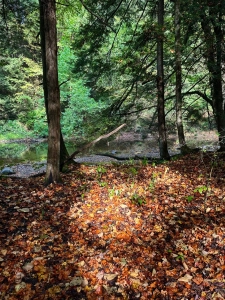
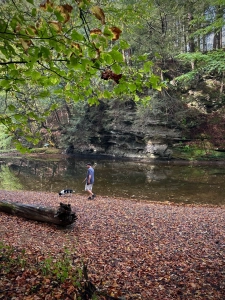
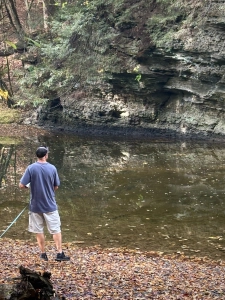
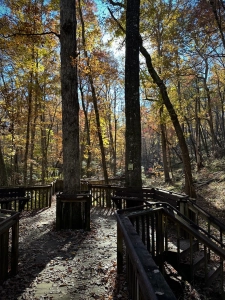
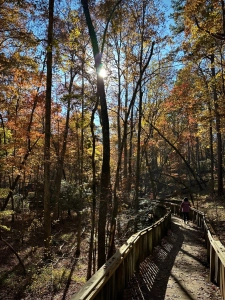
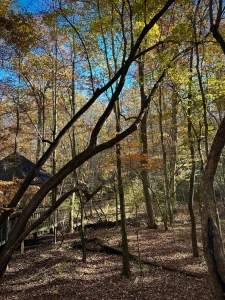
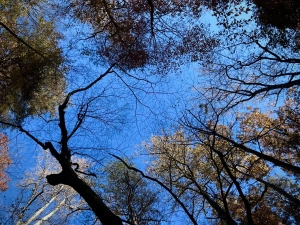
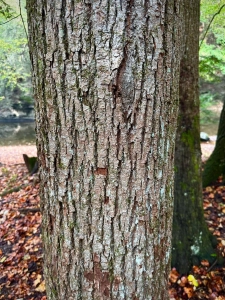
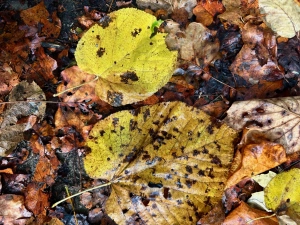
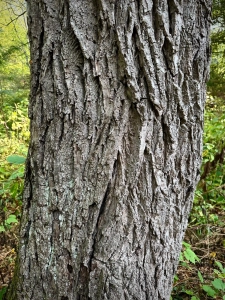
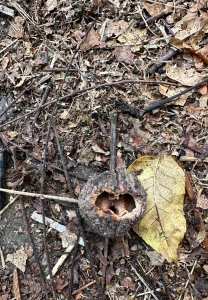
I attended an Alabama State Parks Foundation Board morning meeting on Thursday, November 6, 2026, at the DeSoto State Park Lodge. I had hiked extensively at the park the previous afternoon. Following the board session, I hiked the Chalet Trail from the Lodge and circuited the nearby cabins area. I am seldom disappointed by the magic a short saunter reveals, if only one looks deeply enough to discover what lies hidden in plain sight.
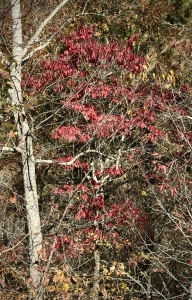
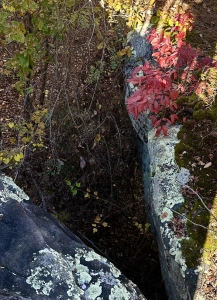
Come along with me to see the beauty, magic, wonder, and awe I spotted. The lodge deck overlooking the canyon of the West Fork of the Little River proved a good place to begin my trek. A brilliantly red sourwood tree stood at eye level, peering through the now-leafless yellow poplar (left). A smaller sourwood shrub topped a sandstone ledge near the deck (right). As a run-of-the-mill guy who knows only the basic rainbow colors, I referred to sourwood’s fall cape simply as red. Online leafyplace.com relied on more color-proficient descriptors: vibrant shades of crimson red to burgundy and purple.
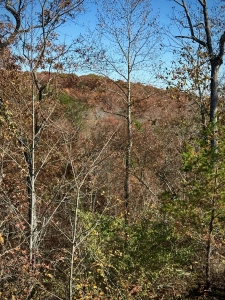
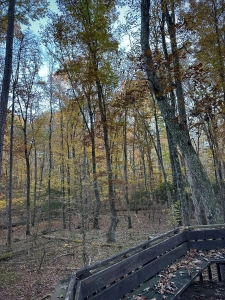
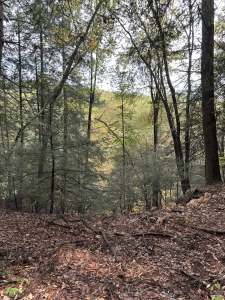
The canyon reached ~250′ from stream to rimrock. Summer foliage hides the opposite ridge, now visible with leaf-drop.
I recorded this 58-second video from the Lodge deck.
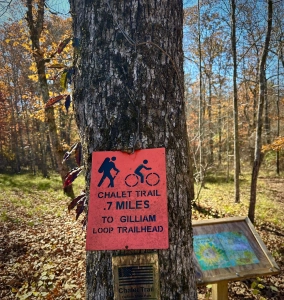
Intent on uncovering more of the forest’s secrets, I walked from the Lodge to the Chalet Trailhead.
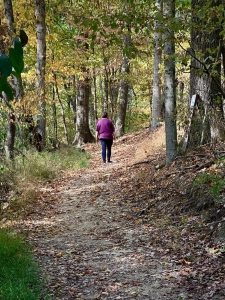
Afternoon along the Chalet Trail
A hike doesn’t need to be long and daunting to offer rewards. A perfect afternoon for leisurely sauntering is ideal for recovering mentally from a Board meeting, and for preparing physically for the required two-hour drive home.
I recorded this 59-second video within the forest along the trail.
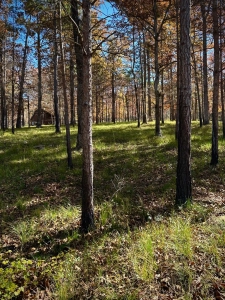
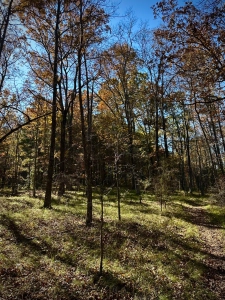
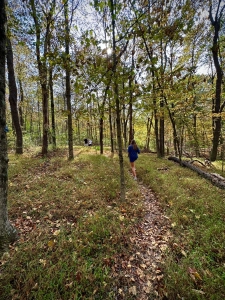
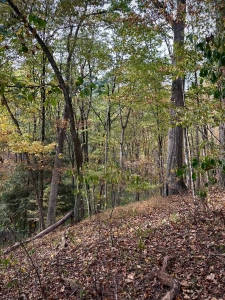
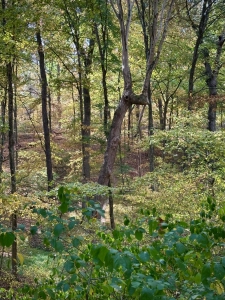
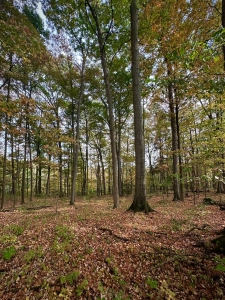
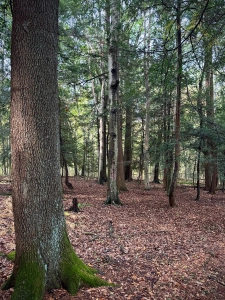
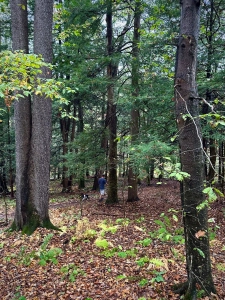
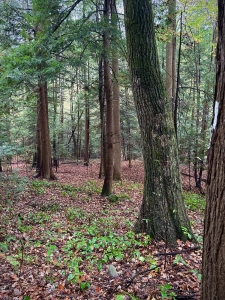
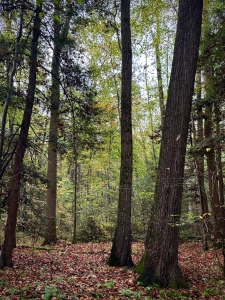
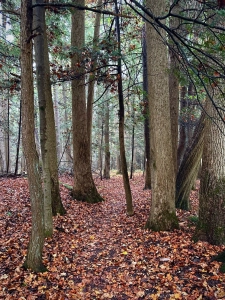
Periodic prescribed fire has eliminated understory trees and shrubs, creating an open-grown grassy impression. Some refer to the appearance as park-like, a condition that many persons queried in surveys prefer.
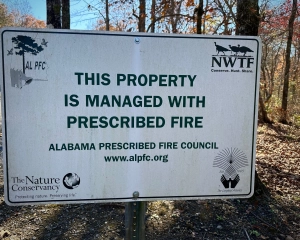
I chose the Chalet Trail to focus on the benefits and consequences of prescribed fire as a parkland management tool. Note that the sign is sanctioned by: Alabama Prescribed Fire Council; National Wild Turkey Federation; The Nature Conservancy; and The Longleaf Alliance.
The understory is open, with no brambles or thickets impeding walking and, ostensibly, hiding snakes, critters, and other scary woodland denizens. I speak in jest of scary woodland denizens, yet I, too, prefer parklike stands in an area heavily trafficked around picnic tables, campgrounds, and cabins.
I recorded a 60-second video of the stand managed by fire and evidencing charred trunks.
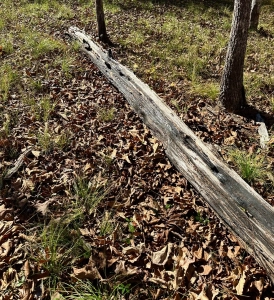
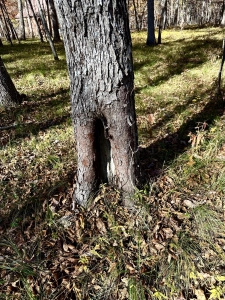
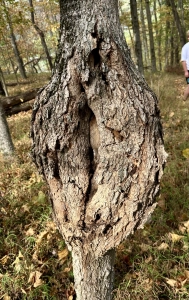
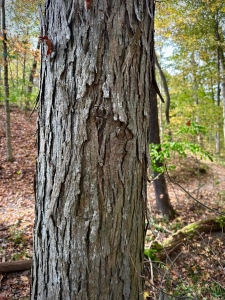
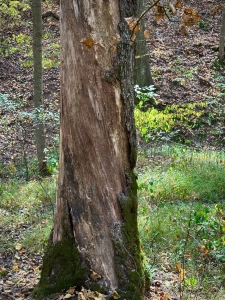
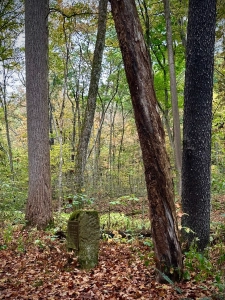
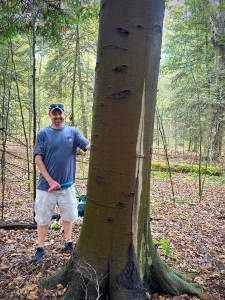
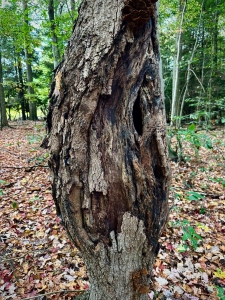
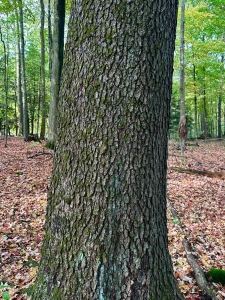
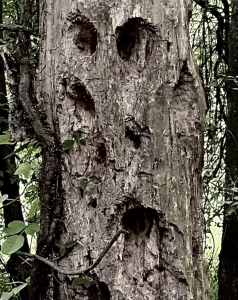
I observe in nearly every Great Blue Heron photo essay that death is a big part of life in our forests. Whether a wildfire or controlled burn, dead and down woody debris is part of the ground-level fuel. Occasionally even a intentionally administered prescription fire will burn intensely enough to damage cambium at the base, opening a court of fungal infection. The kickory tree at left bears a catface, a hollow resulting from heart decay. The rot extends upward, eliminating any commercial timber value and weakening structural soundness. However, in this park cabin area management regime, timber value is of little consequence. Instead, squirrels, snakes, birds, and other critters value tree cavities! All the better for park wildlife enthusiasts.
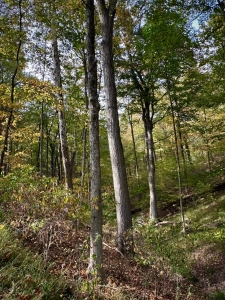
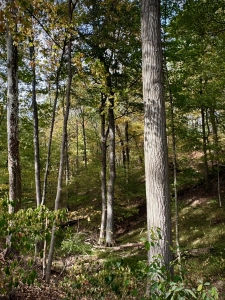
Fall colors, open canopy, an orchard stocking level, and a welcoming understory tell me that controlled fire is an effective management tool.
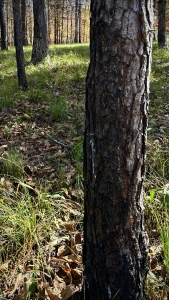
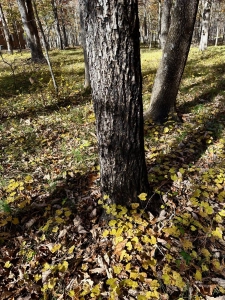
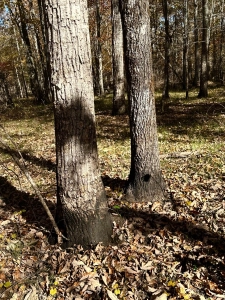
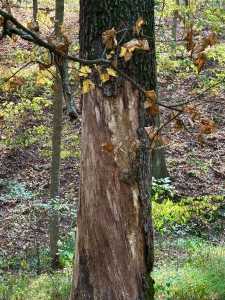
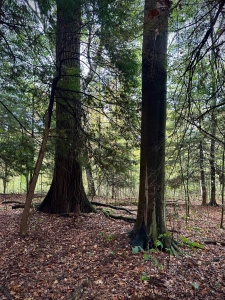
Charred trunks and nearly bare forest floor evidence employed fire success.
Across my 12 years practicing forestry in the southeastern US for a Fortune-500 paper and allied forest products manufacturer, I control-burned tens of thousands of acres of company-owned forest land. Whether site preparation or established stand burning, the tool is essential to meeting our seeming insatiable demand for pulp, lumber, poles, chips, and miscellaneous other probucts. For the record our South Alabama crews once ignited and safely managed a rough-reduction, aerial ignition day when we covered 4,300 acres, a banner accomplishment!
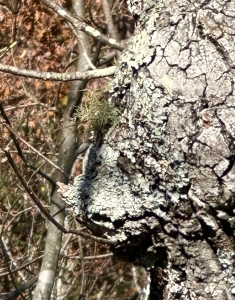
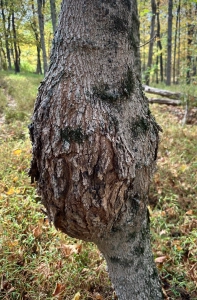
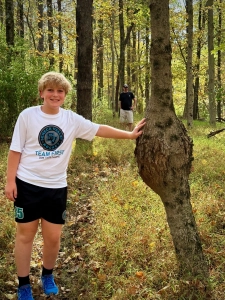
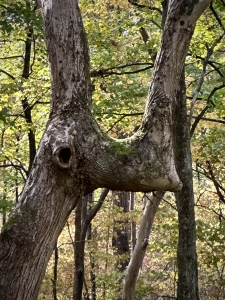
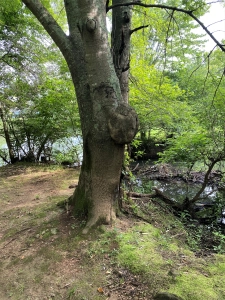
Many surprises in Nature lie hidden in plain sight, including this groundhog head. A burl on a water oak trunk trailside. The critter sports a moustached mouth, abbreviated proboscis, two eyes (its right one with a lichened, overhanging brow), and a plated forebrow. It’s okay to employ a little imagination when searching our forests for obscure mammal residents.
Albert Einstein observed:
Imagination is more important than knowledge. Knowledge is limited. Imagination encircles the world.
It is the supreme art of the teacher to awaken joy in creative expression and knowledge.
Closing
I accept the challenge of distilling these Brief-Form Posts into a single distinct reflection.
Aldo Leopold, a preeminent mid-Twentieth Century ecologist, is my conservation hero, and his writing, A Sand County Almanac, is a lyrical conservation classic. Leopold encouraged informed and responsible land management, employing an arsenal of effective, bold practices informed by experience, wisdom, and hard work. He professed:
Prudence never kindled a fire in the human mind; I have no hope for conservation born of fear.
Nature’s special treats await our discovery, our understanding, and our interpretation!
Subscribe to my free weekly photo essays (like this one) at: http://eepurl.com/cKLJdL
https://stevejonesgbh.com/wp-content/uploads/2025/11/IMG_9570.jpg-11.06.25-DeSoto-SP-Deck-at-Lodge-Sourwood-on-Ledge-scaled.webp25601856Steve Joneshttp://stevejonesgbh.com/wp-content/uploads/2017/01/gbhweblogo.pngSteve Jones2026-02-11 08:22:492026-02-11 08:22:49Brief-Form Post #54: Second Autumn Afternoon Near the Lodge and Cabins at AL's DeSoto State Park!
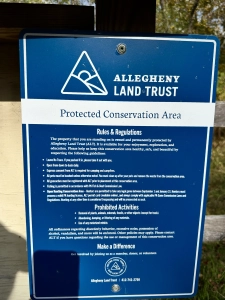
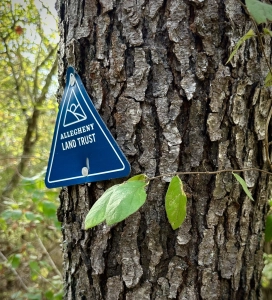
Judy and I visited our son, Matt, and his family in late September 2025, at their home in Butler County, Pennsylvania, 20 miles north of Pittsburgh. We explored several parks and natural areas, including Leebrook Park, located in Franklin Park Borough, Allegheny County. Come along with Matt, Judy, Hannah, Nate, and me as we view memorable Leebrook Nature attractions on an autumn afternoon.
I always appreciate well-marked trails and informative signage.
Upper Roadside Parking Entrance
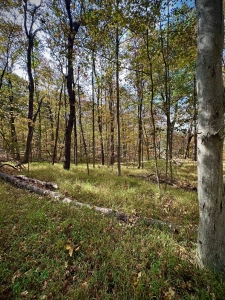
We entered by a trailhead distant from the main parking lot, primary entrance, and recreation fields. The second-growth mixed hardwood stand occupied a long-abandoned pasture.
I recorded this 60-second video as we traipsed through the former pasture forest.
This sugar maple, likely the same age as the overstory trees, sports a massive canker, infecting the entire trunk, and accounting for the tree’s distortion and stunted growth.
Nate provided scale.
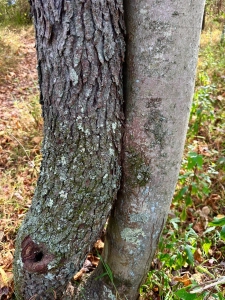
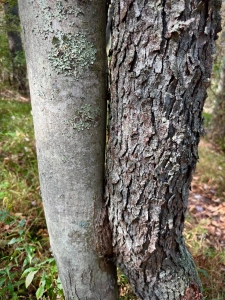
Eight to ten inch diameter black cherry and red maple trees stand side by side. Germinating decades ago six inches apart, they have closed the gap. Inosculation is the term describing trees that seem to grasp one another, growing eventually as one.
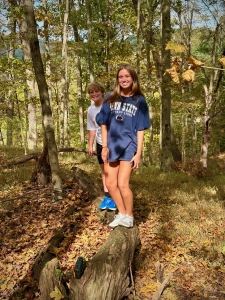
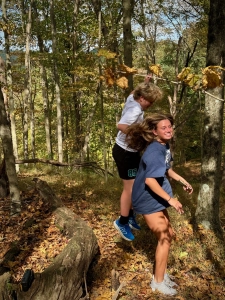
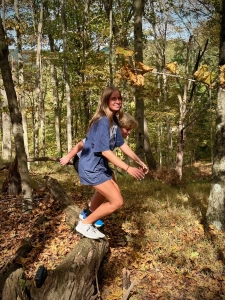
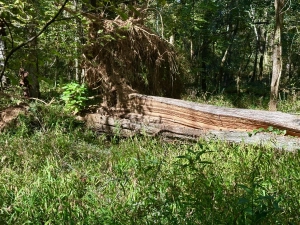
Hannah (18) and Nate (12) stood atop a dead and downed trunk before leaping to the leaf-littered ground. Not a big deal, you say, but in the sunest years of their grandfather, it is a moment worth cherishing.
Rather than hike into the lower forest and needing to climb back to the car, Matt relocated us to the lower, richer slope with a far more interesting forest.
Lower Trail at Playing Field Entrance
Larger trees, greater variety of tree species, and wrinkled terrain drew my interest.
The bowl-shaped ravine supported a stand of cove hardwoods: mixed oaks, sugar maple, black cherry, a single sycamore, shagbark hickory, and yellow poplar, among others.
My 60-second video captured the special essence of the cove.
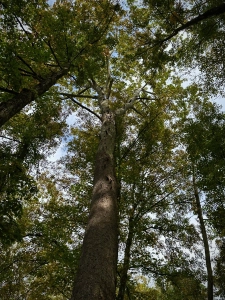
Trees reach more than 110 feet skyward. Such sites are characterized by deeper soils, greater soil moisture, denser shading by virtue of their lower slope position, and protection from ridgetop winds. I love the look and feel (shade and microclimate) of Appalachian hardwood coves.
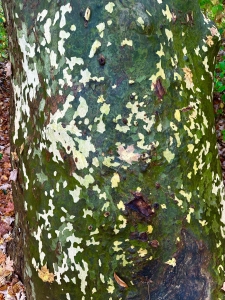
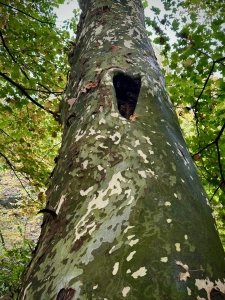
The centered tree above (left) is a colorfully-patterned sycamore:
I recorded this 36-second video focusing on the three bird or mammal cavities in the towering top of the sycamore.
Shagbark hickory is as happy and comfortable on the hills of west-central Penn’s-woods as it is on Alabama’s Cumberland Plateau.
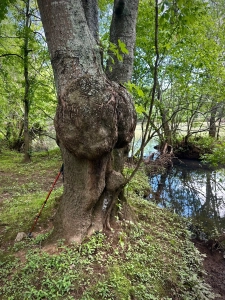
Always alert for tree form oddities and curiosities, I had to capture the image of this main canopy sugar maple. Suffering a decades-old upper crown injury, the old denizen has a snout and eye where the stem broke. Two large forks ascend in a prominent U-shape from the snout. The odd creature appears to stand sentry above the sylvan cove.
I find enchantment in such peculiarities, knowing full well that there is a story to be told. A heavy burden of snow or ice decapitated the younger tree? A thunderstorm gust brought its top down? I can only imagine the year, month, and causal agent.
Spiral Grain and Woodpecker Excavation
Spiral wood grain fascinates me. I see it often in downed hardwood trees after decomposition sheds their bark. When I discuss spiraling with others, nearly everyone insists that the spiraling should be apparent in the bark of a living tree. I insist, contrarily, that the phenomenon is completely hidden beneath the bark. Finally, I found direct evidence. This spiraled, standing dead oak has lost much of its bark, revealing the grain (right). The still clinging bark above (right) evidences no external indication of the structural spiraling!
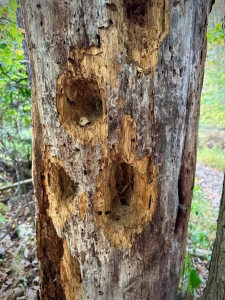
Works of Nature’s creative sculpturing abound. Woodpeckers hungry for grubs and adult insects are assisting decomposition of this standing trunk.
A brief three-generation, leisurely family stroll reveals many secrets, mysteries, and magic in a place close to home, publicly maintained, and accessible free of charge. As I draft this narrative, I am halfway through teaching a six-week adult education course on our US National Parks. At the outset, I offer a Warning/Caution/Alert: Don’t be so smitten, enamored, and captivated by our incredible 63 National Parks that you ignore and shun the incredible beauty, magic, wonder, awe, and inspiration of local special places and everyday Nature. LeeBrook Park is one such example — much closer, less expensive, and less crowded than Yosemite, Yellowstone, or the Grand Canyon! Enjoy pancakes at home, have a sandwich in the park, and be home for dinner.
Thoughts and Reflections
I offer these observations:
A brief three-generation, leisurely family stroll can reveal many secrets, mysteries, and magic in a place close to home, publicly maintained, and accessible free of charge. (Steve Jones)
I find enchantment in tree form oddities and peculiarities, knowing full well that there is a story to be told. (Steve Jones)
Our death is not an end if we can live on in our children and the younger generation. For they are us; our bodies are only wilted leaves on the tree of life. (Albert Einstein)
Inhale and absorb Nature’s elixir. May Nature Inspire, Inform, and Reward you!
I am available for Nature-Inspired Speaking, Writing, and Consulting — contact me at steve.jones.0524@gmail.com
Subscribe to my free weekly photo essays (like this one) at: http://eepurl.com/cKLJdL
Reminder of my Personal and Professional Purpose, Passion, and Cause
If only more of us viewed our precious environment through the filters I employ. If only my mission and vision could be multiplied untold orders of magnitude:
Mission: Employ writing and speaking to educate, inspire, and enable readers and listeners to understand, appreciate, and enjoy Nature… and accept and practice Earth Stewardship.
Vision:
People of all ages will pay greater attention to and engage more regularly with Nature… and will accept and practice informed and responsible Earth Stewardship.
They will see their relationship to our natural world with new eyes… and will understand more clearly their Earth home.
Tagline/Motto: Steve (Great Blue Heron) encourages and seeks a better tomorrow through Nature-Inspired Living!
Steve’s Four Books
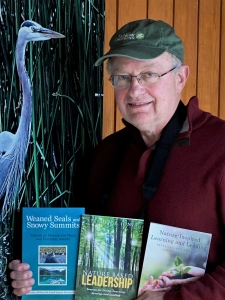
I wrote my books Nature Based Leadership (2016), Nature-Inspired Learning and Leading (2017), Weaned Seals and Snowy Summits: Stories of Passion for Place and Everyday Nature (2019; co-authored with Dr. Jennifer Wilhoit), and Dutton Land & Cattle: A Land Legacy Story (2023) to encourage all citizens to recognize and appreciate that every lesson for living, learning, serving, and leading is either written indelibly in or is powerfully inspired by Nature. All four of my books present compilations of personal experiences expressing my deep passion for Nature. All four books offer observations and reflections on my relationship with the natural world… and the broader implications for society. Order any from your local indie bookstore, or find them on IndieBound or other online sources such as Amazon and LifeRich.
I began writing books and Posts for several reasons:
I love hiking and exploring Nature
I see images I want to (and do) capture with my trusty iPhone camera
I enjoy explaining those images — an educator at heart
I don’t play golf!
I do love writing — it’s the hobby I never needed when my career consumed me
Judy suggested my writing is in large measure my legacy to our two kids, our five grandkids, and all the unborn generations beyond
And finally, perhaps my books and Blogs could reach beyond family and touch a few other lives… sow some seeds for the future
https://stevejonesgbh.com/wp-content/uploads/2025/09/IMG_9072-1.jpg-09.21.25-Leebrook-Park-Land-Trust-scaled.webp25601920Steve Joneshttp://stevejonesgbh.com/wp-content/uploads/2017/01/gbhweblogo.pngSteve Jones2026-02-06 08:51:492026-02-07 09:00:15Crispy-Leafed Early Autumn at Leebrook Park in Pennsylvania's Franklin Park Borough
On October 14, 2025, I had nearly two hours to roam before meeting with a colleague to prepare for a scheduled joint seminar the next week. I visited the tupelo swamp on the northeast side of Huntsville’s Goldsmith-Schiffman Wildlife Sanctuary. I had no objective beyond seeing what may lie hidden in plain sight during the dry autumn season. Never disappointed by my routine impromptu explorations, I discovered a portfolio of interesting features.
A Big Oak Topples into the River
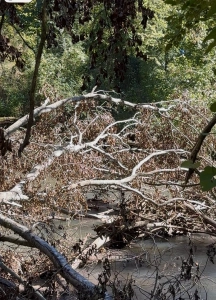
Sometime this past summer, this 2.5-foot diameter water oak toppled violently into the adjacent Flint River, blocking at least half of the river’s width. The crown clings to the brown leaves that were in full flush when the tree fell.
I recorded this 58-second video of the toppled water oak.
I wonder whether the crown will hold in place when winter rains swell the river to bankfull and beyond. The force will be powerful. Only Nature knows her limits, yet cares nothing of the consequences. I’ll keep an eye on her antics and impacts.
I observe in nearly every Post, death is a big part of life in our forests.
Another Big Oak Decomposes and Decays
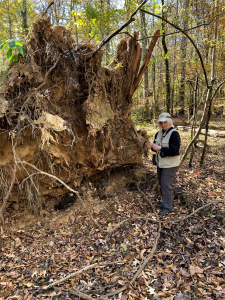
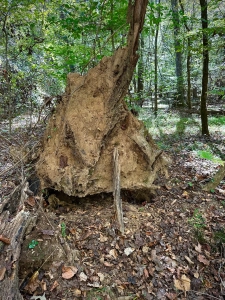
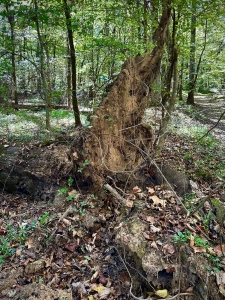
Across eight years of permanent residence in North Alabama, I am learning better how to estimate the pace of decomposition and decay based on observation. Marian Moore Lewis, author of Southern Sanctuary, and I encountered a recently uprooted red oak on November 18, 2020 in this same bottomland forest. Fine roots were still evident; the root ball soil remined intact; bole bark and crown appeared fresh.
The massive root ball is clearly weathering away in my October 14, 2025 photo. Only the largest woody roots remain, yet even they are rapidly decaying. Trunk bark is shredding and stripping. Five years leave a striking mark on a large oak. My eye is calibrating. I am confident that I can estimate time since windthrow within 2-3 years, through the first 20 years. By then, the soil incorporation is in control.
I will continue to Monitor…and Learn.
A Rich Species Mix
With litte necessary narrative, here are some of the tree varieties I encountered.
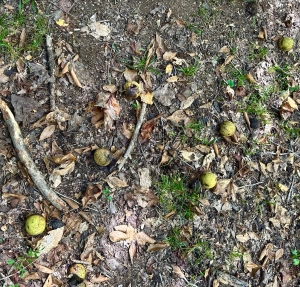
A nice crop of walnuts beneath a 24-inch diameter black walnut.
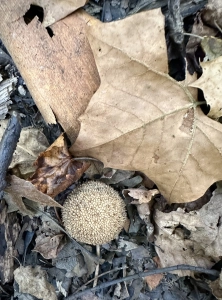
A sycamore and an attractive natural forest floor arrangement of peeled sycamore bark, a dropped leaf, and a seed ball.
Sycamore’s peeling bark is one of its distinctive features.
During my frequent Nature interpretive walks, more than half of participants recognize sycamore, provided I offer some hints and prompts.
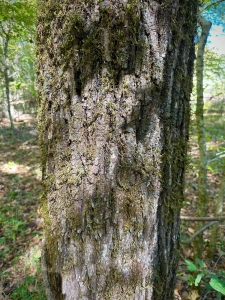
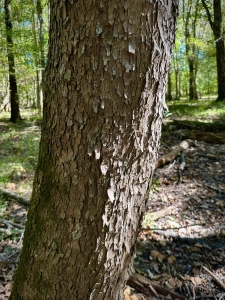
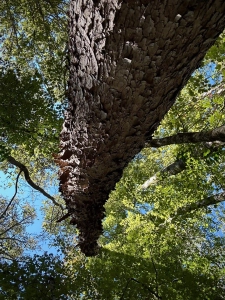
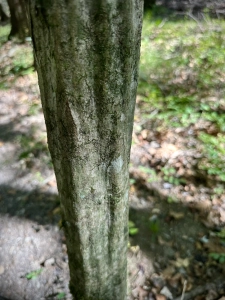
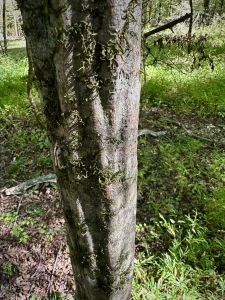
Carpinus caroliniana is an understory to mid-canopy hardwood that has been a favorite of mine since my undergraduate student days. I learned its common name as musclewood. It resembles the sinewed fibers of a muscled arm. Other common monikers include American hornbeam, blue beech, and ironwood. I photographed two individuals.
I’m a lifetime fancier of tree form oddities and curiosities.
An Attractive Fungal Resident
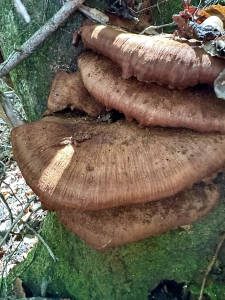
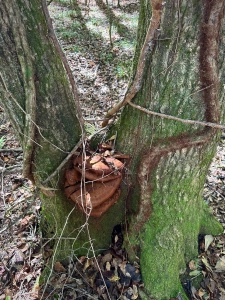
A twin water oak nestled aged resinous polypore brakets in its fork.
I recorded a 58-second video at the infected twin water oak
Again, death is a big part of life in our forests. The twins are diseased. Mycelia are decomposing and decaying the twin. Death is underway. Although macabre, the truth is that the end begins at the start…for all life on earth.
Answer Me This
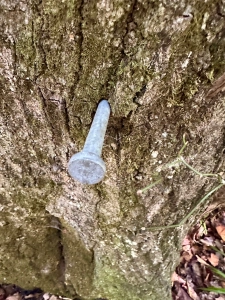
Just ten feet from the infected twin, I spotted this galvanized nail in another water oak. Yet another story that I cannot but weakly ponder. Did it mark a survey point? Is it related to transfer of the private property to the city to create the Sanctuary? A scavenger hunt or geocaching site? Pardon the pun, but I am unable to nail the reason!
I will continue finding riddles I cannot solve.
Water Tupelo Swamp
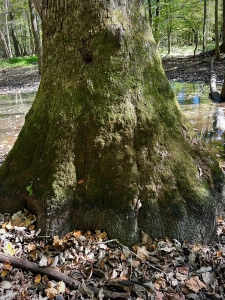
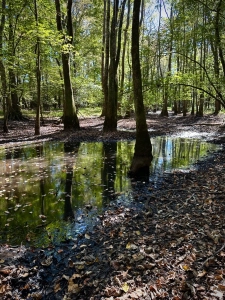
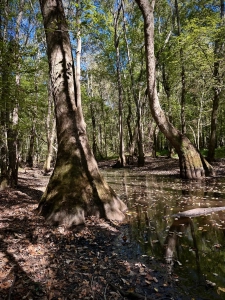
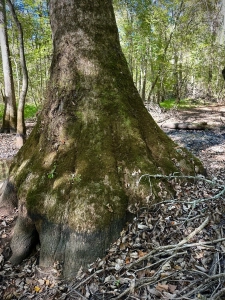
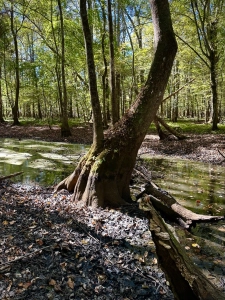
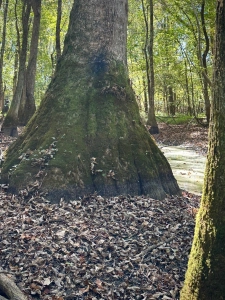
I grew up and attended forestry school far north of the natural range of water tupelo, which may explain my fascination with this forest type. I’ve published at least a dozen Posts about my adventures in this forest type, including several in the Sanctuary. I will offer only an album of photographs without detailed narrative. These buttressed tupelo draw me. The dry season standing water and soil saturation hint at the deeper water ahead in the winter.
You don’t need much beyond my 60-second swamp tour video overview.
Strange tree forms and a haunting aspect dominate.
This is far removed from the upland hardwood forests I wandered in my youth.
I recorded a 48-second video of a massive water tupelo. I estimated its ground-level diameter as 12-14 feet!
I relish the beauty, magic, wonder, awe, and inspiration!
What is the hairy, grizzled, bearded old man of the tupelo forest!?!?
See my related Post (https://stevejonesgbh.com/2025/10/27/brief-form-post-47-strange-bearded-tupelo-trees-air-root-mysteries-and-curiosities/) for the answer!
Thoughts and Reflections
I offer these observations:
Tupelo forests are far removed from the upland hardwood forests I wandered in my youth. (Steve Jones)
Death is a big part of life in our North Alabama forests. (Steve Jones)
I have no special talent. I am only passionately curious. (Albert Einstein)
Inhale and absorb Nature’s elixir. May Nature Inspire, Inform, and Reward you!
I am available for Nature-Inspired Speaking, Writing, and Consulting — contact me at steve.jones.0524@gmail.com
Subscribe to my free weekly photo essays (like this one) at: http://eepurl.com/cKLJdL
Reminder of my Personal and Professional Purpose, Passion, and Cause
If only more of us viewed our precious environment through the filters I employ. If only my mission and vision could be multiplied untold orders of magnitude:
Mission: Employ writing and speaking to educate, inspire, and enable readers and listeners to understand, appreciate, and enjoy Nature… and accept and practice Earth Stewardship.
Vision:
People of all ages will pay greater attention to and engage more regularly with Nature… and will accept and practice informed and responsible Earth Stewardship.
They will see their relationship to our natural world with new eyes… and will understand more clearly their Earth home.
Tagline/Motto: Steve (Great Blue Heron) encourages and seeks a better tomorrow through Nature-Inspired Living!
Steve’s Four Books
I wrote my books Nature Based Leadership (2016), Nature-Inspired Learning and Leading (2017), Weaned Seals and Snowy Summits: Stories of Passion for Place and Everyday Nature (2019; co-authored with Dr. Jennifer Wilhoit), and Dutton Land & Cattle: A Land Legacy Story (2023) to encourage all citizens to recognize and appreciate that every lesson for living, learning, serving, and leading is either written indelibly in or is powerfully inspired by Nature. All four of my books present compilations of personal experiences expressing my deep passion for Nature. All four books offer observations and reflections on my relationship with the natural world… and the broader implications for society. Order any from your local indie bookstore, or find them on IndieBound or other online sources such as Amazon and LifeRich.
I began writing books and Posts for several reasons:
I love hiking and exploring Nature
I see images I want to (and do) capture with my trusty iPhone camera
I enjoy explaining those images — an educator at heart
I don’t play golf!
I do love writing — it’s the hobby I never needed when my career consumed me
Judy suggested my writing is in large measure my legacy to our two kids, our five grandkids, and all the unborn generations beyond
And finally, perhaps my books and Blogs could reach beyond family and touch a few other lives… sow some seeds for the future
https://stevejonesgbh.com/wp-content/uploads/2025/10/IMG_9411.jpg-GSWS-East-Side-10.14.25-Water-Tupelo-Aertion-Roots.webp20161512Steve Joneshttp://stevejonesgbh.com/wp-content/uploads/2017/01/gbhweblogo.pngSteve Jones2026-02-02 12:30:132026-02-02 12:30:13Curiosities, Oddities, and Mysteries In a Sanctuary's Bottomland Hardwood Forest!
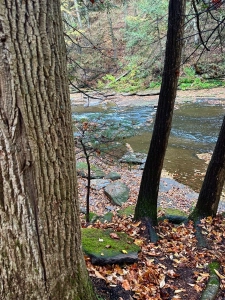
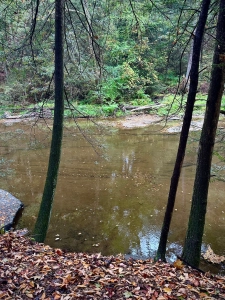
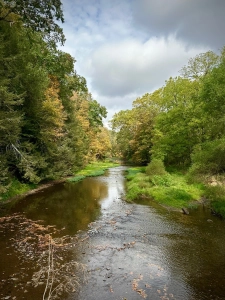
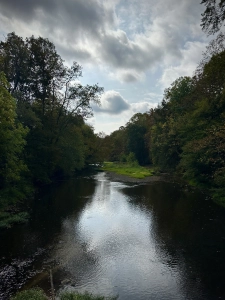
Wolf Creek Narrows Natural Area, owned and managed by the Western Pennsylvania Conservancy (WPC), is in northwestern Butler County, Pennsylvania, just 30 minutes from where my son and his family reside north of Pittsburgh. Matt, his dog Oakley, and I circuited the 2.35-mile trail on the morning of September 22, the first day of autumn. I focus this photo essay on Wolf Creek and streamside elements of the preserve.
Forest Portal to Wolf Creek
The ecotone where deep forest meets the stream corridor represents a sharp transition from shaded stillness, damp air, and relative silence to gurgling water, bright sunshine, and refreshing breezes.
The towering old growth hardwoods tap streamside soil moisture and fertiity available in the deep alluvial soils. Their streamside branches harvest full sunlight from the opening above the stream channel. The trees have nearly unlimited access the the essential resources necessary for maximum growth: moisture, nutrients, sunlight, and space.
I love the stark visual contrast of closed shade to open stream. The sun found a way to spotlight a leaf-covered patch of forest floor near the stream.
Too often I encounter southern streamside forests supporting thick understory cover of greenbriars, cane, and brush. I appreciate the parklike high forest and sparse ground cover along Wolf reek.
Wolf Creek Proper
The stream channel and canyon floor beckoned and embraced us. I vividly recall taking Matt accompanying me hiking along woodland streams 40 years ago. Along Wolf Creek, I sensed our roles shifting, feeling as though now I accompanied Matt as we circuited the Narrows trail system. I suppose such is the circle of life.
I recorded this 59-second video of Matt and Oakley along Wolf Creek.
The press of family visitation affairs limited the time available at Wolf Creek Narrows. I would loved to have lingered along our transit. Many places were custom made for leaning against a tree streamside, sipping coffee or hot chocolate, nibbling a cookie, or eating a peanut butter and banana sandwich. Funny, when Matt was young, it was I who endured busy days, time constraints, and the pressures of living. It is now I who has time for a liesurely pace.
I recorded this 59-second video along Wolf Creek.
We paused at the road bridge that marked our turn-around point. The orientation of clouds and sun created contrasting views of Wolf Creek. Bright sunlight highlighted the view upstream (left). Clouds darkened the sky and the stream as I snapped a photo downstream. Nothing in Nature is static. A heartbeat flits by and everything shifts.
We reentered the deep forest, leaving the road and stream corridor to enter what I term a a place of reverence…a streamside cathedral.
Streamside Cathedral
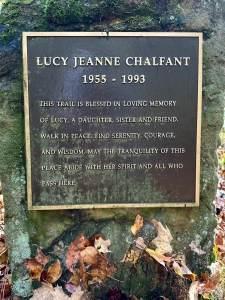
I felt the solemnity and said a prayer for those who loved Lucy Jeanne Chalfant and this special place. Lucy was born just four years after Judy and I entered the world some 100 miles south of here in western Maryland. As I stood silently, I felt Lucy’s presence. She walked on with me for a spell, and she returns as a vapor as I draft this narrative.
Lucy Jeanne Chalfant (1955-1993)
This trail is blessed in loving memory of Lucy, a daughter, sister, and friend. Walk in peace. Find serenity, courage, and wisdom. May the tranquillity of this place abide with her spirit and all who pass here.
I felt the peace, tranquility, and serenity. I pondered Lucy’s story. What took her from her parents, siblings, and friends at the fresh age of 38? I was four at Lucy’s birth, and I write these words 33 years after she ascended to a place of permanent and ultimate renewal. What makes me so blessed as to pass silently through the sylvan refuge where her memory persists? Who among those who loved her return? I can imagine no better place to rest, linger, and remember. Something touched me on the trail…and left a mark.
This special place reminds me of words Robert Service applied in his The Spell of the Yukon:
It’s the forest where silence has lease;
It’s the beauty that thrills me with wonder,
It’s the stillness that fills me with peace.
I recorded this 56-second video of a moment of deeply spiritual reflection at Wolf Creek Narrows.
I wonder, are Lucy’s spirit mists rising within the canopy 120 feet above the forest floor.
As with any forest saunter, I found delights. A speckled sycamore trunk reached into the soaring crown. A hollowed stem opened 30 feet above ground, welcoming whateever critter occupies the sheltering interior.
I recall in my youth grabbing a World Book encyclopedia volume from the shelf and thumbing rendomly through the pages, discovering what treasures lie hidden within, awaiting my curious and eager mind. I’m struck now at age 74 by how similar is my woodland sauntering. I’m thumbing through the forest, gleefully sating my curiously eager mind, still discovering and learning as I wander…and wonder!
Magical Mystery Tour: Ferns and Toads
Sensitive fern (left) and Christmas fern, common here and back in Northern Alabama, greeted me along the way. I shall remain a fern aficionado as long as my stride carries me through dark woods.
Wood fern (below) and New York fern, ubiquitous across my doctoral research forests in NW Pennsylvania and SW New York, is not common in northern Alabama.
An American toad, hiding within a protective rock crevice, likely knows where he will wait out the coming winther.
I am completing this narrative two days before Christmas, a season when the Pennsylvania toad is tucked away, secure from winter predators and Pennsylvania’s piercing Arctic blasts. Madison, Alabama is forecast to experience upper 60s to lower 70s through Christmas weekend, and then drop into the upper teens the following week. What’s an Alabama toad to do?
Thoughts and Reflections
I offer these observations:
I thumb through the forest, gleefully sating my curiously eager mind, still discovering and learning as I wander…and wonder! (Steve Jones)
This trail is blessed in loving memory of Lucy, a daughter, sister, and friend. Walk in peace. Find serenity, courage, and wisdom. (Memorial stone for Lucy Jeanne Chalfant (1955-1993))
Nothing in Nature is static. A heartbeat flits by and everything shifts. (Steve Jones)
Inhale and absorb Nature’s elixir. May Nature Inspire, Inform, and Reward you!
I am available for Nature-Inspired Speaking, Writing, and Consulting — contact me at steve.jones.0524@gmail.com
Subscribe to these free weekly Nature Blogs (photo essays) at: http://eepurl.com/cKLJdL
Reminder of my Personal and Professional Purpose, Passion, and Cause
If only more of us viewed our precious environment through the filters I employ. If only my mission and vision could be multiplied untold orders of magnitude:
Mission: Employ writing and speaking to educate, inspire, and enable readers and listeners to understand, appreciate, and enjoy Nature… and accept and practice Earth Stewardship.
Vision:
People of all ages will pay greater attention to and engage more regularly with Nature… and will accept and practice informed and responsible Earth Stewardship.
They will see their relationship to our natural world with new eyes… and will understand more clearly their Earth home.
Tagline/Motto: Steve (Great Blue Heron) encourages and seeks a better tomorrow through Nature-Inspired Living!
Steve’s Four Books
I wrote my books Nature Based Leadership (2016), Nature-Inspired Learning and Leading (2017), Weaned Seals and Snowy Summits: Stories of Passion for Place and Everyday Nature (2019; co-authored with Dr. Jennifer Wilhoit), and Dutton Land & Cattle: A Land Legacy Story (2023) to encourage all citizens to recognize and appreciate that every lesson for living, learning, serving, and leading is either written indelibly in or is powerfully inspired by Nature. All four of my books present compilations of personal experiences expressing my deep passion for Nature. All four books offer observations and reflections on my relationship with the natural world… and the broader implications for society. Order any from your local indie bookstore, or find them on IndieBound or other online sources such as Amazon and LifeRich.
I began writing books and Posts for several reasons:
I love hiking and exploring Nature
I see images I want to (and do) capture with my trusty iPhone camera
I enjoy explaining those images — an educator at heart
I don’t play golf!
I do love writing — it’s the hobby I never needed when my career consumed me
Judy suggested my writing is in large measure my legacy to our two kids, our five grandkids, and all the unborn generations beyond
And finally, perhaps my books and Blogs could reach beyond family and touch a few other lives… sow some seeds for the future
https://stevejonesgbh.com/wp-content/uploads/2025/09/IMG_9189.jpg-09.22.25-WCN-NA-Upstream.webp18001350Steve Joneshttp://stevejonesgbh.com/wp-content/uploads/2017/01/gbhweblogo.pngSteve Jones2026-01-21 13:03:542026-01-21 13:03:54The Stream at Pennsylvania's Wolf Creek Narrows Natural Area
I explored the Azalea Cascade, Orange, Blue, and Chalet Trails at AL’s DeSoto State Park on November 5 & 6, 2025. Perfect weather and peak fall colors elevate my pleasurable routine saunters to an extraordinary experience. It’s no wonder that I am addicted to Special Places and Everyday Nature! DeSoto State Park sits atop Sand Mountain at 1,600 feet above sea level in northeast Alabama, eight miles from Fort Payne, and not much further to the Georgia line. Come along with me on a gorgeous autumn afternoon.
As I began drafting this photo essay narrative (November 25, 2025), the ground in Fairbanks, Alaska, where we lived for four years, has carried a snowpack for six weeks, and the lows dip well below zero. I noticed on this morning’s news that portions of Michigan’s Upper Peninsula are expecting 2-3 feet of lake effect by Thanksgiving. Lucky me — I am enjoying the prime outdoor season in North Alabama. Autumn, winter, and spring invite, welcome, and comfort me during these perfect days. Forget about frostbite, howling bitter winds, drifting snow, clouds of mosquitoes, insuferable chiggars, stifling heat, torrid humidity, and other natural tortures. This is heavenly!
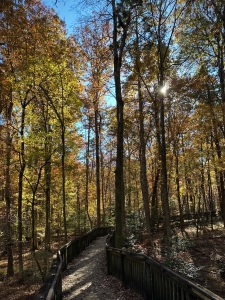
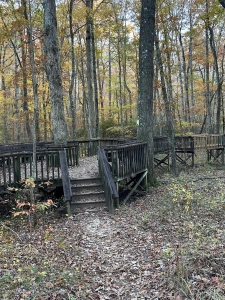
Peak color, blue sky, bright sun, and a towering hardwood forest reached out, grabbed me, and dragged me along the Azalea Cascade Talmadge Butler Boardwalk. The deep alluvial soil and protected cove position spelled ample year-round moisture and a nutrient-rich, high-productivity site. The mixed hardwood forest stood greater than 100 feet tall.
I don’t see need for a lot of science-based narrative. Instead, I give you a guided tour along a series of trails during what may be the best day of the year, with perfect weather, a languid afternoon, a stress-free mind, and full autumn colors in a southern upland hardwood forest!
I recorded this 59-second video along the boardwalk.
Sourwood (Oxydendron arboreum) is a common intermediate canopy species in our North Alabama upland forests. It refuses to be either positively phototropic (growing toward the sun) or negatively geotropic (growing vertically opposite gravity). Instead, it chooses its own course, like this one leaning in no particular direction.
Most main canopy species reach heavenward, seeking the bounty of full sun high above.
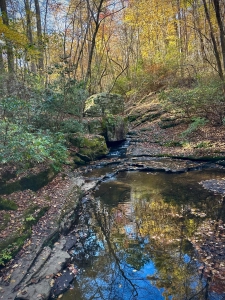
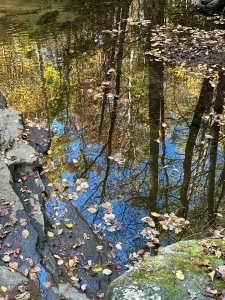
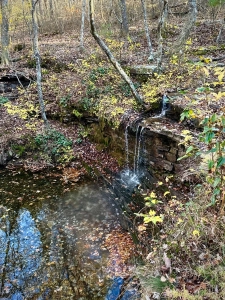
The boardwalk leads to azalea cascade, where a small stream enters a reflecting pool through the boulders.
Here is my 29-second video of the spectacular autumn leaves reflections.
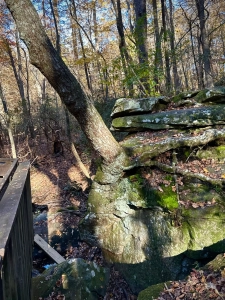
A birch tree clings to the rock ledge where its seed germinated decades ago, sending its roots to exploit mineral soil both uphill and beneath the ledge. Every tree has a compelling story to tell.
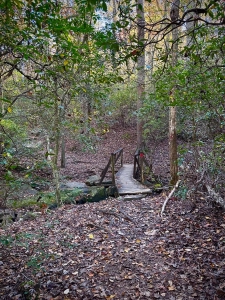
Several hundred feet above the cascade the trail crosses the stream on a rustic footbridge.
I recorded a 58-second video at the quaint woodland footbridge.
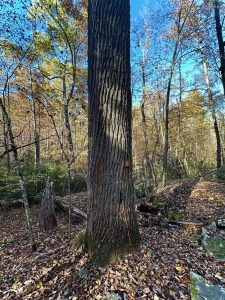
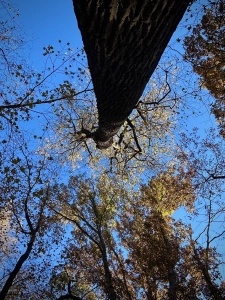
I’ll offer a little forestry lesson at this 30-inch-diameter yellow poplar tree. The species reigns supreme across Alabama’s most productive forest sites…well-drained bottomlands and upland cove sites. The species, unlike sourwood, insists on growing straight and tall. It has a low relative stocking density, contrasting it to white oak and American Beech, among some others. Note how little crown space this yellowpoplar occupies. A beech or white oak of this diameter would have a crown of at least 50 percent greater area, i.e. a greater relative stand density.
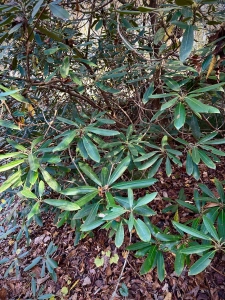
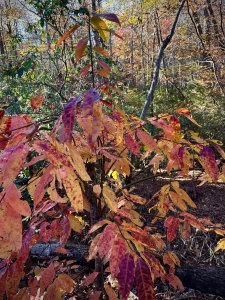
Rhododendron is a classic broad-leaved evergreen, thriving in moist, sheltered forest micro sites. Sourwood (right) bursts in deep color, rivalling the flaming sugar maple magic of New England autumn.
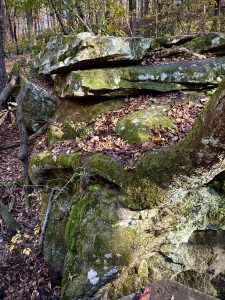
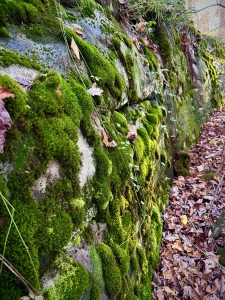
Brilliant emerald moss brightens this sandstone ledge along the trail.
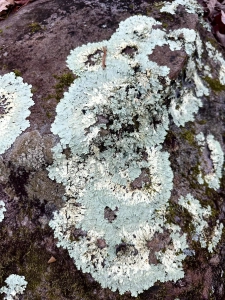
Rock greenshield lichen crusts this boulder near the ledge. Lichens are complex manifestations of a communal interdependent association of algae, fungi, and often bacteria, appearing as an artist’s palette. Fall beauty is unbounded by life form.
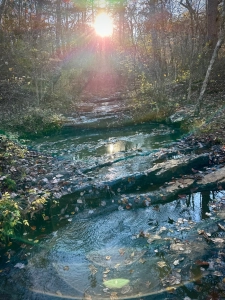
Lost Falls served as my destination, its upstream brook reflecting the late afternoon sun touching the ridge. The dry autumn streamflow furnishes little of the excitement I’ve witnessed during the maelstrom of early April’s wet season.
Here is my 40-second video of Lost Falls.
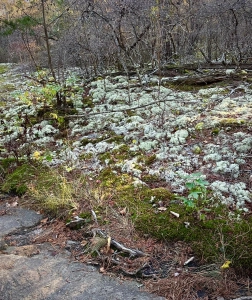
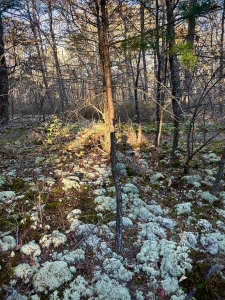
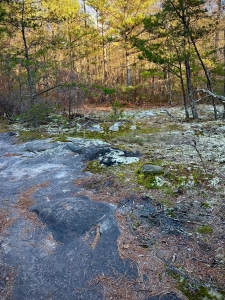
Beyond the falls, a sandstone glade ecotype dominates for a while. Exposed sandstone bedrock, very thin and acidic soils, and extremely variable moisture conditions prevail, ranging from standing surface water in the dormant season to xeric in summer. Thick reindeer lichen, and obligate glade plants make for challenging and entertaining botanizing.
I recorded this 58-second video of the glade.
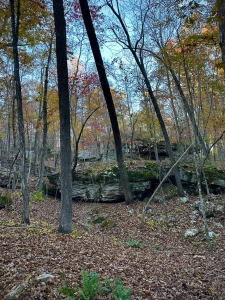
From the Azalea Cascade to the sandstone ledge forest to the glades, my trek traversed at least three major ecotypes. This stretch of the glade is other worldly.
Leaving the glades behind, I descended toward the Azalea Cascade, through a stand control-burned three years ago to reduce understory vegetation. The forest floor is no longer densely populated with understory trees, shrubs, and herbaceous plants. Bark-charred standing trees and burned woody debris evidence the burn.
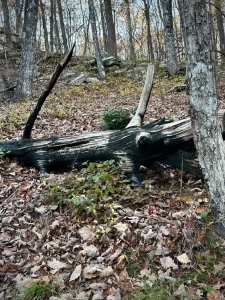
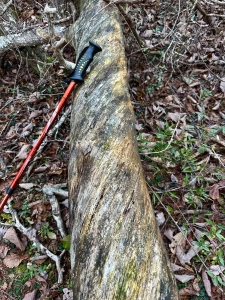
Without offering explanation, I will simply observe that some hardwood trees have spiral grain, evident only when the stem is dead (de-barked by progressive decomposition), whether vertical or on the ground. I have not found definitive literature revelations on why trees spiral. When I find the answer, I will devote an entire photo essay to the explanation.
Returning to the boardwalk cove, the forest-yellow, pale blue late afternoon sky, and camo-green sandstone ledges bid me farewell.
The evening gloaming is descending, offering a late autumn kiss on the cheek.
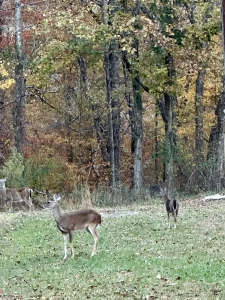
Even the deer emerged along the road, another signal that the autumn day has run full circle.
My Nature wanderings come in many shapes and sizes. Judy and I wander our suburban neighborhood nearly every day. I find wonder and delight even in the everyday Nature within walking distance of my home. I venture into regional State Parks, the nearby Wheeler National Wildlife Refuge, Land Trust Nature Preserves, and other natural areas withinin 90-minutes of home once a week. Two or three times annually I seek out of state locations to eplore, requiring travel, overnight stays, and greater expense. Now that I am 74 years old, I believe my international Nature-Based consulting assignments may have ended, the last one in 2019 to Kazakhstan. Regardless, I will continue to find beauty, magic, wonder, awe, passion, inspiration, and spiritual renewal in special places and everyday Nature!
Alabama State Parks Foundation
I’ll remind you that although I serve on the Alabama State Parks Foundation Board (Secretary), in part because of my love of Nature and in recognition for my writing many prior Posts about visiting and experiencing the Parks, any positions or opinions expressed in these Posts are mine alone and do not in any manner represent the Foundation or its Board.
I urge you to take a look at the Foundation website and consider ways you might help steward these magical places: https://asparksfoundation.org/ Perhaps you might think about supporting the Parks System education and interpretation imperative: https://asparksfoundation.org/give-today#a444d6c6-371b-47a2-97da-dd15a5b9da76
The Foundation exists for the sole purpose of providing incremental operating and capital support for enhancing our State parks… and your enjoyment of them.
We are blessed in Alabama to have our Park System. Watch for future Great Blue Heron Posts as I continue to explore and enjoy these treasures that belong to us. I urge you to discover the Alabama State Parks near you. Follow the advice of John Muir:
And into the forest I go, to lose my mind and find my soul.
In every walk with Nature one receives far more than he seeks.
I only went out for a walk and finally concluded to stay out till sundown, for going out, I found, was really going in.
Between every two pines is a doorway to a new world.
Thoughts and Reflections
I offer these observations:
Look deep into nature, and then you will understand everything better. (Albert Einstein)
Fall beauty is unbounded by life form. (Steve Jones)
I embrace Nature’s relentless magic, wonder, awe, and inspiration — her infinite storm of BEAUTY! (Steve Jones)
I will continue to find beauty, magic, wonder, awe, passion, inspiration, and spiritual renewal in special places and everyday Nature! (Steve Jones)
Inhale and absorb Nature’s elixir. May Nature Inspire, Inform, and Reward you!
I am available for Nature-Inspired Speaking, Writing, and Consulting — contact me at steve.jones.0524@gmail.com
Subscribe to my free weekly photo essays (like this one) at: http://eepurl.com/cKLJdL
Reminder of my Personal and Professional Purpose, Passion, and Cause
If only more of us viewed our precious environment through the filters I employ. If only my mission and vision could be multiplied untold orders of magnitude:
Mission: Employ writing and speaking to educate, inspire, and enable readers and listeners to understand, appreciate, and enjoy Nature… and accept and practice Earth Stewardship.
Vision:
People of all ages will pay greater attention to and engage more regularly with Nature… and will accept and practice informed and responsible Earth Stewardship.
They will see their relationship to our natural world with new eyes… and will understand more clearly their Earth home.
Tagline/Motto: Steve (Great Blue Heron) encourages and seeks a better tomorrow through Nature-Inspired Living!
Steve’s Four Books
I wrote my books Nature Based Leadership (2016), Nature-Inspired Learning and Leading (2017), Weaned Seals and Snowy Summits: Stories of Passion for Place and Everyday Nature (2019; co-authored with Dr. Jennifer Wilhoit), and Dutton Land & Cattle: A Land Legacy Story (2023) to encourage all citizens to recognize and appreciate that every lesson for living, learning, serving, and leading is either written indelibly in or is powerfully inspired by Nature. All four of my books present compilations of personal experiences expressing my deep passion for Nature. All four books offer observations and reflections on my relationship with the natural world… and the broader implications for society. Order any from your local indie bookstore, or find them on IndieBound or other online sources such as Amazon and LifeRich.
I began writing books and Posts for several reasons:
I love hiking and exploring Nature
I see images I want to (and do) capture with my trusty iPhone camera
I enjoy explaining those images — an educator at heart
I don’t play golf!
I do love writing — it’s the hobby I never needed when my career consumed me
Judy suggested my writing is in large measure my legacy to our two kids, our five grandkids, and all the unborn generations beyond
And finally, perhaps my books and Blogs could reach beyond family and touch a few other lives… sow some seeds for the future
https://stevejonesgbh.com/wp-content/uploads/2025/11/IMG_9558-3.jpg-11.05.25-DeSoto-SP-Azalea-Cascades.webp20161512Steve Joneshttp://stevejonesgbh.com/wp-content/uploads/2017/01/gbhweblogo.pngSteve Jones2026-01-14 15:47:282026-01-14 15:47:28Wandering Peak-Color Autumn Forests Afternoon at AL's DeSoto State Park!
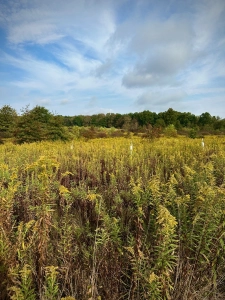
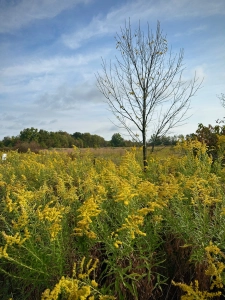
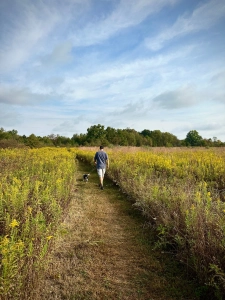
Wolf Creek Narrows Natural Area, owned and managed by the Western Pennsylvania Conservancy (WPC), is located in northwestern Butler County, Pennsylvania, just 30 minutes from where my son and his family reside north of Pittsburgh. Matt, his dog Oakley, and I circuited the 2.35-mile trail on the morning of September 22, the first day of autumn. My heart soared at the prospect of returning to an ecosystem shaped by a continental ice sheet just 13 millennia ago. This Post focuses on our passages (out from the trailhead and back) through a goldenrod-dominated autumn meadow.
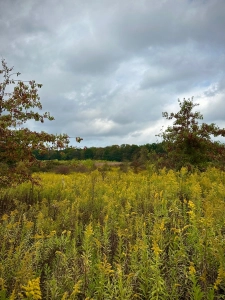
The 243 acre Natural Area includes several distinct ecosystems: meadow; forest/field ecotone; upland forest, forested riparian zone; and the immediate Slippery Rock Creek. I like the openess of the meadow, accenting the vibrant autumn sky above. Meadows are temporary landscape features unless managed to short-circuit the natural successional impetus to transition to forest cover. I am not sure whether the ash sapling in the photo at right was planted or is a volunteer.
The perennial herbacious cover is dense, ideal for songbirds, small mammals, snakes, and other critters. As I drafted this text on December 2, 2025, western Pennsylvania was reporting several inches of fresh snow. I imagine diverse wildlife hunkered in the tangled vegetation beneath the snow.
I recorded this 58-second video in the luscious goldenrod meadow.
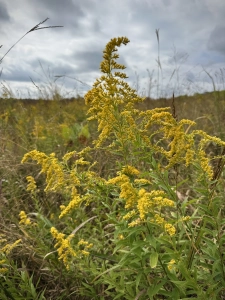
I can’t resist the image of goldenrod backdropped by the fall sky. The air, comfortable and clear, cut through my North Alabama mental fatigue with a long summer and a September dry spell. This a meadow still fresh, blooming, and vibrant, awaiting a first freeze, autumn rains, and an impending deep winter rest.
Hiking the meadow with Matt, sharing the autumn sunshine and exploration, reminded me of Einstein’s view of extending our life-reach beyond our own fleeting existence:
Our death is not an end if we can live on in our children and the younger generation. For they are us; our bodies are only wilted leaves on the tree of life. (Albert Einstein)
Some videos express the essence of a special place better without narration. I recorded this 59-second video focusing on the sounds of autumn breezes and late season insects.
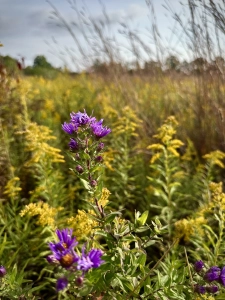
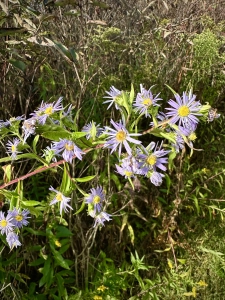
An ideal stage for late season bloomers, the meadow celebrates the end of a full summer of generous meadow sunshine with goldenrod, New England aster, and smooth blue aster. Bright flowers will greet the icy fingers certain to come.
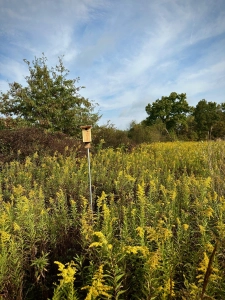
Supplemental wildlife accoutrements (a bluebird nesting box) enrich the meadow bird habitat.
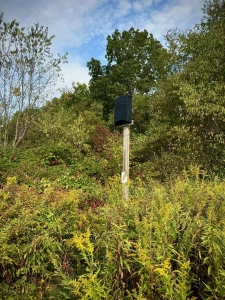
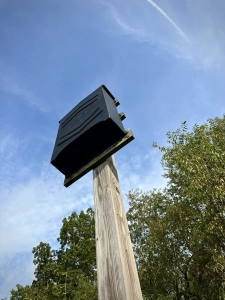
As does the bat house at the meadow/forest edge.
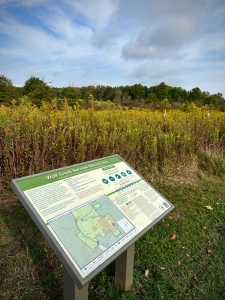
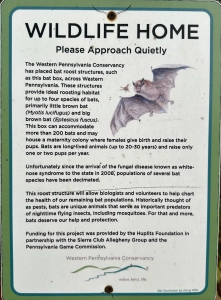
I compliment the LConservancy for both the artificial nesting structures and the excellent interpretive signage.
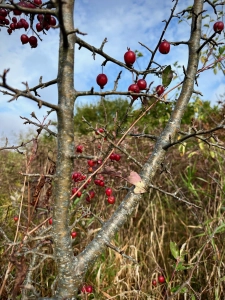
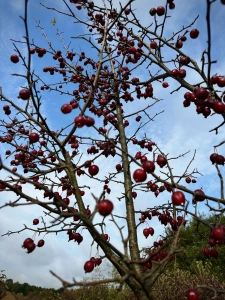
Pear leaf crabapple is both an excellent wildlife food source and an early meadow colonizer in the successional steps toward natural forest regeneration.
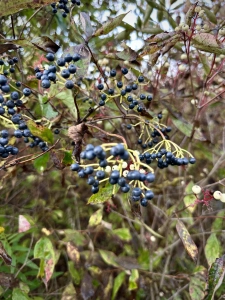
The same is true of northern arrowwood. Both species are prolific producers of fruit that wildlife consumes, digestively scarifies its seeds, and disseminates to enable further colonization.
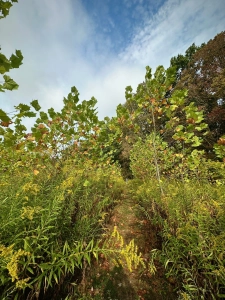
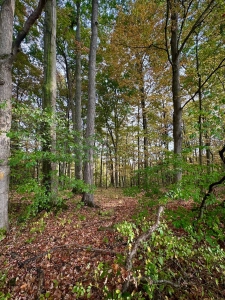
Two red oaks (left) and numerous sycamore saplings represent the advancing forest along the meadow’s north flank, which is a separate ecotone, neither meadow or forest. View the oak and sycamore saplings as scouts from the advancing forest army. Imagine a squierrel caching an acorn in rich soil under the goldenrod, and then losing track of it. The acorn sprouts with spring’s warmth. The seedling oak flourishes in full sunlight, partially protected by the 4-6-foot-high meadow vegetation from deer and rabbit browsing. The oaks are now out of easy reach of the hungry mammals. This day’s northwesterly breezes may be carrying windborne sycamore seed, potentially extending the forest deeper into the meadow.
The scouts will give way to an outright forest invasion. This isn’t the forest successionary army’s first rodeo. Just 13,000 years ago, the vast continental ice sheet yielded to a warming climate. Hundreds of millions of acres of once fertile and forested land emerged from the deep icepack barren and stark, stretching from the former ice edge near here far into the sub-Arctic Canadian Shield. That wild expanse, now ruchly forested, attests to Nature’s capacity to reclaim devastated territory, whether blasted by Mt. Saint Helens (1980), incinerated by the Big Burn (1910 in Washington, Idaho, and Montana), or savagely innundated by tropical storm remnants flushing western North Carolina river bottomland forests (The Great Flood of 1916). A beautiful postage stamp upland meadow in modern day Butler County Pennsylvania is just a bump in the road for an advancing vegetative front intent on expanding a forest.
I recorded this 59-second video at the meadow/woodland edge ecotone.
The real challenge falls to the Western Pennsylvania Conservancy managers. How do they hold the forest at bay, if indeed that is their objective, which I hope it is. I appreciate and value ecosystem diversity. I won’t attempt to recommend a treatment scenario. I have little relevant expertise, beyond thinking that fire may be among the alternatives.
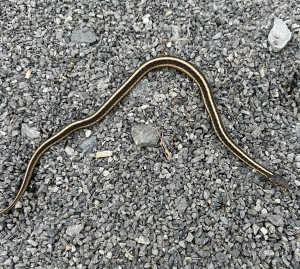
I do know that the common garter snake we spotted in the meadow depends on the meadow ecotype, as do many other wildlife species.
How long will the meadow survive as a unique ecosystem without management practices, like bush-hogging, prescribed fire, selective herbicide treatments, and other alternatives? No matter where my Nature wanderings take me, I discover a constant: Nothing in Nature is Static. Nothing remains the same. In this case, human intervention will be necessary to keep the meadow…a meadow.
I often turn to John Muir for words that succinctly capture my sentiments…far better than my own feelings. Of my passion for the meadow, I turn to Muir:
Everybody needs beauty as well as bread, places to play in and pray in, where nature may heal and give strength to body and soul.
Thoughts and Reflections
I offer these observations:
Nothing in Nature is Static. Nothing remains the same. (Steve Jones)
Everybody needs beauty as well as bread, places to play in and pray in, where nature may heal and give strength to body and soul. (John Muir)
Our death is not an end if we can live on in our children and the younger generation. For they are us; our bodies are only wilted leaves on the tree of life. (Albert Einstein)
Inhale and absorb Nature’s elixir. May Nature Inspire, Inform, and Reward you!
I am available for Nature-Inspired Speaking, Writing, and Consulting — contact me at steve.jones.0524@gmail.com
Subscribe to these free weekly Nature Blogs (photo essays) at: http://eepurl.com/cKLJdL
Reminder of my Personal and Professional Purpose, Passion, and Cause
If only more of us viewed our precious environment through the filters I employ. If only my mission and vision could be multiplied untold orders of magnitude:
Mission: Employ writing and speaking to educate, inspire, and enable readers and listeners to understand, appreciate, and enjoy Nature… and accept and practice Earth Stewardship.
Vision:
People of all ages will pay greater attention to and engage more regularly with Nature… and will accept and practice informed and responsible Earth Stewardship.
They will see their relationship to our natural world with new eyes… and will understand more clearly their Earth home.
Tagline/Motto: Steve (Great Blue Heron) encourages and seeks a better tomorrow through Nature-Inspired Living!
Steve’s Four Books
I wrote my books Nature Based Leadership (2016), Nature-Inspired Learning and Leading (2017), Weaned Seals and Snowy Summits: Stories of Passion for Place and Everyday Nature (2019; co-authored with Dr. Jennifer Wilhoit), and Dutton Land & Cattle: A Land Legacy Story (2023) to encourage all citizens to recognize and appreciate that every lesson for living, learning, serving, and leading is either written indelibly in or is powerfully inspired by Nature. All four of my books present compilations of personal experiences expressing my deep passion for Nature. All four books offer observations and reflections on my relationship with the natural world… and the broader implications for society. Order any from your local indie bookstore, or find them on IndieBound or other online sources such as Amazon and LifeRich.
I began writing books and Posts for several reasons:
I love hiking and exploring Nature
I see images I want to (and do) capture with my trusty iPhone camera
I enjoy explaining those images — an educator at heart
I don’t play golf!
I do love writing — it’s the hobby I never needed when my career consumed me
Judy suggested my writing is in large measure my legacy to our two kids, our five grandkids, and all the unborn generations beyond
And finally, perhaps my books and Blogs could reach beyond family and touch a few other lives… sow some seeds for the future
https://stevejonesgbh.com/wp-content/uploads/2025/09/IMG_9089-1.jpg-09.22.25-Wolf-Creek-Narrows-Natural-Area-WCN-NA.webp20161512Steve Joneshttp://stevejonesgbh.com/wp-content/uploads/2017/01/gbhweblogo.pngSteve Jones2025-12-18 11:24:222025-12-18 11:24:22The Meadow at Pennsylvania's Wolf Creek Narrows Natural Area
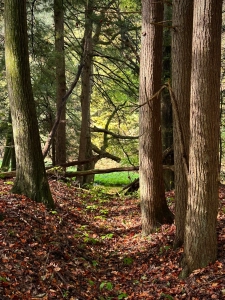
Wolf Creek Narrows Natural Area, owned and managed by the Western Pennsylvania Conservancy (WPC), is located in northwestern Butler County, Pennsylvania, just 30 minutes from where my son and his family reside north of Pittsburgh. Matt, his dog Oakley, and I circuited the 2.35-mile trail on the morning of September 22, the first day of autumn. I focus this photo essay on the exquisite old-growth northern hardwood forest.
My heart soared at the prospect of returning to an ecosystem shaped by a continental ice sheet just 13 millennia ago. The absolute freshness and newness stimulate wild conjecture and total admiration for Nature’s rapid recovery from thousands of feet of ice.
The Western PA Conservancy provided an online description:
Wolf Creek Narrows Natural Area is particularly known for its spectacular display of spring wildflowers. An active floodplain, mature northern hardwood forest, and scenic cliffs make this property one of WPC’s most popular. It is believed that the steep, narrow gorge of Wolf Creek Narrows originally formed when the ceiling of an ice-age cave eroded and collapsed due to runoff from the melting glacier. The site now consists of a high-quality stream meandering through towering 50-foot cliffs. These natural processes, including annual flooding and ice scouring, as well as limited human activities, have resulted in diverse natural communities.
We have lots of karst topography and abundant caves in my present home range of northern Alabama, but nothing so exciting as ice-age caves and ice scouring!
The meadow trail below led into the deep forest.
Okay, I’ve opened the portal to Wolf Creek Narrows. Now comes the tough part. How do I package 31 photos and two brief videos into a Post digestible within 15-minutes? Species resident to the Allegheny Hardwood forests of my 1984-85 NW PA and SW NY PhD field research welcomed me with warm and comforting embrace.
I’ve found that brief videos tell a richer tale than still photographs and written narrative. I recorded this 58-second video within the mixed forest. I hope that I’ve stimulated your interest in this special place.
The Narrows and Wolf Creek lie beyond the forest edge.
Matt stands six-feet tall, behind a 30-inch diameter American beech. The red oak beyond the beech (at left) is nearly 40-inches in diameter.
You don’t need my narrative to appreciate the beauty, magic, inspiration, and awe of this park-like northern hardwood wonderland.
Take a look heavenward into this cathedral forest canopy.
I love the deep shade and open understory far below.
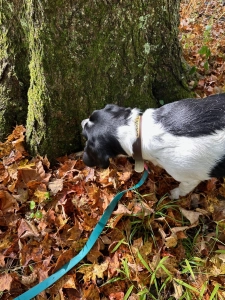
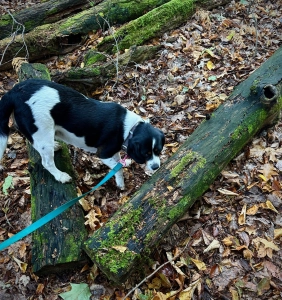
I frequently lead or co-lead organized woodland Nature excursions (saunters) in parks, preserves, refuges, and sanctuaries near my Madison, Alabama home. Like John Muir, I prefer sauntering in the woods…abhoring hurrying through the forest. I noticed that Oakley takes the same approach, sniffing and scenting her way within the woods, reading the signs, never missing an olfactory clue. My iPhone camera substitutes for scenting. So much of what I seek in Nature lies hidden in plain sight. I believe my own joy in discovery matches Oakley’s!
I can’t imagine Oakley concerned with steps, miles, time elapsed, or other metrics. For her, each sniff tells a tale. My objective is to learn from every Nature venture, intent upon constructing a meaningful tale in form of a photo essay like this one.
In fact, my retirement mission, practiced in these Posts, is to: Employ writing (and photography) to educate, inspire, and enable readers and viewers to understand, appreciate, and enjoy Nature… and accept and practice Earth Stewardship.
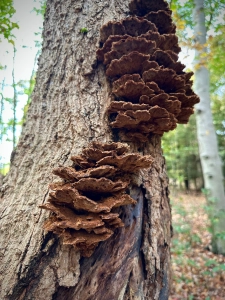
I keep my nose fine-tuned for sniffing tree form oddities and curiosities. A living, deeply decayed, cankered intermediate canopy sugar maple forced me to snap photographs of both the canker and the brown mushrooms above. How long ago did the fungus (or fungi) infect the sugar maple? How long will the tree survive? Death is a big part of life in the forest, whether west-central Pennsylvania or Alabama’s Tennessee River Valley.
Again, so much in Nature lies hidden in plain sight. Oakley discovered untold olfactory treasures. Most un-attuned hikers would not have seen, understood, and appreciated the visual treasures I encountered in our brief morning excursion. Allow me now to superficially catalog the more notable main canopy tree species.
Diverse Species Introductions
With little need for extensive narrative, I offer photos expressing the forest’s dominant upper canopy tree species. Yellow poplar reigns supreme at Wolf Creek Narrows, just as the species rules the high canopy at my favorite deep forest stand along the Wells Memorial Trail in Alabama’s Monte Sano State Park.
I recorded this 59-second video of the forest’s mixed species.
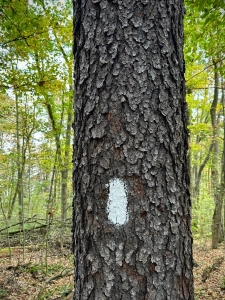
I conducted my doctoral field research in the Allegheny Hardwood forests within 80 miles of Wolf Creek…forests dominated by black cherry. I revere the species for its beautiful high grade furniture wood, superior height growth, straight form, and handsome bark and foliage. The white-trail-marked black cherry (image below right) delivered a message meant for me. The species marked my professional development re-route. I worked 12 years after earning my Forestry BS for a southern paper and allied products manufacturing company that relied heavily on loblolly pine, a utility species here in the Southeast. Black cherry is anything but a utility species. It’s the filet mignon of furniture grade timber. Black cherry served as the North Star for my second career launch. The big white-blazed cherry signaled that the species remains a major emblem and totem for my path well into retirement. Among my fellow Union Camp foresters, I chose the path less traveled…one lined by black cherry trees (the other edged by loblolly pine) leading to a PhD and 35 years at nine universities.
Two roads diverged in a wood, and I— I took the one less traveled by, And that has made all the difference.
(Robert Frost)
American beech and yellow birch reminded me of my love for northern hardwood forests.
Basswood (tree and leaves) also ranges into northern Alabama, but the entire mixed species forest package at Wolf Creek represents a special orchestration that strokes my psyche and lifts my entire body, heart, mind, soul, and spirit. The assemblage reached me as Art Garfunkel belting his full-bodied Bridge Over Troubled Waters!
Black walnut tree and nut.
Bitternut hickory.
And nut.
Cucumber tree and leaf.
Red oak, deep memories, and an older gent feeling young-at-heart experiencing a symbolic step into his past…at home in a place he’d never been before.
Forests like this netted me decades ago, never completely allowing release. I think of Robert Service’s The Spell of the Yukon:
The freshness, the freedom, the farness–
O God! how I’m stuck on it all.
There’s a land–oh, it beckons and beckons,
And I want to go back–and I will.
It’s the great, big, broad land ‘way up yonder,
It’s the forest where silence has lease;
It’s the beauty that thrills me with wonder,
It’s the stillness that fills me with peace.
Some of me remains in the Far Northland of Alaska, where we lived 2004-08. Service nailed the place and my sentiment. In similar fashion, vestiges of these magnificent northern hardwood forests habituate my psyche. I want to go back–and I will, if only to the nearby Wells Memorial Trail, a suitable southern version of a rich upland forest.
Thoughts and Reflections
I offer these observations:
The rich northern hardwood forest is an orchestral composition, a natural Bridge Over Troubled Waters. (Steve Jones)
Black Cherry is a trail marker species, both a literal guide through the Wolf Creek Narrows forest…and a career/life path symbol and guidepost for me. (Steve Jones)
Mine is a story of passion for place and everyday Nature. (Steve Jones)
Inhale and absorb Nature’s elixir. May Nature Inspire, Inform, and Reward you!
I am available for Nature-Inspired Speaking, Writing, and Consulting — contact me at steve.jones.0524@gmail.com
Subscribe to these free weekly Nature Blogs (photo essays) at: http://eepurl.com/cKLJdL
Reminder of my Personal and Professional Purpose, Passion, and Cause
If only more of us viewed our precious environment through the filters I employ. If only my mission and vision could be multiplied untold orders of magnitude:
Mission: Employ writing and speaking to educate, inspire, and enable readers and listeners to understand, appreciate, and enjoy Nature… and accept and practice Earth Stewardship.
Vision:
People of all ages will pay greater attention to and engage more regularly with Nature… and will accept and practice informed and responsible Earth Stewardship.
They will see their relationship to our natural world with new eyes… and will understand more clearly their Earth home.
Tagline/Motto: Steve (Great Blue Heron) encourages and seeks a better tomorrow through Nature-Inspired Living!
Steve’s Four Books
I wrote my books Nature Based Leadership (2016), Nature-Inspired Learning and Leading (2017), Weaned Seals and Snowy Summits: Stories of Passion for Place and Everyday Nature (2019; co-authored with Dr. Jennifer Wilhoit), and Dutton Land & Cattle: A Land Legacy Story (2023) to encourage all citizens to recognize and appreciate that every lesson for living, learning, serving, and leading is either written indelibly in or is powerfully inspired by Nature. All four of my books present compilations of personal experiences expressing my deep passion for Nature. All four books offer observations and reflections on my relationship with the natural world… and the broader implications for society. Order any from your local indie bookstore, or find them on IndieBound or other online sources such as Amazon and LifeRich.
I began writing books and Posts for several reasons:
I love hiking and exploring Nature
I see images I want to (and do) capture with my trusty iPhone camera
I enjoy explaining those images — an educator at heart
I don’t play golf!
I do love writing — it’s the hobby I never needed when my career consumed me
Judy suggested my writing is in large measure my legacy to our two kids, our five grandkids, and all the unborn generations beyond
And finally, perhaps my books and Blogs could reach beyond family and touch a few other lives… sow some seeds for the future
https://stevejonesgbh.com/wp-content/uploads/2025/09/IMG_9161.jpg-09.22.25-WCN-NA.webp18021352Steve Joneshttp://stevejonesgbh.com/wp-content/uploads/2017/01/gbhweblogo.pngSteve Jones2025-12-11 04:59:022025-12-11 04:59:02The Northern Hardwood Forest at Pennsylvania's Wolf Creek Narrows Natural Area
I am pleased to add the 46th of my GBH Brief-Form Posts (Less than five minutes to read!) to my website. I get wordy with my routine Posts. I don’t want my enthusiasm for thoroughness and detail to discourage readers. So, I will occasionally publish these brief Posts.
I frequent forest wildness wherever my excursions take me, searching for the beauty, magic, mystery, wonder, and awe that lie hidden in plain sight. This Post derives from years of experience, study, and contemplation, inspired by some recent discoveries (August 15 and October 14, 2025). My focus is on two examples of specialized tree roots.
Adventitious Water Roots
I published a GBH Post on September 17, 2025, chronicling a mid-August visit to Huntsville, Alabama’s Goldsmith-Schiffman Wildlife Sanctuary (the Sanctuary), reporting:
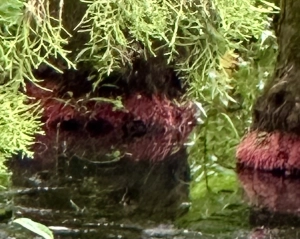
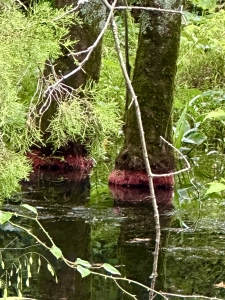
We found a puzzling phenomenon, 100-feet from the shore and out of our reach, on the upstream section of Jobala Pond. Two clearly living red maple trees (Acer rubrum), standing in water, called out to us with a pinkish circumferential ring 2-4″ immediately above the water line. I magnified the image up to the limits of resolution clarity, showing the fibrous nature of the feature. I shared via social media, generating speculation. Chris and I agree with several persons who suggested that the trees, attempting to survive the saturated soil environment, sprouted air roots above the water for supplemental aeration.
Niether of us, fellow retired forester Chris Stuhlinger and I, had previously seen such a curiosity. I scoured the literature and found no succinct explanation. Note: Scoured the literature may be a little overstated! I looked, but it wasn’t like I was preparing my doctoral Literature Review. Shall I say, nothing relevant jumped out at me.
Then, lo and behold, just two months later while solo-exploring the dry-season water tupelo swamp on the Sanctuary, a Eureka moment surged from among the mosquito-infested early autumn dampness!
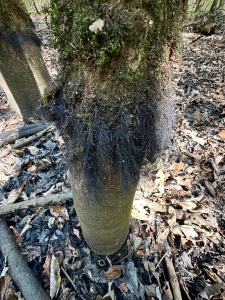
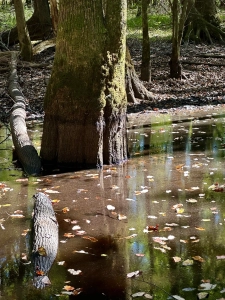
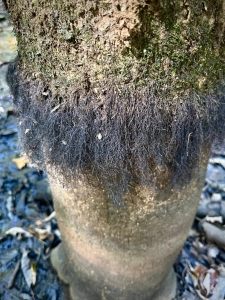
This three-foot diameter (dbh: diameter breast height) water tupelo, standing in persistent water in the dry-season swamp, evidenced that the winter water level reaches more than two feet higher. Although this stem stands out of my reach in my upland hiking boots, other nearby tupelos stood on dry season upland. And what a surprise to see a band of fibrous air roots ringing the high water marks.
Perseverance does indeed reward the patient and persistent Nature enthusiast. I did not visit the swamp intent on discovering the phenomenon; I went only to seek what delights might be hidden in plain sight! Even the literature opened slightly to my focused stealth…inquiring specifically of water tupelo air roots. I found:
LENTICEL AND WATER ROOT DEVELOPMENT OF SWAMP
TUPELO UNDER VARIOUS FLOODING CONDITIONS
DONALD. HOOK, CLAUD L. BROWN, AND PAUL P. KORMANIK
Forest Service, USDA, Southeastern Forest Experiment Station, Athens, Georgia 30601; School of Forest Resources, University of Georgia, Athens, Georgia 30601; Southeastern Forest Experiment Station, Athens, Georgia 30601
Plant physiology is a is not a subject for the faint of heart, or well-suited to an old retired forest generalist. Suffice it for me to conclude:
Experts confirmed the existence of such a phenomenon.
The authors observed, Water roots developed primarily under continuous flooding in moving water, some apparently originating beneath the phellogen of a lenticel and others within the phellogen or its derivatives.
Chris and I correctly explained the curiosity we observed two months prior on the red maple trees standing in water at the edge of Jobala Pond.
I discovered another facet of delight. Dr. Paul Kormanik, the third listed author, was an acquaintance during my forest industry research period (1975-79), a half-century ago.
Leonardo da Vinci relied on observation and experience to inform reason. He would have applauded Chris and me:
Wisdom is the daughter of experience.
Although nature commences with reason and ends in experience it is necessary for us to do the opposite, that is to commence with experience and from this to proceed to investigate the reason.
I recorded this 59-second video of what I termed incredible adventitious air root beards.
I loved the incredible adventitious root beards! Shall we call these trees the old men of the Tupelo Swamp? I plan to revisit when winter rains fill the sloughs.
Another Variety of Air Roots
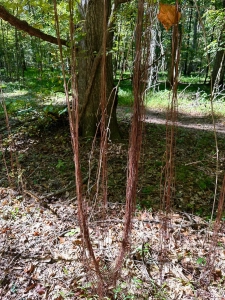
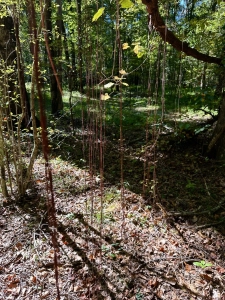
Muscadine grape vines drape the bottomland forest at GSWS. I photographed these curtains of air roots south of the tupelo swamp. I’ve encountered the phenomenon in other wetland hardwood forests across northern Alabama. I presumed their purpose was to reach the ground (as these do), take root vegetatively, and provide propagation of their genotype. Now I am less than certain.
Once again, my uncertainty spurred additional literature scouring, if you will. A Mississippi State University Cooperative Extension on-line bulletin amplified my uncertainty:
Aerial root formation in Vitis has been documented on different grape species; however, the driving forces behind the formation of adventitious roots are not well understood.
So, where does that lead me? I have yet to document a case of the air roots sprouting regenerates when contacting the forest soil. I can suggest alternatively that thess drapes capture moist air condensation (swamp fog) to supplement aeration when soils are saturated. I pledge to continue observations and exploration, in the spirit of Albert Einstein:
I have no special talent. I am only passionately curious.
One cannot help but be in awe when [one] contemplates the mysteries of eternity, of life, of the marvelous structure of reality.
In my realm of forest Nature exploration, I conclude: The more I learn, the less I know!
Closing
I accept the challenge of distilling these Brief-Form Posts into a single distinct reflection, a task far more elusive than assembling a dozen pithy statements.
I cannot offer a quote more poignantly apropos than Albert Einstein’s:
One cannot help but be in awe when [one] contemplates the mysteries of eternity, of life, of the marvelous structure of reality.
I add my own bullet of Nature wisdom:
The more I learn, the less I know! (Steve Jones)
Nature’s special treats await our discovery, our understanding, and our interpretation!
Subscribe to my free weekly photo essays (like this one) at: http://eepurl.com/cKLJdL
https://stevejonesgbh.com/wp-content/uploads/2025/10/IMG_9412.jpg-GSWS-East-Side-10.14.25-Water-Tupelo-Aertion-Roots.webp20161512Steve Joneshttp://stevejonesgbh.com/wp-content/uploads/2017/01/gbhweblogo.pngSteve Jones2025-10-27 08:52:162025-10-27 08:52:16Brief-Form Post #47: Strange Bearded Tupelo Trees -- Air Root Mysteries and Curiosities!
[Note: I dedicate this Post to the memory of Charlie Kirk, a bold, courageous pioneer who tirelessly promoted a life of Faith in God’s merciful love, Patriotism, and Family. Two days after his assassination, his widow Erika said of Charlie: He loved nature, which always brought him closer to God. I echo those sentiments. Nature never fails to bring me closer to God.]
On August 15, 2025, fellow retired forester Chris Stuhlinger and I explored the western reaches of Huntsville’s Goldsmith-Schiffman Wildlife Sanctuary, a special place I’ve visited dozens of times since retiring to northern Alabama. I come back again and again, not to see the same thing, but to observe a universe of things that change minute by minute, hour by hour, day by day, and across the seasons and years. Take a walk with Chris and me to see some things that will never look exactly the same again. Nothing in Nature is static; special places offer infinite treats to those of us who seek them.
David George Haskell, professor of biology at the University of the South, published The Forest Unseen: A Year’s Watch in Nature (2012). From the back cover:
Visiting a one-square-meter patch of old-growth Tennessee forest almost daily for one year, biologist David Haskell traces nature’s path through the seasons and brings the forest and its inhabitants to vivid life. Beginning with simple observations — a salamander scuttling across the leaf litter; the first blossoms of spring wildflowers — Haskell spins a brilliant web of biology, ecology, and poetry. He explains the science that binds together the tiniest microbes and the largest mammals, and describes the ecosystems that have cycled for thousands — sometimes millians — of years. Written with remarkable grace and empathy, The Forest Unseen is a grand tour of nature in all its beauty and complexity.
Such is my mindset when I repeatedly visit the sanctuary, touring its 400 acres in all of its beauty and complexity.
Mid-Summer Morning Trek from Hidden Spring to Jobala Pond
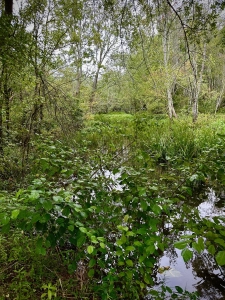
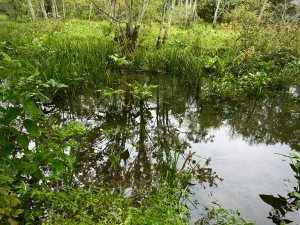
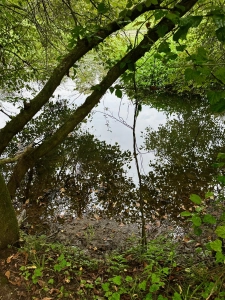
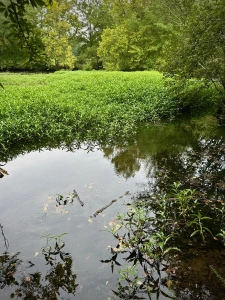
Most of its infinite treats are hidden in plain sight, requiring only that we get into the out there from time to time, and that we understand enough of Nature to know how and where to look. Hidden Spring rises within a hunrdred feet of the Taylor Road entrance. Luxuriously vegetated with wetland trees, shrubs, and herbs, the marsh below the spring widens to several hundred feet. Heavy overcast, moistened air, and foliage still dripping from a morning shower set the other-world mood. I imagined an Old World fen.
We observed the transition from wide marsh to Hidden Spring Brook, the channel that extends through a series of beaver dams into Jobala Pond, and eventually the Flint River.
I recorded this 60-second video of what I termed on that special morning, an other-world marsh.
Clear water reflected the cloudy sky and overhead branches, amplfying the other-world mood.
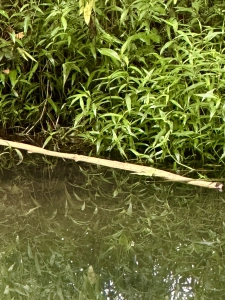
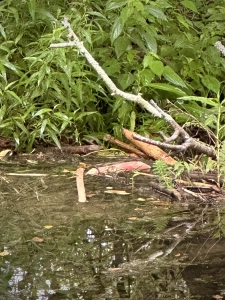
Beaver enjoy the tasty and nutritious leaves, bark and cambium of native hardwood trees, stripping branches and stems, and then employing the stripped stems to repair and reinforce their structures.
This dam held back 15-18 inches of ponded water. Excuse the pun: beavers are dam-good engineers!
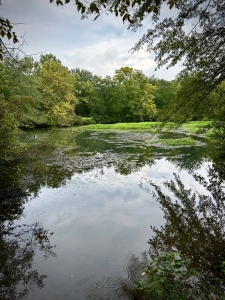
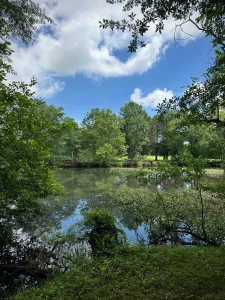
I’ve told the story of Jobala Pond many times. Human road engineers mined sand, clay, and gravel from the area to construct Route 431 in the 1950s, creating a borrow pit, a barren excavated depression accepting, holding, and then releasing the flow from Hidden Spring. Nature is remarkably resilient, superbly adept at healing her own wounds as well as convalescencing human insults to the land. The old borrow pit has naturalized over eight decades.
We found a puzzling phenomenon, 100-feet from the shore and out of our reach, on the upstream section of Jobala Pond. Two clearly living red maple trees (Acer rubrum), standing in water, called out to us with a pinkish circumferential ring 2-4″ immediately above the water line. I magnified the image up to the limits of resolution clarity, showing the fibrous nature of the feature. I shared via social media, generating speculation. Chris and I agree with several persons who suggested that the trees, attempting to survive the saturated soil environment, sprouted air roots above the water for supplemental aeration.
Chris and I plan to return with either a canoe or waders to more closely examine the mysterious growth.
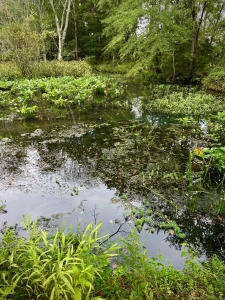
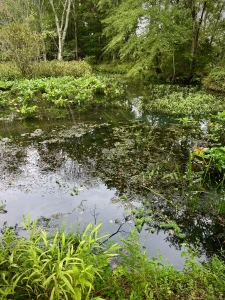
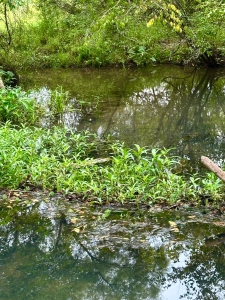
Here are two more images of the richly-vegetated upper end of Jobala.
I hope that you agree that this is a special place.
My Avatar: Great Blue Heron
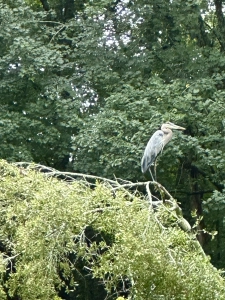
The great blue heron is the totem for my Dad, who passed away in 1996. The heron appeared as an avatar at sunrise on the frigid morning of Dad’s memorial service. Look for the story on my website. I consider every sighting of a great blue heron as Dad checking on me. He lives within me.
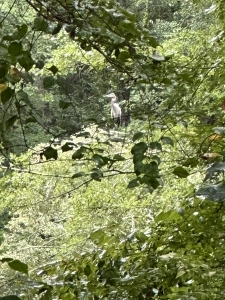
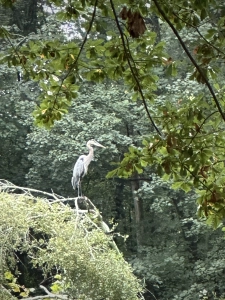
A heron passed noiselessly as Chris and I stood at Jobala. He (my sentimental assumption of gender) alighted beyond the pond’s outlet. We stalked the bird to within camera range.
I recorded this 50-second video when I dared not get closer.
The video and photos are not magazine-worthy, but they are soul-value priceless to me.
Again, all special places bless us with infinite treats.
Seasonal Flora
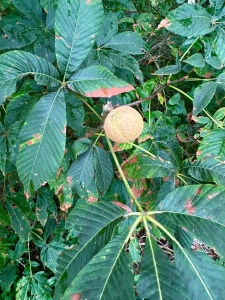
I give you some of the special floral delights we noted along our summer morning route, with no more narration than necessary. A red buckeye carries ripe fruit, its glossy fruit still within its husk.
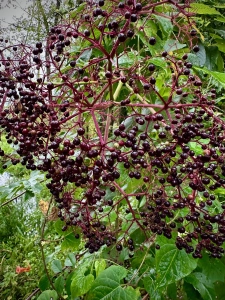
Elderberry in full ripe fruit.
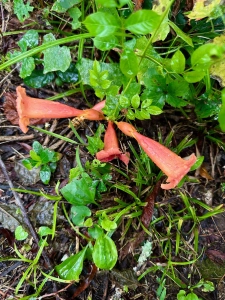
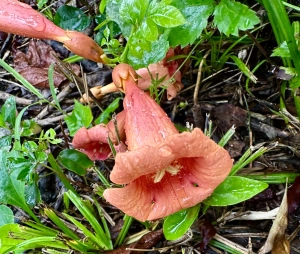
Trumpet vine sporting its late summer bugles.
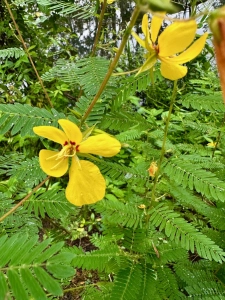
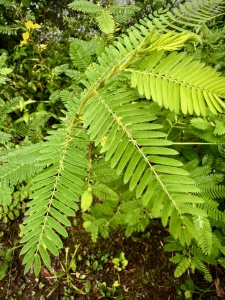
Delicate partridge pea and sensitive pea.
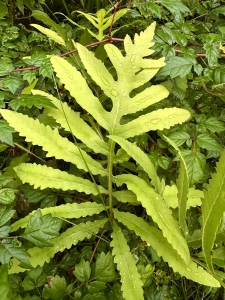
Sensitive fern.
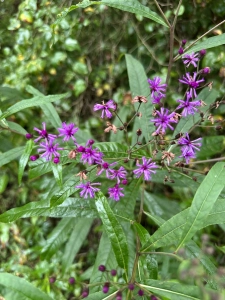
Tall ironweed.
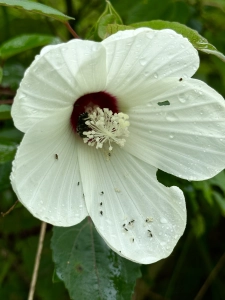
Wild hibiscus.
I’ve begun to lose my bias for spring wildflowers; these late sumer beauties are hard to beat!
Nature spins a brilliant web of biology, ecology, and poetry.
Area’s Native American Presence: Archaeology and Anthropology at GSWS
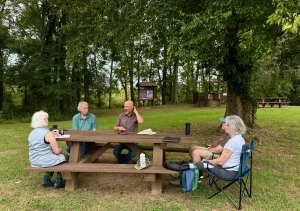
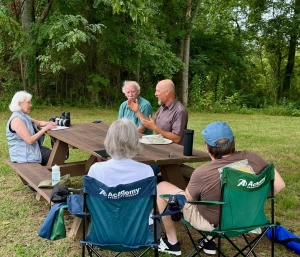
I won’t devote more than a few sentences to these two images. Chris and I took advantage of our need to be on-site for a session to discuss the Native American archaeology and anthropolgy on the property with noted local archaeologist Ben Hoksbergen. Marian Moore Lewis, author of Southern Sanctuary, Bill Heslip, director of a 13-minute video about the Sanctuary, and Bill’s wife Becky gathered for a couple hours with us at a picnic table near the entrance. We made plans to visit pertinent sites on the Sanctuary when cooler weather arrives.
Watch for updates in a subsequent Post.
Thoughts and Reflections
I offer these observations:
Every walk in Nature can be a grand tour of her beauty and complexity. (Steve Jones)
Look deep into Nature, and then you will understand everything better.(Albert Einstein)
Nothing in Nature is static; special places offer infinite treats to those of us who seek them. (Steve Jones)
He loved nature, which always brought him closer to God.(Erika Kirk)
Inhale and absorb Nature’s elixir. May Nature Inspire, Inform, and Reward you!
Note: Unless otherwise noted, all blog post images are created & photographed by Stephen B. Jones.
I am available for Nature-Inspired Speaking, Writing, and Consulting — contact me at steve.jones.0524@gmail.com
A reminder of my Personal and Professional Purpose, Passion, and Cause
If only more of us viewed our precious environment through the filters I employ. If only my mission and vision could be multiplied by untold orders of magnitude:
Mission: Employ writing and speaking to educate, inspire, and enable readers and listeners to understand, appreciate, and enjoy Nature… and accept and practice Earth Stewardship.
Vision:
People of all ages will pay greater attention to and engage more regularly with Nature… and will accept and practice informed and responsible Earth Stewardship.
They will see their relationship to our natural world with new eyes… and understand their Earth home more clearly.
Tagline/Motto: Steve (Great Blue Heron) encourages and seeks a better tomorrow through Nature-Inspired Living!
Steve’s Four Books
I wrote my books Nature Based Leadership (2016), Nature-Inspired Learning and Leading (2017), Weaned Seals and Snowy Summits: Stories of Passion for Place and Everyday Nature (2019; co-authored with Dr. Jennifer Wilhoit), and Dutton Land & Cattle: A Land Legacy Story (2025) to encourage all citizens to recognize and appreciate that every lesson for living, learning, serving, and leading is either written indelibly in or is powerfully inspired by Nature. All four of my books present compilations of personal experiences expressing my deep passion for Nature. All four books offer observations and reflections on my relationship with the natural world… and the broader implications for society. Order any from your local indie bookstore, or find them on IndieBound or other online sources such as Amazon and LifeRich.
I began writing books and Posts for several reasons:
I love hiking and exploring Nature
I see images I want to (and do) capture with my trusty iPhone camera
I enjoy explaining those images — an educator at heart
I don’t play golf!
I do love writing — it’s the hobby I never needed when my career consumed me
Judy suggested my writing is in large measure my legacy to our two kids, our five grandkids, and all the unborn generations beyond
And finally, perhaps my books and Blogs could reach beyond family and touch a few other lives… sow some seeds for the future
https://stevejonesgbh.com/wp-content/uploads/2025/08/IMG_8638.jpg-08.15.25-GBH-at-Old-Pond-to-South-scaled.webp25601920Steve Joneshttp://stevejonesgbh.com/wp-content/uploads/2017/01/gbhweblogo.pngSteve Jones2025-09-17 10:03:152025-09-17 10:23:11Mid-August Morning at the Goldsmith-Schiffman Wildlife Sanctuary: A Great Blue Heron Encounter
I initially developed this Tenth-Anniversary photo essay as a single post. However, its length exceeded even my generous tolerance for content and length. Here is the link to Part One: https://stevejonesgbh.com/2025/07/18/part-one-huntsvilles-goldsmith-schiffman-wildlife-sanctuary-tenth-anniversary-of-southern-sanctuary/
I repeat the opening paragraph of Part One:
I visited Huntsville, Alabama’s Goldsmith-Schiffman Wildlife Sanctuary on May 17, 2025, with Marian Moore Lewis, author of Southern Sanctuary: A Naturalist’s Walk through the Seasons ((2015), Bill Heslip, Director of A Tale of Two Extraordinary Women (2022; a 14-minute video telling the tale of the Sanctuary), Chris Stuhlinger, a fellow retired forester, and me (I produced the video). We wanted to keep our friendship and love for the Sanctuary vibrant, and once more discover the delights we would find hidden in plain sight. Objective accomplished; we pledged to do it again in October!
Part One carried our venture from Hidden Spring through the marsh and down Hidden Spring Brook to the third beaver dam discharging the creek into Jobala Pond.
Jobala Pond
I’ve devoted significant narrative in some prior GSWS photo essays to the history of Jobala Pond. I won’t repeat here except to say that highway engineers created the pond by mining sand, clay, and gravel for road construction in the 1950s. All the vegetation and the complex associated ecosystem resulted from naturalization. John Muir missed nothing in Nature. Jobala Pond’s recovery from the mining ravages would not have surprisedthe inveterate Mr. Muir:
Earth has no sorrow that earth can not heal.
I never tire of the beauty, magic, wonder, awe, and inspiration that this old borrow pit presents and evokes (left). Marian caught images of two cooters from across Jobala (right).
I am hopelessly addicted to tree form oddities and curiosities. As others enjoyed the pond, I drifted to the swampy slough across the gravel path. The old snag was watching us and, with what I thought was a wink of one of the two eyes (at right), beckoned me to take a closer look. I credit woodpeckers, fungi, insects, and other critters with the sculpting. Note that the snag still supports a clinging vine, the tree’s lifelong companion. A new actor will lead the next act in this Nature drama — gravity will once again prevail. The fallen log will decompose into the rich soil. Nothing in Nature is static!
Nearby, its feet anchored in the same slough, a tree (I failed to identify the species on-site) stands on stilted legs…a living natural bridge. One might question the cause of such an odd form. Imagine decades ago a decaying tree stump offering a favorable site for a fallen seed to germinate. The seedling nourished on moisture and nutrients available in the decomposing stump, even as it extended roots downward along the stump into the rich mineral soil where the prior tree grew. In time the stump decomposed in full, leaving the stilted-root tree embracing thin air…the ghost of a stump.
Leonardo da Vinci, a ghost-spirit of a different sort, inspires me to question, puzzle, and offer explanation for the Nature mysteries I encounter:
There is no result in nature without a cause; understand the cause and you will have no need of the experiment.
I’ve watched this burled water oak near the outlet of Jobala Pond for several years. Since June 6, 2020 (image at right), the burl has more than doubled its girth.
Whether I’m writing about a North Alabama Land Trust Preserve, one of our 22 Alabama State Parks, the Sanctuary, or some other special place, I urge the managing entity to establish permanent photo points to chronicle the change that is ongoing, inevitable, and significant. The paired photos above tell the story far better than the “inimitable Dr. Jones” standing at the tree claiming, “This burl is twice as big as it was five years ago.” Only one AL State Park has created photo points: Monte Sano with funds I helped raise. Education is a fundamental mission element for the Park system, the Land Trust, and the City of Huntsville. Are these entities falling short of meeting their education imperative? You be the judge.
Here is the 59-second video of Marian offering her thoughts on our tenth anniversary explorations at Jobala Pond.
I recorded this 59-second video just below Jobala.
Enjoy the tranquil beauty of the iron bridge and Hidden Spring Brook flowing beyond it, seeking its confluence with the Flint River.
I recorded this 58-second video below Jobala at the iron bridge crossing Hidden Spring Brook.
Chris Stuhlinger, Bill Heslip, Marian Moore Lewis, and Becky Heslip posed at the wetland mitigation area.
I recorded this 59-second video of the wetland mitigation. Note, I refer to Bill in the video narrative as the Sanctuary video’s Producer; instead, he directed the production. He kindly declared me the Producer.
Closing
In closing, the Sanctuary is a speciel place. My third book, Weaned Seal and Snowy Summits: Stories of Passion for Place and Everyday Nature, captures the ecological, spiritual, and emotional nature of such special places. I offer this text from my Introduction to the book:
Awakening to Nature does not require a trip to the Grand Canyon or a trek across the Gobi. Nature is in our backyard, a nearby city park, or a state park just down the road. Anyone can develop a relationship with Nature wherever you are, a point I reiterate in each essay and a message I exhort in each and every nature-inspired life and living address I deliver. My relationship with Nature is spiritual. I view my engagement as a calling, and a noble cause to sow seeds so that others might do their own part to change some small corner of this Earth for the better through wisdom, knowledge, and hard work.
Sharing a special place with special friends multiplies the reward:
There’s a land–oh, it beckons and beckons,
And we want to go back–and we will!
Thoughts and Reflections
I offer these observations:
Nature reaches far into my heart, soul, body, mind, and spirit. (Steve Jones)
Awakening to Nature does not require a trip to the Grand Canyon or a trek across the Gobi.(Steve Jones)
Any glimpse into the life of an animal quickens our own and makes it so much the larger and better in every way. (John Muir)
Inhale and absorb Nature’s elixir. May Nature Inspire, Inform, and Reward you!
Note: Unless otherwise noted, all blog post images are created & photographed by Stephen B. Jones.
I am available for Nature-Inspired Speaking, Writing, and Consulting — contact me at steve.jones.0524@gmail.com
A reminder of my Personal and Professional Purpose, Passion, and Cause
If only more of us viewed our precious environment through the filters I employ. If only my mission and vision could be multiplied by untold orders of magnitude:
Mission: Employ writing and speaking to educate, inspire, and enable readers and listeners to understand, appreciate, and enjoy Nature… and accept and practice Earth Stewardship.
Vision:
People of all ages will pay greater attention to and engage more regularly with Nature… and will accept and practice informed and responsible Earth Stewardship.
They will see their relationship to our natural world with new eyes… and understand their Earth home more clearly.
Tagline/Motto: Steve (Great Blue Heron) encourages and seeks a better tomorrow through Nature-Inspired Living!
Steve’s Four Books
I wrote my books Nature Based Leadership (2016), Nature-Inspired Learning and Leading (2017), Weaned Seals and Snowy Summits: Stories of Passion for Place and Everyday Nature (2019; co-authored with Dr. Jennifer Wilhoit), and Dutton Land & Cattle: A Land Legacy Story (2025) to encourage all citizens to recognize and appreciate that every lesson for living, learning, serving, and leading is either written indelibly in or is powerfully inspired by Nature. All four of my books present compilations of personal experiences expressing my deep passion for Nature. All four books offer observations and reflections on my relationship with the natural world… and the broader implications for society. Order any from your local indie bookstore, or find them on IndieBound or other online sources such as Amazon and LifeRich.
I began writing books and Posts for several reasons:
I love hiking and exploring Nature
I see images I want to (and do) capture with my trusty iPhone camera
I enjoy explaining those images — an educator at heart
I don’t play golf!
I do love writing — it’s the hobby I never needed when my career consumed me
Judy suggested my writing is in large measure my legacy to our two kids, our five grandkids, and all the unborn generations beyond
And finally, perhaps my books and Blogs could reach beyond family and touch a few other lives… sow some seeds for the future
https://stevejonesgbh.com/wp-content/uploads/2025/05/IMG_7452.jpg-05.17.25-Marian-Bill-and-SJ.webp15122016Steve Joneshttp://stevejonesgbh.com/wp-content/uploads/2017/01/gbhweblogo.pngSteve Jones2025-08-13 10:30:162025-08-17 15:12:12Part Two -- Huntsville's Goldsmith-Schiffman Wildlife Sanctuary: Tenth Anniversary of Southern Sanctuary!