Posts

Brief-Form Post #63: Mid-Summer Osher Lifelong Learning Institute Nature Walk at the Wheeler National Wildlife Refuge!

NOTE: Some of my GBH photo essays were not routinely distributed from mid-February through mid-June. I will resend those one by one, beginning the first week of July. Here is my Post from April 9 (https://stevejonesgbh.com/2026/04/09/mid-december-delights-and-mysteries-on-the-wnwr-hiking-and-bicycling-trail/)

_________________________________________________________________________________________


I am pleased to add the 63rd of my GBH Brief-Form Posts (Less than five minutes to read!) to my website. I get wordy with my routine Posts. I don’t want my enthusiasm for thoroughness and detail to discourage readers. So, I will occasionally publish these brief Posts.


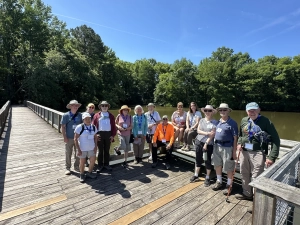
Fellow retired forester Chris Stuhlinger and I co-led an OLLI (Osher Lifelong Learning Institute, University of Alabama in Huntsville) Nature walk on June 13, 2026, at the Wheeler National Wildlife Refuge in Decatur, Alabama. We planned to saunter through the rich bottomland forest along the Flint Creek Trail, slowly exploring the beauty, magic, awe, and inspiration of Nature hidden in plain sight. Three of us appropriately dallied, immersed in wonder, wandering within the forest, truly focusing on the intended discovery and learning. The other dozen or so participants yielded to resident bottomland blood-sucking mosquitoes. As a result, the three of us were persuaded to abandon the trek and head to the nearby Refuge Visitors Center instead. I’ll take you there with me.


I had arrived at the trailhead early enough to examine the parking area Refuge buffer of sowed wildflower mix. Bergamots were among the plants already flowering.
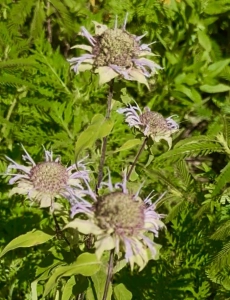
 

I recorded this 53-second video of the beds dominated at the moment by bergamots and black-eyed Susans.


Black-eyed Susans are among my favorite summer natives.
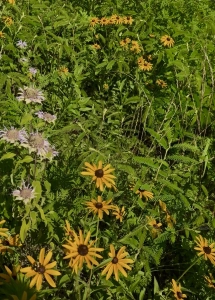
 

We began our trek within sight of the beds, by crossing the boardwalk, which carried us across a sunny, breezy, mosquito-free (a relevant point as I will soon reveal) passage into the forest.
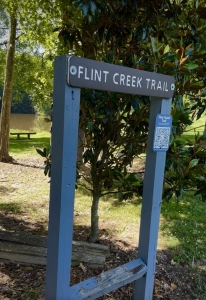
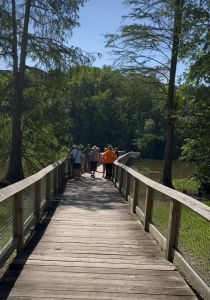
 

I recorded this 59-second video as we approached the trail via the boardwalk.


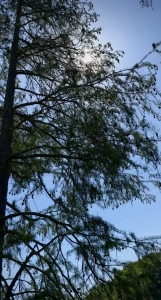
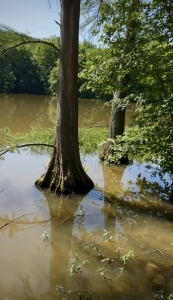
Pond cypress, a water-tolerant deciduous conifer, stood in the Flint Creek inlet at the boardwalk trailhead.
Flint CrFlint Cr


My Musings on What Warrants Doing as Time Wanes


We entered the forest where wonders awaited some of us… and two-winged, six-legged terrorists inflicted intolerable annoyance on the others. Summer passage through certain northern Alabama ecotypes exacts a toll. The circumstances of this day lead me to pledge (to self) that I will heretofore exercise greater caution in agreeing to which particular OLLI (or any other) missions I shall choose/decide to accept. 

None of us knows how many woodland excursions lie ahead. I do know that the window eventually closes. The clock continues ticking. I love my deliberate, succinct retirement mission:

Employ writing and speaking to educate, inspire, and enable readers, and listeners to understand, appreciate, and enjoy Nature… and accept and practice Earth Stewardship.

Mightn’t I have been better advised to persue a Nature jaunt of my own design, intent, passion, purpose, and ken, rather than one where the participants are easily dissuaded from the effort? As I draft this text, I will enter my fourth quarter of a century in two days. Chances are slim (to none) that a fifth awaits me (Well, maybe it’s with partaking a fifth of Old Forester that my chance improves!).

Without belaboring my disappointment, allow me to point out that at least eight of our 14 participants wore short-sleeve shirts/blouses, despite our advance suggestion to avoid attracting unwanted insect attention and voracious feeding.


An Abbreviated Woodland Exploration


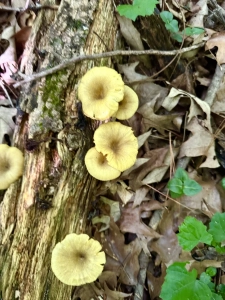
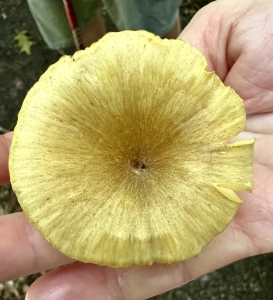
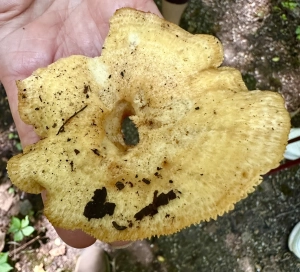
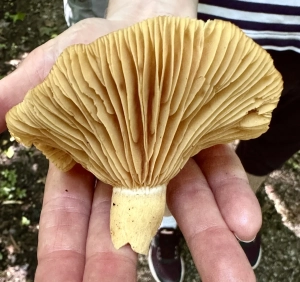
The bottomland forest presented abundant mushrooms for those of us not flushed ahead by the pesky skeeters. Rather than escort you with deep narrative, allow me to introduce our welcoming fungi. Lactarius psammicola gave us palm-size shrooms.
Flint Cr


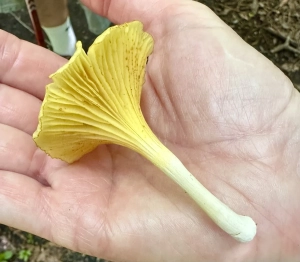
Golden-gilled gerronema showed their characteristic biege funnels.
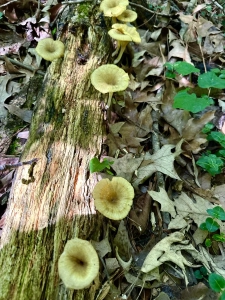
Flint Cr


Although very attractive, the species is not considered edible.
Flint Cr


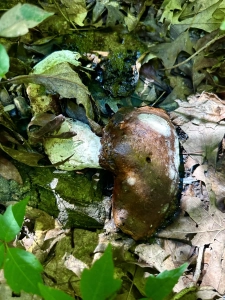
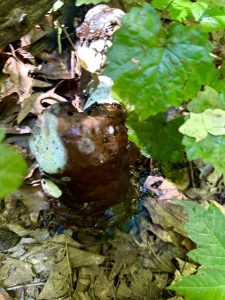
Bolete mushrooms are a group of fungi with spongy pores under their caps instead of gills, including some edible species. I’ve reached a point in my foraging where I’m gaining enough knowledge and confidence to begin selecting certain boletes. This individual is in an advanced state of decay, rotting with a bolete mould.
Flint CrFlint Cr


Nearby we spotted dog vomit slime mold, a fungus that has a moniker that, even if it were edible, would discouraged human consumers.
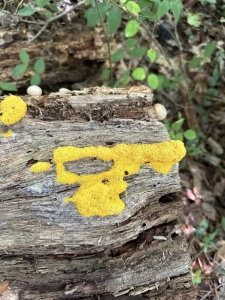
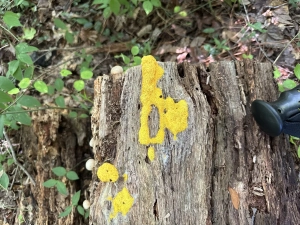
Flint CrFlint Cr


I spotted an unfamiliar understory plant, whitenymph. By this point of progress, the mosquito-spurred group had raced way ahead of us.
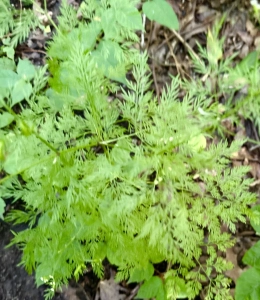
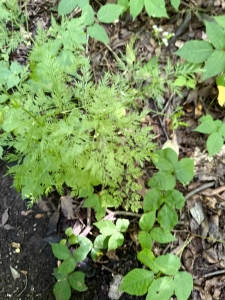
Flint Cr


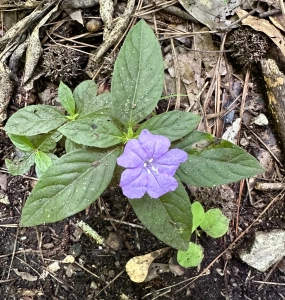
I felt compelled to photograph Carolina ruellia, a lovely little ground-hugging early summer wildflower.
Flint Cr


Quick Trip across the Highway to the Visitors Center Cypress Pond


The larger group hailed us before we had traversed half the distance they covered. We agreed to return to our vehicles, and then leave to the visitors center about a mile away, across the highway, where we anticipated far fewer human-blood-consuming insects. Some of the original group did not transfer to the visitors center.

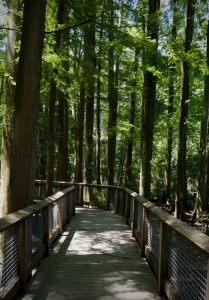
I’ll touch briefly on our mosquito-abatement alternative. I always enjoy the bald cypress pond and boardwalk near the visitors center.
Cypress Pond


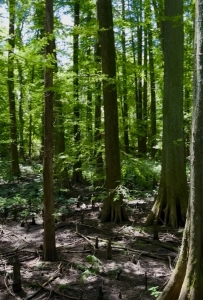
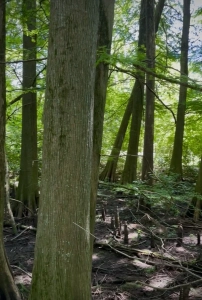
Stems are packed tightly and reach high. Cypress knees perform their function, whether securing incremental anchorage or assisting in gaseous exchange.
Cypress Pond


I recorded this 60-second video within the cypress pond, adding a little Righteous Brothers accompaniment.


I always glance heavenward from the boardwalk. The dense trunk-stocking suggests crowded, intersecting and overlapping crowns. Instead, cypress expresses crown shyness… faithfully, maintaining space-margins and no-touch zones separating one crown from another! Is it my own certifiable introvert personality that explains my admiration of sylvan crown shyness?
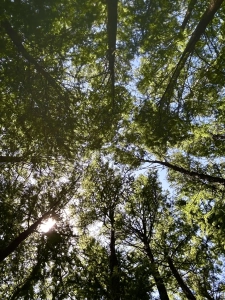
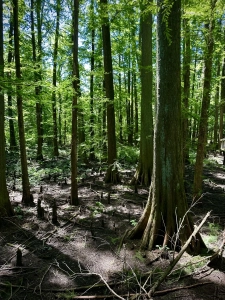
Cypress


Perhaps I overreacted to our change in plans; perhaps not. However, in no small part owing to my seminal life benchmark (75 years!), my angst and pique were real… and persist. I shall be recalibrating priorities. From a time-of-life-dawn, the brim-full hour glass left plenty of room for judgement error. Today, with a setting sun ahead, the sand grains rush unceasingly. The relative cost of each one amplifies. My maternal grandmother, a country girl from Appalachian-region West Virginia, said as much: “The older I get, the faster time goes!”


Closing


I accept the challenge of distilling these Brief-Form Posts into a single distinct reflection, this one cut, modified, and pasted from above:

None of us knows how many woodland excursions lie ahead. I do know that the window eventually closes. The clock continues ticking. I love my deliberate, succinct retirement mission:

Employ writing and speaking to educate, inspire, and enable readers and listeners to understand, appreciate, and enjoy Nature… and accept and practice Earth Stewardship.

Mightn’t I have been better advised to pursue a Nature jaunt of my own design, intent, passion, purpose, and ken?


Nature’s special treats await our discovery, our understanding, and our interpretation!


Subscribe to my free weekly photo essays (like this one) at: http://eepurl.com/cKLJdL
 

Flint Cr

Brief-Form Post #61: Mid-February OLLI Eagle Safari at Lake Guntersville State Park

I am pleased to add the 61st of my GBH Brief-Form Posts (Less than five minutes to read!) to my website. I get wordy with my routine Posts. I don’t want my enthusiasm for thoroughness and detail to discourage readers. So, I will occasionally publish these brief Posts.


Along with fellow retired forester Chris Stuhlinger, I co-led a University of Alabama in Huntsville OLLI (Osher Lifelong Learning Institute) Eagle Observation Safari on February 14, 2026, to Alabama’s Lake Guntersville State Park (LGSP). Alabama State Parks Northeast District Naturalist Erik Cline and Park Naturalist Anna Crow presented the program, leading us to two nest observation sites in the Park and another along the Sunset Greenway in Guntersville, AL. Come along to experience the tour stops the 55 of us enjoyed as we spotted ten eagles!

Unfortunately, because my trusty iPhone cannot capture images of eagles nesting or in flight, well enough to post in these photo essays, I’ll rely on you to imagine the magnificent eagle safari stars. I intend to demonstrate the remarkable enthusiasm that a low-intensity, half-day Nature outing within sixty minutes of campus can inspire among mostly retired, eager learners. Count me among them! Moreover, my retirement life mission impels me to employ writing and speaking to educate, inspire, and enable readers and listeners (and eagle safari participants) to understand, appreciate, and enjoy Nature… and accept and practice Earth Stewardship. Thus, through my OLLI engagement, I am reaching and inspiring concerned Earth citizens to observe, understand, feel, and act on behalf of our pale blue orb.

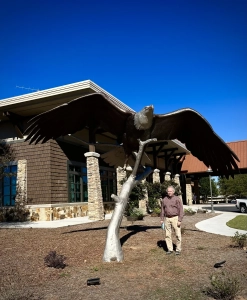
Chris stands under the iconic Park Lodge Bald Eagle on October 23, when we scouted for the February excursion: https://stevejonesgbh.com/2025/12/15/brief-form-post-52-late-october-afternoon-scouting-for-eagles-and-nests-at-lake-guntersville-state-park/


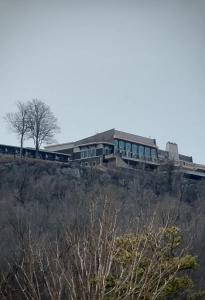
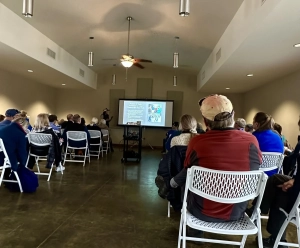
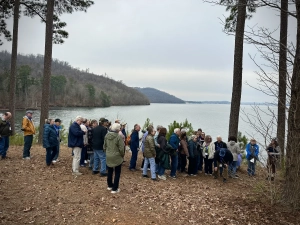
Our group convened in The Gathering Place indoor social hall in the Park campground at lakeside. The Lodge stands ~300 feet above us atop the plateau rim.

Lake GSP


The Gathering Place kept us snug and warm as Anna effectively oriented us to eagle biology and ecology.

Lake GSP


I recorded this 34-second video from the Gathering Place, viewing the lakeshore, panning the audience, then sweeping out the opposite side, and bringing the lodge down to our level.


Who could ask for a finer place to launch our safari?!

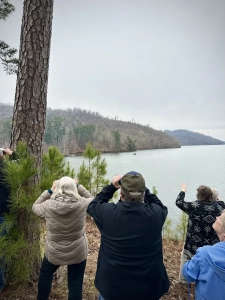
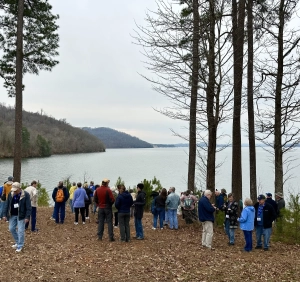
Following lots of questions and eager discussion we drove to our first observation site at the Park cabins, where we aimed our binoculars, spotting scopes, and cameras to an occupied nest 200 yards across the inlet. This first nest, as were all three nests we visited, was firmly anchored in a large-crowned loblolly pine tree. We logged a single mature eagle nest-setting. We spotted no mate nor eaglet.

We showed few signs of cracking under the chilling mid-40s clouds and dampness, although I heard a few grumblings and witnessed signs of efforts to maintain body heat. The eagle sighting kept our attention.


I recorded this 59-second video with narrative as the group anticipated what lies ahead.


The group of seasoned learners paid the price of a chilly, cloudy spring morning for the pleasure of inhaling Nature’s elixir and seeing multiple individuals of a species on the brink of disaster earlier in our lifetime.


Here is my 58-second video of the stop without narrative.


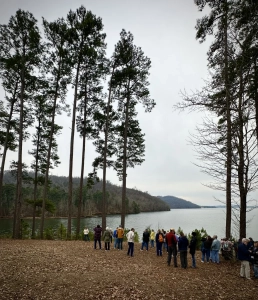
Our second observation point, also along the lakeshore with target nest some 200 yards across the lake rewarded us with six sightings: an adult in the nest, another adult in a nearby tree, two matures in flight and alighting in the nest tree vicinity, and two more flying by above the lake nearer to our shore. That took us to seven. Elation describes our mood.

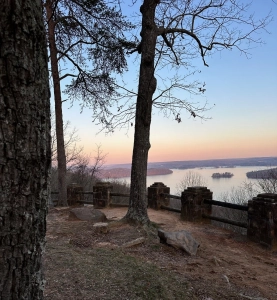
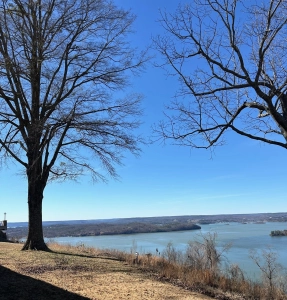
We retreated to the lodge for lunch and warmth. I’ve visited LGSP many times, never tiring of the special Nature of the place: the lake, her hills, wooded trails, wildlife, wildflowers, seasonal variations, and the embrace of its soothing moods and themes.

I snapped these photos on a May 2025 visit. Afternoon image from the lodge (left) and dawn from the Mabry Overlook, one-quarter mile east of the lodge, still on the rim above the lake.
LGSP

LGSP


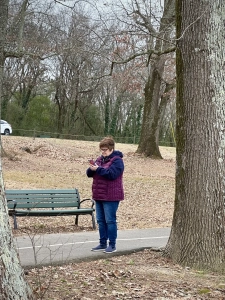
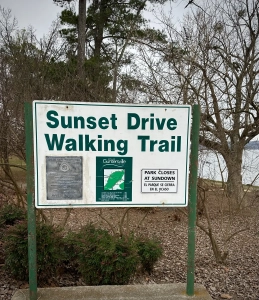
Following a leisurely lunch, we caravaned to Sunset Drive Greenway in the city of Guntersville. Eagles have maintained and reared young in this unlikely congested location for at least the past eight years. I am standing at least 200 feet from the tree’s base, located within a copse of pine trees beyond the observers.

Lake GSP


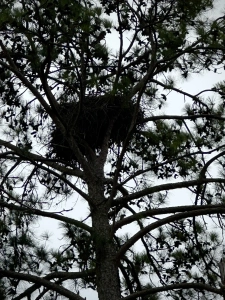
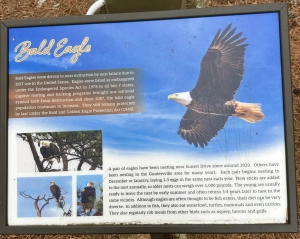
I admit to decades associating eagles to wild, remote, natural settings, distant from the hustle and bustle of urban life and living…until we lived four years in Alaska. Seeing this 1,000+ pound nest 70-feet up a pine tree between a greenway heavily traveled by walkers, runners, skateboarders, and bicyclists, and a busy roadway, however, still strikes me as surprising. An adult stayed on the nest during our hour on-site. Some in our party had already departed when two adults performed a beautiful fly-by!

LGSP

LGSP


John Denver’s The Eagle And The Hawk shaped my earlier impression:

I am the eagle, I live in high country in rocky cathedrals that reach to the sky.
I am the hawk, and there’s blood on my feathers.
But time is still turning, they soon will be dry.
And all those who see me, and all who believe in me
share in the freedom I feel when I fly. Come dance with the west wind and touch on the mountain tops.
Sail o’er the canyons and up to the stars.
And reach for the heavens and hope for the future
and all that we can be, and not what we are.

Alaska opened my eyes and mind to a different bird, a magnificent predator and shameless scavenger, adept at both capturing live game in the wild and dumpster diving in Sitka, Alaska. Eagles are culinary (and nest site) opportunists, at home in both high, rocky cathedrals and the domesticated bustle of Guntersville, Alabama.

LGSP

LGSP


I remind you that nothing in Nature is static. Everything changes…every hour of every day across the seasons and over the eons. The same is true of my impressions, knowledge, and wisdom, such as it is. Eagles are just as noble, elegant, persistant, and rich-with-national-symbolic meaningful as ever. Back from near extinction, the eagle exemplifies the human ability to overcome our collective ignorance. As Louis Bromfield repeated, we are capable of changing some corner of our Earth for the better through wisdom, knowledge, and hard work!

A successful venture — ten eagles! My hope is that the OLLI Eagle Safari awakens all of us to our obligation to wisely steward our One Earth.


Closing


I accept the challenge of distilling these Brief-Form Posts into a single distinct reflection, this one cut and pasted from above:

My retirement life mission impels me to employ writing and speaking to educate, inspire, and enable readers and listeners (and eagle safari participants) to understand, appreciate, and enjoy Nature… and accept and practice Earth Stewardship. Thus, through my OLLI engagement, I am reaching and inspiring concerned Earth citizens to observe, understand, feel, and act on behalf of our pale blue orb.


Nature’s special treats await our discovery, our understanding, and our interpretation!


Subscribe to my free weekly photo essays (like this one) at: http://eepurl.com/cKLJdL