Marshall Forest Preserve National Natural Landmark in Rome, Georgia!
NOTE: Some of my GBH photo essays were not routinely distributed from mid-February through mid-June. I will resend those one by one, beginning the first week of July. Here is my Post from February 18 (https://stevejonesgbh.com/2026/02/18/mid-november-25-year-return-to-alabamas-chewacla-state-park/)
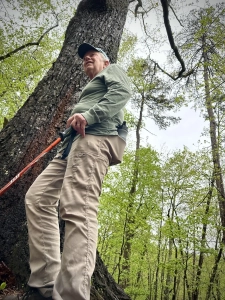
Fellow retired forester Chris Stuhlinger, retired videographer Bill Heslip, and I visited Marshall Forest Preserve, established as Georgia’s first National Natural Landmark near Rome, Georgia, on April 5, 2026. Recognized by the Old Growth Forest Network (https://www.oldgrowthforest.net/), the preserve encompasses ~300 acres of undisturbed upland pine and hardwood forest. Our wandering began as persistent overnight rain ended, rewarding us with trunks stem-flow-darkened and bark surfaces beautifully algae-patterned in the relatively limited light under low clouds. I’m a big fan of National Natural Landmarks!
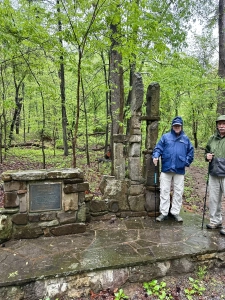
Bill and Chris stood at the traihead monument, a provocative stone symbol, rich with imagined meaning.
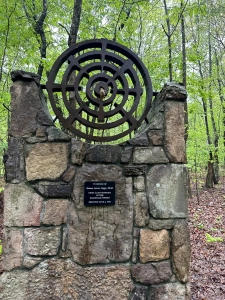
The stone graphic and concentric metal totem below hinted that the forest itself may pose mysteries and puzzles for us to ponder.
I recorded a 60-second rain-dampened video of our entry to MFP.
Although the preserve forest falls short of the scale and sanctity of old-growth redwood and coastal Douglas fir stands, an eastern US perspective allowed me to appreciate this untouched upland ecosystem. A large loblolly pine reached well over one hundred feet above, spreading wide.
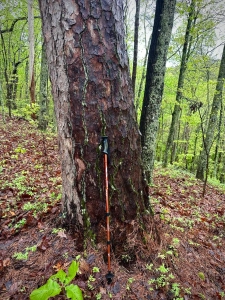
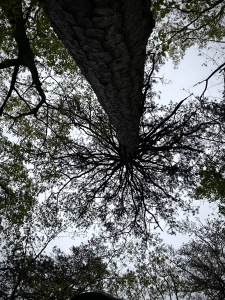
Nearby, a regal red oak stood fat and tall. Had a logging crew been given a chance (logger’s choice), this specimen would have been the first to grace a log truck mill-bound. We foresters commonly sleuth stand history by the quality of tress left, even long after severed stumps have decayed. I saw no evidence at MFP of prior high-grading, the practice of removing high quality standing timber and leaving less commercially valuable stems: smaller, degraded, lower desirability species, hollowed, and decayed.
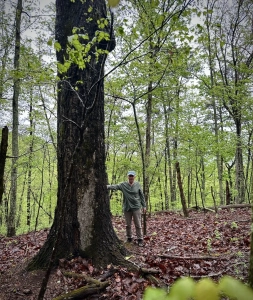
Like the loblolly, the oak occupies a dominant canopy position.
Old-Growth vs. Undisturbed Forest
I’ve been guilty a few times by my own persistent stereotype that the term old-growth implies an ancient forest of magnificent large trees, heavily-shaded understory, mossy ground cover, and fairy tale images fleeting among wisps of fog and vapors. I’ve seen such forests in west coastal rain forests, from northern California redwoods to Oregon’s Douglas fir to the western hemlock and Sitka spruce of southeastern Alaska. I’ve wandered into an occasional dreamscape, magical stand here in the eastern US under the right conditions of landscape, weather, light, and mood (my mood!). I relax my criteria for the reality of our eastern forests.
I also distinguish old-growth from undisturbed forest. Marshall Forest Preserve is undisturbed according to the historical narrative that supported its classification as a National Natural Landmark. Likewise, I cannot contest that it is old-growth. I make the distinction because I routinely visit two local north Alabama disturbed forests that are crossing the threshold (and may have already entered) from late mature to old-growth. One is an 80-90-year-old bottomland forest on the Wheeler National Wildlife Refuge. A second is what I call the Cathedral Forest on Monte Sano State Park. The WNWR stand regenerated naturally from abandoned farmland. I believe the Cathedral Forest regenerated naturally following a combination of natural disturbance and timber harvesting.
Additional Old-Growth Evidence
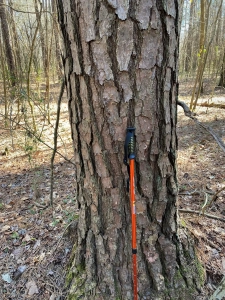
Allow me to attempt conveying additional evidence of the old-growth character of MFP. I’ll borrow photos from two places on prior occasions to make my point. The 22-inch diameter loblolly pine below stands in a rich riparian abandoned agricultural field on the Wheeler National Wildlife Refuge near Huntsville, Alabama. The tree is ~80 years old. I am sure that the annual growth rings are wide, evidencing rapid diameter growth. The bark furrows are deep, also suggesting vigorous radial expansion.
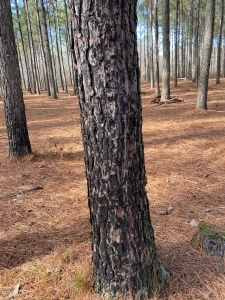
This loblolly, planted less than 30 years ago on an old field converted to a disc golf course on the North Alabama Land Trust’s Chapman Mountain Nature Preserve has grown rapidly across its short life. Thinned at least once, the forest is growing audibly (okay, I’m exagerating a bit). Prescribed fire is holding vegetative competition at bay. Nothing could be further from exhibiting old-growth character than this intensively managed forest.
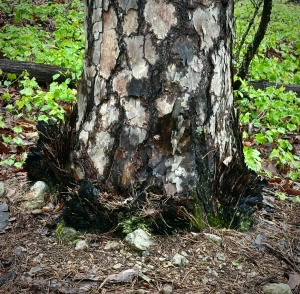
Perhaps 30 inches in diameter, this MFP loblolly tells a different tale. It’s shallowly furrowed broad platy bark suggests an extended period (many decades) of mature radial expansion. This old sentinel is content for now. There is no need to secure additional moisture, nutrients, and space. Its shredded, shed bark trunk collar is a phenomenon I have seldom seen, yet it shouted out for my attention. I suppose that the shredded bark skin at its base is resistant to decay (dry-layered above the moist mineral soil), even if very flammable. This segment of th MFP has not burned, at least for decades.
Its spreading flat-top canopy stands beside a massive dominant oak.
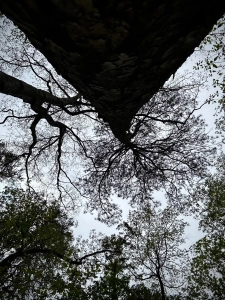
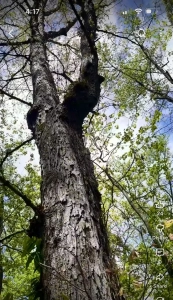
Another dominant loblolly pine stands tall, with crown space separating it from adjacent hardwoods, another indication perhaps that the old, mature stand has achieved a level of equilibrium. No longer does fierce competition among trees rule the day.
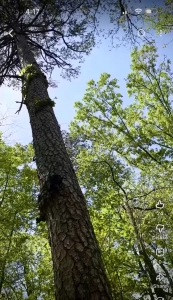
I recorded this 60-second video of a large white oak and adjacent loblolly tree near the trailhead, expressing the same characteristics of main canopy stability.
Another reverent white oak monarch stands watch on a preserve hillside.
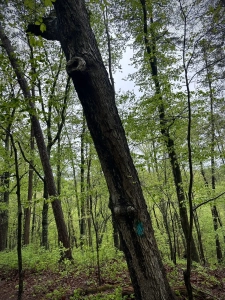
Large ancient trees are absent across much of the preserve. Every acre does not portray the old-growth label. In fact, I wonder whether without having read the MFP history and its desgination as a National Natural Landmark, I would have immediately declared, “This forest is unquestionably old-growth.”
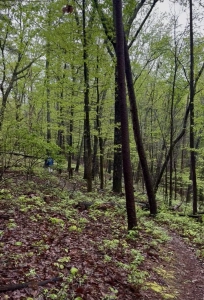
Old-growth or not, spring was erupting on the preserve.
I shall never tire of seeing mountain azalea proclaiming the vernal season in our southern forests!
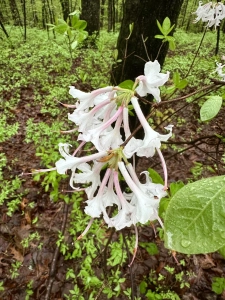
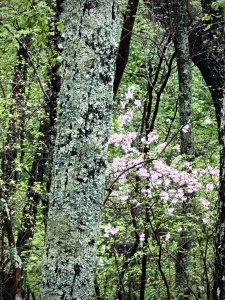
I recorded this 59-second, a celebratory homage, as the sun broke through the persistant stratus.
Succulent oak gall wasp ovipositors have riddled these fresh oak leaves with visible postules.
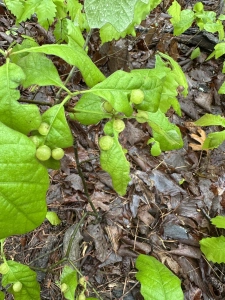
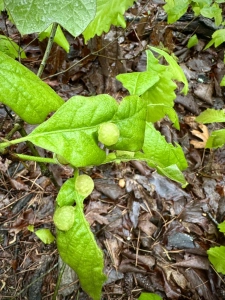
Life in the forest ecosystem is complex, layered among its richly diverse floral, fauna, food chains, consumers, decomposers, competitors, symbionts, and life forms, and agents of death and renewal.
An Enigma
I’ll end with a full portfolio of old forester embarrassment. I spotted a strange growth (fungal; bacterial; alien life form; extraterrestrial???) on the side of an old sweetgum. Odd grey matter with a green wig-like shroud, and some lateral orange highlights.
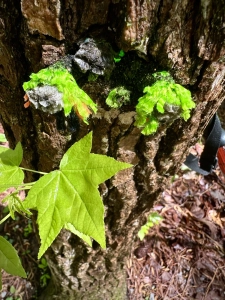
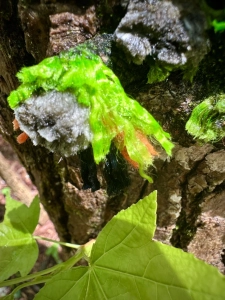
I snapped a few photos, including close-ups. My colleagues were forging ahead. I didn’t take time to feel, probe, or handle. I thought I could identify later with iNaturalist and reference books, or perhaps a query with relevant FaceBook groups.
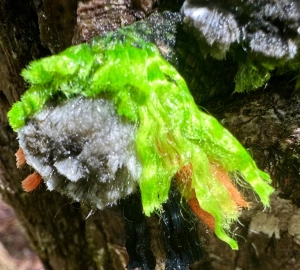
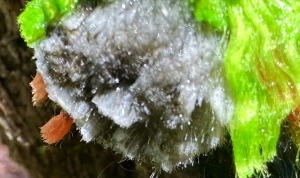
If nothing else, I felt that I may have discovered a new or rare life form. My reference books, internet search, and iNaturalist efforts yielded nothing. So I shifted to Facebook groups. Several folks pointed to nothing more exciting than some former woods traveler had bound the younger sweetgum with a colorful nylon or polypropylene rope; the tree grew around it; and only the cut ends protrude from the tree. Perhaps my camera managed to capture fairy tale images fleeting among wisps of fog and vapors.
Albert Einstein would have chastized this old forester:
Look deep into nature, and then you will understand everything better.
I failed to look deeply into these strange organisms. I’m embarrassed, yet not fully convinced that an old-growth forest sweetgum could scam me with a modern rope protruding from its ancient core. Fool me once, shame on you; fool me twice, shame on me. I want to go back for a second, deeper look!
Thoughts and Reflections
I offer these observations:
-
I shall never tire of seeing mountain azalea proclaiming the vernal season in our southern forests! (Steve Jones)
- I’m a big fan of National Natural Landmarks! (Steve Jones)
-
Look deep into nature, and then you will understand everything better. (Einstein)
- Don’t be fooled by fairy tale images fleeting among wisps of fog and vapor. (Steve Jones)
Inhale and absorb Nature’s elixir. May Nature Inspire, Inform, and Reward you!
Note: Unless otherwise noted, all blog post images are created & photographed by Stephen B. Jones.
Please circulate images with photo credit: “©2026 Steve Jones, Great Blue Heron. All Rights Reserved.”
I am available for Nature-Inspired Speaking, Writing, and Consulting — contact me at steve.jones.0524@gmail.com
Subscribe to my free weekly photo essays (like this one) at: http://eepurl.com/cKLJdL
A reminder of my Personal and Professional Purpose, Passion, and Cause
If only more of us viewed our precious environment through the filters I employ. If only my mission and vision could be multiplied by untold orders of magnitude:
Mission: Employ writing and speaking to educate, inspire, and enable readers and listeners to understand, appreciate, and enjoy Nature… and accept and practice Earth Stewardship.
Vision:
- People of all ages will pay greater attention to and engage more regularly with Nature… and will accept and practice informed and responsible Earth Stewardship.
- They will see their relationship to our natural world with new eyes… and understand their Earth home more clearly.
Tagline/Motto: Steve (Great Blue Heron) encourages and seeks a better tomorrow through Nature-Inspired Living!
Steve’s Four Books
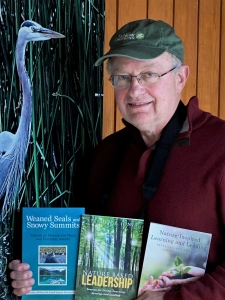
I wrote my books Nature Based Leadership (2016), Nature-Inspired Learning and Leading (2017), Weaned Seals and Snowy Summits: Stories of Passion for Place and Everyday Nature (2019; co-authored with Dr. Jennifer Wilhoit), and Dutton Land & Cattle: A Land Legacy Story (2025) to encourage all citizens to recognize and appreciate that every lesson for living, learning, serving, and leading is either written indelibly in or is powerfully inspired by Nature. All four of my books present compilations of personal experiences expressing my deep passion for Nature. All four books offer observations and reflections on my relationship with the natural world… and the broader implications for society. Order any from your local indie bookstore, or find them on IndieBound or other online sources such as Amazon and LifeRich.
I began writing books and Posts for several reasons:
- I love hiking and exploring Nature
- I see images I want to (and do) capture with my trusty iPhone camera
- I enjoy explaining those images — an educator at heart
- I don’t play golf!
- I do love writing — it’s the hobby I never needed when my career consumed me
- Judy suggested my writing is in large measure my legacy to our two kids, our five grandkids, and all the unborn generations beyond
- And finally, perhaps my books and Blogs could reach beyond family and touch a few other lives… sow some seeds for the future