Early December Nature Explorations along The Natchez Trace Parkway
On Wednesday, December 3, 2025, Judy and I made our first visit to the Natchez Trace Parkway, entering north of the Tennessee River in Alabama near Rock Spring (Mile Post 330) and exiting at the Meriwether Lewis Memorial (Post ~385) in Tennessee. The casual 55-mile journey served as a teaser for the entire 444-mile Parkway from Natchez, MS, to Nashville, TN. Come along with me to experience a taste of Nature and history.
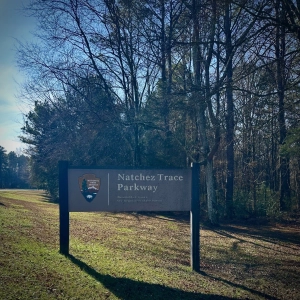
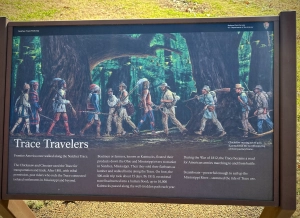
Like most Department of the Interior National Park Service units, the Natchez Trace Parkway tells its story with excellent interpretive signage. I won’t burden the photo essay with narrative repeating details of history associated with Native American and early colonial modern developments.
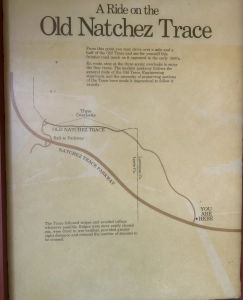
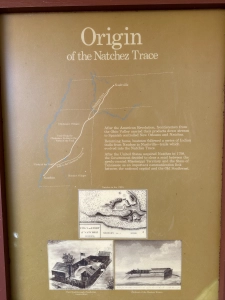
The history is rich, colorful, positive, cruel, punishing, rewarding, and ugly. Choose the flavor you desire. It’s all there. Imagine boatmen and farmers who floated their products down the Mississippi river to market in Natchez, MS, then sold their flatboats as lumber and walked home 500 grueling miles along the Trace. That’s 35 days from punching the clock at the docks to arrive home to spouse and the kids! The sign reads, “By 1810, occasional travel had turned into a human flood; up to 10,000 passed along the well-trodden path each year.”
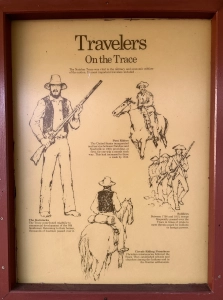
Judy and I traveled leisurely, safely, and without threat of harm. We made our circuit, departing home after breakfast and returning in time for supper.
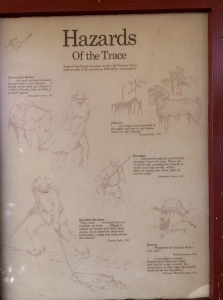
We encountered none of the listed hazards: torrential rains; swollen streams; thieves; swamps; or insects (“muskeetos & gnats & water very bad”):
I passed through the most horrid swamps I had ever seen. These are covered with a prodigious growth of canes and high woods, which shut out the whole light of days for miles. (Alexander Lewis, 1811)
Our camp was surprised in the night, and two of our horses stolen, by Indians. (Francis Baily, 1797)
I can adjust a simple handkerchief about my head and face in a way to parry the mosquitoes, or their more formidable companions the horseflies. (Herman Blennerhassett, 1807),
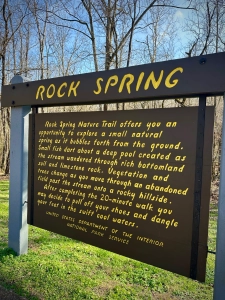
Each stop offered interpretation and explanation. I want to return to explore such delights as these. Rock Spring Trail is a 20-minute saunter exploring woodland and several beaverdams.
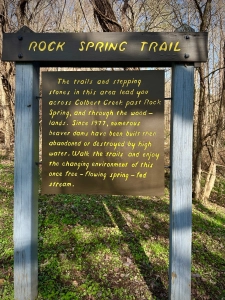
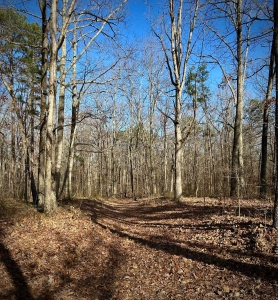
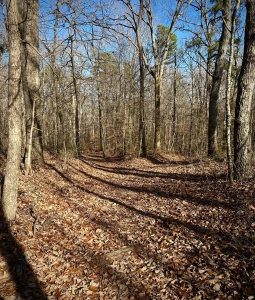
Ten thousand annual traipsers, countless horses, oxen, and mules, iron-rimmed wagons, and other means of coveyance, during dry seasons and mud-plagued torrents, scarred the Trace, in places leaving an obvious sunken pathway. Prior to European settlement, Native Americans traversed these hills and crossed its streams for more than 10,000 years. Every chain (66 feet; 80 chains to a mile) along the length has stories to tell.
The sign presents a multi-generational, multi-millennial theme, comprising volumes of decadal tales of adventure, discovery, love, war, life, and death:
This early interstate road building venture produced a snake-infested, mosquito-beset, robber-haunted, Indian-traveled forest path. Lamented by the pious, cussed by the impious, it tried everyone’s strength and patience.
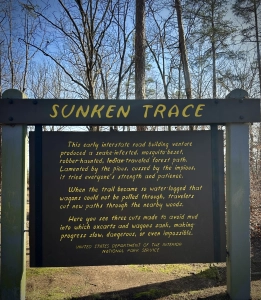
As the sign notes:
Here you see three cuts made to avoid mud into which oxcarts and wagons sank, making progress slow, dangerous, or even impossible.
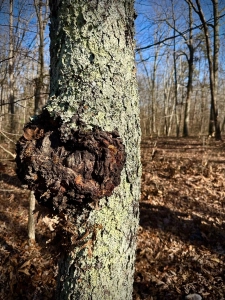
Although enamored with and captivated by this dip into the etheral world of intersecting human venture, natural history, time, and seasons, I kept my eyes alert for Nature’s oddities, curiosities, and mysteries. A black cherry tree infected with the fearsome countenance of a fungal black knot canker (Apiosporina morbosa) demanded my attention and implored a photograph. I wondered whether some handsome Indian warrior in 1026 might have mused on a Prunus serotina similarly infected?
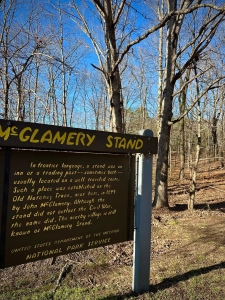
The McGlamery Stand, a combination inn and trading post, served travelers near this location from 1849, closing before 1865. Its name persisted through the next 150 years. Can any of us expect our 2026 moniker (our individual identity) to last beyond 2176?! I am blessed beyond imagination that the lovely young lady at right still carries my surname 54 years after she graciously adopted it in 1972!
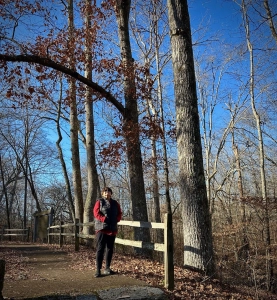
Oh, to inhale the magic of a mild autumn afternoon along a serene stillwater stream!
The branch is still carving and shaping the valley, you may follow the struggle of trees and other vegetation to gain a hold in the shallow rocky soil in the bottom in a 15-minute stroll along this narrow trail.
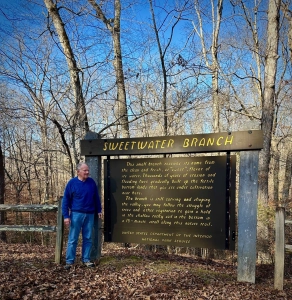
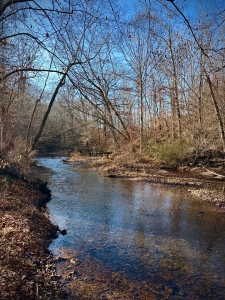
I cling to the emotional power of any southland stream still carving and shaping its valley! Five hundred years ago, Leonardo da Vinci observed:
Water is the driving force of all Nature!
I recorded this 59-second video at Sweetwater Branch.
The Driving Force of All Nature! Who can debate or challenge the half-millennial wisdom of an incredible polymath? No telephone, computer, AI, camera, or combustion engine! No view of our pale blue Earth from Apollo in moon orbit! Yet, he knew, saw, and felt so much more then we in our digitally-distracted world. It’s high time we fattened sheep got into the great out there; time to get out of the darkness into the light!
Here is my 39-second video focusing on the crystal clear water. What could da Vinci have done with my iPhone?
Each stop along our brief trip suggested hours of contemplation and exploration. My career demanded much from me. I seldom had the leisure to devote to what I might have learned when young, physically capable, intellectually exquisite, and tireless. However, it is only now that I yearn to delve deeply enough to probe the depths beyond career expediency. As I listened and yearned for more time to sit quietly, I thought of Chickasaw poet and novelist, Linda Hogan:
Glenrock Branch at milepost 365, yet another stop, stirred my heart, soul, body, mind, and spirit. I wanted more than our superficial circuit allowed.
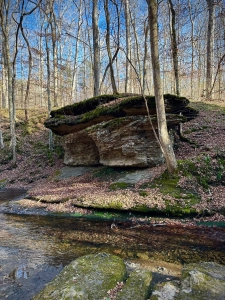
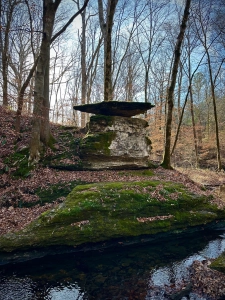
I recorded this 59-second video at Glenrock Branch.
I’m a champion of and advocate for special places and everyday Nature. How many did we see along our 55 mile journey, where we discovered an endless fountain?
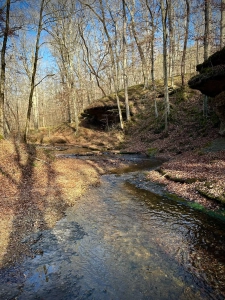
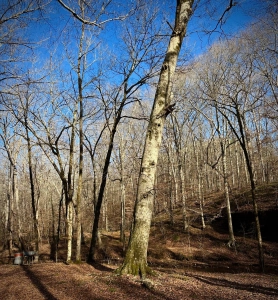
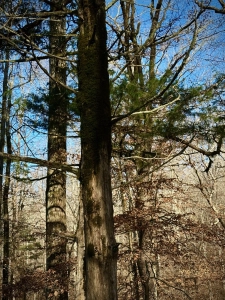
Still at Glenrock Branch, a towering American beech stood creekside (left). Nearby, an Eastern redcedar provided dormant season shade.
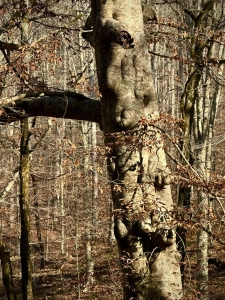
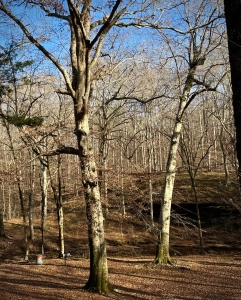
Another beech showed mirthful character with its apparent (to observers with vivid imagination) multiple facial expressions. I see eyes, noses, and mouths. Contrast its expressive trunk (i.e. an extrovert) to its kin above left and beyond it at right, clearly, like me, a certifiable introvert.
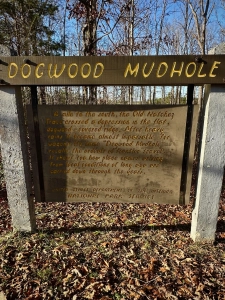
I love catchy, provocative place names, especially those attached to local conditions and experiences:
A mile to the south, the Old Natchez Trace crossed a depression in the flat, dogwood-coverred ridge. After heavy rains it became almost impassable for wagons. Its name, Dogwood Mudhole, recalls the ordeals of travel. It shows, too, how place names arising from local conditions of long ago are carried down through the years.
Stephen Edward Ambrose (January 10, 1936 – October 13, 2002) was an American historian, academic, and author. He published Undaunted Courage (1996), telling the nearly unfathomable 48-month tale of daring and courage of the Lewis and Clark Corps of Discovery. They led the 33-member Corps approximately 8,000 miles, from St. Louis, Missouri to the Pacific Ocean and back.
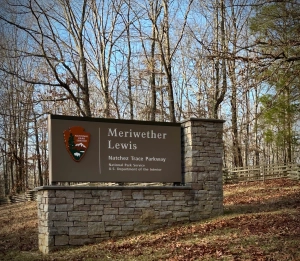
Defying all odds, the Corps completed its mission, losing only a single member, not to accident or hostiles, but to pneumonia. Mr. Lewis succumbed at this site along the Trace, to internal demons, stronger than his fame, courage, or continental conquest.
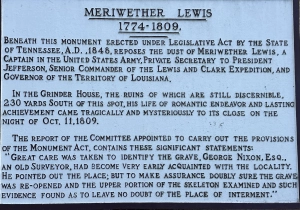
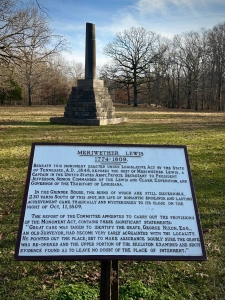
The monument and its massive oak triggered an emptiness in my heart. A man who soared with eagles died alone, scared, and helpless in the wilds of west Tennessee. As I read Undaunted Courage, I pictured Lewis and Clark transitioning to the hereafter with angels singing and trumpets blaring. The sad and troubled soul passed without fanfare.
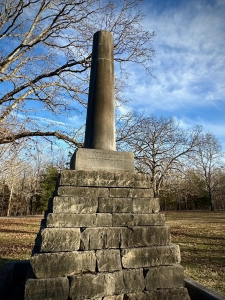
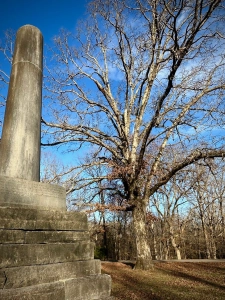
Like other stops, the Meriwhether Lewis memorial presented hiking opportunities. Alas, we allowed no time in our itinerary for pleasant side excursions.
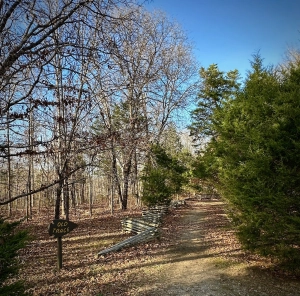
I wondered whether this dogwood tree, batttered, dead, and tortured, once bore a heavenly spring shroud of white-blossom elegance. Did it live a daring and courageous life, only to die alone, scared, and helpless…without fanfare?
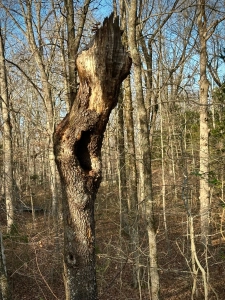
Instead, I’ll bring this essay to close by celebrating that the Trace lives on through a million tales from along its 250 years and 35,520 chains of beauty, magic, wonder, awe, and inspiration!
Thoughts and Reflections
I offer these observations:
-
Water is the driving force of all Nature! (da Vinci)
- The Natchez Trace carves a multi-generational, multi-millennial theme, comprising tales of adventure, discovery, love, war, life, and death. (Steve Jones)
-
Look deep into nature, and then you will understand everything better. (Einstein)
Inhale and absorb Nature’s elixir. May Nature Inspire, Inform, and Reward you!
Note: Unless otherwise noted, all blog post images are created & photographed by Stephen B. Jones.
Please circulate images with photo credit: “©2026 Steve Jones, Great Blue Heron. All Rights Reserved.”
I am available for Nature-Inspired Speaking, Writing, and Consulting — contact me at steve.jones.0524@gmail.com
Subscribe to my free weekly photo essays (like this one) at: http://eepurl.com/cKLJdL
A reminder of my Personal and Professional Purpose, Passion, and Cause
If only more of us viewed our precious environment through the filters I employ. If only my mission and vision could be multiplied by untold orders of magnitude:
Mission: Employ writing and speaking to educate, inspire, and enable readers and listeners to understand, appreciate, and enjoy Nature… and accept and practice Earth Stewardship.
Vision:
- People of all ages will pay greater attention to and engage more regularly with Nature… and will accept and practice informed and responsible Earth Stewardship.
- They will see their relationship to our natural world with new eyes… and understand their Earth home more clearly.
Tagline/Motto: Steve (Great Blue Heron) encourages and seeks a better tomorrow through Nature-Inspired Living!
Steve’s Four Books
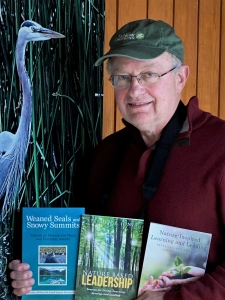
I wrote my books Nature Based Leadership (2016), Nature-Inspired Learning and Leading (2017), Weaned Seals and Snowy Summits: Stories of Passion for Place and Everyday Nature (2019; co-authored with Dr. Jennifer Wilhoit), and Dutton Land & Cattle: A Land Legacy Story (2025) to encourage all citizens to recognize and appreciate that every lesson for living, learning, serving, and leading is either written indelibly in or is powerfully inspired by Nature. All four of my books present compilations of personal experiences expressing my deep passion for Nature. All four books offer observations and reflections on my relationship with the natural world… and the broader implications for society. Order any from your local indie bookstore, or find them on IndieBound or other online sources such as Amazon and LifeRich.
I began writing books and Posts for several reasons:
- I love hiking and exploring Nature
- I see images I want to (and do) capture with my trusty iPhone camera
- I enjoy explaining those images — an educator at heart
- I don’t play golf!
- I do love writing — it’s the hobby I never needed when my career consumed me
- Judy suggested my writing is in large measure my legacy to our two kids, our five grandkids, and all the unborn generations beyond
- And finally, perhaps my books and Blogs could reach beyond family and touch a few other lives… sow some seeds for the future