Mid-December Delights and Mysteries on the WNWR Hiking and Bicycling Trail
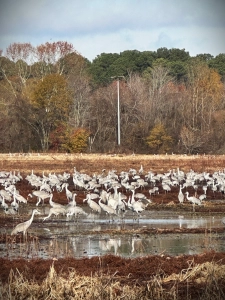
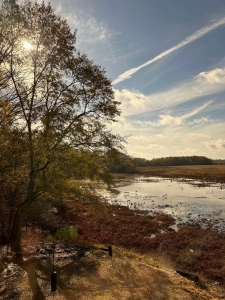
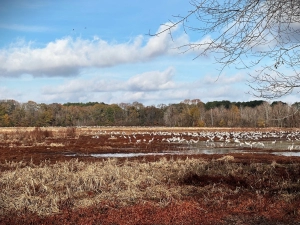
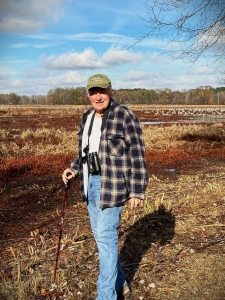
I visited the Wheeler National Wildlife Refuge Visitors Center and Observation Building on December 19, 2025. See my Post on welcoming the sandhill cranes (https://stevejonesgbh.com/2026/01/27/theyre-back-sandhill-cranes-return-to-alabamas-wheeler-national-wildlife-refuge/). I then hiked the refuge’s nearby Hiking and Bicycling Trail, a 5.5-mile trek south through woodland, agricultural fields, and waterfowl impoundments, and along the Flint Creek arm of Lake Wheeler. As with all of my wildland saunters, I discovered Nature’s delights and mysteries, many of them hidden in plain sight.
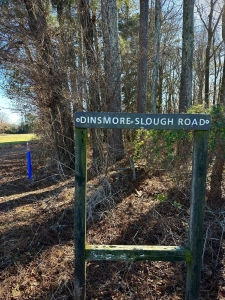
Hardwood and pine intermix in the patchwork of forest, farm, and wetland. I love winter’s sharp contrast of evergreen and deciduous. Contrary to most of my fellow deep-south neighbors, I am in no rush for the return of what I view as a too-long summer.
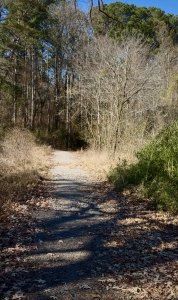
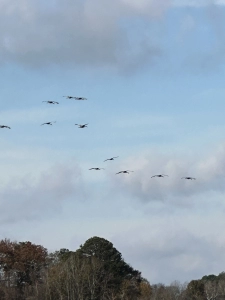
Give me the dormant greys and subtle hues of winter…and the distant crane calls…absent the irritating hum of hungry mosquitoes.
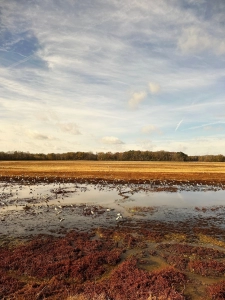
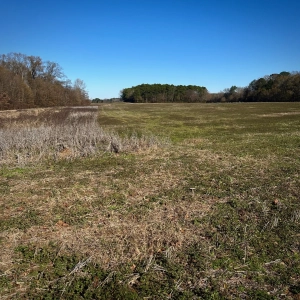
I recorded this 59-second video of a field commercially farmed to produce soybeans and leave a designated portion for winter wildlife consumption.
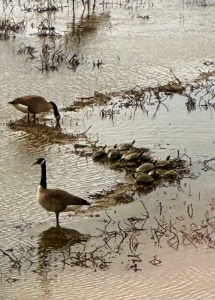
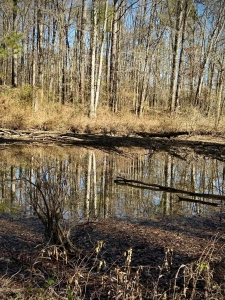
Residual soybeans (left) and ponded rainwater (right) attract diverse wildlife.
The WNWR website succinctly describes this richly diverse property blessedly located within 30 minutes drive of my home:
Although designated as a waterfowl refuge, the 35,000 acre refuge provides for a wide spectrum of wildlife. Its great diversity of habitat includes deep river channels, tributary creeks, tupelo swamps, open backwater embayments, bottomland hardwoods, pine uplands, and agricultural fields. This rich mix of habitats provides places for over 295 bird species to rest, nest and winter, including over 30 species of waterfowl and an increasing population of Sandhill cranes and a small number of Whooping cranes.
The refuge is also home to 115 species of fish, 74 species of reptiles and amphibians, 47 species of mammals, 38 species of freshwater mussels, and 26 species of freshwater snails. Other animals such as the endangered Gray bat and Whooping crane benefit from the protection of the National Wildlife Refuge System, and the care of dedicated refuge staff and other friends of wildlife, like you.
An Alabama Cooperative Extension System online brochure introduces 69 of the most common native trees found in Alabama. Some of the 69 common tree species do not reach this far north. However, many Alabama tree species are not considered common. Where am I heading? I know, I’m hedging on my own wild guess of how many species of native trees and woody shrubs inhabit the refuge’s 55 square miles? Given the rich tapestry of wetlands and uplands, and the fertile overlay of bottomland and alluvial soils, I am going for broke, aiming high. I estimate 150 species of native trees and woody shrubs. If you know, please send me a reliable citation.
Tree Form Curiosities and Oddities
I relentlessly peruse woodland haunts for tree form oddities and curiosities. Spotting them only accomplishes part of the task. It falls to me next to explain the form. Leonardo da Vinci astutely observer that cause generates result:
There is no result in nature without a cause; understand the cause and you will have no need of the experiment.
My 60-second video introduces the first of four curiosities I encountered.
I recalled the multiple times that someone conjectured that a navigationally-motivated Native American bent a young tree to show the way to a game blind, water source, trade route, or the nearest coffee shop. However, this black cherry is a mere youth, 60-70 years old at most. Eastern Woodlands Indians of the Southeast region no longer dwelled naturally in this area since their forced relocation to the West in the 1830s…along the Trail of Tears
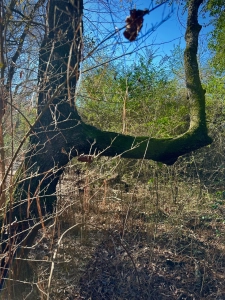
I imagined an extra point or field goal piercing the uprights to win the game!
This example still retains the stub at the broken branch end, from where an adventious bud shot a branch vertically.
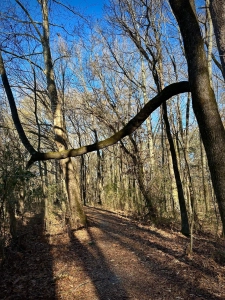
Such tortured stems are common in our forests. This one tells its own story. A branch fell from the overstory canopy, crushed a sapling and snapped the top, leaving the young tree permanently bent. A new stem grew at the break point.
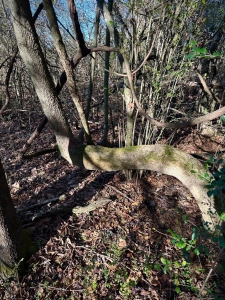
The broken point now shows a clear snout as the tree callouses over the broken end scar.
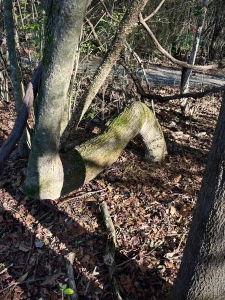
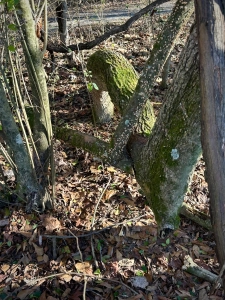
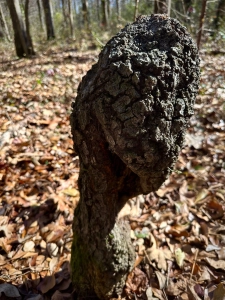
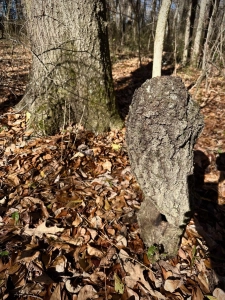
Two water oak saplings grew side by side, just six feet apart,close enough that their roots touched and grafted, a form of below ground inosculation. Some falling object snapped the nearer tree 30 inches above the ground. The larger oak provided nourishment to the broken tree, sustaining it, adding growth increments to the stem, and callousing the wounds. I call this phenomenon a ghost stump, kept alive after a fatal incident. I’ve seen, photographed, and cataloged other examples.
Here is my 59-second ghost stump video.
The ghost stump is a macbre ogre dwarfed by its mature cousin behind it.
Woodland Decay as a Life-Force
Life in our forests is not an idealic Disney-like utopia. Nature is rife with scars, weaknesses, sickness, rot, falling (and fallen) objects. Death is a powerful and ubiquitous part of forest life. Had I passed by this former willow oak three-trunk cluster two or three years ago, without close inspection, I may have marveled at its massive dimension, vigor, and vitality. However, the near-view stem crashed unceremoniously away from the photo point within the past two years, showing its remarkably hollow interior and revealing the hollowed bases of the other two. The falling tree knocked the top out of the right stem.
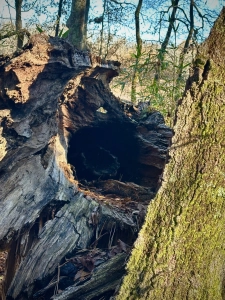
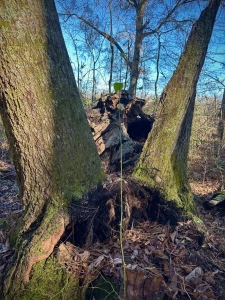
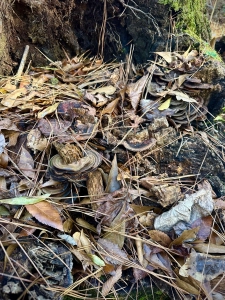
A decay mushroom cluster lines the crater of the fallen stem. Their mycelium are consuming cellulose and lignin of the dead and dying three-stem giant, assuring that the carbon cycle is continuous. The old saw holds — don’t judge a book by its cover.
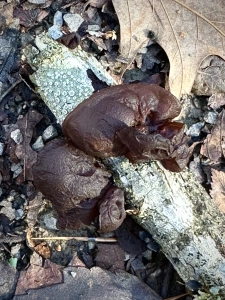
I found this dead lichen-encrusted oak branch on the trail. Somewhere high in the canopy, American amber jelly mycelia were decomposing the branch, until autumn breezes sent the organic matter home to the soil.
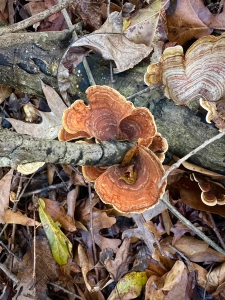
I stumbled across a particularly photogenic colony of false turkeytail mushrooms trailside. When I entered college (1969), fungi were classified within the plant kingdom. Shortly thereafter they elevated into their own kingdom. I neither celebrated nor took note of the epic reclassification. I was too busy with education, life, and career. Today, such things mean more to me.
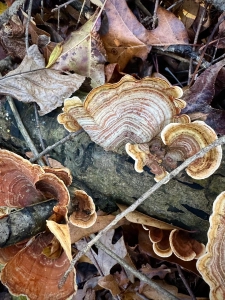
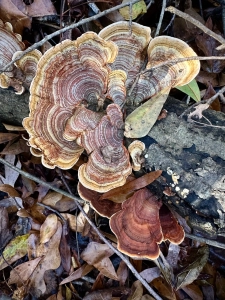
I recorded this 54-second video at the impressive mushroom cluster.
I marvel at Nature’s cycles and fractiles. More than a century ago a willow oak acorn sprouted along a field edge within the rich bottomland destined to become part of the Wheeler National Wildlife Refuge in 1938. A rabbit nibbled the seedling to ground level. Because oak evolved in a world occupied by rabbits and other grazers, the seedling tapped its root reserves and issued three shoots that shot beyond the reach of rabbits and deer. The three oak stems prospered despite some physical injury (a farm kid with a penknife; a deer scraping velvet from antlers; a beaver gnawing; mechanical farm equipment), openimg an infection court for decay fungi. The decay worked within the trunks for 50-70 years, slowly, inexorably the ratio of solid wood rind to tree diameter decreased. Eventually, gravity and wind exceeded tree stength. Decay fungi have mastered the end game. Ironically, this fungus produces mushrooms that are wood-like. They, too, will yield to other fungal decomposers. In time, an acorn will sprout from the aggregated organic debris and mineral soil composite. A nature enthusiast may rediscover the magic in 2175, a century and a half hence.
Necessarily, the food chain extends from microbes to invertebrates to fungi to plants and to animals, large and small.
Powerful Food Chain Impoundment Water Enters Flint Creek
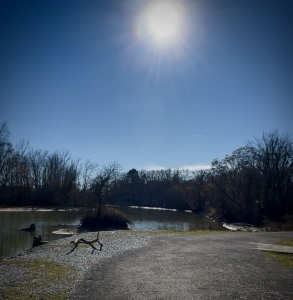
I was fortunate, last winter and this, to make this trek and witness s freshwater food chain spectacle. The water control mechanism below enables WNWR managers to block and maintain winter water levels in flooded areas for overwintering faunal residents. The area beyond the gate is flooded.
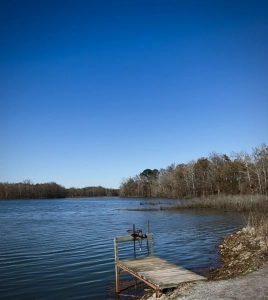
The Flint Creek arm of Wheeler Lake reflects the midday sun.
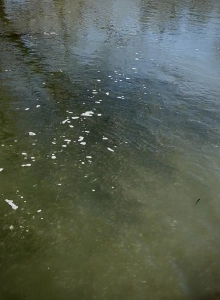
The bubbles (lower left) indicate the discharge from the impoundment entering Flint Creek.
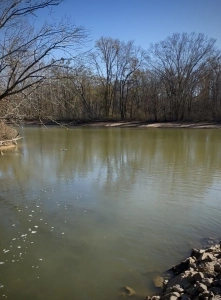
The discharge plume is teeming with small fish feeding on what I supporse is organic debris suspended in the flow. Clouds of tiny fish (up to 2-3″ in length fill the flow. Occasionally a larger predator fish exploded into the school.
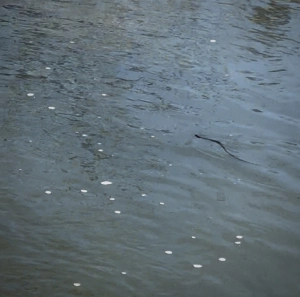
Here is my 58-second video (note snake entering for a fish-snack!).
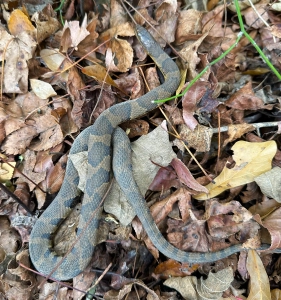
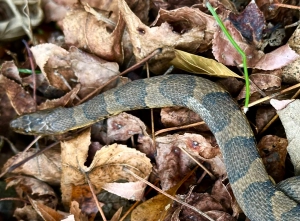
Although mid-December, this brown water snake was warm enough to catch a snack-fish.
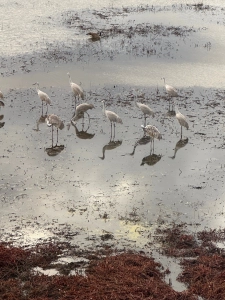
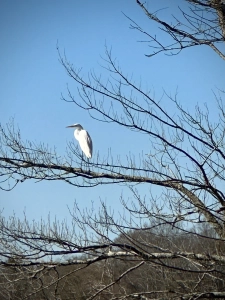
Others like this great white egret, stayed withing reach of the fish-chain feeding frenzy. I also saw several great blue herons and belted kingfishers.
All good things must come to an end, yet another apropos idiom!
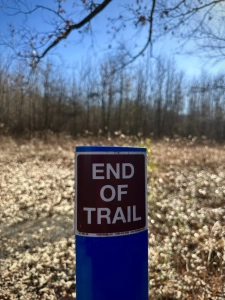
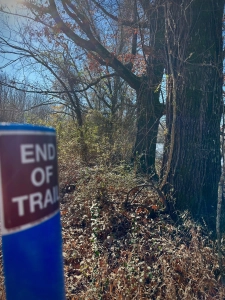
I recorded this 61-second end-of-trail video.
An ancient white oak stands as a fitting trail end totem.
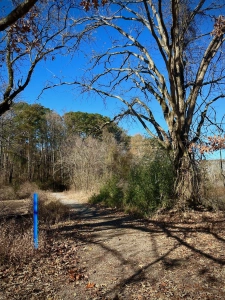
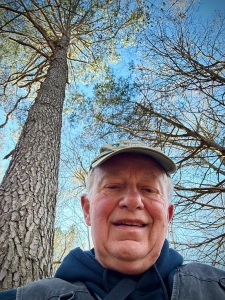
I lead or co-lead many local hikes and Nature santers. I relish sharing my Nature knowledge, passion, and curiosity with others. That said the certifiably introverted scientist filled with youthful exuberance still cherishes occassional ventures alone. I can endulge my pace, my interests, my mood; my imagination; my mental pursuits; my mysteries. I’ve learned that alone in Nature is often all the company I want or need!
Thoughts and Reflections
I offer these observations:
-
There is no result in nature without a cause; understand the cause and you will have no need of the experiment. (da Vinci)
- Death is a powerful and ubiquitous part of forest life. (Steve Jones)
-
Look deep into nature, and then you will understand everything better. (Einstein)
- I’ve learned that alone in Nature is often all the company I want or need! (Steve Jones)
Inhale and absorb Nature’s elixir. May Nature Inspire, Inform, and Reward you!
Note: Unless otherwise noted, all blog post images are created & photographed by Stephen B. Jones.
Please circulate images with photo credit: “©2026 Steve Jones, Great Blue Heron. All Rights Reserved.”
I am available for Nature-Inspired Speaking, Writing, and Consulting — contact me at steve.jones.0524@gmail.com
Subscribe to my free weekly photo essays (like this one) at: http://eepurl.com/cKLJdL
A reminder of my Personal and Professional Purpose, Passion, and Cause
If only more of us viewed our precious environment through the filters I employ. If only my mission and vision could be multiplied by untold orders of magnitude:
Mission: Employ writing and speaking to educate, inspire, and enable readers and listeners to understand, appreciate, and enjoy Nature… and accept and practice Earth Stewardship.
Vision:
- People of all ages will pay greater attention to and engage more regularly with Nature… and will accept and practice informed and responsible Earth Stewardship.
- They will see their relationship to our natural world with new eyes… and understand their Earth home more clearly.
Tagline/Motto: Steve (Great Blue Heron) encourages and seeks a better tomorrow through Nature-Inspired Living!
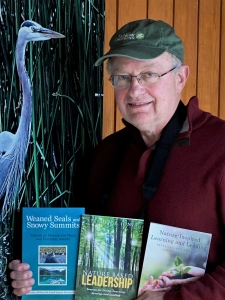
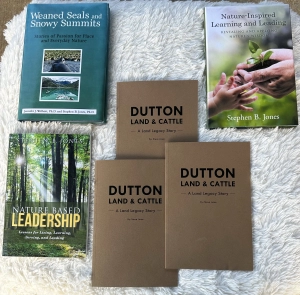
Steve’s Four Books
I wrote my books Nature Based Leadership (2016), Nature-Inspired Learning and Leading (2017), Weaned Seals and Snowy Summits: Stories of Passion for Place and Everyday Nature (2019; co-authored with Dr. Jennifer Wilhoit), and Dutton Land & Cattle: A Land Legacy Story (2025) to encourage all citizens to recognize and appreciate that every lesson for living, learning, serving, and leading is either written indelibly in or is powerfully inspired by Nature. All four of my books present compilations of personal experiences expressing my deep passion for Nature. All four books offer observations and reflections on my relationship with the natural world… and the broader implications for society. Order any from your local indie bookstore, or find them on IndieBound or other online sources such as Amazon and LifeRich.
I began writing books and Posts for several reasons:
- I love hiking and exploring Nature
- I see images I want to (and do) capture with my trusty iPhone camera
- I enjoy explaining those images — an educator at heart
- I don’t play golf!
- I do love writing — it’s the hobby I never needed when my career consumed me
- Judy suggested my writing is in large measure my legacy to our two kids, our five grandkids, and all the unborn generations beyond
- And finally, perhaps my books and Blogs could reach beyond family and touch a few other lives… sow some seeds for the future