Thanksgiving Eve Fungi Encounters at Wheeler National Wildlife Refuge
Mushroom Potpourri
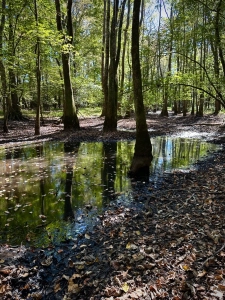
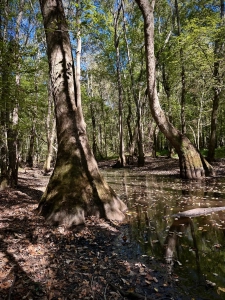
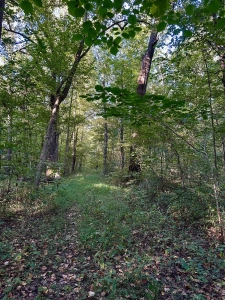
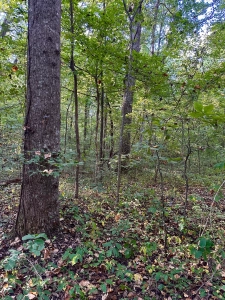
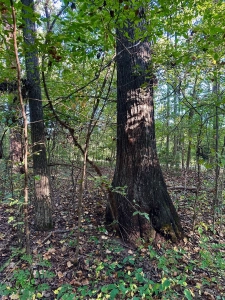
I ventured into the bottomland hardwood forest south of HGH Road, east of Jolly B. Road, on the Wheeler National Wildlife Refuge, Limestone County, Alabama, on the morning of Thanksgiving Eve, 2025. A chilly post-frontal breeze blew from the north-northwest under cloudless, cerulean skies. I hoped recent rains would bless me with a variety of mushrooms to view and catalog. Join me via this Post on my two-hour bushwhack discovery jaunt.
I am an old forester, learning in retirement to identify some regional fungi by their mushrooms, with special attention to common edibles, such as oysters, chanterelles, lion’s mane, puffballs, chicken of the woods, jellies, and a few others. I relish the rich tapestry of a vibrant forest, where death and life are interwoven in an elegant, intricate, and unending dance of carbon accumulation, decay, and recycling. Fungi are among the decomposers; mushrooms, their reproductive organs, disseminate billions of spores to ensure the cycle remains unbroken.
I am not a mycologist. Please don’t hold me to properly identifying the fungi pictured below. I rely on memory, limited referencing my several source books, and too much reliance on my close companion iNaturalist. I give you my best shot.
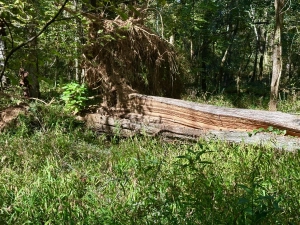
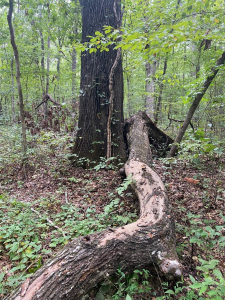
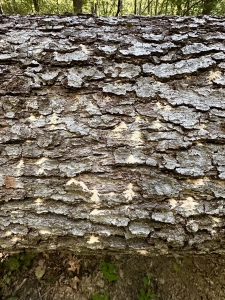
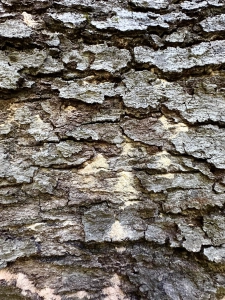
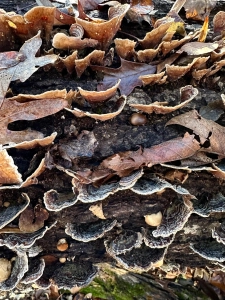
False turkey tail covers the surface of this downed red oak trunk. The bark hasn’t yet sloughed, owing in large measure to the brackets and mycelia holding fast.
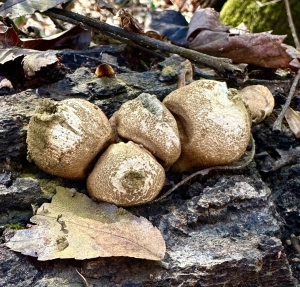
Pear-shaped puffballs populated the oak. These had not yet ripened.
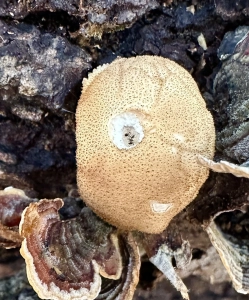
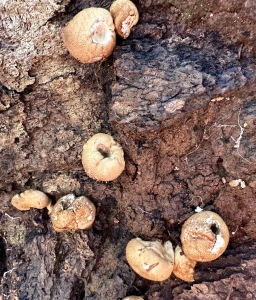
Some puffbals were ripe, emitting clouds of spores when poked.
I recorded this 22-second video of the finger-poked smoking puffballs.
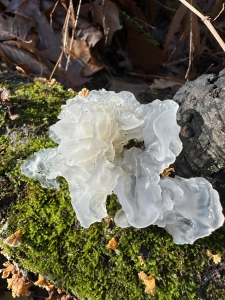
I spotted a biodiversity cornucopia on another downed oak: snow jelly fungus, crowded parchment, and a white-lip globe snail on a carpet of seductive entodon moss. Wow, I’m getting chills just remembering the magic hidden in plain sight…a nature-enthusiast’s siren song!
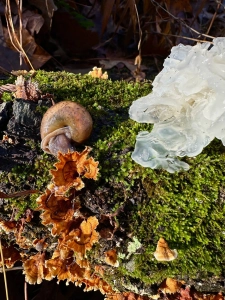
Each time I enter any woodland, I strive to see magic hidden in plain sight. The mushroom/snail/moss menagerie congregated within a six-inch diameter circle. Add to the life assemblage that the snail is very likely consuming algae and organic detritus. A remarkable six inch circle of life. I wonder what I may have missed on my woodland circuit. I spotted the six-inch circle domain only because my wide, circuitous wanderings brought me within a few feet of the log.
I’m reminded of the intensive, scientific forest inventories I’ve conducted across my forestry career:
- Maryland Forest Service, Savage River State Forest (1970-71) — two summers (after freshman and sophomore forestry years) systematically sampling fifth-acre plots
- Union Camp Corporation (1973-1985) — sampling company forestland to prepare timber sales
- UCC (1973-85) — regeration surveys to assess planted pine survival after the first growing season
- Doctoral field research (1986-87) — sampling uncut second growth Allegheny hardwood forests in northwestern Pennsylvania and southwestern New York
I mention my professional inventories to contrast my informal, haphazard, unscientific wanderings seeking whatever caught my eye on a late fall saunter at WNWR. I wonder what a gridded sampling filling a full day would have revealed? I leave such a venture to a forest mycology graduate student…or maybe an artist/photographer intent on assembling a portfolio of Nature’s limitless delights.
Back to the six inch circle of diverse life. Each component of the miniature ecosystem warrants an individual photograph. I don’t recall previously seeing snowy jelly fungus. As its name suggests, it feels like Jello!
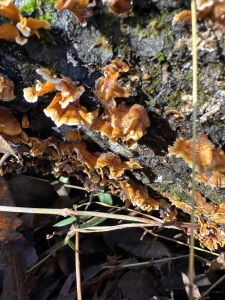
Crowded parchment is ubiquitous throughout our hardwood forests. It is a saprobic, wood decaying bracket fungus occurring on stumps, logs, and sticks of hardwood trees, especially oak.
The white-lip globe snail grazed peacefully, oblivious to the old forester observing it.
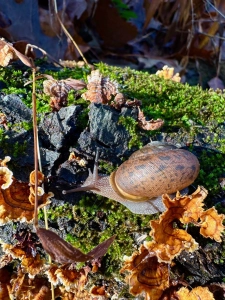
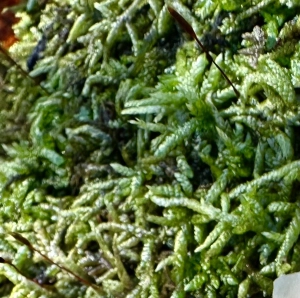
The seductive entodon moss offers a dense carpet, ideal for gathering and holding moisture and nutrients, and offering the snail a surface to scour with its rasping mouth parts. I love the seductive moniker. Perhaps seductive to the globe snail!
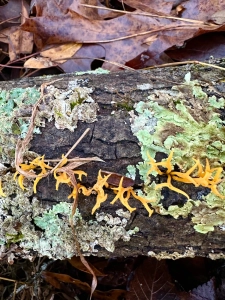
Club-like tuning fork mushrooms and Carolina shield lichen colonize this downed stem. Surely, an other worldly scene!
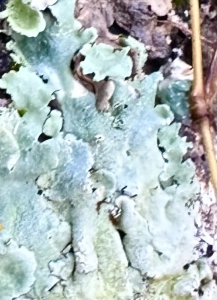
Carolina shield lichen, a primary decomposer, seems to possess this dead and downed hardwood stem. Although I may assume it is understood by many, I will risk stating the obvious. A lichen is a composite organism composed of a fungus and an alga (singular of algae) growing communally. An online source strays from my simplistic explanation: a lichen is a hybrid colony of algae or cynobacteria living symbiotically among filaments of multiple fungus species, along with bacteria embedded in the cortex or skin, in a mutualistic relationship.
I do not aim with these weekly photo essays to demonstrate how much I know. Leonardo da Vinci captured my approach to communicating complexity:
Simplicity is the ultimate sophistication.
I reported to several boards over my senior administrative career. When preparing for quarterly board meetings, I coached my staff to Keep it Simple. Present as though board members were sixth graders, not because they were either unable to understand complex issues, quantitatively limited, or unfamiliar with higher education. Instead, board members have lives, businesses, and many distractions, and then meet only four times a year, jumping into our boiling university cauldron. Forcing you (staff) to keep it simple assures that you will edit, condense, and summarize the essential, key elements more concisely, precisely, and powerfully. I keep my Great Blue Heron prose at the Flesch-Kincaid Grade Level 10.
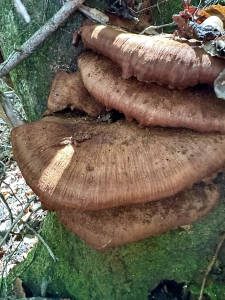
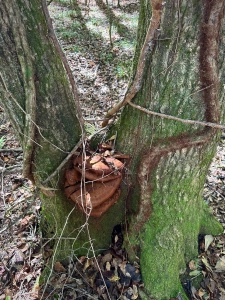
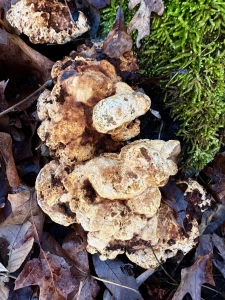
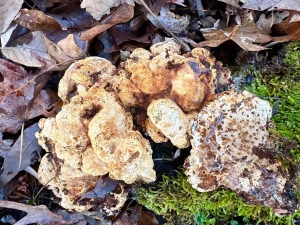
Oak bracket mushrooms can be massive, growing at the base of living and dead oaks. Other common names include weeping conk, warted oak polypore, and weeping polypore. Note the thick amber, honey-like liquid secretions
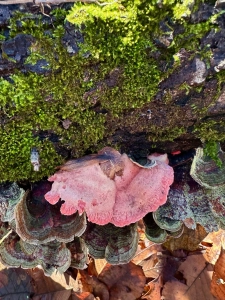
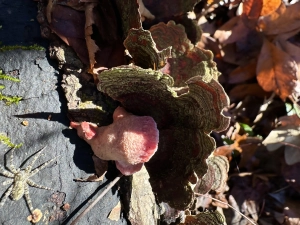
My beauty-of-the-day designation goes to coral-pink merulius, a colorful decomposer of dead woody debris.
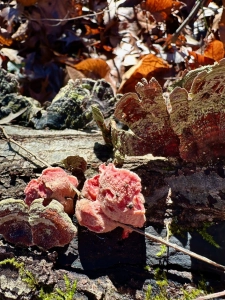
Ganaderma sessile, a type of laquered saprobic polypore bracket fungus, decomposes dead hardwood logs, stumps, and other debris. One oneline site refers to the species as a beautiful polypore, yet I am not persuaded to elevate it to beauty-of-the-day! I recall from my long-ago forest pathology course hearing the moniker bear’s tongue fungus. I see the resemblance.
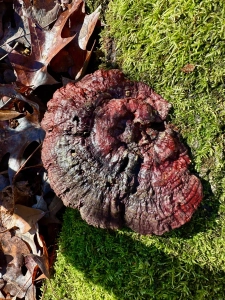
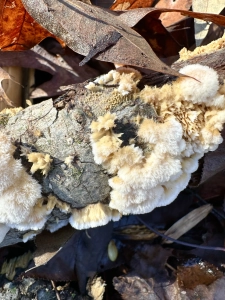
I have doubts about this being deer-colored Trametes (Trametopsis cervina), yet iNaturalist seemed at least marginally confident. I like this individual’s powder puff appearance, which drew me to powderpuff bracket (Postia ptychogaster), which is found in both Europe and North America.
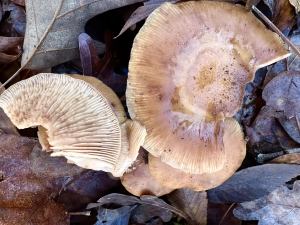
Autumn is the season for bulbous honeytop, a delightful edible. I have found large colonies of honeytop mushrooms elsewhere. I don’t remember seeing bulbous honeytop. The photo at right shows the conspicuous swollen stem base.

The late autumn forest carbon cycle was in full gear, a surging, steaming stewpot of life, death, and renewal.
Other Lifeforms
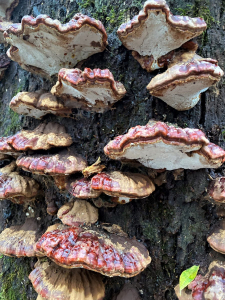
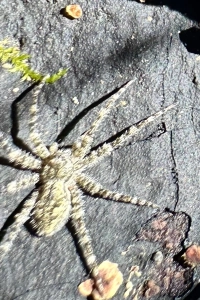
I snapped the below left photo of the bracket fungi and coral-pink merulius, only to find the white-banded fishing spider later when I examined the image, which explains why the enlarged spider image at right is not in focus. The spider was indeed hidden in plain sight.
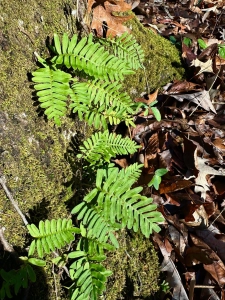
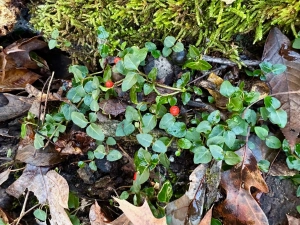
Resurrection fern shows full life during the moist North Alabama dormant season. Partridgeberry likewise displays vibrant green winter foliage, combined with its bright red berries. Some people complain of our winter dreariness and incessant drabness. Contrarily, I delight in its stark simplicity, exquisite contrasts, and unlimited delights. Summer woods present a visual maelstrom that can overwhelm an old forester seeking isolated delights. Dormant season performances present on isolated stages.
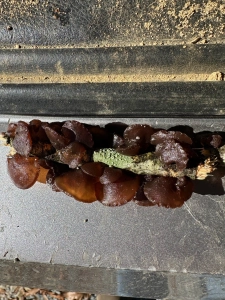
I’ll end with another gelatin mushroom, American amber jelly, which I found on the gravel road near my car. The infected dead twig fell from the canopy overhead. The background is my tailgate. I have harvested and consumed these uniquely-textured shrooms occasionally.
Thanks for accompanying me virtually. It didn’t match a six-mile circuit of Jenny Lake in the Tetons, but it offered everyday Nature delights almost in my backyard (15-mile drive), absent the time and expense visiting a world class National Park.
Thoughts and Reflections
I offer these observations:
- Fungi deepen forest exploration mystery and intrigue. (Steve Jones)
- There are some who can live without wild things and some who cannot. (Aldo Leopold)
- Simplicity is the ultimate sophistication. (Leonardo da Vinci)
Inhale and absorb Nature’s elixir. May Nature Inspire, Inform, and Reward you!
Note: All blog post images created & photographed by Stephen B. Jones unless otherwise noted. Please circulate images with photo credit: “©2026 Steve Jones, Great Blue Heron LLC. All Rights Reserved.”
I am available for Nature-Inspired Speaking, Writing, and Consulting — contact me at steve.jones.0524@gmail.com
Subscribe to my free weekly photo essays (like this one) at: http://eepurl.com/cKLJdL
Reminder of my Personal and Professional Purpose, Passion, and Cause
If only more of us viewed our precious environment through the filters I employ. If only my mission and vision could be multiplied untold orders of magnitude:
Mission: Employ writing and speaking to educate, inspire, and enable readers and listeners to understand, appreciate, and enjoy Nature… and accept and practice Earth Stewardship.
Vision:
- People of all ages will pay greater attention to and engage more regularly with Nature… and will accept and practice informed and responsible Earth Stewardship.
- They will see their relationship to our natural world with new eyes… and will understand more clearly their Earth home.
Tagline/Motto: Steve (Great Blue Heron) encourages and seeks a better tomorrow through Nature-Inspired Living!
Steve’s Four Books
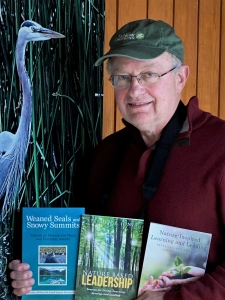
I wrote my books Nature Based Leadership (2016), Nature-Inspired Learning and Leading (2017), Weaned Seals and Snowy Summits: Stories of Passion for Place and Everyday Nature (2019; co-authored with Dr. Jennifer Wilhoit), and Dutton Land & Cattle: A Land Legacy Story (2023) to encourage all citizens to recognize and appreciate that every lesson for living, learning, serving, and leading is either written indelibly in or is powerfully inspired by Nature. All four of my books present compilations of personal experiences expressing my deep passion for Nature. All four books offer observations and reflections on my relationship with the natural world… and the broader implications for society. Order any from your local indie bookstore, or find them on IndieBound or other online sources such as Amazon and LifeRich.
I began writing books and Posts for several reasons:
- I love hiking and exploring Nature
- I see images I want to (and do) capture with my trusty iPhone camera
- I enjoy explaining those images — an educator at heart
- I don’t play golf!
- I do love writing — it’s the hobby I never needed when my career consumed me
- Judy suggested my writing is in large measure my legacy to our two kids, our five grandkids, and all the unborn generations beyond
- And finally, perhaps my books and Blogs could reach beyond family and touch a few other lives… sow some seeds for the future