Posts

Curiosities, Oddities, and Mysteries In a Sanctuary’s Bottomland Hardwood Forest!

On October 14, 2025, I had nearly two hours to roam before meeting with a colleague to prepare for a scheduled joint seminar the next week. I visited the tupelo swamp on the northeast side of Huntsville’s Goldsmith-Schiffman Wildlife Sanctuary. I had no objective beyond seeing what may lie hidden in plain sight during the dry autumn season. Never disappointed by my routine impromptu explorations, I discovered a portfolio of interesting features.


A Big Oak Topples into the River


Sometime this past summer, this 2.5-foot diameter water oak toppled violently into the adjacent Flint River, blocking at least half of the river’s width. The crown clings to the brown leaves that were in full flush when the tree fell.
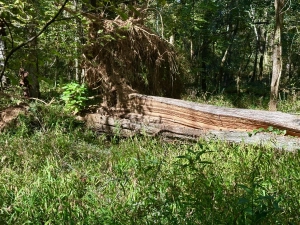
 

I recorded this 58-second video of the toppled water oak.


I wonder whether the crown will hold in place when winter rains swell the river to bankfull and beyond. The force will be powerful. Only Nature knows her limits, yet cares nothing of the consequences. I’ll keep an eye on her antics and impacts.
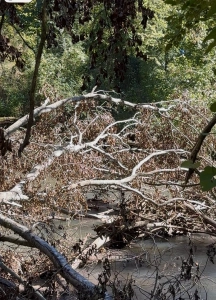
 

I observe in nearly every Post, death is a big part of life in our forests.


Another Big Oak Decomposes and Decays


Across eight years of permanent residence in North Alabama, I am learning better how to estimate the pace of decomposition and decay based on observation. Marian Moore Lewis, author of Southern Sanctuary, and I encountered a recently uprooted red oak on November 18, 2020 in this same bottomland forest. Fine roots were still evident; the root ball soil remined intact; bole bark and crown appeared fresh.
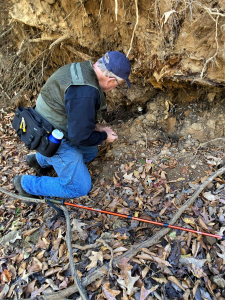
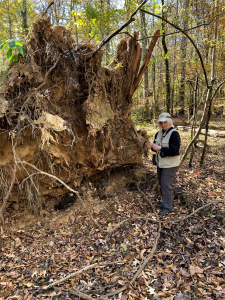
November 2020 November 2020


The massive root ball is clearly weathering away in my October 14, 2025 photo. Only the largest woody roots remain, yet even they are rapidly decaying. Trunk bark is shredding and stripping. Five years leave a striking mark on a large oak. My eye is calibrating. I am confident that I can estimate time since windthrow within 2-3 years, through the first 20 years. By then, the soil incorporation is in control.
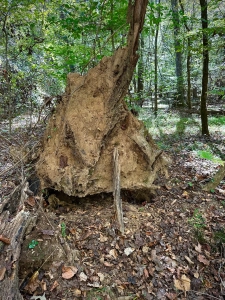
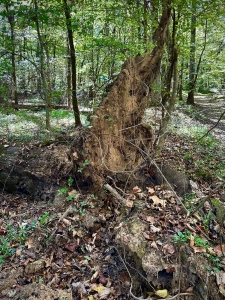
 

I will continue to Monitor…and Learn.

A Rich Species Mix


With litte necessary narrative, here are some of the tree varieties I encountered.

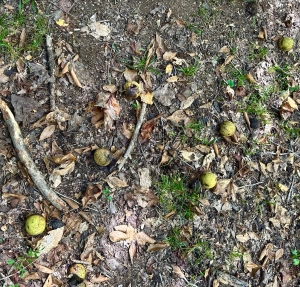
A nice crop of walnuts beneath a 24-inch diameter black walnut.


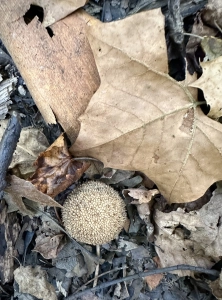
A sycamore and an attractive natural forest floor arrangement of peeled sycamore bark, a dropped leaf, and a seed ball.
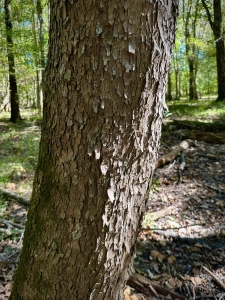
 

Sycamore’s peeling bark is one of its distinctive features.
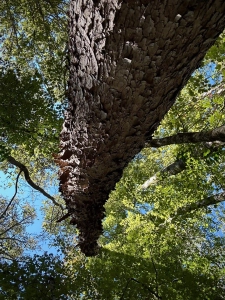
 

During my frequent Nature interpretive walks, more than half of participants recognize sycamore, provided I offer some hints and prompts.

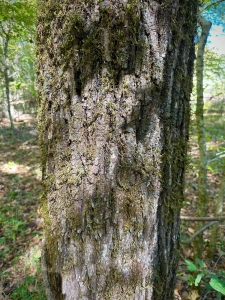
Carpinus caroliniana is an understory to mid-canopy hardwood that has been a favorite of mine since my undergraduate student days. I learned its common name as musclewood. It resembles the sinewed fibers of a muscled arm. Other common monikers include American hornbeam, blue beech, and ironwood. I photographed two individuals.
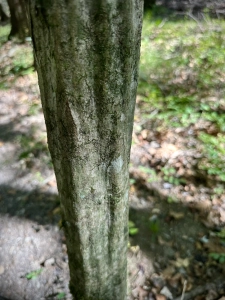
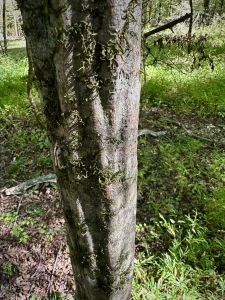
 

I’m a lifetime fancier of tree form oddities and curiosities.


An Attractive Fungal Resident


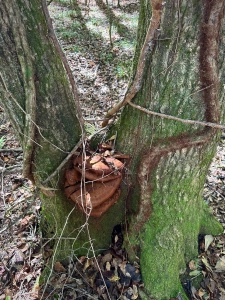
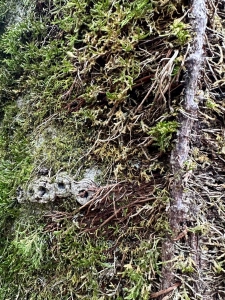
A twin water oak nestled aged resinous polypore brakets in its fork.
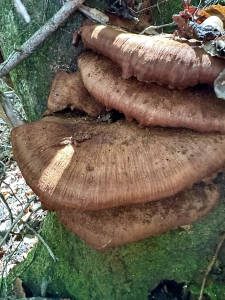
 

I recorded a 58-second video at the infected twin water oak


Again, death is a big part of life in our forests. The twins are diseased. Mycelia are decomposing and decaying the twin. Death is underway. Although macabre, the truth is that the end begins at the start…for all life on earth.


Answer Me This


Just ten feet from the infected twin, I spotted this galvanized nail in another water oak.  Yet another story that I cannot but weakly ponder. Did it mark a survey point? Is it related to transfer of the private property to the city to create the Sanctuary? A scavenger hunt or geocaching site? Pardon the pun, but I am unable to nail the reason!
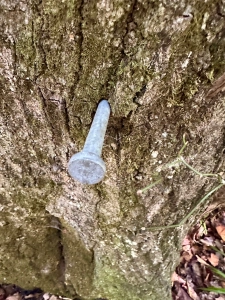
 

I will continue finding riddles I cannot solve.

Water Tupelo Swamp


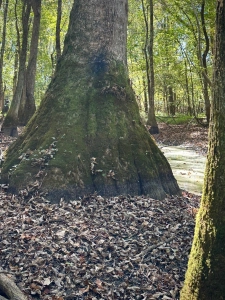
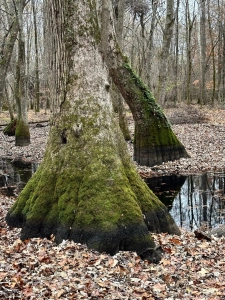
I grew up and attended forestry school far north of the natural range of water tupelo, which may explain my fascination with this forest type. I’ve published at least a dozen Posts about my adventures in this forest type, including several in the Sanctuary. I will offer only an album of photographs without detailed narrative. These buttressed tupelo draw me. The dry season standing water and soil saturation hint at the deeper water ahead in the winter.
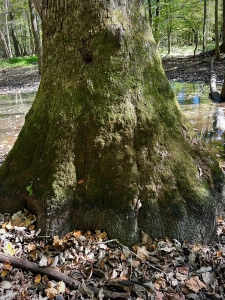
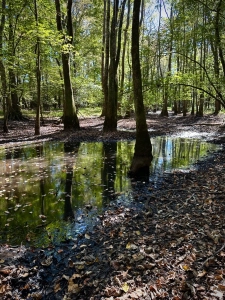
 

You don’t need much beyond my 60-second swamp tour video overview.


Strange tree forms and a haunting aspect dominate.
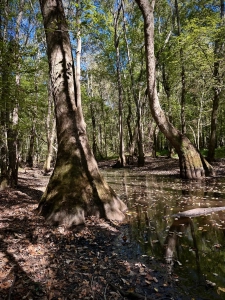
 

This is far removed from the upland hardwood forests I wandered in my youth.
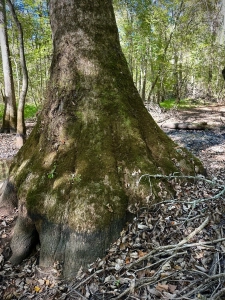
 

I recorded a 48-second video of a massive water tupelo. I estimated its ground-level diameter as 12-14 feet!


I relish the beauty, magic, wonder, awe, and inspiration!


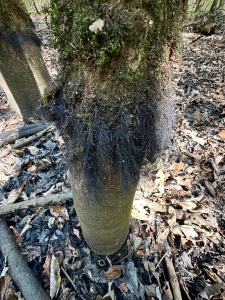
What is the hairy, grizzled, bearded old man of the tupelo forest!?!?


See my related Post (https://stevejonesgbh.com/2025/10/27/brief-form-post-47-strange-bearded-tupelo-trees-air-root-mysteries-and-curiosities/) for the answer!


Thoughts and Reflections


I offer these observations:

  • Tupelo forests are far removed from the upland hardwood forests I wandered in my youth. (Steve Jones)
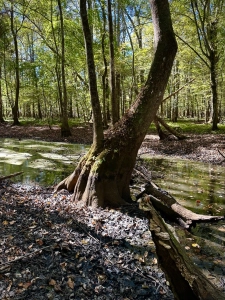
  • Death is a big part of life in our North Alabama forests. (Steve Jones)
  • I have no special talent. I am only passionately curious. (Albert Einstein)

Inhale and absorb Nature’s elixir. May Nature Inspire, Inform, and Reward you!


Note: All blog post images created & photographed by Stephen B. Jones unless otherwise noted. Please circulate images with photo credit: “©2026 Steve Jones, Great Blue Heron LLC. All Rights Reserved.”

I am available for Nature-Inspired Speaking, Writing, and Consulting — contact me at steve.jones.0524@gmail.com

Subscribe to my free weekly photo essays (like this one) at: http://eepurl.com/cKLJdL


Reminder of my Personal and Professional Purpose, Passion, and Cause


If only more of us viewed our precious environment through the filters I employ. If only my mission and vision could be multiplied untold orders of magnitude:

Mission: Employ writing and speaking to educate, inspire, and enable readers and listeners to understand, appreciate, and enjoy Nature… and accept and practice Earth Stewardship.

Vision:

  • People of all ages will pay greater attention to and engage more regularly with Nature… and will accept and practice informed and responsible Earth Stewardship.
  • They will see their relationship to our natural world with new eyes… and will understand more clearly their Earth home.

Tagline/Motto: Steve (Great Blue Heron) encourages and seeks a better tomorrow through Nature-Inspired Living!


Steve’s Four Books


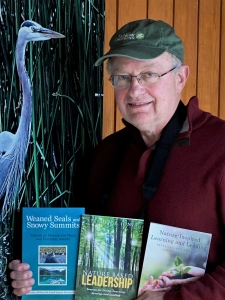
I wrote my books Nature Based Leadership (2016), Nature-Inspired Learning and Leading (2017), Weaned Seals and Snowy Summits: Stories of Passion for Place and Everyday Nature (2019; co-authored with Dr. Jennifer Wilhoit), and Dutton Land & Cattle: A Land Legacy Story (2023) to encourage all citizens to recognize and appreciate that every lesson for living, learning, serving, and leading is either written indelibly in or is powerfully inspired by Nature. All four of my books present compilations of personal experiences expressing my deep passion for Nature. All four books offer observations and reflections on my relationship with the natural world… and the broader implications for society. Order any from your local indie bookstore, or find them on IndieBound or other online sources such as Amazon and LifeRich.

I began writing books and Posts for several reasons:

  • I love hiking and exploring Nature
  • I see images I want to (and do) capture with my trusty iPhone camera
  • I enjoy explaining those images — an educator at heart
  • I don’t play golf!
  • I do love writing — it’s the hobby I never needed when my career consumed me
  • Judy suggested my writing is in large measure my legacy to our two kids, our five grandkids, and all the unborn generations beyond
  • And finally, perhaps my books and Blogs could reach beyond family and touch a few other lives… sow some seeds for the future


Goldsmith-Schiffman Wildlife Sanctuary Exploration with My Alabama Grandsons!

On November 22, 2023, my Alabama grandsons (Jack, age 16, and Sam, age nine) accompanied me to Huntsville, Alabama’s Goldsmith-Schiffman Wildlife Sanctuary. We enjoyed an unusually mild late-November mid-morning through early afternoon, entering from the east side, exploring the riparian hardwood forest, walking along the Flint River shoreline, and visiting the adjacent tupelo swamp. I offer observations, reflections, 27 photos, and four videos.

You can access 26 previous Great Blue Heron Posts from prior trips I’ve made to the Sanctuary. Search Goldsmith under the Blog banner at my website: https://stevejonesgbh.com/


Forest Wonder Potpourri


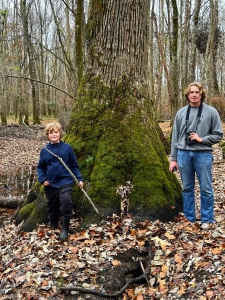
We discovered a potpourri of forest wonders. I’m grateful any time that the boys come along with me. Their lives and interests will in time diverge from their aging Pap’s. I am pleased that they still appreciate and learn from our forest wanderings. The Sanctuary remains one of our favorite destinations.

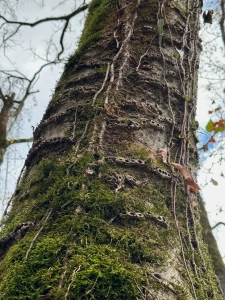
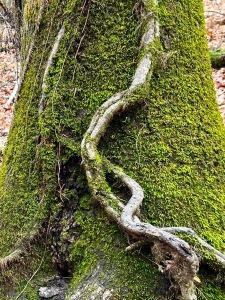
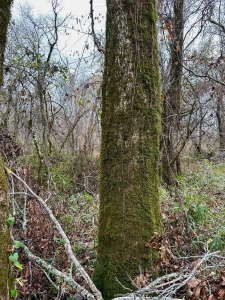
I never tire of finding a forest trunk draped in tree moss. This hickory, just 100 feet from the Flint River, evidences our moist temperate climate and its proximity to the morning fogs and heightened humidity along the river.


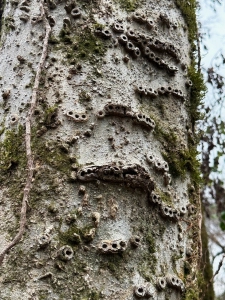
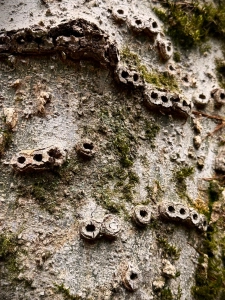
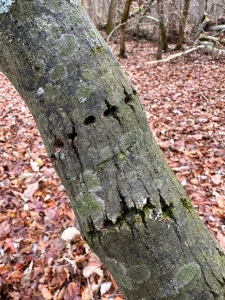
A nearby sugarberry trunk teems with life. Dense tree moss and a Virginia creeper vine adorn the stem below left. At the lower center of the photo at left and up the entire trunk within the photo at right, horizontal rows of yellow bellied sapsucker birdpecks portray a history of woodpecker insect foraging.


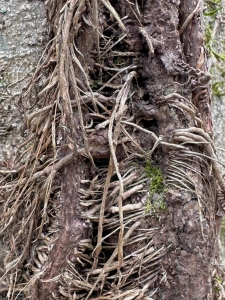
Virginia creeper literally clings to life on this sugarberry tree, its air roots grasping the trunk, assuring lifetime anchorage on its tree trunk lift to the upper canopy rich with direct sun to fuel life-sustaining photosynthesis. It bears repeating that Virginia creeper, wild grapevines, and supplejack do not climb trees. Instead, they grow up with the supporting tree. Imagine this Virginia Creeper germinating beside the sugarberry geminate. The creeper grew vertically at the same rate as the seedling, its leaves with each season remaining in full sunlight.


As with many organisms coexisting in Nature, Virginia creeper and sugarberry seem to have achieved some balance. That is, evolutionarily, the creeper has learned not to overgrow and suffocate the tree, for doing so would kill the vine’s highway to the sky. The vine enjoys a direct, full sunlight benefit from the tree. I am unsure of the reciprocal benefit to the tree from providing a lift to the vine. Without exploring the ecological literature for verification, I can only muse that the vine provides cover and access for birds and small mammals that feed on insects that consume sugarberry leaves. The vines might also ensure a canopy microclimate that deters fungi, viral agents, mold, and bacteria potentially harmful to the tree.

I am smitten by the cylindrical sugarberry birdpeck scars. So much of Nature’s beauty, magic, wonder, and awe is hidden in plain sight.


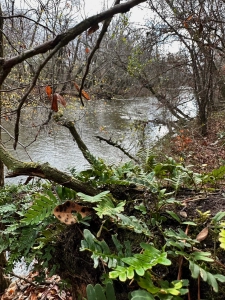
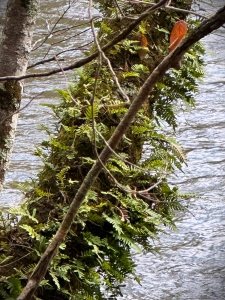
Resurrection fern, no longer in its drought-induced desiccated state, overhhangs the Flint River.


I recorded this 32-second video along the Flint River, amplifying the mood of peace and tranquility:


How can a naturalist not be attracted to such a beauty as this farkleberry (AKA sparkleberry), the largest member of our native blueberries (genus Vaccinium (arboreum)). Even its common names evoke mystery.


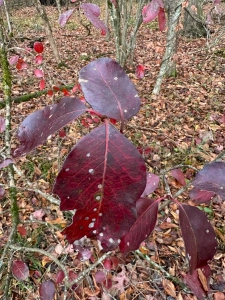
Nearby another handsome shrub drew us closer, a rusty blackhaw. I borrowed this description from an NC State University Extension online reference:

Rusty blackhaw is a deciduous multi-stemmed shrub or small single-stemmed tree in the Viburnaceae (haw) family.  It is native to eastern and central USA and is found in most areas of NC growing in rocky or dry woodlands and forests, along streams and valleys. The name comes from the rusty brown hairs on the undersides of leaves, buds and stems.

Rusty blackhaw grows in dry to moist loams in full sun to partial shade slowly reaching a height and width of 10 to 20 feet. Clusters of small, white flowers mature in early spring followed by a blue drupe that matures in fall. The leaves have excellent fall color. 


I love the dormant season with full understory visibility, no biting insects, and comfortable temperatures!


Tupelo Swamp


I recorded this 57-second video in the water tupelo swamp on the Sanctuary’s northeast quadrant. Recent rains were just beginning to rewater the swamp.


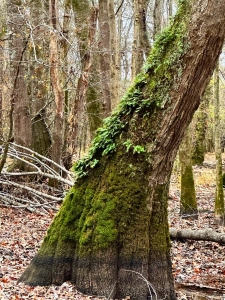
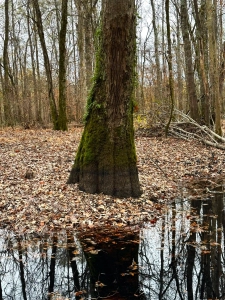
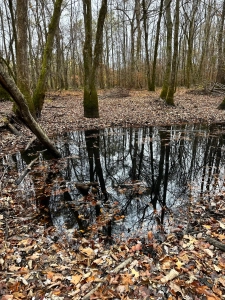
Tree moss skirts, clinging vines, buttressed trunks, swamp stain lines, and a forest floor bereft of vegetation characterize the Sanctuary’s tupelo stands. I am tempted to refer to these stands as special places, yet I could just as logically term dozens of other elements of the Sanctuary as special places.


Note the swamp water stain lines (on the tree at left) suggesting normal winter water depth). I wear my calf-high rubber boots when I visit mid-winter.


I recorded this 17-second video within the swamp. I am intent on making these grandson forays meaningful, educational, and fun.


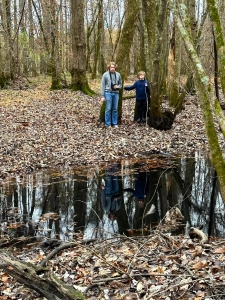
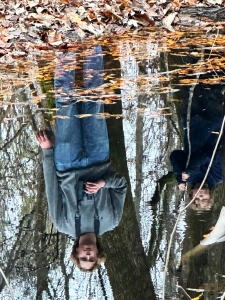
I seek to inspire mindful reflection, even as I remain alert to Nature’s reflections. Both of these photographs express the purpose and realization of that goal.


I can’t add anything to the power of this photo essays by adding to the verbal narrative.


Here’s a 36-second video from the same location.


These graceful swamp residents pose dutifully, seeming intent to reward our visit with their majestic form and rhythm.


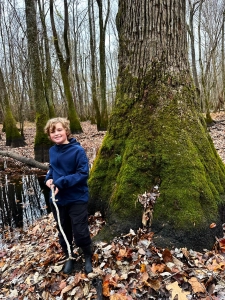
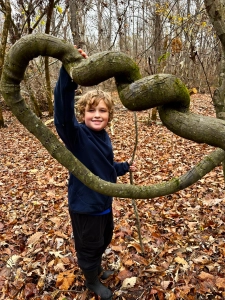
Back to the riparian forest, Sam poses with a hefty supplejack vine. The stem it had once wrapped is long since dead and decayed, leaving only the vine corkscrew. Yellow-bellied sapsucker birdpeck scars encircle the supplejack at right.


A Few Living Critters!


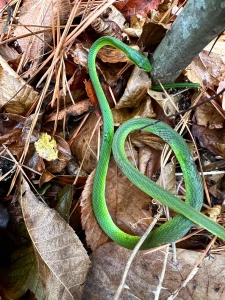
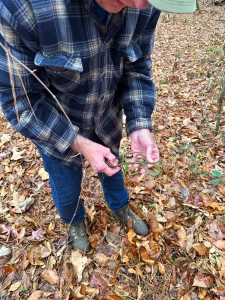
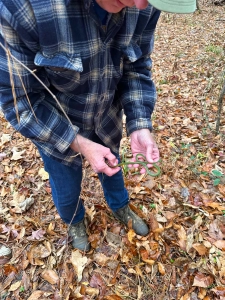
A mild late fall day, a rough greensnake surprised us, accommodating our disturbance and gentle handling. We anticipated we might see deer or squirrels, but did not expect to see a coldblooded critter. We bid the snake adieu.


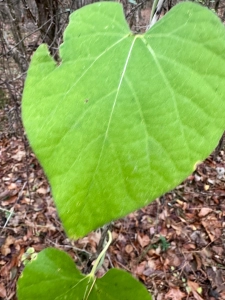
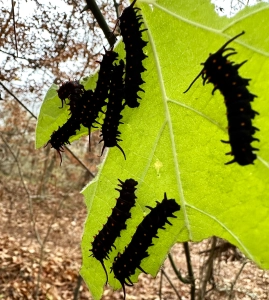
As we examined the snake, I noticed a few still-green pipevine leaves nearby. Knowing the plant’s exclusive hosting relationship to the pipevine swallowtail, I looked more closely, discovering a troop of the butterfly’s caterpillars. Online literature suggests that the larvae will soon form a chrysalis suspended several feet above the ground.


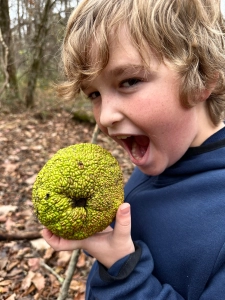
I’ll bring closure with this image of Sam feigning a bite from the fruit (some call it a hedge apple) of an osage orange.


We three boys enjoyed a great morning and early afternoon. I can only hope that they will remember these Nature outings as highlights of their young lives, and that the experiences yield a lasting relationship with Nature.

Thoughts and Reflections


I offer these observations:

  • I am intent on making these grandson forays meaningful, educational, and fun.
  • I love the dormant season with full understory visibility, no biting insects, and comfortable temperatures!
  • The Sanctuary, as do most wild areas of my acquaintance, hosts many special places.

Inhale and absorb Nature’s elixir. May Nature Inspire, Inform, and Reward you!


Note: Unless otherwise noted, all blog post images are created & photographed by Stephen B. Jones. Please circulate images with photo credit: “©2024 Steve Jones, Great Blue Heron LLC. All Rights Reserved.”

Another Note: If you came to this post via a Facebook posting or by another route, please sign up now (no cost… no obligation) to receive my Blog Post email alerts: http://eepurl.com/cKLJdL

And Third: I am available for Nature-Inspired Speaking, Writing, and Consulting — contact me at steve.jones.0524@gmail.com


A reminder of my Personal and Professional Purpose, Passion, and Cause

If only more of us viewed our precious environment through the filters I employ. If only my mission and vision could be multiplied by untold orders of magnitude:

Mission: Employ writing and speaking to educate, inspire, and enable readers and listeners to understand, appreciate, and enjoy Nature… and accept and practice Earth Stewardship.

Vision:

  • People of all ages will pay greater attention to and engage more regularly with Nature… and will accept and practice informed and responsible Earth Stewardship.
  • They will see their relationship to our natural world with new eyes… and understand their Earth home more clearly.

Tagline/Motto: Steve (Great Blue Heron) encourages and seeks a better tomorrow through Nature-Inspired Living!


Steve’s Three Books


I wrote my books Nature Based Leadership (2016), Nature-Inspired Learning and Leading (2017), and Weaned Seals and Snowy Summits: Stories of Passion for Place and Everyday Nature (2019; co-authored with Dr. Jennifer Wilhoit) to encourage all citizens to recognize and appreciate that every lesson for living, learning, serving, and leading is either written indelibly in or is powerfully inspired by Nature.

I began writing books and Posts for several reasons:

  • I love hiking and exploring Nature
  • I see images I want to (and do) capture with my trusty iPhone camera
  • I enjoy explaining those images — an educator at heart
  • I don’t play golf!
  • I do love writing — it’s the hobby I never needed when my career consumed me
  • Judy suggested my writing is in large measure my legacy to our two kids, our five grandkids, and all the unborn generations beyond
  • And finally, perhaps my books and Blogs could reach beyond family and touch a few other lives… sow some seeds for the future


All three of my books (Nature Based LeadershipNature-Inspired Learning and LeadingWeaned Seals and Snowy Summits) present compilations of personal experiences expressing my (and co-author Dr. Wilhoit for Weaned Seals and Snowy Summits) deep passion for Nature. All three books offer observations and reflections on my relationship with the natural world… and the broader implications for society. Order any from your local indie bookstore, or find them on IndieBound or other online sources such as Amazon and LifeRich.

I now have a fourth book, published by Dutton Land and Cattle Company, Dutton Land & Cattle: A Land Legacy Story. Available for purchase directly from me. Watch for details in a future Post.