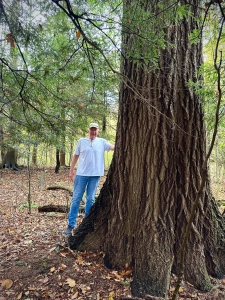
Posts

Brief-Form Post #53: Wolf Creek Narrows Forest Renewal in an Old Growth Northern Hardwood Stand!


I am pleased to add the 53rd of my GBH Brief-Form Posts (Less than five minutes to read!) to my website. I get wordy with my routine Posts. I don’t want my enthusiasm for thoroughness and detail to discourage readers. So, I will occasionally publish these brief Posts.


Wolf Creek Narrows Natural Area, owned and managed by the Western Pennsylvania Conservancy (WPC), is in northwestern Butler County, Pennsylvania, just 30 minutes from where my son and his family reside north of Pittsburgh. Matt, his dog Oakley, and I circuited the 2.35-mile trail on the morning of September 22, the first day of autumn. My heart soared at the prospect of returning to an ecosystem shaped by a continental ice sheet just 13 millennia ago. This Post focuses on a recent blowdown within the Natural Area and my reflections on the implications for the affected stand.


Blowdown in the Forest


All forests are in flux. Individual trees germinate, grow, senesce, and die. Forests come and go with disturbance. Wind, ice, fire, insects, and disease affect trees and entire forests. I observe often that death is a big part of life in forested ecosystems and, for that matter, in any ecosystem. Within a discreet portion of the Wolf Creek Narrows Natural Area old growth forest, a wind storm (thunderstorm downdraft or microburst; derecho; tornado; or perhaps sustained winter gales) toppled enough mature trees to give the affected stand a unique character.
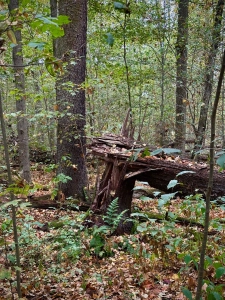
 

The fallen trees align parallel to the wind direction, their lower trunks shattered or the entire tree uprooted. Based on the apparent progress of woody debris decay, I estimate that the wind event occurred within the past three years.
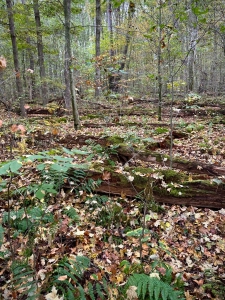
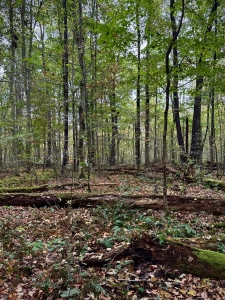
 

The wind eliminated enough overstory canopy to significantly reduce forest floor shading. Already understory woody and herbaceous plants are responding with increased vitality. Nature abhors a vacuum.
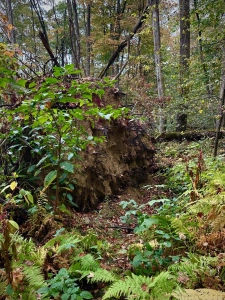
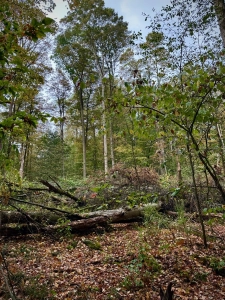
 

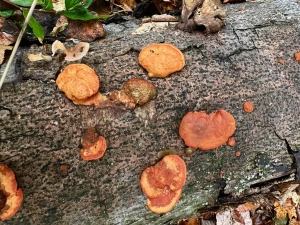
A cinnabar bracket fungus has colonized this downed American beech, evidencing that the windthrow-accelerated carbon cycling is in full gear.
 

Elevated root mounds provide ideal sites for herbaceous exploitation. White ash seedlings are quickly colonizing the forest floor on either side of the downed white ash tree.
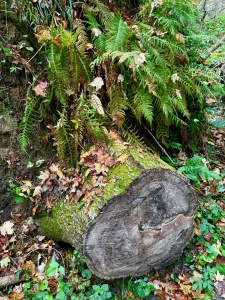
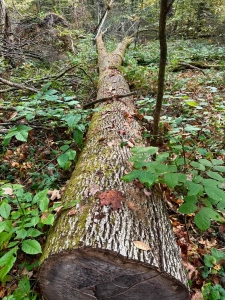
 

Not all of the downed trees resulted from the discreet recent event. These trunks toppled more than five years ago. This hardwood stand, like most of Pennsylvania’s forests, is probably even-aged, regenerating following some catastrophic event, such as timber harvesting, widespread major wind, or fire.
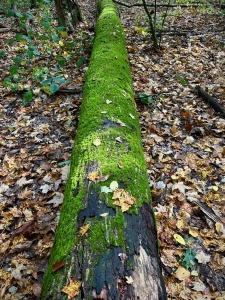
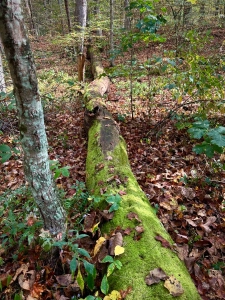
 

An even-aged forest grows in a predictable manner. The inverse J-shaped diameter distribution is one such formulaic metric. Consider the graphs below as a generalized representation of the growth pattern across time. A young even-aged stand my have thousands of stems per acre. Look above at the many ash seedlings surrounding the single mature fallen ash. Over decades, the stand density (stems per unit area) declines. What may have been thousands becomes hundreds, and ultimately scores and dozens. Average stem diameter of the white ash seedlings (two rows above) is less than an inch. The fallen mother (seed source) tree is perhaps two feet.


The tendancy of an even-aged old growth hardwood forest is to gradually transition naturally to uneven-age. Some of the windthrow openings may be large enough to allow trees, their germination triggered by the recent storm, to emerge into the upper canopy, representing a younger age class. Many of the openings will at least be large enough to allow a sapling or mid-canopy cohort to establish, staging one or more of those individuals to rapidly ascend into the main canopy when a subsequent storm topples a large dominat tree, or a cluster of the original old growth cohort.

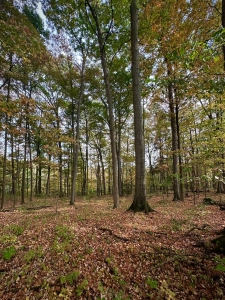
The forest is in no hurry. Its evolutionary pathway prepared this very successful admixture of species to flourish and persist when conditions are favorable and respond when change presents opportunities. The ash seedlings are already carpeting the ground now blessed with open canopy sunlight. Although my examinations were only surperficial, I observed that American beech, sugar maple, and white oak are stand components. They are shade tolerant species that can persist for decades under a full canopy. They and others are poised to constitute a greater percentage of the future dominant canopy.

The forest is changing, as are all forests. The wind event accelerated the change. I’d like to monitor it annually over another several decades, but my own life curve continues unabated. Perhaps I can revisit Wolf Creek Narrows another time or two, but there are no guarantees. I am grateful for having made this inaugural visit. I’ve learned something of this slice of Nature near to my son’s home and not too far from where I conducted my forestry doctoral research four decades ago.

I am addicted to special places and everyday Nature. Wolf Creek Narrows Natural Area is one such Special Place.


Closing


I accept the challenge of distilling these Brief-Form Posts into a single distinct reflection, a task far more elusive than assembling a dozen pithy statements.

I cannot offer a quote more apropos than an observation I made in the text above:

The forest is in no hurry. Its evolutionary pathway prepared it to flourish and persist when conditions are favorable, and to respond when change presents opportunities to exploit.


Nature’s special treats await our discovery, our understanding, and our interpretation!


Subscribe to my free weekly photo essays (like this one) at: http://eepurl.com/cKLJdL
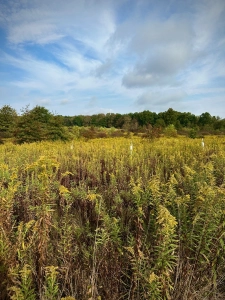


The Meadow at Pennsylvania’s Wolf Creek Narrows Natural Area

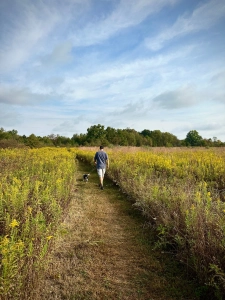
Wolf Creek Narrows Natural Area, owned and managed by the Western Pennsylvania Conservancy (WPC), is located in northwestern Butler County, Pennsylvania, just 30 minutes from where my son and his family reside north of Pittsburgh. Matt, his dog Oakley, and I circuited the 2.35-mile trail on the morning of September 22, the first day of autumn. My heart soared at the prospect of returning to an ecosystem shaped by a continental ice sheet just 13 millennia ago. This Post focuses on our passages (out from the trailhead and back) through a goldenrod-dominated autumn meadow.


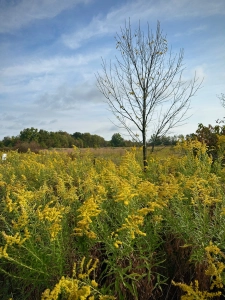
The 243 acre Natural Area includes several distinct ecosystems: meadow; forest/field ecotone; upland forest, forested riparian zone; and the immediate Slippery Rock Creek. I like the openess of the meadow, accenting the vibrant autumn sky above. Meadows are temporary landscape features unless managed to short-circuit the natural successional impetus to transition to forest cover. I am not sure whether the ash sapling in the photo at right was planted or is a volunteer.


The perennial herbacious cover is dense, ideal for songbirds, small mammals, snakes, and other critters. As I drafted this text on December 2, 2025, western Pennsylvania was reporting several inches of fresh snow. I imagine diverse wildlife hunkered in the tangled vegetation beneath the snow.

I recorded this 58-second video in the luscious goldenrod meadow.


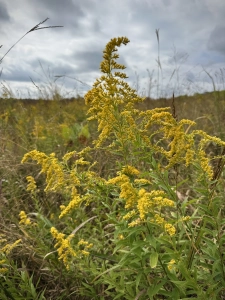
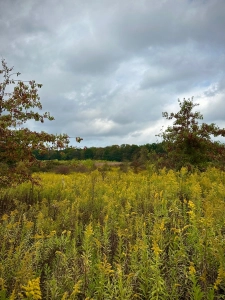
I can’t resist the image of goldenrod backdropped by the fall sky. The air, comfortable and clear, cut through my North Alabama mental fatigue with a long summer and a September dry spell. This a meadow still fresh, blooming, and vibrant, awaiting a first freeze, autumn rains, and an impending deep winter rest.


Hiking the meadow with Matt, sharing the autumn sunshine and exploration, reminded me of Einstein’s view of extending our life-reach beyond our own fleeting existence:

Our death is not an end if we can live on in our children and the younger generation. For they are us; our bodies are only wilted leaves on the tree of life. (Albert Einstein)

Some videos express the essence of a special place better without narration. I recorded this 59-second video focusing on the sounds of autumn breezes and late season insects.


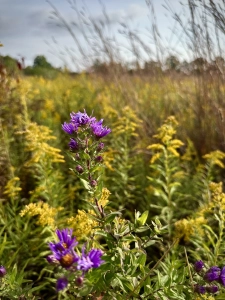
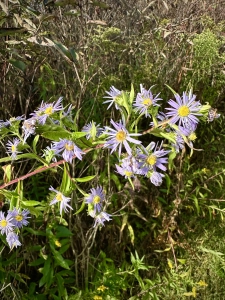
An ideal stage for late season bloomers, the meadow celebrates the end of a full summer of generous meadow sunshine with goldenrod, New England aster, and smooth blue aster. Bright flowers will greet the icy fingers certain to come.


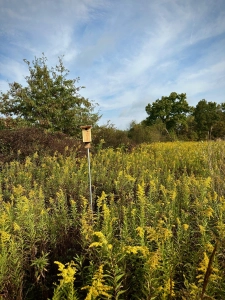
Supplemental wildlife accoutrements (a bluebird nesting box) enrich the meadow bird habitat.


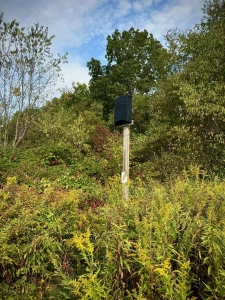
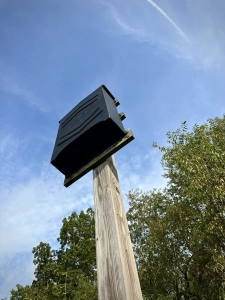
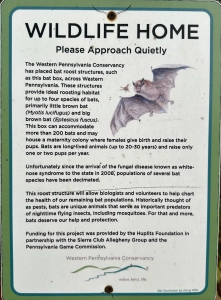
As does the bat house at the meadow/forest edge.


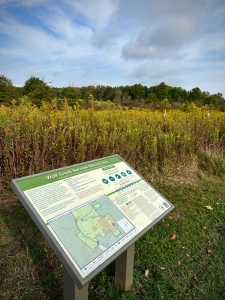
I compliment the LConservancy for both the artificial nesting structures and the excellent interpretive signage.


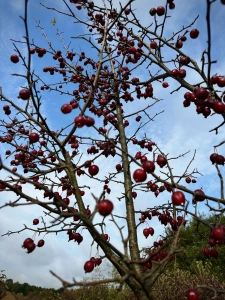
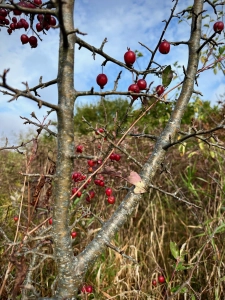
Pear leaf crabapple is both an excellent wildlife food source and an early meadow colonizer in the successional steps toward natural forest regeneration.


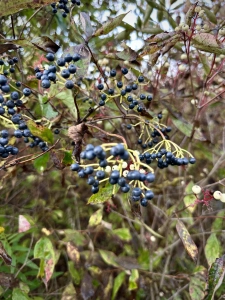
The same is true of northern arrowwood. Both species are prolific producers of fruit that wildlife consumes, digestively scarifies its seeds, and disseminates to enable further colonization.


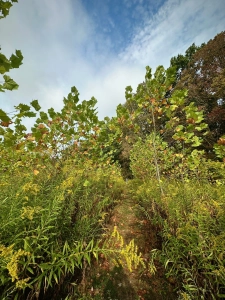
Two red oaks (left) and numerous sycamore saplings represent the advancing forest along the meadow’s north flank, which is a separate ecotone, neither meadow or forest. View the oak and sycamore saplings as scouts from the advancing forest army. Imagine a squierrel caching an acorn in rich soil under the goldenrod, and then losing track of it. The acorn sprouts with spring’s warmth. The seedling oak flourishes in full sunlight, partially protected by the 4-6-foot-high meadow vegetation from deer and rabbit browsing. The oaks are now out of easy reach of the hungry mammals. This day’s northwesterly breezes may be carrying windborne sycamore seed, potentially extending the forest deeper into the meadow.


The scouts will give way to an outright forest invasion. This isn’t the forest successionary army’s first rodeo. Just 13,000 years ago, the vast continental ice sheet yielded to a warming climate. Hundreds of millions of acres of once fertile and forested land emerged from the deep icepack barren and stark, stretching from the former ice edge near here far into the sub-Arctic Canadian Shield. That wild expanse, now ruchly forested, attests to Nature’s capacity to reclaim devastated territory, whether blasted by Mt. Saint Helens (1980), incinerated by the Big Burn (1910 in Washington, Idaho, and Montana), or savagely innundated by tropical storm remnants flushing western North Carolina river bottomland forests (The Great Flood of 1916). A beautiful postage stamp upland meadow in modern day Butler County Pennsylvania is just a bump in the road for an advancing vegetative front intent on expanding a forest.

I recorded this 59-second video at the meadow/woodland edge ecotone.


The real challenge falls to the Western Pennsylvania Conservancy managers. How do they hold the forest at bay, if indeed that is their objective, which I hope it is. I appreciate and value ecosystem diversity. I won’t attempt to recommend a treatment scenario. I have little relevant expertise, beyond thinking that fire may be among the alternatives.

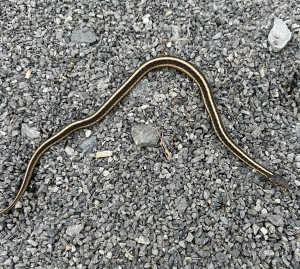
I do know that the common garter snake we spotted in the meadow depends on the meadow ecotype, as do many other wildlife species.


How long will the meadow survive as a unique ecosystem without management practices, like bush-hogging, prescribed fire, selective herbicide treatments, and other alternatives? No matter where my Nature wanderings take me, I discover a constant: Nothing in Nature is Static. Nothing remains the same. In this case, human intervention will be necessary to keep the meadow…a meadow.

I often turn to John Muir for words that succinctly capture my sentiments…far better than my own feelings. Of my passion for the meadow, I turn to Muir:

Everybody needs beauty as well as bread, places to play in and pray in, where nature may heal and give strength to body and soul.


Thoughts and Reflections


I offer these observations:

  • Nothing in Nature is Static. Nothing remains the same. (Steve Jones)
  • Everybody needs beauty as well as bread, places to play in and pray in, where nature may heal and give strength to body and soul. (John Muir)
  • Our death is not an end if we can live on in our children and the younger generation. For they are us; our bodies are only wilted leaves on the tree of life. (Albert Einstein)

Inhale and absorb Nature’s elixir. May Nature Inspire, Inform, and Reward you!


Note: All blog post images created & photographed by Stephen B. Jones unless otherwise noted. Please circulate images with photo credit: “©2025 Steve Jones, Great Blue Heron LLC. All Rights Reserved.”

I am available for Nature-Inspired Speaking, Writing, and Consulting — contact me at steve.jones.0524@gmail.com


Subscribe to these free weekly Nature Blogs (photo essays) at: http://eepurl.com/cKLJdL
 

Reminder of my Personal and Professional Purpose, Passion, and Cause

If only more of us viewed our precious environment through the filters I employ. If only my mission and vision could be multiplied untold orders of magnitude:

Mission: Employ writing and speaking to educate, inspire, and enable readers and listeners to understand, appreciate, and enjoy Nature… and accept and practice Earth Stewardship.

Vision:

  • People of all ages will pay greater attention to and engage more regularly with Nature… and will accept and practice informed and responsible Earth Stewardship.
  • They will see their relationship to our natural world with new eyes… and will understand more clearly their Earth home.

Tagline/Motto: Steve (Great Blue Heron) encourages and seeks a better tomorrow through Nature-Inspired Living!


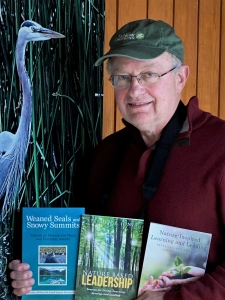
Steve’s Four Books


I wrote my books Nature Based Leadership (2016), Nature-Inspired Learning and Leading (2017), Weaned Seals and Snowy Summits: Stories of Passion for Place and Everyday Nature (2019; co-authored with Dr. Jennifer Wilhoit), and Dutton Land & Cattle: A Land Legacy Story (2023) to encourage all citizens to recognize and appreciate that every lesson for living, learning, serving, and leading is either written indelibly in or is powerfully inspired by Nature. All four of my books present compilations of personal experiences expressing my deep passion for Nature. All four books offer observations and reflections on my relationship with the natural world… and the broader implications for society. Order any from your local indie bookstore, or find them on IndieBound or other online sources such as Amazon and LifeRich.

I began writing books and Posts for several reasons:

  • I love hiking and exploring Nature
  • I see images I want to (and do) capture with my trusty iPhone camera
  • I enjoy explaining those images — an educator at heart
  • I don’t play golf!
  • I do love writing — it’s the hobby I never needed when my career consumed me
  • Judy suggested my writing is in large measure my legacy to our two kids, our five grandkids, and all the unborn generations beyond
  • And finally, perhaps my books and Blogs could reach beyond family and touch a few other lives… sow some seeds for the future


The Northern Hardwood Forest at Pennsylvania’s Wolf Creek Narrows Natural Area

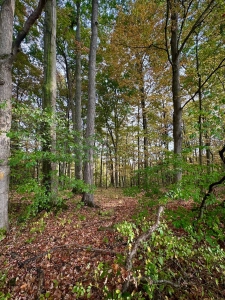
Wolf Creek Narrows Natural Area, owned and managed by the Western Pennsylvania Conservancy (WPC), is located in northwestern Butler County, Pennsylvania, just 30 minutes from where my son and his family reside north of Pittsburgh. Matt, his dog Oakley, and I circuited the 2.35-mile trail on the morning of September 22, the first day of autumn. I focus this photo essay on the exquisite old-growth northern hardwood forest.

My heart soared at the prospect of returning to an ecosystem shaped by a continental ice sheet just 13 millennia ago. The absolute freshness and newness stimulate wild conjecture and total admiration for Nature’s rapid recovery from thousands of feet of ice.

The Western PA Conservancy provided an online description:

Wolf Creek Narrows Natural Area is particularly known for its spectacular display of spring wildflowers. An active floodplain, mature northern hardwood forest, and scenic cliffs make this property one of WPC’s most popular. It is believed that the steep, narrow gorge of Wolf Creek Narrows originally formed when the ceiling of an ice-age cave eroded and collapsed due to runoff from the melting glacier. The site now consists of a high-quality stream meandering through towering 50-foot cliffs. These natural processes, including annual flooding and ice scouring, as well as limited human activities, have resulted in diverse natural communities.

We have lots of karst topography and abundant caves in my present home range of northern Alabama, but nothing so exciting as ice-age caves and ice scouring!

The meadow trail below led into the deep forest.


Okay, I’ve opened the portal to Wolf Creek Narrows. Now comes the tough part. How do I package 31 photos and two brief videos into a Post digestible within 15-minutes? Species resident to the Allegheny Hardwood forests of my 1984-85 NW PA and SW NY PhD field research welcomed me with warm and comforting embrace.


I’ve found that brief videos tell a richer tale than still photographs and written narrative. I recorded this 58-second video within the mixed forest. I hope that I’ve stimulated your interest in this special place.


The Narrows and Wolf Creek lie beyond the forest edge.


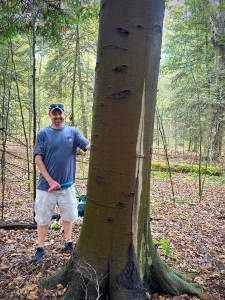
Matt stands six-feet tall, behind a 30-inch diameter American beech. The red oak beyond the beech (at left) is nearly 40-inches in diameter.


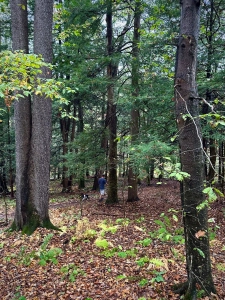
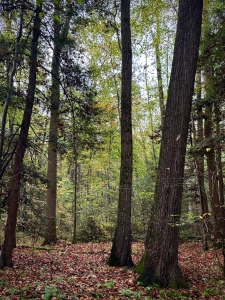
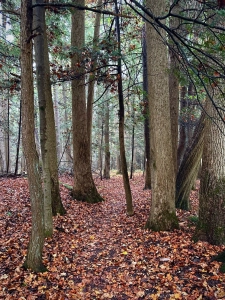
You don’t need my narrative to appreciate the beauty, magic, inspiration, and awe of this park-like northern hardwood wonderland.


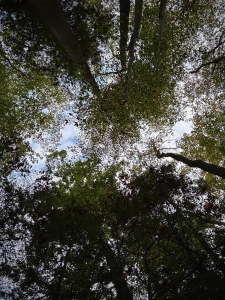
Take a look heavenward into this cathedral forest canopy.


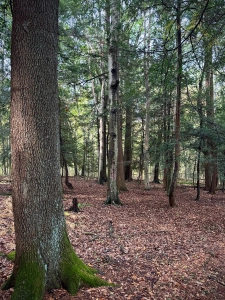
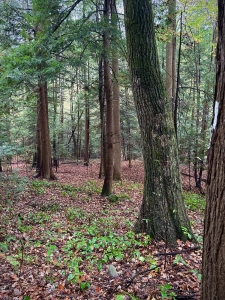
I love the deep shade and open understory far below.


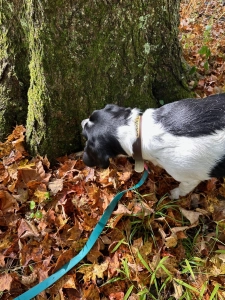
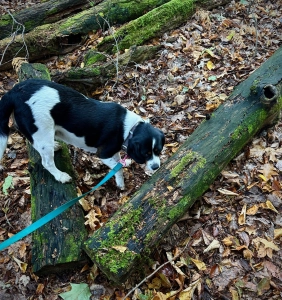
I frequently lead or co-lead organized woodland Nature excursions (saunters) in parks, preserves, refuges, and sanctuaries near my Madison, Alabama home. Like John Muir, I prefer sauntering in the woods…abhoring hurrying through the forest. I noticed that Oakley takes the same approach, sniffing and scenting her way within the woods, reading the signs, never missing an olfactory clue. My iPhone camera substitutes for scenting. So much of what I seek in Nature lies hidden in plain sight. I believe my own joy in discovery matches Oakley’s!


I can’t imagine Oakley concerned with steps, miles, time elapsed, or other metrics. For her, each sniff tells a tale. My objective is to learn from every Nature venture, intent upon constructing a meaningful tale in form of a photo essay like this one.

In fact, my retirement mission, practiced in these Posts, is to: Employ writing (and photography) to educate, inspire, and enable readers and viewers to understand, appreciate, and enjoy Nature… and accept and practice Earth Stewardship.

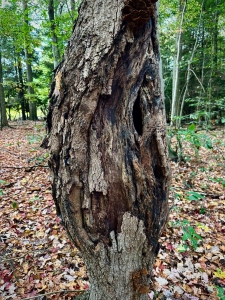
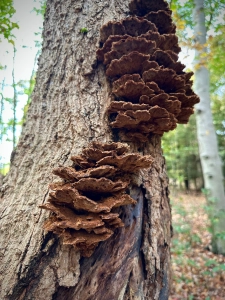
I keep my nose fine-tuned for sniffing tree form oddities and curiosities. A living, deeply decayed, cankered intermediate canopy sugar maple forced me to snap photographs of both the canker and the brown mushrooms above. How long ago did the fungus (or fungi) infect the sugar maple? How long will the tree survive? Death is a big part of life in the forest, whether west-central Pennsylvania or Alabama’s Tennessee River Valley.


Again, so much in Nature lies hidden in plain sight. Oakley discovered untold olfactory treasures. Most un-attuned hikers would not have seen, understood, and appreciated the visual treasures I encountered in our brief morning excursion. Allow me now to superficially catalog the more notable main canopy tree species.


Diverse Species Introductions


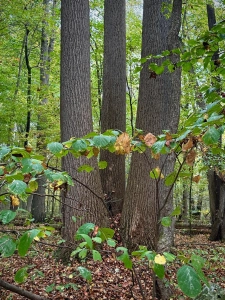
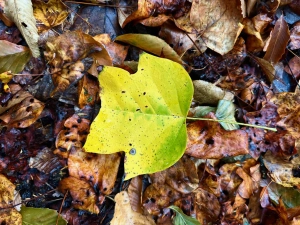
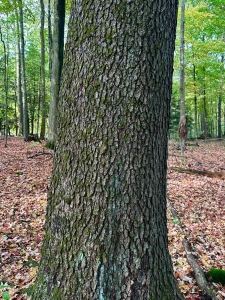
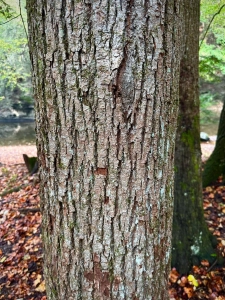
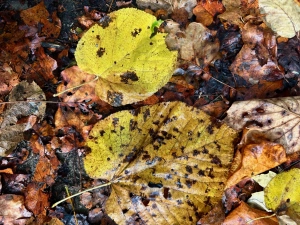
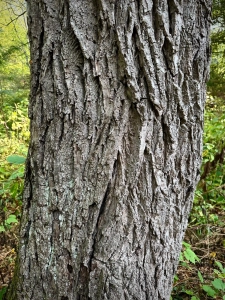
With little need for extensive narrative, I offer photos expressing the forest’s dominant upper canopy tree species. Yellow poplar reigns supreme at Wolf Creek Narrows, just as the species rules the high canopy at my favorite deep forest stand along the Wells Memorial Trail in Alabama’s Monte Sano State Park.


I recorded this 59-second video of the forest’s mixed species.


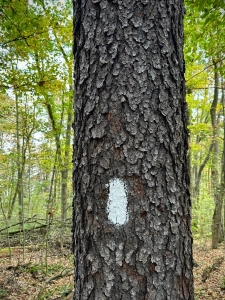
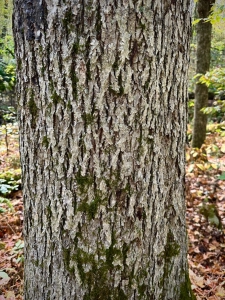
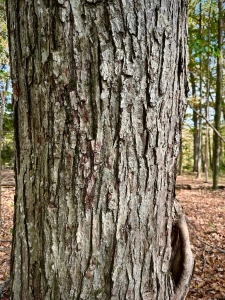
I conducted my doctoral field research in the Allegheny Hardwood forests within 80 miles of Wolf Creek…forests dominated by black cherry.  I revere the species for its beautiful high grade furniture wood, superior height growth, straight form, and handsome bark and foliage. The white-trail-marked black cherry (image below right) delivered a message meant for me. The species marked my professional development re-route. I worked 12 years after earning my Forestry BS for a southern paper and allied products manufacturing company that relied heavily on loblolly pine, a utility species here in the Southeast. Black cherry is anything but a utility species. It’s the filet mignon of furniture grade timber. Black cherry served as the North Star for my second career launch. The big white-blazed cherry signaled that the species remains a major emblem and totem for my path well into retirement. Among my fellow Union Camp foresters, I chose the path less traveled…one lined by black cherry trees (the other edged by loblolly pine) leading to a PhD and 35 years at nine universities.

Two roads diverged in a wood, and I—
I took the one less traveled by,
And that has made all the difference.

(Robert Frost)


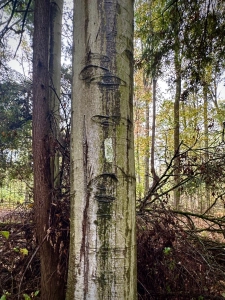
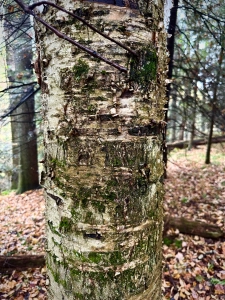
American beech and yellow birch reminded me of my love for northern hardwood forests.


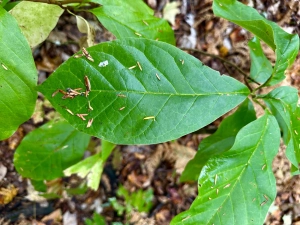
Basswood (tree and leaves) also ranges into northern Alabama, but the entire mixed species forest package at Wolf Creek represents a special orchestration that strokes my psyche and lifts my entire body, heart, mind, soul, and spirit. The assemblage reached me as Art Garfunkel belting his full-bodied Bridge Over Troubled Waters!


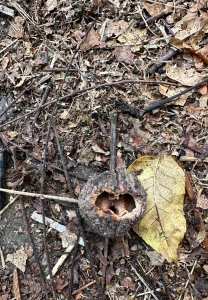
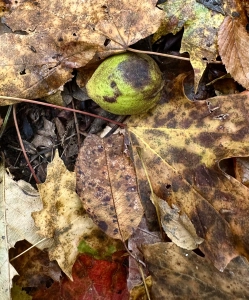
Black walnut tree and nut.


Bitternut hickory.


And nut.


Cucumber tree and leaf.


Red oak, deep memories, and an older gent feeling young-at-heart experiencing a symbolic step into his past…at home in a place he’d never been before.


Forests like this netted me decades ago, never completely allowing release. I think of Robert Service’s The Spell of the Yukon:

The freshness, the freedom, the farness–

O God! how I’m stuck on it all.

There’s a land–oh, it beckons and beckons,

And I want to go back–and I will.

It’s the great, big, broad land ‘way up yonder,

It’s the forest where silence has lease;

It’s the beauty that thrills me with wonder,

It’s the stillness that fills me with peace.

Some of me remains in the Far Northland of Alaska, where we lived 2004-08. Service nailed the place and my sentiment. In similar fashion, vestiges of these magnificent northern hardwood forests habituate my psyche. I want to go back–and I will, if only to the nearby Wells Memorial Trail, a suitable southern version of a rich upland forest.


Thoughts and Reflections


I offer these observations:

  • The rich northern hardwood forest is an orchestral composition, a natural Bridge Over Troubled Waters. (Steve Jones)
  • Black Cherry is a trail marker species, both a literal guide through the Wolf Creek Narrows forest…and a career/life path symbol and guidepost for me. (Steve Jones)
  • Mine is a story of passion for place and everyday Nature. (Steve Jones)

Inhale and absorb Nature’s elixir. May Nature Inspire, Inform, and Reward you!


Note: All blog post images created & photographed by Stephen B. Jones unless otherwise noted. Please circulate images with photo credit: “©2025 Steve Jones, Great Blue Heron LLC. All Rights Reserved.”

I am available for Nature-Inspired Speaking, Writing, and Consulting — contact me at steve.jones.0524@gmail.com

Subscribe to these free weekly Nature Blogs (photo essays) at: http://eepurl.com/cKLJdL
 

Reminder of my Personal and Professional Purpose, Passion, and Cause

If only more of us viewed our precious environment through the filters I employ. If only my mission and vision could be multiplied untold orders of magnitude:

Mission: Employ writing and speaking to educate, inspire, and enable readers and listeners to understand, appreciate, and enjoy Nature… and accept and practice Earth Stewardship.

Vision:

  • People of all ages will pay greater attention to and engage more regularly with Nature… and will accept and practice informed and responsible Earth Stewardship.
  • They will see their relationship to our natural world with new eyes… and will understand more clearly their Earth home.

Tagline/Motto: Steve (Great Blue Heron) encourages and seeks a better tomorrow through Nature-Inspired Living!


Steve’s Four Books


I wrote my books Nature Based Leadership (2016), Nature-Inspired Learning and Leading (2017), Weaned Seals and Snowy Summits: Stories of Passion for Place and Everyday Nature (2019; co-authored with Dr. Jennifer Wilhoit), and Dutton Land & Cattle: A Land Legacy Story (2023) to encourage all citizens to recognize and appreciate that every lesson for living, learning, serving, and leading is either written indelibly in or is powerfully inspired by Nature. All four of my books present compilations of personal experiences expressing my deep passion for Nature. All four books offer observations and reflections on my relationship with the natural world… and the broader implications for society. Order any from your local indie bookstore, or find them on IndieBound or other online sources such as Amazon and LifeRich.

I began writing books and Posts for several reasons:

  • I love hiking and exploring Nature
  • I see images I want to (and do) capture with my trusty iPhone camera
  • I enjoy explaining those images — an educator at heart
  • I don’t play golf!
  • I do love writing — it’s the hobby I never needed when my career consumed me
  • Judy suggested my writing is in large measure my legacy to our two kids, our five grandkids, and all the unborn generations beyond
  • And finally, perhaps my books and Blogs could reach beyond family and touch a few other lives… sow some seeds for the future