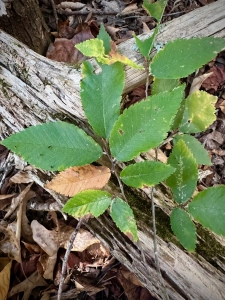
I am pleased to add the 52nd of my GBH Brief-Form Posts (Less than five minutes to read!) to my website. I get wordy with my routine Posts. I don’t want my enthusiasm for thoroughness and detail to discourage readers. So, I will occasionally publish these brief Posts.
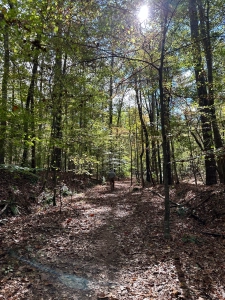
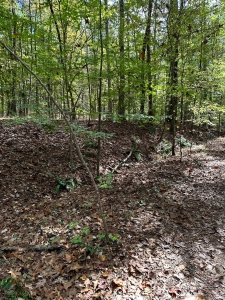
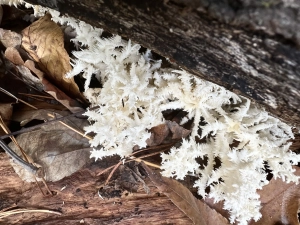
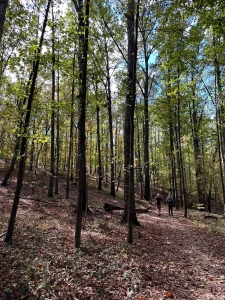
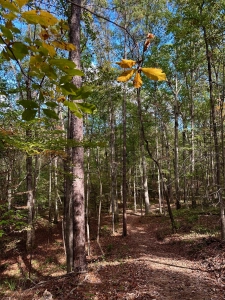
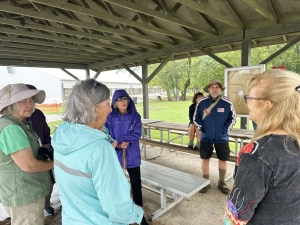
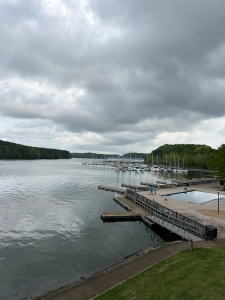
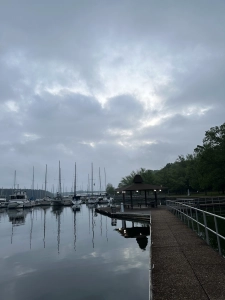
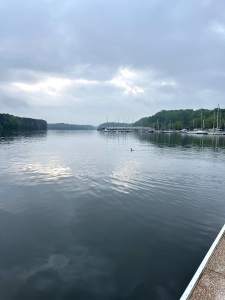
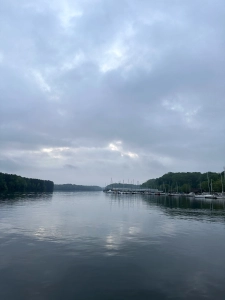
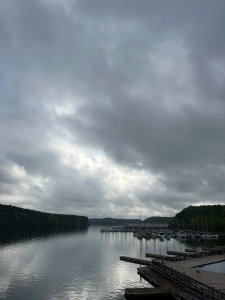
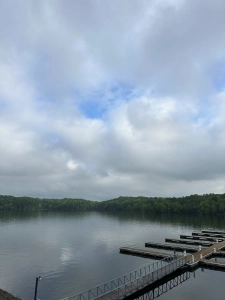
Fellow retired forester Chris Stuhligher and I visited Lake Guntersville State Park (LGSP) on October 23, 2025, to scout a scheduled spring 2026 eagle view outing for the University of Alabama in Huntsville Osher Lifelong Learning Institute (OLLI). The LGSP map in hand, we stopped by several indicated locations. I present an overview of our afternoon ramblings, keeping the narrative brief and technically superficial.
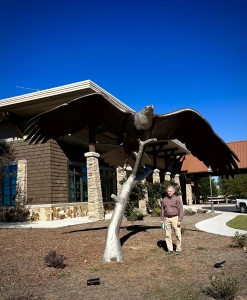
The eagle at the lodge set the tone for our scouting venture.
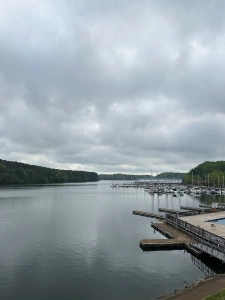
We enjoyed lunch at the lodge restaurant, our table overlooking the lake.
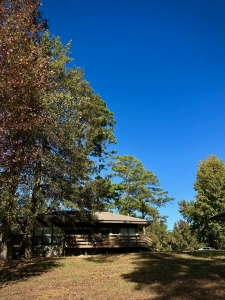
Cabins Shoreline
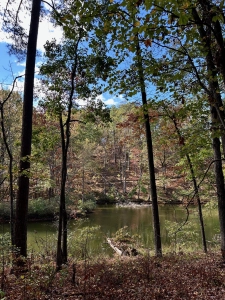
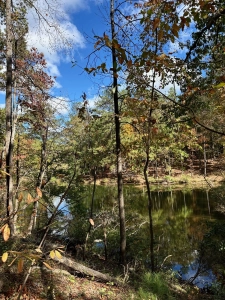
Our first suggested viewing spot was the shoreline adjacent to the cabins. We were to search the opposite bank for a summer-foliage-obscured nest. We did not find it, yet we spotted a pair of eagles soaring above us, an adult and an immature.
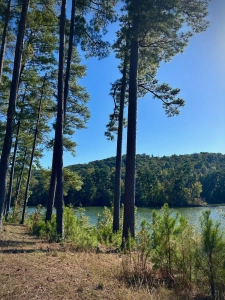
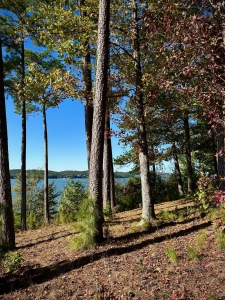
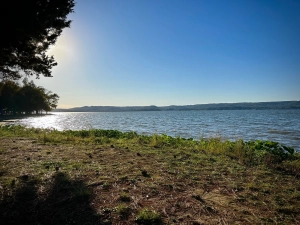
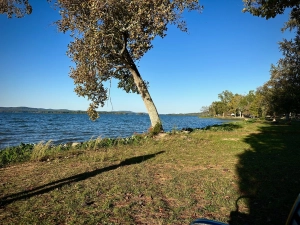
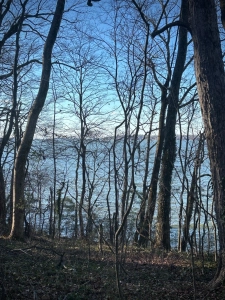
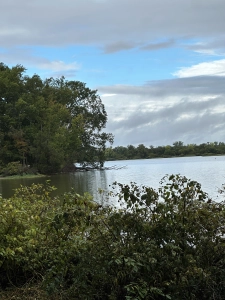
The photo at left shows the opposite shoreline, where the eagle’s nest, we were assured, lies hidden to our eyes. Regradless, who could not appreciate the cerulean sky, bright sunshine, and comfortable early autumn temperature!
Here is my 58-second video from the cabins lakeshore.
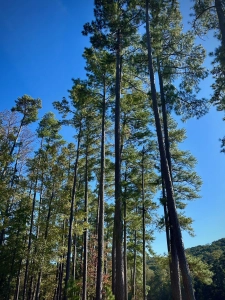
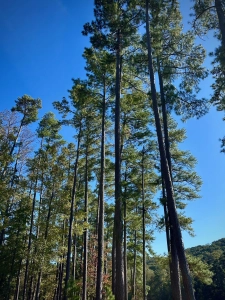
I’m a sucker for tall loblollies and shoreline vistas.
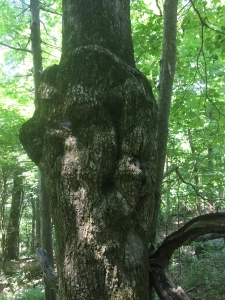
I wanted to revisit the nearby Cave Trail, hoping to quickly photograph the oak burled in the distinctive Big Foot image.
Brief Saunter at the Cave Trail
Here is my July 18, 2018 photo:
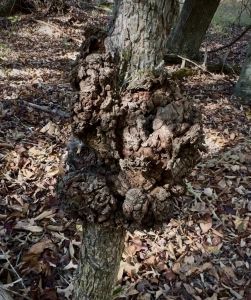
I intended to insert the new image here. However, just as there are days when I cannot remember what I had for lunch the day before, I failed to navigate us back the the infamous tree! I will try another day when we have more time for frivality. However, in searching, I did find a very unattractive, yet photo-worthy canker along the Cave Trail.
I recorded this 58-second grotesque Halloween canker video on an elm tree.
I sampled a twig from the elm and offer a still photo.
Town Creek Boat Launch
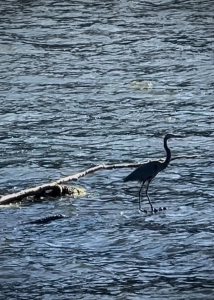
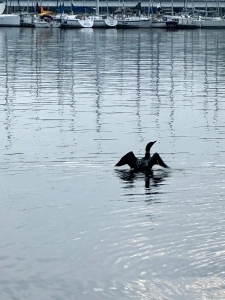
Our second viewing location forced us to look across the lake directly into the late afternoon sun. We imagined how much better the spot would be with the morning sun at our backs. However, the location kindly presented us with a great blue heron buffeted by persistent winds and surrounded by whitecaps.
I recorded this 59-second video of the windy great blue heron. Pardon the wind drowning out my narrative.
Unfortunately, the heron took graceful flight when I stopped recording.
As regular readers know, I am a huge fan of great blue herons.
Sunset Drive Greenway in Guntersville, Alabama
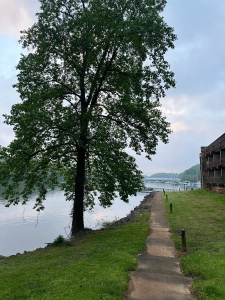
We drove to a final suggested site, this one off the State Park along Sunset Drive Greenway in the town of Guntersville. The shoreline and greenway are lovely. I intend to visit with Judy during the coming months, to enjoy a mid-morning stroll followed by lunch in Guntersville.
A highlight for such a stroll will be the massive eagle’s nest in a grand loblolly pine.
My 60-second Sunset Drive Eagle’s Nest.
Ours was not an outing requiring months of planning, air travel, and expensive lodging. We needed no reservations. Instead, we boarded Chris’ car after adjouring our 10:00 to 11:30 AM National Parks (LearningQuest) class session at Hampton Cove, drove 45 minutes to the park, grabbed lunch at the lodge, and began our scouting. I am a firm advocate of enjoying Nature near at hand…making the most of special places and everyday Nature!
Closing
I accept the challenge of distilling these Brief-Form Posts into a single distinct reflection, a task far more elusive than assembling a dozen pithy statements.
I cannot offer a quote more poignantly apropos than this anonymous statement:
The strength of the bald eagle lies not just in its wings, but in its unyielding spirit…its symbol of purity, grandeur, wildness, mastery, freedom, independence, integrity, and Americanism.
Nature’s special treats await our discovery, our understanding, and our interpretation!
Subscribe to my free weekly photo essays (like this one) at: http://eepurl.com/cKLJdL
https://stevejonesgbh.com/wp-content/uploads/2025/10/IMG_9446.jpg-10.23.25-LGSP-Near-Cabins.webp20161512Steve Joneshttp://stevejonesgbh.com/wp-content/uploads/2017/01/gbhweblogo.pngSteve Jones2025-12-15 12:11:082025-12-15 12:11:08Brief-Form Post #52: Late October Afternoon Scouting for Eagles and Nests at Lake Guntersville State Park!
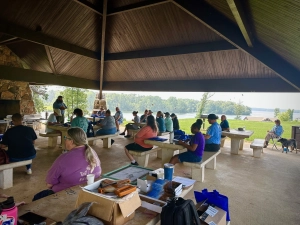
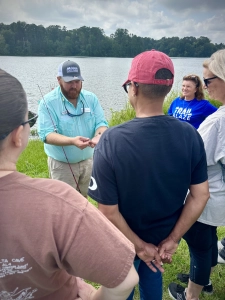
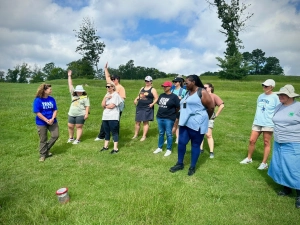
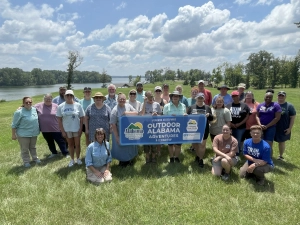
On August 9, 2025, I assisted with the delivery of a Teacher-Educator Adventures in Alabama State Parks Workshop at Joe Wheeler State Park. Funded by a grant from the Caring Foundation of Blue Cross and Blue Shield, the workshop introduced the 23 participants to the Nature of the park face-to-face. They engaged with expert naturalists, experienced field-based learning, and received program curricula, lesson plans, and teaching kits. My role was simple: offering opening words of inspiration and lunchtime reflections on Aldo Leopold, a pre-eminent conservation scholar of the twentieth century.
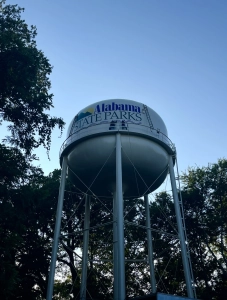
A recently painted water tower welcomed visitors to Joe Wheeler State Park.
Just a 50-minute drive from my Madison, Alabama residence, the park welcomes me at least once every season. I enthusiastically agreed to assist with the Saturday workshop.
Setting
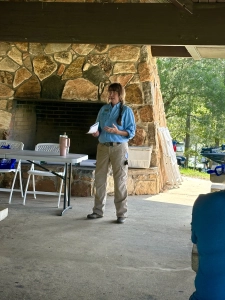
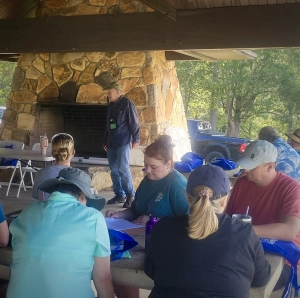
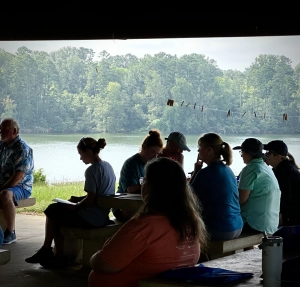
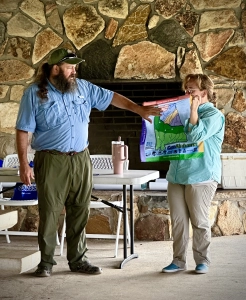
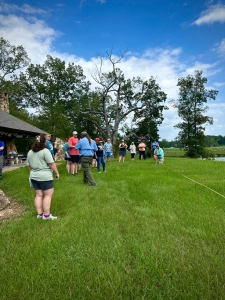
We gathered at the Day Use Area pavilion along Lake Wheeler, enjoying fair skies and a summer breeze. Alabama State Parks Chief Naturalist, Renee Rainey, welcomed participants and introduced speakers and staff.
Renee is a tireless champion of Nature education and interpretation.
Words of Inspiration
Asked to offer words of inspiration, I emphasized that Nature education is a process of outdoor immersion, discovery, illumination, inspiration, and encouragement. I reflected on the dual, and seeming contradictory, emotions I felt when I first encountered a full profile view of Alaska’s Mount Denali (McKinley) from the nearby, and much lesser, Mount Quigley in 2005. Simultaneously, the feelings of absolute humility and overwhelming inspiration brought me to tears…and nearly to my knees. The gleaming towering white mountain ediface reached high above me, just 20 miles south of where I stood. Breathless, I knew that nothing in my life matched its glory…its significance…its eminence…its symbol of Creation and God. Countering the weight of Humility, its Inspiration lifted me…buoyed me…reminded me what John Muir knew all along:
When we contemplate the whole globe as one great dewdrop, striped and dotted with continents and islands, flying through space with other stars all singing and shining together as one, the whole universe appears as an infinite storm of beauty.
I counseled that their role as educators requires an approach steeled in humility and inspiration. Humilty in recognizing that they are changing the world through each young person they reach, educate, and encourage.
Don’t judge each day by the harvest you reap but by the seeds that you plant. (Robert Louis Stevenson)
And Inspiration in accepting that the differences they make can last a lifetime and beyond…permanent, resilient, and immutable, like Denali Mountain.
Pulitzer Prize novelist and essayist Louis Bromfield wrote in his non-fiction Pleasant Valley of his life’s work rehabilitating his old worn out Ohio Farm:
The adventure at Malabar is by no means finished…The land came to us out of eternity and when the youngest of us associated with it dies, it will still be here. The best we can hope to do is to leave the mark of our fleeting existence upon it, to die knowing that we have changed a small corner of this earth for the better by wisdom, knowledge, and hard work. (Louis Bromfield (1896-1956)
Whether shaping Malabar Farm….or an eager sixth grader…wisdom, knowedge, and hard work, fueled by passion, and laced with humility and inspiration, carry the day.
What a great pleasure and privilege to engage with enthusiastic educators.
Setting the Stage
Environmental Educator and Main Guest for the workshop, Jimmy Stiles, introduced Dr. Scott Duncans’s Southern Wonder: Alabama’s Surprising Biodiversity. My intent is not to reiterate workshop content. Instead, I want to give you a feel for the major themes and a sense of the exquisite setting.
Why should we focus on our state’s biodiversity? First and foremost, Albert Einstein, instructed us:
Look deep into nature, and then you will understand everything better.
We cannot truly know our state and teach environmental education without understanding our location, climate, geology, geography, and surrounding ecosystems. Biodiversity is interwoven with all those factors.
The ever-present lake served as backdrop for the entire day.
Jimmy presented how the ice age that ended 13,000 years ago influenced Alabama’s present-day biodiversity (my 60-second video).
Jimmy and NW District Naturalist Amber Coger presented where we are, the Highland Rim, emphasizing the importance in knowing our location and context.
Fishing as a Learning Exercise
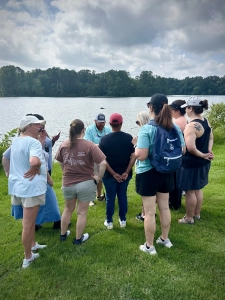
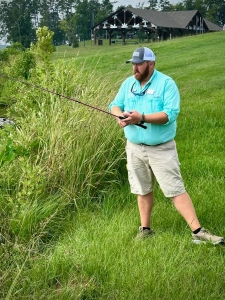
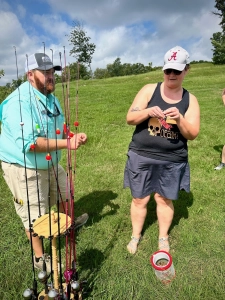
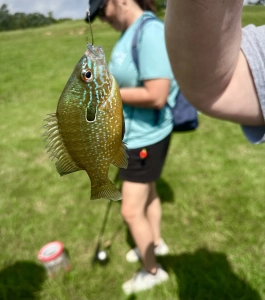
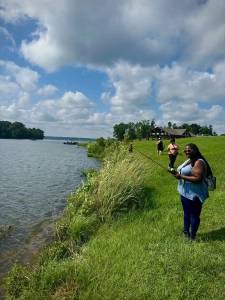
Obviously, Lake Wheeler and its associated ecosystem is a major component of where they are. Joe Wheeler State Park Naturalist, Jennings Earnest, oriented the teachers to one of the lake’s residents, its ubiquitous sunfish. For some participants, this was their first fishing experience. Excitement ran high!
Here’s my 60-second video of Jennings readying the educators to fish.
Exemplifying a critical characterization of teaching, Jennings exudes passion and enthusiasm
He admits that he has the best job on the planet!
I recorded this 57-second video capturing the moment when one of the teachers landed a sunfish.
Not a trophy, but a successful teachable moment.
The day could not have been better. These moments along the lake will accompany participants into their fall classrooms and will infuse the spirit and passion of their teaching.
Often I find that others who preceded me constructed verbiage long ago far superior to any utterances I might make to express timeless wisdom. Robert Louis Stevenson (1850-1894) was among them.
Don’t judge each day by the harvest you reap but by the seeds that you plant.
I believe our workshop instructors planted seeds that will multiply manifold times through the students they touch.
Meeting Animal Friends
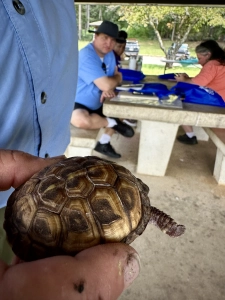
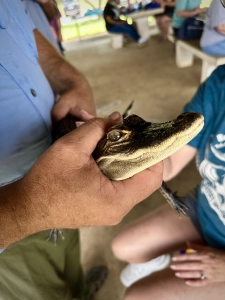
Again, I offer some photos with narrative unecessary: box turtle and American aligator.
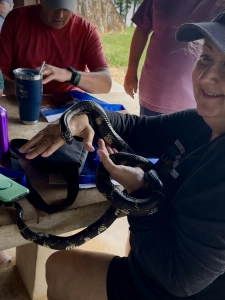
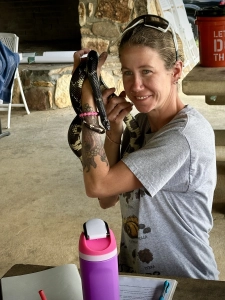
Black kingsnake.
I recorded this 46-second creature-teacher video
Knowing our setting and introducing some of our common animal neighbors impressed participants.
Measuring Vegetative Cover
Jimmy conducted an exercise adding an element of quantifying elements of our surroundings, like measuring vegetative cover in field and forest edge.
I recorded a 56-second video of measuring vegetative cover.
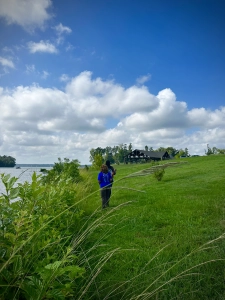
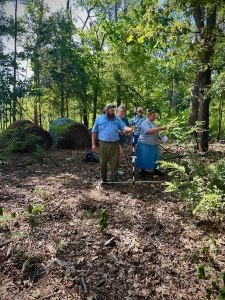
I remember summer days prescribed burning, marking and cruising timber, laying out roads, and other field tasks during my 12 years practicing industrial forestry…hard demanding days of exertion, sweating, challenge, and near exhaustion. And, too, younger days! As a 74-year-old retiree, such days would be more than I can handle. The state park workshop required no such toil. Total relaxation, at least physically. A bit of intellectual engagement, which knows no limit to date, just some continuous tuning by teaching, speaking, writing, and woods-sauntering!
Steve’s Shoreline Ramble
I explored during sessions, wandering (and wondering) along the lakeshore. As I’m drafting this narrative, some Leonard Da Vinci wisdom emerged from my mental recesses:
It’s not enough that you believe what you see. You must also understand what you see.
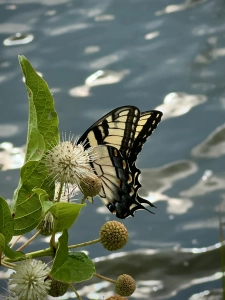
I regret not including that wisdom in my lunchtime message. The workshop’s core theme is opening the educators’ eyes to understanding the Nature around them. Empowering them to see, appreciate, and understand all that lies hidden in plain sight, like the magnificent eastern tiger swallowtail sipping nectar from a buttonbush.
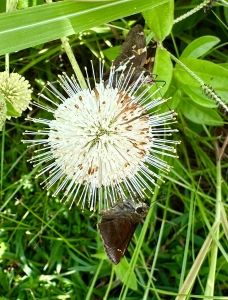
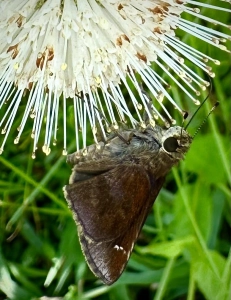
Or the clouded skipper on a buttonbush nearby.
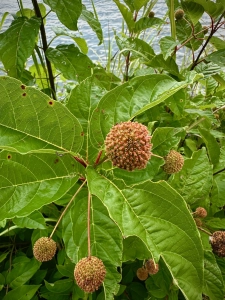
Buttonbush seedpods give the plant its moniker.
I added each participant to the distribution for my weekly photo essays. I hope at least a few find time to read this edition. I know I learned as much as they did. I admire their eagerness to learn and I sensed their desire to deliberately incorporate Nature into the fabric of teaching.
I am privileged to occasionally interact with educators committed to learn from and teach in accord with Nature.
Don’t judge each day by the harvest you reap but by the seeds that you plant. Robert Louis Stevenson
I care to live only to entice people to look at Nature’s loveliness. John Muir
Alabama State Parks Foundation
I’ll remind you that although I serve on the Alabama State Parks Foundation Board (Secretary), in part because of my love of Nature and in recognition for my writing many prior Posts about visiting and experiencing the Parks, any positions or opinions expressed in these Posts are mine alone and do not in any manner represent the Foundation or its Board.
I urge you to take a look at the Foundation website and consider ways you might help steward these magical places: https://asparksfoundation.org/ Perhaps you might think about supporting the Parks System education and interpretation imperative: https://asparksfoundation.org/give-today#a444d6c6-371b-47a2-97da-dd15a5b9da76
The Foundation exists for the sole purpose of providing incremental operating and capital support for enhancing our State parks… and your enjoyment of them.
We are blessed in Alabama to have our Park System. Watch for future Great Blue Heron Posts as I continue to explore and enjoy these treasures that belong to us. I urge you to discover the Alabama State Parks near you. Follow the advice of John Muir:
And into the forest I go, to lose my mind and find my soul.
In every walk with Nature one receives far more than he seeks.
I only went out for a walk and finally concluded to stay out till sundown, for going out, I found, was really going in.
Between every two pines is a doorway to a new world.
Thoughts and Reflections
I offer these observations:
Look deep into nature, and then you will understand everything better. (Albert Einstein)
Nature doesn’t steal time, it amplifies it. (Richard Louv)
I embrace Nature’s relentless magic, wonder, awe, and inspiration — her infinite storm of BEAUTY! (Steve Jones)
Every lesson for living, learning, serving, and leading is written indelibly in or powerfully inspired by Nature. (Steve Jones)
Inhale and absorb Nature’s elixir. May Nature Inspire, Inform, and Reward you!
I am available for Nature-Inspired Speaking, Writing, and Consulting — contact me at steve.jones.0524@gmail.com
Subscribe to my free weekly photo essays (like this one) at: http://eepurl.com/cKLJdL
Reminder of my Personal and Professional Purpose, Passion, and Cause
If only more of us viewed our precious environment through the filters I employ. If only my mission and vision could be multiplied untold orders of magnitude:
Mission: Employ writing and speaking to educate, inspire, and enable readers and listeners to understand, appreciate, and enjoy Nature… and accept and practice Earth Stewardship.
Vision:
People of all ages will pay greater attention to and engage more regularly with Nature… and will accept and practice informed and responsible Earth Stewardship.
They will see their relationship to our natural world with new eyes… and will understand more clearly their Earth home.
Tagline/Motto: Steve (Great Blue Heron) encourages and seeks a better tomorrow through Nature-Inspired Living!
Steve’s Four Books
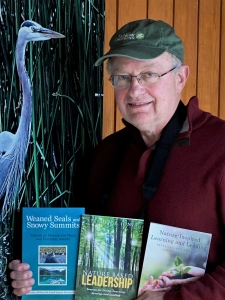
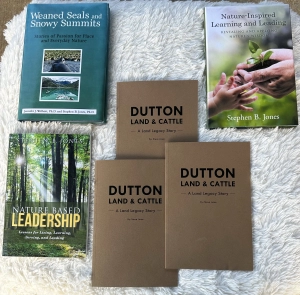
I wrote my books Nature Based Leadership (2016), Nature-Inspired Learning and Leading (2017), Weaned Seals and Snowy Summits: Stories of Passion for Place and Everyday Nature (2019; co-authored with Dr. Jennifer Wilhoit), and Dutton Land & Cattle: A Land Legacy Story (2023) to encourage all citizens to recognize and appreciate that every lesson for living, learning, serving, and leading is either written indelibly in or is powerfully inspired by Nature. All four of my books present compilations of personal experiences expressing my deep passion for Nature. All four books offer observations and reflections on my relationship with the natural world… and the broader implications for society. Order any from your local indie bookstore, or find them on IndieBound or other online sources such as Amazon and LifeRich.
I began writing books and Posts for several reasons:
I love hiking and exploring Nature
I see images I want to (and do) capture with my trusty iPhone camera
I enjoy explaining those images — an educator at heart
I don’t play golf!
I do love writing — it’s the hobby I never needed when my career consumed me
Judy suggested my writing is in large measure my legacy to our two kids, our five grandkids, and all the unborn generations beyond
And finally, perhaps my books and Blogs could reach beyond family and touch a few other lives… sow some seeds for the future
https://stevejonesgbh.com/wp-content/uploads/2025/08/IMG_8525-2.jpg-08.09.25-JWSP-BCBS-Workshop-scaled.webp25601920Steve Joneshttp://stevejonesgbh.com/wp-content/uploads/2017/01/gbhweblogo.pngSteve Jones2025-11-12 02:31:042025-11-12 02:31:04Teacher-Educator Adventures in Alabama State Parks Workshop Lakeside at Joe Wheeler State Park!
I am pleased to add the 44th of my GBH Brief-Form Posts (Less than five minutes to read!) to my website. I get wordy with my routine Posts. I don’t want my enthusiasm for thoroughness and detail to discourage readers. So, I will publish these brief Posts regularly.
January Fungi Discoveries
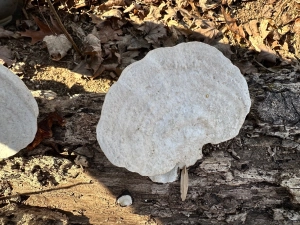
I spent January 23 and 24, 2025, at Joe Wheeler State Park primarily to learn more about the 1930s Wheeler Dam Village (housing construction workers and their families) and the 1930s to early 1950s Recreation Area remains along the CCC Trail on the hillside above Wheeler Dam overlooking Wilson Lake, which lies just downstream of Wheeler Dam. This photo essay reports on mushrooms I photographed as we performed our intended archeological pursuits.
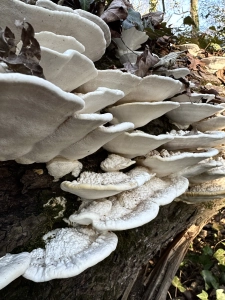
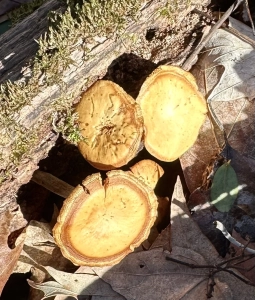
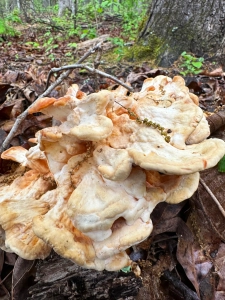
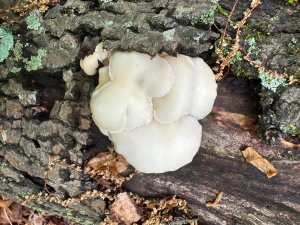
I am not a mycologist. I am simply a fungi hobbyist and edible wild mushroom enthusiast. Lumpy bracket mushrooms densely occupy this fallen hickory. Their nearly luminescent whiteness evidences freshness; algae have not yet darkened their surfaces. They are not edible due to their hard, woody nature. Located within the old Recreation Area, English ivy proliferates as a ground cover. The ivy-mushroom combination (right) presents an aesthetic package.
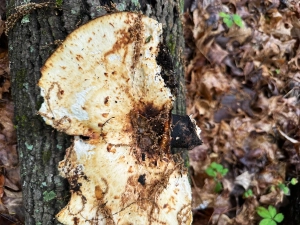
This is another Trametes species (aesculi), which like lumpy bracket is a saprophyte (consumes dead wood). It is an agent of decomposition, not a parasite that infects and decays living trees.
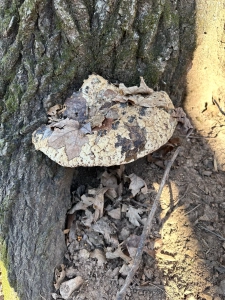
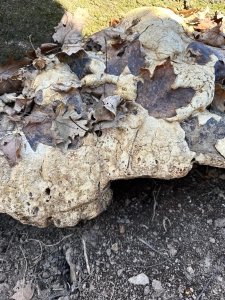
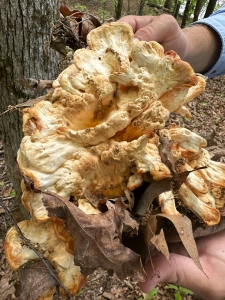
Pseudoinonotus (dryadeus?) is a bracket fungus with inedible fibrous flesh. The genus commonly grows at the base of oak trees infected by its wood-consuming hyphae. My forest pathology professor would have characterized this genus as a disease when I took the course in 1972…more than a half-century ago. I admit to needing a forest pathology update! Just yesterday (I’m drafting this on April 9, 2025) I wandered through a bottomland hardwood forest on the Wheeler National Wildlife Refuge. Conks, brackets, burls, hollows, catfaces, rusts, scars, and and other disfigurements are ubiquitous. As with so much in Nature, the more I learn, the less I know!
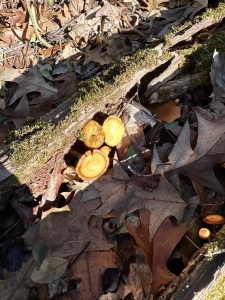
What I do know is that a mushroom known as funeral bell is likely not edible!
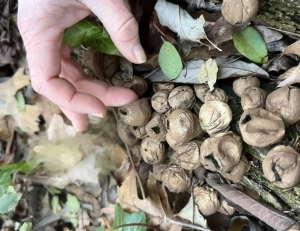
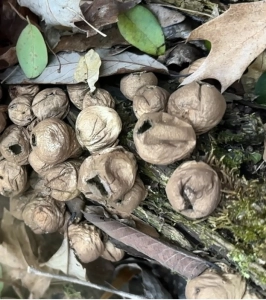
And I do know that spore-ripe puffballs are fun for those of us who never age beyond finding mystery, joy, and amusement in the natural world. Einstein recognized the magic of wonder:
The most beautiful emotion we can experience is the mysterious. It is the fundamental emotion that stands at the cradle of all true art and science. He to whom this emotion is a stranger, who can no longer wonder and stand rapt in awe, is as good as dead, a snuffled-out candle.
Poofing puffballs never grows tiresome…and I refuse to age beyond enjoying such a simple pleasure.
Sure, I understand the biological function of ripening puffballs and the reproductive necessity of spore dissemination. Perhaps most importantly, I also know the basic tenet of foraging and consuming puffballs: The inside of edible puffball mushrooms should be solid and pure white, like a marshmallow, or fresh mozzarella balls (eartheplanet.org). Lord, give me a wet field loaded with giant puffballs at the perfect stage of purity. I will do the rest with sharp knife, a light flour coating, seasoning salt, wide skillet, and sizzling butter. Oh, the wonders of Nature!
Closing
I accept the challenge of distilling these Brief-Form Posts into a single distinct reflection, a task far more elusive than assembling a dozen pithy statements. A single trek along a forested trail discloses only a brief moment in time, obscuring the decades prior and the future ahead, isolating us from the scope and scale of the grand forest cycle of life. Albert Einstein captured the sentiment I felt as we explored the Wonder of decay and renewal:
He who can no longer wonder and stand rapt in awe, is as good as dead, a snuffled-out candle.
Nature’s special treats await our discovery, our understanding, and our interpretation!
Alabama State Parks Foundation
I’ll remind you that although I serve on the Alabama State Parks Foundation Board, in part because of my love of Nature and in recognition for my writing many prior Posts about visiting and experiencing the Parks, any positions or opinions expressed in these Posts are mine alone and do not in any manner represent the Foundation or its Board.
I urge you to take a look at the Foundation website and consider ways you might help steward these magical places: https://asparksfoundation.org/ Perhaps you might think about supporting the Parks System education and interpretation imperative: https://asparksfoundation.org/give-today#a444d6c6-371b-47a2-97da-dd15a5b9da76
The Foundation exists for the sole purpose of providing incremental operating and capital support for enhancing our State parks… and your enjoyment of them.
We are blessed in Alabama to have our Park System. Watch for future Great Blue Heron Posts as I continue to explore and enjoy these treasures that belong to us. I urge you to discover the Alabama State Parks near you. Follow the advice of John Muir:
And into the forest I go, to lose my mind and find my soul.
In every walk with Nature one receives far more than he seeks.
I only went out for a walk and finally concluded to stay out till sundown, for going out, I found, was really going in.
Between every two pines is a doorway to a new world.
https://stevejonesgbh.com/wp-content/uploads/2025/01/IMG_6138.jpg-01.23.25-CCC-Trail-JWSP-scaled.webp25601920Steve Joneshttp://stevejonesgbh.com/wp-content/uploads/2017/01/gbhweblogo.pngSteve Jones2025-04-22 10:06:062025-04-22 10:06:06Brief-Form Post #44: January Fungi Discoveries along the CCC Trail at Alabama's Joe Wheeler State Park
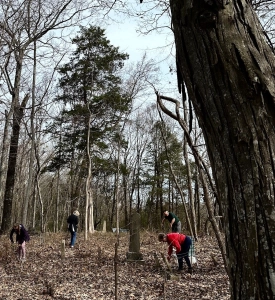
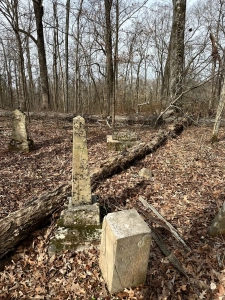
On March 8, 2025, at the request of local history buff Gilbert White, I visited the Mooresville, Alabama Cemetery as a group of a dozen friends of the 200-year-old graveyard (Madison History Association) cleared brush and storm debris. I snapped photographs and recorded brief videos to develop a photo essay with observations and reflections. I developed a tale of the multi-tiered web of life and death (Nature and Human) intersecting across this hallowed land, a permanent resting place for more than 100 deceased former residents. Volume One introduces the historic cemetery and sets the stage for the two succeeding volumes.
The story of Mooresville Cemetery encompasses several components:
The overlapping natural environment and human community over time and generations.
A deeper view into the elements of interaction and overlap.
The macabre (and lighter) dimension of an old forested cemetery.
Another story along the fledgling 200+ mile Singing River Trail.
I’d like you to please watch for subsequent Great Blue Heron photo essays (The Nature of the Singing River Trail) I will feature as whistle stops along the fledgling 200+-mile trail.
I viewed the burial ground as a provocative subject. The town is historic:
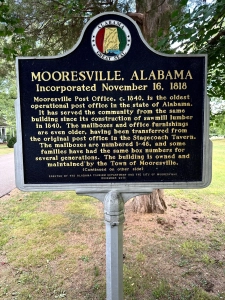
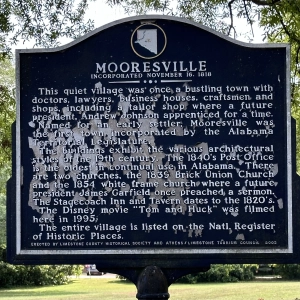
Historic Mooresville, Alabama is the first town incorporated by the Alabama Territorial Legislature, on November 16, 1818. The entire town is on the National Register of Historic Places, and is one of Alabama’s most important and intact villages. Historic homes and buildings, gracious gardens, and tree-shaded streets make a visit to Mooresville seem like a step back in time.
I beamed myself back to 1822, when the first documented burial took place on the grassy knoll three hundred yards southeast of the town. Young trees grace the heights, still too young to cast shade over memorial services. Albert Einstein granted me the means to travel back two centuries:
Imagination is more important than knowledge. Knowledge is limited. Imagination encircles the world.
I often speculate in these posts about the past from reading today’s forests. Borrowered from an online file, this image depicts the Mooresville Cemetery site as I picture its grassy knoll 200 years ago.
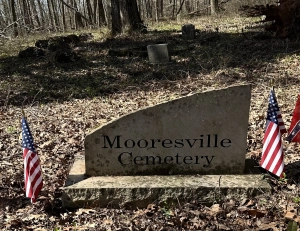
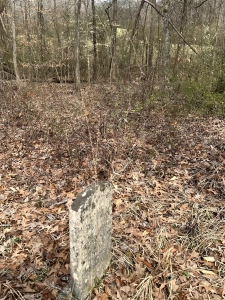
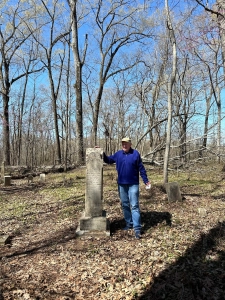
This monument welcomes visitors today. The background trees are not leaning to the south (left); I tilted the photograph to righten the leaning stone.
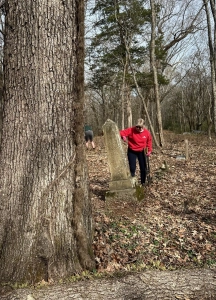
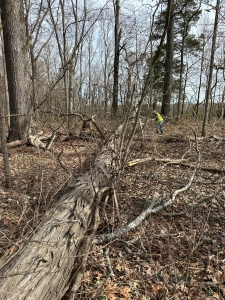
The crew labored for two hours. Their work made a dent in restoring order to a sunny hilltop long ago captured by time and a relentlessly advancing forest.
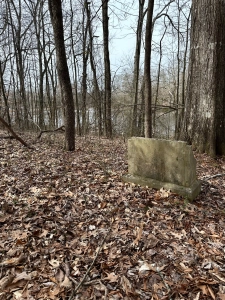
I often observe in these photo essays that life and death are constant, cyclical companions in our forests. Humans have added an overlapping dimension of life and death to the cemetery hilltop. The forest tells its own story. Each tombstone, every unmarked rectangular depression, and every echo of human memorial service, graveside visit, and fading memory, jubilation, and grief combine to reach across the two centuries. I felt the presence of others as I criss-crossed the knoll.
I wondered whether this fallen shagbark hickory bore witness to teary-eyed ceremonies, grieving loved ones, and soothing spring mornings.
I recorded this 57-second video of the uprooted tree:
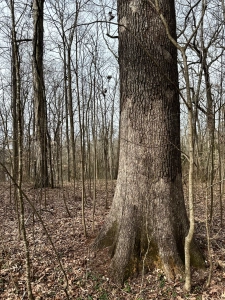
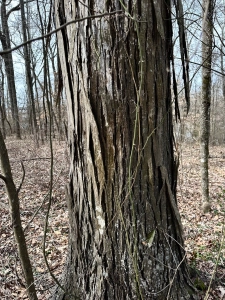
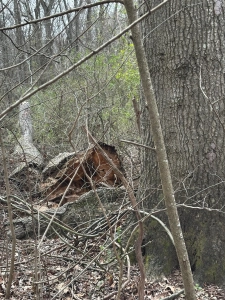
I’ve studied our northern Alabama forests enough to know that neither the red oak (left) nor the shagbark hickory (right) witnessed the first 70-90 years of burials. They most likely were no more than seedlings or saplings when Wheeler Dam engineers closed the gates that flooded the adjacent Limestone Bay in the 1930s.
How many interred former Mooresville bones did this crashing oak rattle when it succumbed to undeafeated gravity?
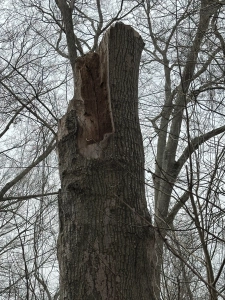
What manner of disturbance did this decades-old hickory tree lightning blast create among the lingering spirits? Resident squirrels and other critters relying upon tree cavities celebrated as fungi infected and enlarged the wound and the tree survived the electrical insult. Life and death hand in hand — the cycle of renewal and demise persisting!
The cavity the critters appreciated served for how long…before the hollow they valued yielded to forces beyond the woody rind’s ability to hold the tree aloft?
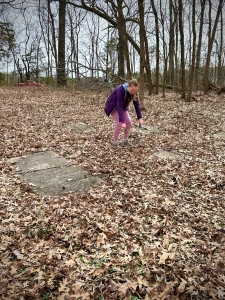
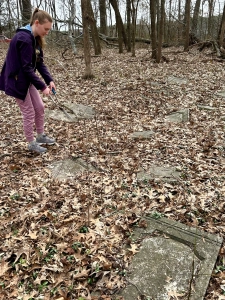
Maria Rakoczy, The Madison Record news writer, worked feverishly with loppers across an area dominated by flat monuments.
Imagine the cleared summit view northwest into Mooresville (left) and southwest into Limestone Bay (fed by Limestone Creek, Mooresville Spring, Piney Creek, and Beaverdam Creek) two centuries ago. Mooresville’s checkerboard streets, homes, the brick church belltower, and the 200-acre Bay would have been visible, unobstructed by the invading forest. Today only the deep dormant season allows a glimpse without imagination.
I observe often that every tree and each forest grove has a story to tell. The tales told at the Mooresville Cemetery are overlain by layers of deep memories and generations past.
I recorded this 59-second video of a poignant, heart-rending tombstone message:
Margaret Alice Morris’ engraved tombstone (An angel visited the green earth and took the flower away) occupied a grassy hill (now a closed-canopy forest) above Limestone Bay.
As I said at the outset, the story of Mooresville Cemetery encompasses several components:
The overlapping natural environment and human community over time and generations.
A deeper view into the elements of interaction and overlap.
The macabre dimension of an old forested cemetery.
Another story along the fledgling 200+ mile Singing River Trail.
I’ve taken us through chapters one and part of two. I’ll begin Volume Two where this one ends.
The Nature of the Singing River Trail
The Singing River Trail will be a 200+ mile greenway system that strengthens regional bonds and creates new health and wellness, educational, economic, tourism, and entrepreneurial opportunities for the people and communities of North Alabama.
The SRT is headquartered just two miles west of the cemetery. The trail will prominently feature Mooresville. As a lifelong devotee of hiking/sauntering, running, biking, and Nature exploration, I envision anew Great Blue Heron weekly photo essay series focused on The Nature of the Singing River Trail. I will incorporate individual essays into my routine Posts that total approximately 450 to-date (archived and accessible at: https://stevejonesgbh.com/blog/). I offer this essay as an orientation to the new series.
Thoughts and Reflections
I offer these observations:
Life and death sustain a natural forest over time; a human cemetery within adds deeper complexity and layers of sentiment, emotion, and memories.
Natural processes overtake all traces of human habitation in the absence of intervention and maintenance. Even a north Alabama graveyard yields to forest.
It’s not what you look at that matters, it’s what you see. I saw an aging forest and felt my own mortality, yet embraced the comprehension of both.
Inhale and absorb Nature’s elixir. May Nature Inspire, Inform, and Reward you!
Note: Unless otherwise noted, all blog post images are created & photographed by Stephen B. Jones.
I am available for Nature-Inspired Speaking, Writing, and Consulting — contact me at steve.jones.0524@gmail.com
A reminder of my Personal and Professional Purpose, Passion, and Cause
If only more of us viewed our precious environment through the filters I employ. If only my mission and vision could be multiplied by untold orders of magnitude:
Mission: Employ writing and speaking to educate, inspire, and enable readers and listeners to understand, appreciate, and enjoy Nature… and accept and practice Earth Stewardship.
Vision:
People of all ages will pay greater attention to and engage more regularly with Nature… and will accept and practice informed and responsible Earth Stewardship.
They will see their relationship to our natural world with new eyes… and understand their Earth home more clearly.
Tagline/Motto: Steve (Great Blue Heron) encourages and seeks a better tomorrow through Nature-Inspired Living!
Steve’s Four Books
I wrote my books Nature Based Leadership (2016), Nature-Inspired Learning and Leading (2017), Weaned Seals and Snowy Summits: Stories of Passion for Place and Everyday Nature (2019; co-authored with Dr. Jennifer Wilhoit), and Dutton Land & Cattle: A Land Legacy Story (2025) to encourage all citizens to recognize and appreciate that every lesson for living, learning, serving, and leading is either written indelibly in or is powerfully inspired by Nature. All four of my books present compilations of personal experiences expressing my deep passion for Nature. All four books offer observations and reflections on my relationship with the natural world… and the broader implications for society. Order any from your local indie bookstore, or find them on IndieBound or other online sources such as Amazon and LifeRich.
I began writing books and Posts for several reasons:
I love hiking and exploring Nature
I see images I want to (and do) capture with my trusty iPhone camera
I enjoy explaining those images — an educator at heart
I don’t play golf!
I do love writing — it’s the hobby I never needed when my career consumed me
Judy suggested my writing is in large measure my legacy to our two kids, our five grandkids, and all the unborn generations beyond
And finally, perhaps my books and Blogs could reach beyond family and touch a few other lives… sow some seeds for the future
https://stevejonesgbh.com/wp-content/uploads/2025/03/IMG_6661.jpg-03.08.25-Mooresville-Cemetary.webp20161512Steve Joneshttp://stevejonesgbh.com/wp-content/uploads/2017/01/gbhweblogo.pngSteve Jones2025-04-08 10:28:392025-04-08 10:28:39Mooresville, Alabama Cemetary: A New Dimension to Life and Death in the Forest! [Volume One]
I spent January 23 and 24, 2025 at Joe Wheeler State Park primarily to learn more about the 1930s Wheeler Dam Construction Village and 1930s to early 1950s Recreation Area remains along the CCC Trail on the hillside above Wheeler Dam overlooking Wilson Lake, which lies just downstream of Wheeler Dam. This photo essay reports on the natural delights my colleagues and I discovered and chronicled as we performed our intended archeological pursuits.
We found some of what we were seeking, and as Henry David Thoreau observed, so much more…and that in itself is a delight:
The question is not what you look at, but what you see.
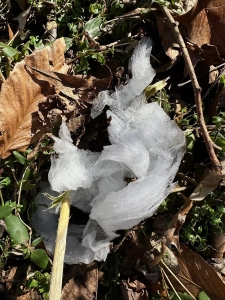
We unintentionally scheduled a cold day, locating an intact frost flower as we began our CCC Trail exploration a little after noon. Fascination propagates from every find; magic lies hidden in plain sight to all woodland saunterers!
Waves rippled Wislon Lake as northwest winds fueled the clear winter day. I imagined a similar day 90 years prior as workmen labored to build the dam. The forest is approximately the same age as the dam.
Individual trees, like these oaks above the Nance Creek Bay, provided shade for a concrete picnic table, its wooden seats long since decayed:
We identified several specimens of Kentucky yellowwood (Cladrastic kentuckea), which according to an online source is one of the rarest trees of eastern North America, found principally on the limestone cliffs of Kentucky, Tennessee, and North Carolina. The source indicated that yellowood native to Alabama have leaves more densely hairy underneath than those from furth north, distinguished as f. tomentosa. The species is new to me, at leaste as far as I recall.
Woodland delights come in nearly endless variety. Leonardo da Vinci observed simply that:
There is no result in nature without a cause.
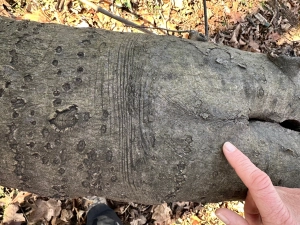
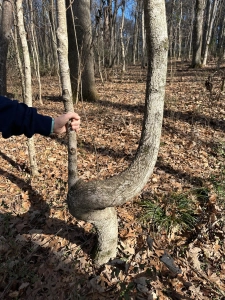
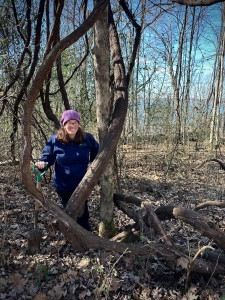
I refuse to attribute such tree form oddities and curiosities to will or reason. The sugar maple sapling had no purpose other than to survive and propagate beyond the injury (a falling branch…a strangling vine?) that triggered the main stem and a spurred branch to reach vertically toward the sun and its sustaining rays.
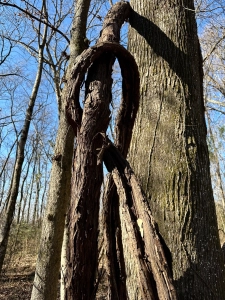
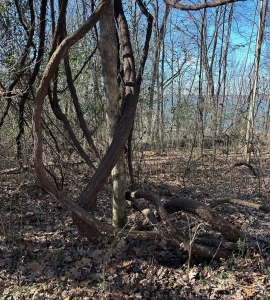
Muscadine grape vines rely on their flexibility, strength, and suppleness to stay aloft in the high wind-swaying tree canopy. Their cause is to adapt to their motion-dominated environment, retaining a tree-provided full sunlight perch, and thrive for succeeding generations.
A higher power may have considered the aesthetic appeal to human woodland saunterers. Grape vines are among my forest delights.
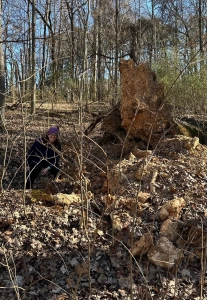
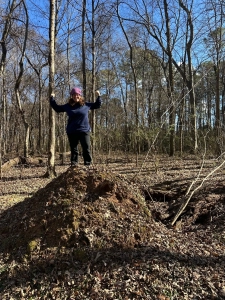
I consider my doctoral discipline as an amalgam of applied ecology, soil science, and forestry (An Evaluation of Soil-Site Relationshps in Allegheny Hardwoods — Ph.D. Dissertation). Not surprisingly, I find soil and its nature and processes delightful! The sites I studied in the 70-90-year-old-second-growth forests of southwest New York and northwest Pennsylvania evidenced the pit-and-mound, hummock-and-hollow, and pillow-and-cradle microtopography that is likewise common across our northern Alabama forests. A maturing tree grasping its root ball yields to windthrow, lifting its soil mass from the excavated basin, as in the two exapmles below, where Alabama State Parks Northwest District Naturalist Amber Coger crouches in a pit/hollow/cradle (left) or stands triumphantly on a mound/hummock/pillow (right).
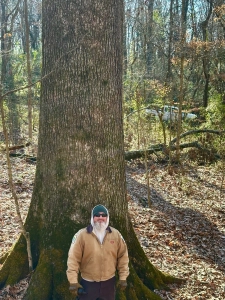
So long as I wander our woods I will not tire of seeing quality (high commerciel value) standing timber. Josh Kennum, technician at Joe Wheeler State Park, serves as a reference scale to a magnificent cherrybark oak. The old industrial forester within me resurfaces at will.
Yes, I still find delight with straight bole, three 16-foot logs to the first branch, sound wood, and hefty girth — a timeless delight!
What is not timeless is the old forester (me) standing with a magnificent yellow poplar (left) and a handsome cherrybark oak (right).
Age adds its own special delight factor to the ancient American beech within 100 feet of the 200-foot wide power line transmitting hydro-power from Wheeler Dam.
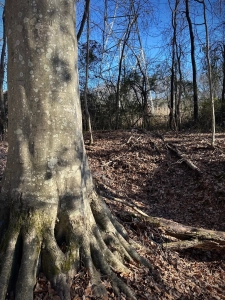
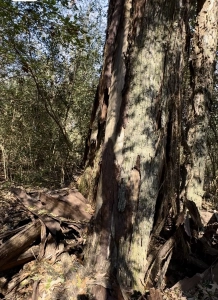
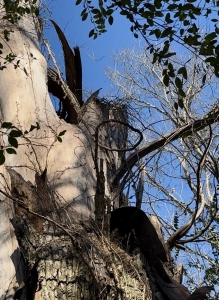
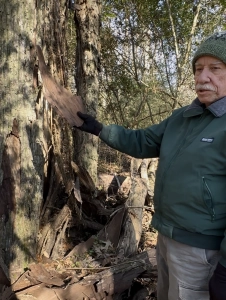
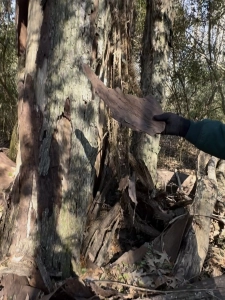
Fellow retired forester Chris Stuhlinger and I struggled to identify the tree species for this large dead standing tree-delight. Its three-foot plus diameter and large collapsed crown drew us closer. We concurred that the outer bark resembled American elm. The inner bark confused us…brittle with a rough cured leather appearance.
Because we needed to focus on our focused pursuit of the abandoned Village and Recreation Area, we decided the tree warrants deeper examination in the coming spring.
No doubt, the elm is an object of delight.
I recorded this 43-second video of Chris at the elm:
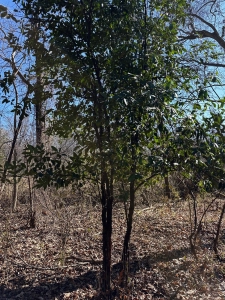
This laurel cherry met my delight criteria, a relative rarity and foreign to my previous woodland discoveries.
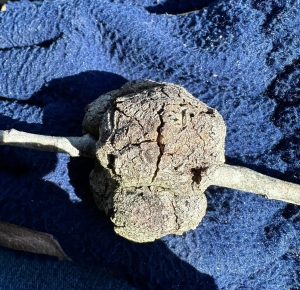
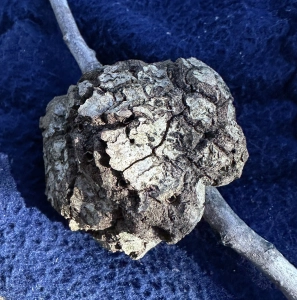
I gathered this gouty oak gall for examining and photographing at home. How could one not find delight in a small wasp ovipositing in an oak twig, triggering woody growth to shelter and feed the wasp’s larvae as they grow and transition to wasp adulthood? Nature is truly amazing and delightful.
I discovered this menagerie in just two days when we focused our direct attention on our primary objective. This photo essay reports on the natural delights my colleagues and I discovered and chronicled as we performed our intended archeological pursuits.
We found some of what we were seeking, and as Henry David Thoreau observed, so much more…and that in itself is a delight:
The question is not what you look at, but what you see.
I delighted in seeing all that open exploration afforded trained eyes, curious minds, and shared passion for Nature’s beauty, magic, wonder, awe, and inspiration!
Alabama State Parks Foundation
I’ll remind you that although I serve on the Alabama State Parks Foundation Board, in part because of my love of Nature and in recognition for my writing many prior Posts about visiting and experiencing the Parks, any positions or opinions expressed in these Posts are mine alone and do not in any manner represent the Foundation or its Board.
I urge you to take a look at the Foundation website and consider ways you might help steward these magical places: https://asparksfoundation.org/ Perhaps you might think about supporting the Parks System education and interpretation imperative: https://asparksfoundation.org/give-today#a444d6c6-371b-47a2-97da-dd15a5b9da76
The Foundation exists for the sole purpose of providing incremental operating and capital support for enhancing our State parks… and your enjoyment of them.
We are blessed in Alabama to have our Park System. Watch for future Great Blue Heron Posts as I continue to explore and enjoy these treasures that belong to us. I urge you to discover the Alabama State Parks near you. Follow the advice of John Muir:
And into the forest I go, to lose my mind and find my soul.
In every walk with Nature one receives far more than he seeks.
I only went out for a walk and finally concluded to stay out till sundown, for going out, I found, was really going in.
Between every two pines is a doorway to a new world.
Thoughts and Reflections
I offer these observations:
I delighted in seeing all that open exploration afforded trained eyes, curious minds, and shared passion for Nature’s beauty, magic, wonder, awe, and inspiration!
The question is not what you look at, but what you see. (Henry David Thoreau)
There is no result in nature without a cause. (Leonardo da Vinci)
In retirement I am enriched by the freedom of time without pressures, restrictions, and deadlines. (Steve Jones)
Inhale and absorb Nature’s elixir. May Nature Inspire, Inform, and Reward you!
I am available for Nature-Inspired Speaking, Writing, and Consulting — contact me at steve.jones.0524@gmail.com
Reminder of my Personal and Professional Purpose, Passion, and Cause
If only more of us viewed our precious environment through the filters I employ. If only my mission and vision could be multiplied untold orders of magnitude:
Mission: Employ writing and speaking to educate, inspire, and enable readers and listeners to understand, appreciate, and enjoy Nature… and accept and practice Earth Stewardship.
Vision:
People of all ages will pay greater attention to and engage more regularly with Nature… and will accept and practice informed and responsible Earth Stewardship.
They will see their relationship to our natural world with new eyes… and will understand more clearly their Earth home.
Tagline/Motto: Steve (Great Blue Heron) encourages and seeks a better tomorrow through Nature-Inspired Living!
Steve’s Four Books
I wrote my books Nature Based Leadership (2016), Nature-Inspired Learning and Leading (2017), Weaned Seals and Snowy Summits: Stories of Passion for Place and Everyday Nature (2019; co-authored with Dr. Jennifer Wilhoit), and Dutton Land & Cattle: A Land Legacy Story (2023) to encourage all citizens to recognize and appreciate that every lesson for living, learning, serving, and leading is either written indelibly in or is powerfully inspired by Nature. All four of my books present compilations of personal experiences expressing my deep passion for Nature. All four books offer observations and reflections on my relationship with the natural world… and the broader implications for society. Order any from your local indie bookstore, or find them on IndieBound or other online sources such as Amazon and LifeRich.
I began writing books and Posts for several reasons:
I love hiking and exploring Nature
I see images I want to (and do) capture with my trusty iPhone camera
I enjoy explaining those images — an educator at heart
I don’t play golf!
I do love writing — it’s the hobby I never needed when my career consumed me
Judy suggested my writing is in large measure my legacy to our two kids, our five grandkids, and all the unborn generations beyond
And finally, perhaps my books and Blogs could reach beyond family and touch a few other lives… sow some seeds for the future
https://stevejonesgbh.com/wp-content/uploads/2025/01/IMG_6093.jpg-01.23.25-CCC-Trail-YP-along-CCC-Trail-at-JWSP.webp20161512Steve Joneshttp://stevejonesgbh.com/wp-content/uploads/2017/01/gbhweblogo.pngSteve Jones2025-03-27 11:24:522025-03-27 11:24:52January Natural Delights along the CCC Trail at Joe Wheeler State Park
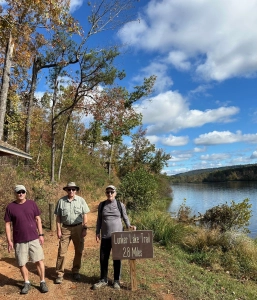
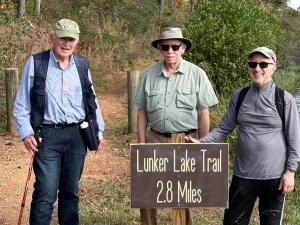
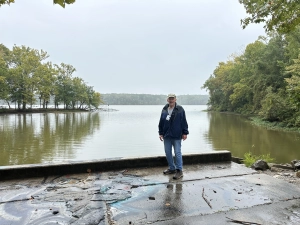
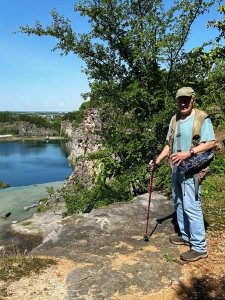
I often wander forest trails alone, content to saunter leisurely absorbing the sights, sounds, and feel of Nature. I relished having friends to share a November 7, 2024 hike with fellow retired forester Chris Stuhlinger, Tom Cosby, fellow former Alabama State Parks Foundation board member, and Dennis McMillian, an old friend from Fairbanks, Alaska now retired to his native Birmingham, AL. We explored the 2.8 mile Lunker Lake Trail at Oak Mountain State Park in Pelham, AL.
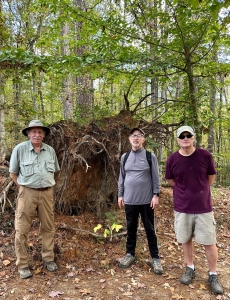
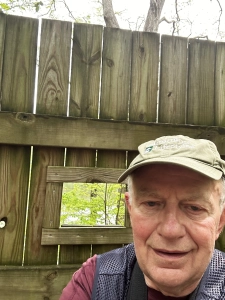
Dennis, Chris, and Tom left to right below left. That’s me in the vest below right. I’m ten weeks beyond my August 20, 2024, total right knee replacement. I maintained a pace that kept me within sight of the others! Lunker Lake and the trail stretch to the northeast behind us.
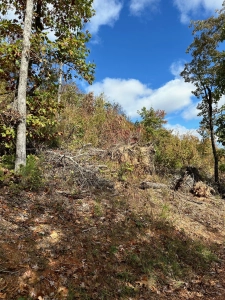
Three years earlier an EF-1 tornado ripped along the lake’s northwest shore.
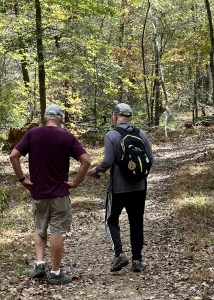
Dennis and Tom grew up together and shared old stories with Chris and me as we walked. I believe many (some) of them were true! We paused at a tremensous upturned root ball, testament to the ferocity of the storm that spun off the tornado.
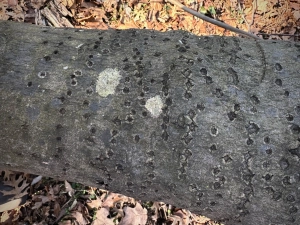
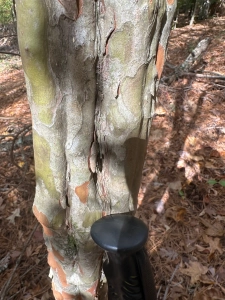
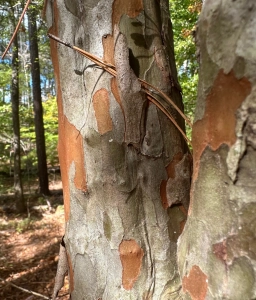
I am a student of tree form and bark patterns. Chris and I concluded that this hawthorne sported a particularly unusual and attractive bark, a design reminding both of us of Chinese elm. We wondered whether it is unique enough to propogate vegetatively as ornamental stock.
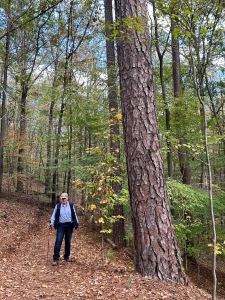
The old commercial industry forester within me never tires of seeing a fat loblolly pine with three clear 16-foot logs.
The trail leg leading us back to the parking lot ran along an old embedded farm road, entrenched through repeated dragging (scraping) to remove mud to three feet below the original ground level. Microtopography tells the story of past use to the inquiring eye.
Coral tooth fungus mushroom brightened our passage, clinging ornately to a dead branch trailside. This tasty edible enticed the forager in me, but I resisted the temptation given its presence along a well traveled route.
The open hardwood stand welcoed the early afternoon sun and the trekkers passing beneath. It would have been a glorious time and place to lean against a tall oak reflecting on the pleasure delivered by healing knees and a day of retirement releasing me from faculty issues, budget difficulties, enrollemt shortfalls, and miscellaneous nuiscances associated with leading a university. I labored with love over a rewarding career in higher education administration, yet I am enriched by the freedom of time without pressures, restrictions, and deadlines.
Henry David Thoreau captured the essence I felt:
Our life is frittered away by detail… simplify, simplify.
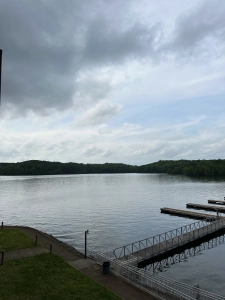
Our path returned us to Lunker Lake, reopening our vista to placid waters and a cerulean sky adorned with scattered cumulus.
When I retired from my fourth university presidency, I worried about how I would handle retirement. Would I find challenge and reward. Would I stay busy in useful pursuits. I admit that shifting gears required adjustment. Yes, I missed the urgency, high-level engagement, and even the sense of imporatance and attention associated with being in charge. However, I adapted…learning in time to relish the freedom and luxury to focus on what is most important to me and the mission I have embraced:
Employ writing and speaking to educate, inspire, and enable readers and listeners to understand, appreciate, and enjoy Nature… and accept and practice Earth Stewardship.
Once again, I turn to Thoreau:
As you simplify your life, the laws of the universe will be simpler; solitude will not be solitude, poverty will not be poverty, nor weakness weakness.
Alabama State Parks Foundation
I’ll remind you that although I serve on the Alabama State Parks Foundation Board, in part because of my love of Nature and in recognition for my writing many prior Posts about visiting and experiencing the Parks, any positions or opinions expressed in these Posts are mine alone and do not in any manner represent the Foundation or its Board.
I urge you to take a look at the Foundation website and consider ways you might help steward these magical places: https://asparksfoundation.org/ Perhaps you might think about supporting the Parks System education and interpretation imperative: https://asparksfoundation.org/give-today#a444d6c6-371b-47a2-97da-dd15a5b9da76
The Foundation exists for the sole purpose of providing incremental operating and capital support for enhancing our State parks… and your enjoyment of them.
We are blessed in Alabama to have our Park System. Watch for future Great Blue Heron Posts as I continue to explore and enjoy these treasures that belong to us. I urge you to discover the Alabama State Parks near you. Follow the advice of John Muir:
And into the forest I go, to lose my mind and find my soul.
In every walk with Nature one receives far more than he seeks.
I only went out for a walk and finally concluded to stay out till sundown, for going out, I found, was really going in.
Between every two pines is a doorway to a new world.
Thoughts and Reflections
I offer these observations:
As you simplify your life, the laws of the universe will be simpler; solitude will not be solitude, poverty will not be poverty, nor weakness weakness. (Henry David Thoreau)
Our life is frittered away by detail… simplify, simplify. (Thoreau)
In retirement I am enriched by the freedom of time without pressures, restrictions, and deadlines. (Steve Jones)
Inhale and absorb Nature’s elixir. May Nature Inspire, Inform, and Reward you!
I am available for Nature-Inspired Speaking, Writing, and Consulting — contact me at steve.jones.0524@gmail.com
Reminder of my Personal and Professional Purpose, Passion, and Cause
If only more of us viewed our precious environment through the filters I employ. If only my mission and vision could be multiplied untold orders of magnitude:
Mission: Employ writing and speaking to educate, inspire, and enable readers and listeners to understand, appreciate, and enjoy Nature… and accept and practice Earth Stewardship.
Vision:
People of all ages will pay greater attention to and engage more regularly with Nature… and will accept and practice informed and responsible Earth Stewardship.
They will see their relationship to our natural world with new eyes… and will understand more clearly their Earth home.
Tagline/Motto: Steve (Great Blue Heron) encourages and seeks a better tomorrow through Nature-Inspired Living!
Steve’s Four Books
I wrote my books Nature Based Leadership (2016), Nature-Inspired Learning and Leading (2017), Weaned Seals and Snowy Summits: Stories of Passion for Place and Everyday Nature (2019; co-authored with Dr. Jennifer Wilhoit), and Dutton Land & Cattle: A Land Legacy Story (2023) to encourage all citizens to recognize and appreciate that every lesson for living, learning, serving, and leading is either written indelibly in or is powerfully inspired by Nature. All four of my books present compilations of personal experiences expressing my deep passion for Nature. All four books offer observations and reflections on my relationship with the natural world… and the broader implications for society. Order any from your local indie bookstore, or find them on IndieBound or other online sources such as Amazon and LifeRich.
I began writing books and Posts for several reasons:
I love hiking and exploring Nature
I see images I want to (and do) capture with my trusty iPhone camera
I enjoy explaining those images — an educator at heart
I don’t play golf!
I do love writing — it’s the hobby I never needed when my career consumed me
Judy suggested my writing is in large measure my legacy to our two kids, our five grandkids, and all the unborn generations beyond
And finally, perhaps my books and Blogs could reach beyond family and touch a few other lives… sow some seeds for the future
https://stevejonesgbh.com/wp-content/uploads/2024/11/IMG_5312.jpg-11.07.24-Lunker-Trail-OMSP-Dennis-Near-End-of-Clockwise-Loop.jpg20161512Steve Joneshttp://stevejonesgbh.com/wp-content/uploads/2017/01/gbhweblogo.pngSteve Jones2025-01-09 13:13:162025-01-09 17:06:42A First Circuit of the Lunker Lake Trail at Oak Mountain State Park!
On September 29, 2024, I co-led a University of Alabama in Huntsville OLLI (Osher Lifelong Learning Institute) Nature Walk at Point Mallard Park in nearby Decatur, Alabama. We departed a picnic shelter at 3:00 PM as a shower associated with superstorm Helene was abating.
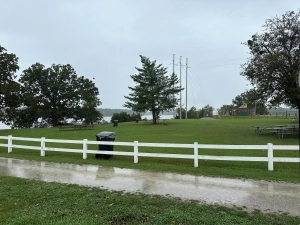
The Park borders Dinsmore Slough and Flint Creek on the west extension of the Wheeler National Wildlife Refuge, on the south side of the Refuge. The Tennessee River (Wheeler Lake) and the Refuge reach some 20 miles upstream to Ditto Landing, on the north side of the river southeast of Huntsville. I view the Refuge as one of my go-to places for Nature wandering. The view below to the east and southeast looks exclusively over the west end of the Refuge.
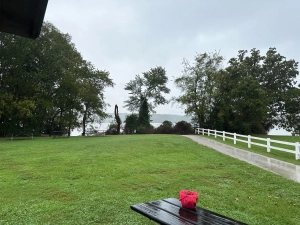
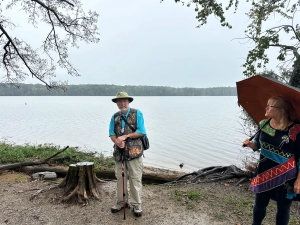
Randy and Kim’s hat and umbrella evidence that the rain had not yet ceased as they provided foreground to the expansive lake and Refuge forest edge at the far shore.
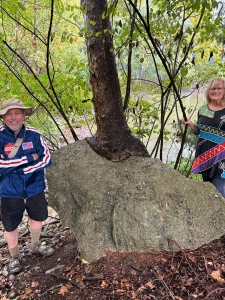
Nature alone provides amusement and sparks curiosity and imagination. Over the past 13 millennia, since Native Americans first populated this region, the Tennesee River provided food, transportation, and sites for gathering and habitation. Humans have left the mark of their occupation in countless ways across those 130 centuries. I wonder how many Native men, women, and children leaned a stone against a young sycamore tree, and then witnessed the tree slowly grow around it, a seeming act of consumption. Maybe none. However, one of our recent inhabitants propped a five-foot slab of cement against this sycamore 10-20 years ago. Darrell and Kim stood near it for scale. Certainly the effect is amusing, curious, and sparks immagination…but the result is not Nature acting alone.
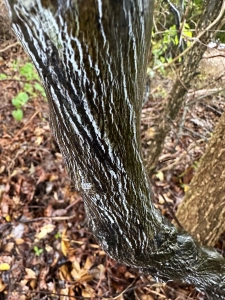
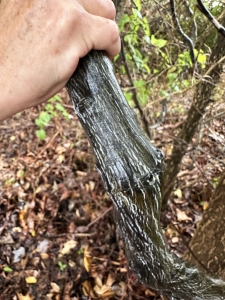
Rain pften enriches my forest wanderings, even as it dampens the way and soaks my garb. Since retiring to northern Alabama, I’ve grown fond of the perrenial green and smooth bark of supplejack vine. I don’t recall ever seeing the wetted vine showing prominent white vertical striations. I’ll henceforth pay more attention. This may turn out to be a unique individual or perhaps this is a common feature hidden in plain sight without the accent provided by the earlier shower.
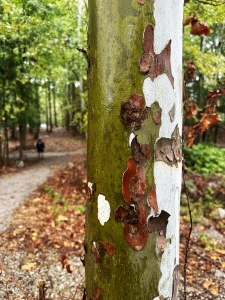
The eight-inch diameter sycamore below left likewise drew my attention…and camera lens. The half-green and white trunk punctuated with brown flecks would, without the recent wetting, have been nothing special. I hadn’t noticed one of our OLLI group walking along the trail in the distance until I examined the photo. The background elements enhance the image of the tree.
The nearby 10-inch-diameter sycamore, backdropped by the slough, does not project the same attractive bark countenance.
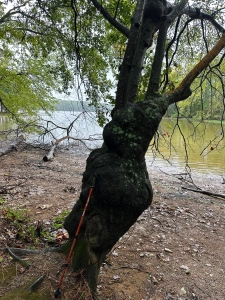
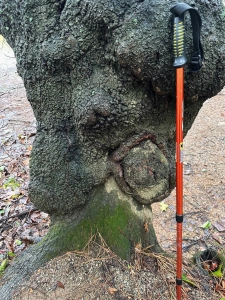
Always on the lookout for tree form curiosities and oddities, I found intrigue and mystery in water oak. The bloated, convoluted form signals internal decay…or alternatively viral and or bacterial infection emanatring from an old wound. In reality, I can’t say for certain. The tree is grossly mishapen due to some combination of physical and biological factors. The tree may be hollow…or it may have exotic wood grain within. Were I a bowl-turner of wood craftsman, I might have greater interest in what lay hidden beneath the bark.
Here is my 51-second video of the contorted water oak:
Although we classifed our OLLI outing as as a Nature Walk, the group soon advance beyond me in the damp afternoon. I was content to proceed at a Nature Walk pace, seeking novelties hidden in pain sight.
Woodland Fungi
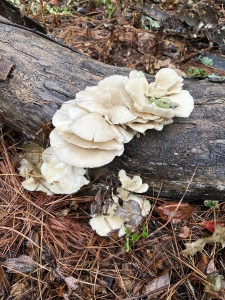
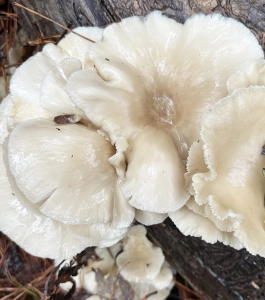
Numerous and varied mushrooms attracted my attention. Oysters, one of my favorite edibles, grew on a downed trunk just off the trail. I harvested a cluster, with a primary purpose of showing the group far ahead what they had missed as they commited the unpardonable sin of walking through the forest rather that sauntering within the forest. I admit to a secondary purpose — making sure that I protected enough of the cluster to saute with tomorrow morning’s eggs!
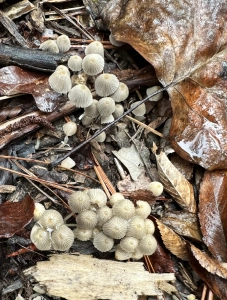
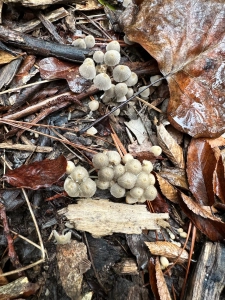
Not nearly as large and conspicuous, trooping crumble cap mushrooms appeared to live uo to their name, marching across the sodden litter.
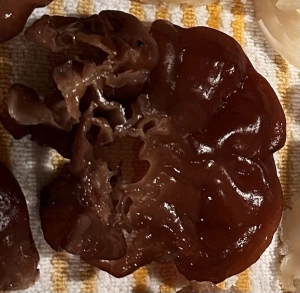
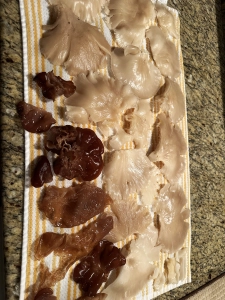
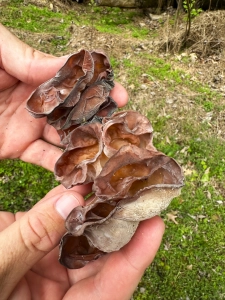
I failed capture a decent photo of the large colony of amber jelly mushrooms we encountered after we connected with the full OLLI group as we returned to the parking lot. All local jelly mushrooms are edible. I the interest of Nature education and interpretation, I collected a handful of the jellies. These were among the largest individuals I have found. Were I foraging on a property where I had permission to harvest, I could have collected a bucketful of both amber jelly and oysters. Here are my educational samples cleaned and ready for simmering, should my interpretive purposes be fulfilled!
Only during retirement have I begun my pursuit of edible mushrooms, beginning with oysters and evolving through a currect set of nearly one dozen species more or less common in northern Alabama. Lion’s mane is my favorite; I don’t find it as often as I would like. I love morrels, but I am afriad that we lie south of their preferred range. I even like the common puffballs and meadow mushrooms that I find in neighborhood lawns and athletic fields. I hold fast to several foraging rules I have adopted:
Eat only those species for which my certainty is 100 percent
Never consume an uncooked mushroom
Clean harvested mushrooms to remove most of the associated insect and slug protein
Urge potential foragers to do extensive homework — don’t take my word for anything
Don’t chew off more than you can bite — a twist on the more common advice to not bite off more than you can chew
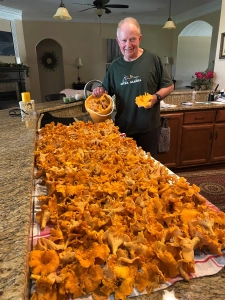
The process of foraging, cleaning, cooking, and packaging is time consuming. At the completion of this chanterelle foraging venture three years ago, I felt like I had chewed off more than I could bite!
Mushroom foraging is an active hobby, and a great way to learn about new facets of the forest ecosystem. Both oysters and jellies are the reproductive organs (spore-producing), chanterelles are associated with myc0rhizal fungi which form essential symbiotic relationships with tree roots.
Clearing Sky
We’ve watched the news of Helene’s devastation from Category Four impact at Florida’s Big Bend to its record-setting rainfall and flooding through Georgia, the Carolnas, Virginia, and Tennessee. Much of the most flood-ravaged region lies within the upper Tennessee River Basin. Almost without exception, the storm delivered from five to 30+ inches upstream from Chattanooga, including the French Broad Basin and Asheville. I measured just 1.51 inches in my Madison, Alabama backyard gauge. We were fortunate to be far west of the track. The clearing sky at Point Mallard revealed no damage…only the damp beauty of parting clouds.
I recorded this 46-second video of promising evening freshened by the departing showers.
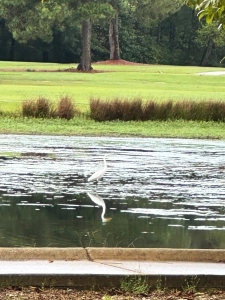
I great egret likewise welcomed the drying weather. With the slough behind me, the egret stands in a wetland pondadjacent to the Park golf course. Egrets and herons elevate the esthetic value of such recreational venues, and amplify the ecosystem integrity and ecological complexity of revirside Park.
I felt blessed just five weeks after total right knee replacement surgery to return to Nature’s glory on such a placid evening on gentle trails. I’m rekindld, rejevenated, and grateful!
Thoughts and Reflections
I offer these observations:
Gloomy skies and rainy days can lift routine Nature to a level of exceptional beauty.
Nature’s ferocity (i.e. Helene in the southern Appalachians) often displays a softer side, in this case, three days of gentle showers in the Huntsville area.
When we contemplate the whole globe as one great dewdrop, striped and dotted with continents and islands, flying through space with other stars all singing and shining together as one, the whole universe appears as an infinite storm of beauty. (John Muir)
Inhale and absorb Nature’s elixir. May Nature Inspire, Inform, and Reward you!
Note: Unless otherwise noted, all blog post images are created & photographeerved.”
A reminder of my Personal and Professional Purpose, Passion, and Cause
If only more of us viewed our precious environment through the filters I employ. If only my mission and vision could be multiplied by untold orders of magnitude:
Mission: Employ writing and speaking to educate, inspire, and enable readers and listeners to understand, appreciate, and enjoy Nature… and accept and practice Earth Stewardship.
Vision:
People of all ages will pay greater attention to and engage more regularly with Nature… and will accept and practice informed and responsible Earth Stewardship.
They will see their relationship to our natural world with new eyes… and understand their Earth home more clearly.
Tagline/Motto: Steve (Great Blue Heron) encourages and seeks a better tomorrow through Nature-Inspired Living!
Steve’s Four Books
I wrote my books Nature Based Leadership (2016), Nature-Inspired Learning and Leading (2017), Weaned Seals and Snowy Summits: Stories of Passion for Place and Everyday Nature (2019; co-authored with Dr. Jennifer Wilhoit), and Dutton Land & Cattle: A Land Legacy Story (2023) to encourage all citizens to recognize and appreciate that every lesson for living, learning, serving, and leading is either written indelibly in or is powerfully inspired by Nature. All four of my books present compilations of personal experiences expressing my deep passion for Nature. All four books offer observations and reflections on my relationship with the natural world… and the broader implications for society. Order any from your local indie bookstore, or find them on IndieBound or other online sources such as Amazon and LifeRich.
I began writing books and Posts for several reasons:
I love hiking and exploring Nature
I see images I want to (and do) capture with my trusty iPhone camera
I enjoy explaining those images — an educator at heart
I don’t play golf!
I do love writing — it’s the hobby I never needed when my career consumed me
Judy suggested my writing is in large measure my legacy to our two kids, our five grandkids, and all the unborn generations beyond
And finally, perhaps my books and Blogs could reach beyond family and touch a few other lives… sow some seeds for the future
https://stevejonesgbh.com/wp-content/uploads/2024/10/IMG_4781.jpg-09.29.24-SJ-Wet-Sycamore-scaled.webp25601920Steve Joneshttp://stevejonesgbh.com/wp-content/uploads/2017/01/gbhweblogo.pngSteve Jones2024-10-22 06:35:452024-10-22 06:35:45Exploring the Forest along Lake Wheeler at Point Mallard Park!
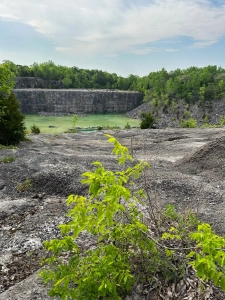
My total left knee replacement (January 23, 2024) healed enough by April 26, to allow me to comfortably explore old access roads on Madison, Alabama’s long abandoned limestone quarry, a site proposed by Madison Trails and Greenways (MTG) as a potential Nature Preserve. I snapped photographs and recorded a 60-second video of the old quarry. When I returned home I found excellent photos depicting Nature’s tireless revegetation of the abused and savaged land at the quarry’s periphery. I also discovered that my iPhone had recorded the 60-second video in a 5-minute slow-motion format! I returned on May 28 to record another quarry video, snap a few photos of additional wildflowers, and record a second video of a stripped and vacant operational area on the outlet’s lower slope below the quarry.
Some of my MTG colleagues view the site’s preserve potential through rose-colored glasses. I visited the property prepared to assess it objectively and dispassionately. Once in my younger professional years, I was directly responsible for my employer’s (Union Camp Corporation) 500 square miles (320,000 acres) of south-central Alabama forestland, a majority untouched by attempted domestication as pasture or cropland, much less stripped of overburden, deeply scarred by quarrying, and with roads, dozing, and cement-dumping across much of the area we traversed. I tried to see the property without bias, yet I admit skepticism regarding categorizing a savaged abused land as a Nature Preserve.
I will attempt to reflect on the quarry in light of a potential refuge in a county rapidly developing with residential, commercial, and industrial expansion. Perhaps a 66 acre property, severely disturbed as it is, can serve a useful role in recreation, conservation, and Nature education and interpretation.
I divided this photo essay into presenting the actual quarry and reflecting on Nature’s attempt to revegetate the abused land, which prior to the quarry cutting and lifting the first block of limestone was a Madison County forested hilltop. Questions I have not answered include:
Who operated the quarry?
Beginning when?
Ending when?
Quality of the limestone removed?
Fascinating and Colorful Background
My efforts to uncover historic information on the quarry’s operations fell far short of my target.
Instead, I found this undated text from a website on Alabama diving:
Once closed to diving, Madison Quarry, which is best known for its sunken Minuteman Missile, is a fantastic place to visit. Located Southwest of Huntsville and maintained by a shop called Better Divers, this beautiful quarry is surrounded by soaring cliffs and has lots to see underwater, including an F-4 Phantom jet, a titan missile nose cone, houseboats and other boats, a pickup truck, a fire truck, and more. There are lines installed for controlled swimming ascents, plus there is a shallow confined water area for training. Maximum depth is 55 feet, but average depth is just 40 feet. Visibility is normally between 20 and 30 feet, and temperatures are normally in the 70’s during the summer months. You’ll find catfish and grass carp, brim, koi, and bass here, along with the occasional harmless freshwater jellyfish. Topside amenities are numerous, including a snack shop with hot food, changing rooms and restrooms, air fills, and more. Madison Quarry is open on weekends between May 1 through October 31st; if you have a group that wants to dive on a weekday, you can make an appointment to do so.
And from another website:
Rock Divers Madison Quarry is a shore accessible fresh water dive site, located in Madison, AL. This dive site has an average rating of 3.67 out of 5 from 9 scuba divers. The maximum depth is 31-35ft/9-11m. The average visibility is 11-15ft/3-5m. This dive site provides bathrooms and airfills. Training platforms are available.
Madison Alabama – The city owns it and there’s a guy who leases it and charges to dive there.
Water visibility varies from 20 to 40 feet depending upon “new” divers in the water and rainfall. Water temperature is usually hovers between mid 60’s and 70’s year round with a normal low in winter of 50 to a high of 85 in the summer. The Park has a Full Service Dive Shop offering SCUBA classes, equipment rental, air, and equipment sales. Facilities include underwater training platforms, a 30-foot houseboat, 36 foot-long steel bridge, 30 foot NASA Space Station Module, and other sunken relics such as various NASA hardware, a City of Madison Truck, numerous smaller boats and a U. S. Air Force F4 Fighter.
My April 26 and May 28, 2024 Visits
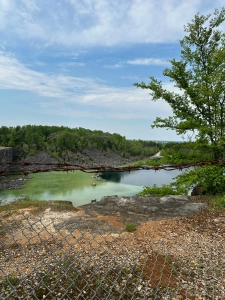
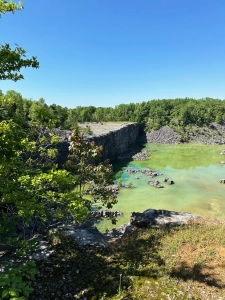
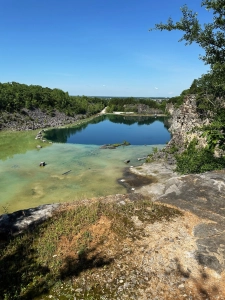
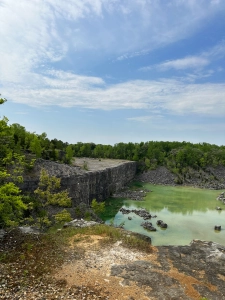
The green-shaded area below my perch 70 feet above is shallow water tinted with algae and sediment. The 30-35-foot deeper water appears nearly black in the image at right. The immediate foreground and at least an acre on this side of the rim area, including portions of the access roads, seems to have served as a dumping area for cement trucks left at the end of a shift with cement not distributed on a delivery site. The site reminds me of hardened lava overflow near a volcano, Nature’s example of severe disturbance. Importantly, Nature has limitless time; she’s in no hurry to develop a Nature Preserve in a north Alabama urbanizing environment.
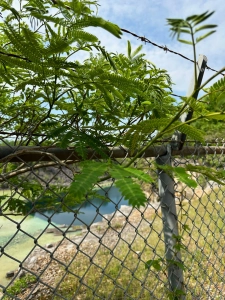
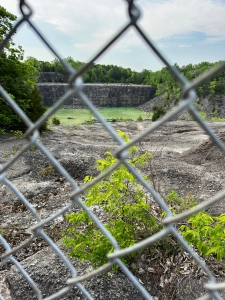
I see safety hazards wherever my eyes roam. Granted, the Grand Canyon presents precipitous overlooks where visitors could tumble thousands of feet. The chain link fence along the quarry perimeter is there for a reason. What is the cost of protecting visitors and indemnifying the City or MGT?
I must admit that the quarry is oddly hypnotizing with its diving days halcyon history and its exotic beauty.
Here is my May 28, 60-second video:
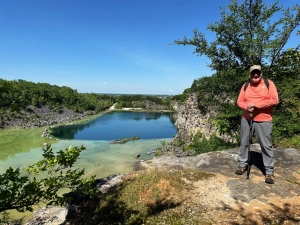
I found a better overlook viewpoint during our May perimeter circuit. You may think I crossed over a damaged part of the perimeter fence to get an unobstructed perspective. Those of you who know me would not accuse me of such ill-advised behavior!
Nor would you expect such a thing from Brian Conway, a fellow MGT Board member.
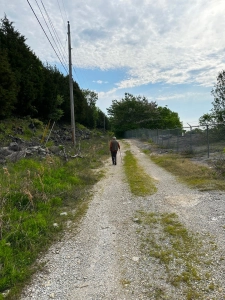
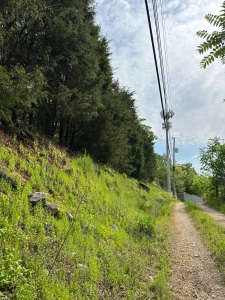
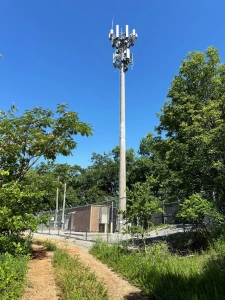
The north rim access road leads to a communication tower. Power lines service the tower. Picture this road as one of the hiking trails. See the perimeter fence to the right. Yes, that’s the perimeter fence that Brian and I did not violate!
The microwave tower lends a space age dimension to the ancient quarry.
Nature’s Healing Ways
Although the quarry struck me as a curiosity, a relic of man’s dependence on Nature and her diverse natural resources, I focused both excursions on Nature’s efforts to heal wounds. Nature does abhor a vacuum, her relentless attempt to revegetate abused land as an example.
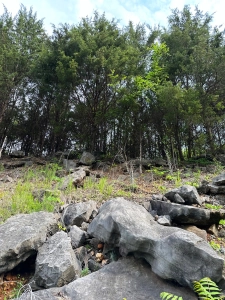
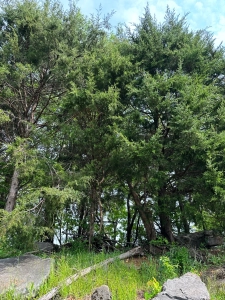
Decades ago quarry operators lined the access road with a levy of boulders opposite the quarry edge. Eastern red cedar, a classic pioneer species, colonized the berm above the road. Birds consume the cedar fruits; their digestive juices scarify the seed coat; the birds dutifully deposits the seeds during their rounds, in this case in brush along the road.
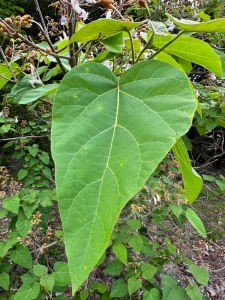
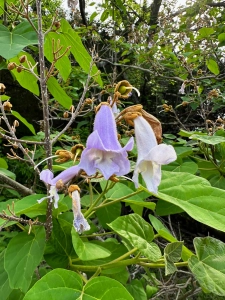
Princess tree, Paulownia tomentosa, is a pioneer invasive (Asian), adept at colonizing edge habitat. The species showcased its blue flowers during the April visit.
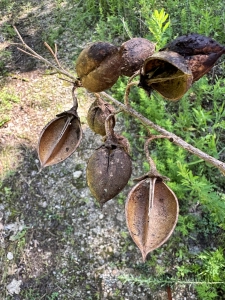
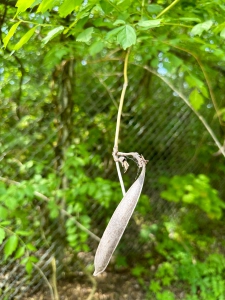
The April Flowers had transformed to green seed pods by the end of May. I discovered a discarded stem of last year’s seed pods (right). Pioneer species are adept at prodigious seed production, effective seed dispersal, and a demand for germination and growth dependent upon full sunshine.
Tree of heaven is yet another invasive early stage successional tree species, an exceptionally fast grower that colonizes readily, grows rapidly, and eventually yields occupied sites to longer lived forest species, i.e. later stage successional tree species such as oak and hickory.
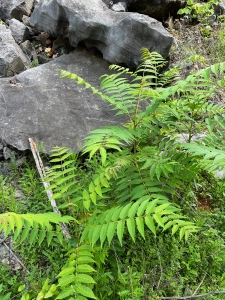
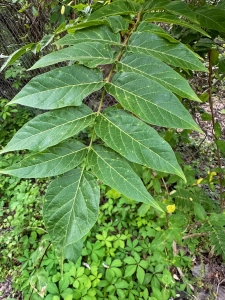
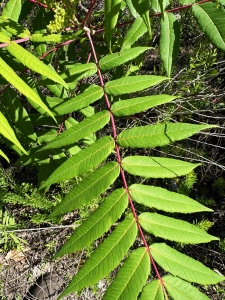
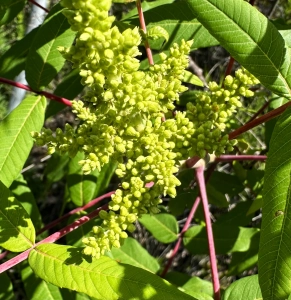
I found lots of smooth sumac securing purchase on these bruised and battered quarry-proximate sites. This is yet another early successional species specializing in invading disturbed sites, living robustly over their relatively short life, and passing the forest gavel to the next successional cohort. Like other such species, smooth sumac produces large quantities of fleshy seeds, attracting birds that consume the fruit, digestively scarify tough seedcoats, and distribute the seeds to other disturbed sites within their range.
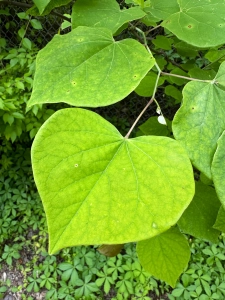
Anyone who roams northern Alabama during early spring can attest to the widely distributed species (with red blossoms) that flourishes at the forest edge along our byways and across abandoned pastures and meadows. Redbud and service berry (white flowers) may be the most recognized spring wildflowers across the eastern US.
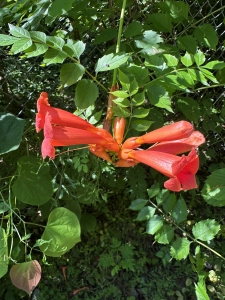
Trumpet vine is another first-rank colonizer common along the perimeter road.
The lovely trumpet flowers greeted me during my May return visit.
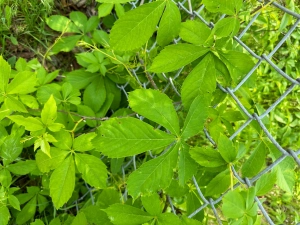
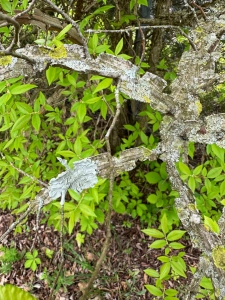
Virginia creeper vine clung to a section of the perimeter fence.
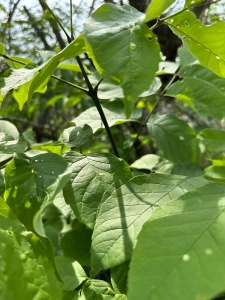
Box elder and green ash likewise joined in reclaiming a sense of wildness among the ruins.
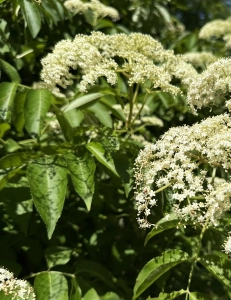
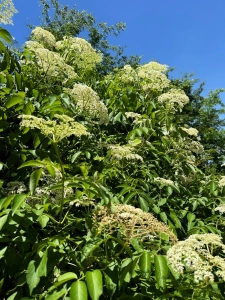
Elderberry flower clusters enhanced the natural beauty of its own accord without the intentional assistance of man, who merely ravaged the formal hilltop, operated the quarry, and walked away, abandoning the site and allowing Nature to do her thing. Eons of evolution have prepared Nature to remediate, recolonize, and reforest areas savaged by fire, wind, volcano, landslide, meteoric blasts, and other acts of God (and man).
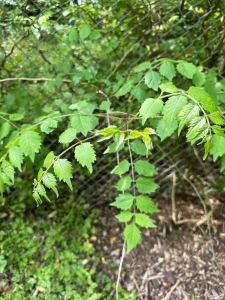
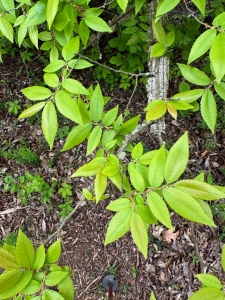
Winged elm is among the woody species playing a role in reclamation.
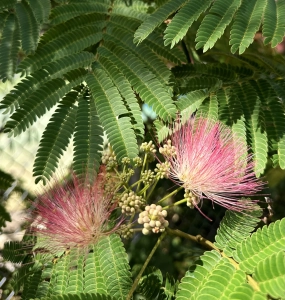
Mimosa, another Asian plant invasive, welcomed me in May with delicate flowers.
Fragrant sumac, a species that looks enough like poison oak to ward off many humans, presents fresh leaves and a few residual berries from last summer’s crop.
My old friend (NOT!), Chinese privet, found a foothold, grew aggressively, flowered prodigiously, and will produce heavy seed crops to attract birds and ensure seed dispersal and distribution.
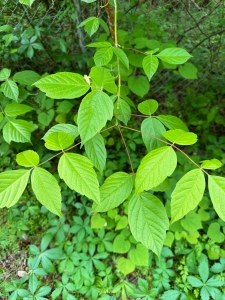
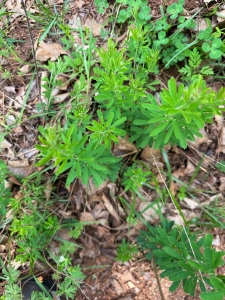
On a much brighter note, lespedeza (a native genus) is growing along the perimeter road. Lespedeza’s roots sport nitrogen fixing bacteria which draw nitrogen from the atmosphere and enrich the soil where they are rooted, just another natural mechanism for remediating barren, scarred, and abused land.
A Relevant Sidebar on DEI
I want to add a time-relevant reflection. We hear so much today about DEI — Diversity, Equity, and Inclusion, a social construct that has no parallel in Nature. Nature is a strict meritocracy that is reclaiming Madison Quarry without regard to DEI. The plant community colonizing the area will be diverse based upon species and individual’s merit in taking root and competing effectively on the wide range of environmental conditions. Equity does not exist…only equal opportunity pervades Nature. Merit and performance matter. No one is taking attendance, keeping track, and counting heads. If fragrant sumac and smooth sumac perform, compete, and persevere, they proceed forward in time and succession. Inclusion is determined strictly by performance. Nature doesn’t check a box, keep a tally, or guarantee a role. Again, merit and performance matter.
See my 2021 photo essay elaborating on the theme of Nature As a Meritocracy: https://stevejonesgbh.com/2021/09/21/lessons-from-nature-nature-is-a-meritocracy/
June 15, 2024, Scale AI CEO Aledandr Wang announced that his company will hire not for DEI, but for MEI: Merit, Excellence, and Intelligence.
Like Nature, America’s founding was based on merit and performance, serving us well for 250 years. Capitalism likewise is performance-based. Nature rewards merit, weeds out non-performers, and succeeds according to her own rules. I can only imagine how pitifully and imperfectly a governmental “task force” would revegetate the Madison Quarry.
Harsh Ruins of Stark Beauty and Haunting Promise
Muir: Earth has no sorrow that Earth cannot heal.
I contemplate the quarry with mixed feelings. I’m taken with its stark and haunting beauty and mystery. Its story is rich with lessons:
Man’s absolute dependence on natural resources
Our careless disregard for the consequences of our actions
Nature’s inherent skill in healing wounds through natural processes
The relentless and seeming disjointed regional development that leads us through desperation to reclaiming a savaged relic of abused wasteland as a Nature Preserve
I contrast this fenced harsh landscape (moonscape) to the 500 square miles of fertile, undisturbed forest I managed in south-central Alabama from 1981-85, and wonder how 40 years later in a relatively wealthy region of north Alabama we are contemplating salvaging a savaged hilltop as a Nature Preserve.
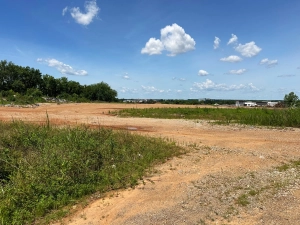
I have not given much focus to a lower elevation corner of the property, leveled decades ago, perhaps employed as a staging area for quarry-related operations. Discarded materiels lie about the clearing. Developed commercial, residential, and industrial development reach beyond the property.
I recorded this 44-second video during my May return visit:
I remain torn about my assessment of the quarry’s future as wasteland or preserve. A lifelong Nature enthusiast, I can see virtue in both possibilities. I need more information. Please view this history-starved assessment as stage one.
Thoughts and Reflections
I offer these observations:
Earth has no sorrow that Earth cannot heal. (John Muir)
Often magic lies within Nature’s every nook and cranny; in this case, battered wildness lies crumpled in plain sight.
Is resurrecting wildness from savage brutality worth the price?
Inhale and absorb Nature’s elixir. May Nature Inspire, Inform, and Reward you!
Another Note: If you came to this post via a Facebook posting or by another route, please sign up now (no cost… no obligation) to receive my Blog Post email alerts: http://eepurl.com/cKLJdL
And Third: I am available for Nature-Inspired Speaking, Writing, and Consulting — contact me at steve.jones.0524@gmail.com
A reminder of my Personal and Professional Purpose, Passion, and Cause
If only more of us viewed our precious environment through the filters I employ. If only my mission and vision could be multiplied by untold orders of magnitude:
Mission: Employ writing and speaking to educate, inspire, and enable readers and listeners to understand, appreciate, and enjoy Nature… and accept and practice Earth Stewardship.
Vision:
People of all ages will pay greater attention to and engage more regularly with Nature… and will accept and practice informed and responsible Earth Stewardship.
They will see their relationship to our natural world with new eyes… and understand their Earth home more clearly.
Tagline/Motto: Steve (Great Blue Heron) encourages and seeks a better tomorrow through Nature-Inspired Living!
Steve’s Three Books
I wrote my books Nature Based Leadership (2016), Nature-Inspired Learning and Leading (2017), and Weaned Seals and Snowy Summits: Stories of Passion for Place and Everyday Nature (2019; co-authored with Dr. Jennifer Wilhoit) to encourage all citizens to recognize and appreciate that every lesson for living, learning, serving, and leading is either written indelibly in or is powerfully inspired by Nature.
I began writing books and Posts for several reasons:
I love hiking and exploring Nature
I see images I want to (and do) capture with my trusty iPhone camera
I enjoy explaining those images — an educator at heart
I don’t play golf!
I do love writing — it’s the hobby I never needed when my career consumed me
Judy suggested my writing is in large measure my legacy to our two kids, our five grandkids, and all the unborn generations beyond
And finally, perhaps my books and Blogs could reach beyond family and touch a few other lives… sow some seeds for the future
All three of my books (Nature Based Leadership; Nature-Inspired Learning and Leading; Weaned Seals and Snowy Summits) present compilations of personal experiences expressing my (and co-author Dr. Wilhoit for Weaned Seals and Snowy Summits) deep passion for Nature. All three books offer observations and reflections on my relationship with the natural world… and the broader implications for society. Order any from your local indie bookstore, or find them on IndieBound or other online sources such as Amazon and LifeRich.
I now have a fourth book, published by Dutton Land and Cattle Company, Dutton Land & Cattle: A Land Legacy Story. Available for purchase directly from me. Watch for details in a future Post.
On April 17 and 18, 2024, I visited Joe Wheeler State Park for the quarterly meeting of the Alabama State Parks Foundation. Rather than present a single long Post from my wanderings during my free time, please look for four separate photo essays:
Reading evidence of past land use in the current 80-90-year-old forests
Tree form oddities and related curiosities
Lakeside forest panoply — this Post
Dawn from the lodge docks
I sauntered for nearly three hours (April 17) along the lakeside Awesome Trail, enjoying diverse attractions, many of them hidden in plain sight. Although the bird blind was in no way hidden, I felt compelled to look closely, which beckoned me to spend more time than I could devote, given the time-certain deadline to attend the late afternoon Foundation gathering at the Park Lodge. I often find in Nature that I want to linger longer than I’m able.
I concur with those autumn forest enthusiasts who are smitten with fall’s color palette. However, I am equally attracted to the seeming infinite shades of green that enrich spring forest ventures. I’m reminded of the title of yet another banal Hollywood blockbuster that I missed (or refused to see) on the big screen: Fifty Shades of Grey. Give me spring’s fifty shades of green and I will see the reel time after time!
The blind’s portals frame whatever fine image you select…each one unique and worthy of photo-capture.
The full Awesome Trail runs from the Park’s Boat Launch parking lot 4.1 miles to the Marina near the Lodge. I recorded this 37-second video to convey the mood, spirit, and nature of this soothing lakeside path, ideal for this woods-wanderer still recovering from the past ten months headlined by my June 19, 2013 triple bypass surgery, October bi-lateral inguinal hernia repair, and January 23, 2024 total left knee replacement!
I recorded the video at 1:37 PM:
The trail passes by this copse of yellow poplar trees, which features the most impressive timbers in this 80-90-year-old forest. When the TVA acquired this property in the early 1930s, the land was severely eroded, deeply-gullied, worn-out pasture, an affliction common across Alabama and the southeast in those Great Depression years. How much larger would this copse have presented had the original soil been protected from abusive agricultural practices?!
A patch of native rusty blackhaw enriched the trek with its profusion of large, showy flower heads!
Fungal Friends
Plants were not the sole features. This white-pored chicken of the woods cluster sprouted within twenty feet of the trail. I resisted the temptation to harvest this edible mushroom.
I spotted this five-inch pale oyster mushroom, another edible.
This foot-wide deer-colored Trametes mushroom (non-edible), has a rather dull beige upper surface, yet compensates with its fascinating underside of distinct open pores.
Two three-inch worms (I am note sure whether they are in fact “worms” — iNaturalist did not identify) found refuge and nourishment in the darkness beneath the bracket.
This ear-like mushroom covered a fallen decaying tree in a thicket too dense for me to capture a clear image. Instead, I gathered a small handful to show wood ear fungus, yet another edible.
I am committed to learning more about the wonderful Fungi Kingdom, which when I was an undergraduate was still part of the Plant Kingdom — oh, how things change over a mere fifty years! Who says lifelong learning isn’t necessary for an old forester who insists upon better understanding the secrets of Nature hidden in plain sight?
Oh, the Gall of This Wasp!
The new leaves on this white oak seedling opened just a week or two before I discovered and photographed them (below left). Already, the seedling stem bears a fresh wool sower gall (below right). During that short time, a wool sower gall wasp had oviposited its eggs into the stem. An NC State University Cooperative Extension bulletin tells the rest of the story:
The wool sower gall is a distinct and unusual plant growth induced by the secretions of the grubs of a tiny gall wasp, Callirhytis seminator. These wasps are about 1/8 inch long, dark brown, and their abdomens are noticeably flattened from side to side. The grubs are translucent to white, plump, and legless. Their heads are more or less shapeless blobs. The wool sower gall is specific to white oaks and only occurs in the spring. When the gall is pulled apart, inside are small seed-like structures inside of which the gall wasp grubs develop (the wool sower gall is also called the oak seed gall).
Nature never disappoints the curious naturalist. I offer most every audience, whether classroom or field trip, my five verbs for truly enjoying Nature:
Five Essential Verbs: Believe, Look, See, Feel, and Act.
I find Nature’s mysteries and curiosities because I know they lie hidden within view — belief enables me to look and see
Really look, with eyes open to your surroundings, external to electronic devices and the distractions of meaningless noise and data
Be alert to see deeply, beyond the superficial
See clearly, with comprehension, to find meaning and evoke feelings
Feel emphatically enough to spur action — learning to seek understanding and awareness is an action
Alabama State Parks Foundation
I’ll remind you that although I serve on the Alabama State Parks Foundation Board, in part because of my love of Nature and in recognition of my writing many prior Posts about visiting and experiencing the Parks, any positions or opinions expressed in these Posts are mine alone and do not in any manner represent the Foundation or its Board.
I urge you to take a look at the Foundation website and consider ways you might help steward these magical places: https://asparksfoundation.org/ Perhaps you might think about supporting the Parks System education and interpretation imperative: https://asparksfoundation.org/give-today#a444d6c6-371b-47a2-97da-dd15a5b9da76
The Foundation exists to provide incremental operating and capital support for enhancing our State parks… and your enjoyment of them.
We are blessed in Alabama to have our Park System. Watch for future Great Blue Heron Posts as I continue to explore and enjoy these treasures that belong to us. I urge you to discover the Alabama State Parks near you. Follow the advice of John Muir:
And into the forest I go, to lose my mind and find my soul.
In every walk with Nature one receives far more than he seeks.
I only went out for a walk and finally concluded to stay out till sundown, for going out, I found, was really going in.
Between every two pines is a doorway to a new world.
Thoughts and Reflections
I offer these observations:
It is an incalculable added pleasure to any one’s sum of happiness if he or she grows to know, even slightly and imperfectly, how to read and enjoy the wonder-book of nature. (Theodore Roosevelt)
Vitality and beauty are gifts of Nature, for those who live according to its laws. (da Vinci)
Nature never disappoints the curious naturalist.
Inhale and absorb Nature’s elixir. May Nature Inspire, Inform, and Reward you!
Another Note: If you came to this post via a Facebook posting or by another route, please sign up now (no cost… no obligation) to receive my Blog Post email alerts: http://eepurl.com/cKLJdL
And Third: I am available for Nature-Inspired Speaking, Writing, and Consulting — contact me at steve.jones.0524@gmail.com
A reminder of my Personal and Professional Purpose, Passion, and Cause
If only more of us viewed our precious environment through the filters I employ. If only my mission and vision could be multiplied by untold orders of magnitude:
Mission: Employ writing and speaking to educate, inspire, and enable readers and listeners to understand, appreciate, and enjoy Nature… and accept and practice Earth Stewardship.
Vision:
People of all ages will pay greater attention to and engage more regularly with Nature… and will accept and practice informed and responsible Earth Stewardship.
They will see their relationship to our natural world with new eyes… and understand their Earth home more clearly.
Tagline/Motto: Steve (Great Blue Heron) encourages and seeks a better tomorrow through Nature-Inspired Living!
Steve’s Three Books
I wrote my books Nature Based Leadership (2016), Nature-Inspired Learning and Leading (2017), and Weaned Seals and Snowy Summits: Stories of Passion for Place and Everyday Nature (2019; co-authored with Dr. Jennifer Wilhoit) to encourage all citizens to recognize and appreciate that every lesson for living, learning, serving, and leading is either written indelibly in or is powerfully inspired by Nature.
I began writing books and Posts for several reasons:
I love hiking and exploring Nature
I see images I want to (and do) capture with my trusty iPhone camera
I enjoy explaining those images — an educator at heart
I don’t play golf!
I do love writing — it’s the hobby I never needed when my career consumed me
Judy suggested my writing is in large measure my legacy to our two kids, our five grandkids, and all the unborn generations beyond
And finally, perhaps my books and Blogs could reach beyond family and touch a few other lives… sow some seeds for the future
All three of my books (Nature Based Leadership; Nature-Inspired Learning and Leading; Weaned Seals and Snowy Summits) present compilations of personal experiences expressing my (and co-author Dr. Wilhoit for Weaned Seals and Snowy Summits) deep passion for Nature. All three books offer observations and reflections on my relationship with the natural world… and the broader implications for society. Order any from your local indie bookstore, or find them on IndieBound or other online sources such as Amazon and LifeRich.
I now have a fourth book, published by Dutton Land and Cattle Company, Dutton Land & Cattle: A Land Legacy Story. Available for purchase directly from me. Watch for details in a future Post.
https://stevejonesgbh.com/wp-content/uploads/2024/04/IMG_2957-2.jpg-4.17-2.49-YP-Along-Awesome.jpg20161512Steve Joneshttp://stevejonesgbh.com/wp-content/uploads/2017/01/gbhweblogo.pngSteve Jones2024-06-12 09:03:402024-06-12 09:03:40Mid-April Lakeside Forest Panoply at Alabama's Joe Wheeler State Park
On April 17 and 18, 2024, I visited Joe Wheeler State Park for the quarterly meeting of the Alabama State Parks Foundation. Rather than present a single long Post from my wanderings during my free time, please look for four separate photo essays:
Reading evidence of past land use in the current 80-90-year-old forests
Tree form oddities and related curiosities
Lakeside forest panoply
Dawn from the Lodge docks — This Post
Going Gently Into That Good Night
Although I titled this photo essay Mid April Dawn, I found no better place to insert two photographs from late afternoon before joining the Foundation social and dinner. I never tire of placid water, lakeside forests, and evening clouds.
I snapped the images from the Lodge docks at 4:47 and 48 PM.
I reluctantly left the docks for the 5:00 PM Foundation session, knowing that the affair and dinner would allow no time for wandering outside before sunset.
Mid-April Dawn
I rarely miss dawn and sunrise. I wonder what could possibly keep me awake so late at night that I miss darkness retreating to the west and the new day breaching the eastern horizon. I made it to the docks during civil twilight at 6:07 AM, ten minutes ahead of sunrise. Overcast dimmed the scene.
By 6:13 (left) the sun had broken the horizon, shielded by trees and shrouded in the low overcast. Little had changed by 6:20 AM. Broken stratus clouds dulled the firmament, holding a bright day at bay. Note the bird on the water (photo at right).
The 6:20 AM bird on the water revealed itself as a common loon, who treated me to a tremolo greeting, a call that stirs me to the core, reminding me of lakeside summer mornings and evenings in the great northland. Loons have normally migrated from northern Alabama to their higher latitude breeding grounds by mid-April.
Contrary to clear-sky mornings when daylight explodes when the sun rises, little change in light level appeared by 6:21 and 6:23 AM.
I embraced the cloud-dulled new day and the mood, character, and serenity it suggested. I recorded this 43-second video at 6:23 AM:
I reemerged between our group breakfast and the start of our business meeting. The clouds lingered at 8:14 AM, yet a few breaks revealed blue above.
Two final morning views completed my morning reconnaissance at 8:38 and 8:42 AM, the first of a fully-leafed-out yellow popular behind the Lodge and the second a last view of the marina.
I realize that this series of dawn through early morning photographs depict only modest shifts in light, mood, and insight. In contrast I’ve experienced other mornings when change happened in leaps and bounds…when the sun burst from the horizon, twilight collapsed without delay, and the morning dispersed in the blink of an eye. Nature is like that. Sometimes predictable…other times surprising. Nothing in Nature is static, whatever the pace.
I recall during my career retirees telling me that they are busier in retirement than ever before. I can’t say that I am as pressed for time as during my two decades of executive university leadership (VP at two institutions and CEO at four others), however, I am more engaged than I imagined I would be. Importantly, my busy days focus on Nature! Secondly, the pace and direction of effort are mine; stress is generally absent.
Alabama State Parks Foundation
I’ll remind you that although I serve on the Alabama State Parks Foundation Board, in part because of my love of Nature and in recognition of my writing many prior Posts about visiting and experiencing the Parks, any positions or opinions expressed in these Posts are mine alone and do not in any manner represent the Foundation or its Board.
I urge you to take a look at the Foundation website and consider ways you might help steward these magical places: https://asparksfoundation.org/ Perhaps you might think about supporting the Parks System education and interpretation imperative: https://asparksfoundation.org/give-today#a444d6c6-371b-47a2-97da-dd15a5b9da76
The Foundation exists to provide incremental operating and capital support for enhancing our State parks… and your enjoyment of them.
We are blessed in Alabama to have our Park System. Watch for future Great Blue Heron Posts as I continue to explore and enjoy these treasures that belong to us. I urge you to discover the Alabama State Parks near you. Follow the advice of John Muir:
And into the forest I go, to lose my mind and find my soul.
In every walk with Nature one receives far more than he seeks.
I only went out for a walk and finally concluded to stay out till sundown, for going out, I found, was really going in.
Between every two pines is a doorway to a new world.
Thoughts and Reflections
I offer these observations:
Nothing in Nature is static, whatever the pace of change.
It’s always sunrise somewhere; the dew is never all dried at once; a shower is forever falling; vapor is ever rising. Eternal sunrise, eternal sunset, eternal dawn and gloaming, on sea and continents and islands, each in its turn, as the round earth rolls. (John Muir)
Those who contemplate the beauty of the earth find reserves of strength that will endure as long as life lasts. There is something infinitely healing in the repeated refrains of nature — the assurance that dawn comes after night, and spring after winter. (Rachel Carson)
Inhale and absorb Nature’s elixir. May Nature Inspire, Inform, and Reward you!
Another Note: If you came to this post via a Facebook posting or by another route, please sign up now (no cost… no obligation) to receive my Blog Post email alerts: http://eepurl.com/cKLJdL
And Third: I am available for Nature-Inspired Speaking, Writing, and Consulting — contact me at steve.jones.0524@gmail.com
A reminder of my Personal and Professional Purpose, Passion, and Cause
If only more of us viewed our precious environment through the filters I employ. If only my mission and vision could be multiplied by untold orders of magnitude:
Mission: Employ writing and speaking to educate, inspire, and enable readers and listeners to understand, appreciate, and enjoy Nature… and accept and practice Earth Stewardship.
Vision:
People of all ages will pay greater attention to and engage more regularly with Nature… and will accept and practice informed and responsible Earth Stewardship.
They will see their relationship to our natural world with new eyes… and understand their Earth home more clearly.
Tagline/Motto: Steve (Great Blue Heron) encourages and seeks a better tomorrow through Nature-Inspired Living!
Steve’s Three Books
I wrote my books Nature Based Leadership (2016), Nature-Inspired Learning and Leading (2017), and Weaned Seals and Snowy Summits: Stories of Passion for Place and Everyday Nature (2019; co-authored with Dr. Jennifer Wilhoit) to encourage all citizens to recognize and appreciate that every lesson for living, learning, serving, and leading is either written indelibly in or is powerfully inspired by Nature.
I began writing books and Posts for several reasons:
I love hiking and exploring Nature
I see images I want to (and do) capture with my trusty iPhone camera
I enjoy explaining those images — an educator at heart
I don’t play golf!
I do love writing — it’s the hobby I never needed when my career consumed me
Judy suggested my writing is in large measure my legacy to our two kids, our five grandkids, and all the unborn generations beyond
And finally, perhaps my books and Blogs could reach beyond family and touch a few other lives… sow some seeds for the future
All three of my books (Nature Based Leadership; Nature-Inspired Learning and Leading; Weaned Seals and Snowy Summits) present compilations of personal experiences expressing my (and co-author Dr. Wilhoit for Weaned Seals and Snowy Summits) deep passion for Nature. All three books offer observations and reflections on my relationship with the natural world… and the broader implications for society. Order any from your local indie bookstore, or find them on IndieBound or other online sources such as Amazon and LifeRich.
I now have a fourth book, published by Dutton Land and Cattle Company, Dutton Land & Cattle: A Land Legacy Story. Available for purchase directly from me. Watch for details in a future Post.
https://stevejonesgbh.com/wp-content/uploads/2024/04/IMG_3003.jpg-4.18.24-6.13-AM-scaled.webp25601920Steve Joneshttp://stevejonesgbh.com/wp-content/uploads/2017/01/gbhweblogo.pngSteve Jones2024-05-29 16:31:592024-05-30 19:29:24Mid-April Dawn at Alabama's Joe Wheeler State Park!