Posts

Curiosities, Oddities, and Mysteries In a Sanctuary’s Bottomland Hardwood Forest!

On October 14, 2025, I had nearly two hours to roam before meeting with a colleague to prepare for a scheduled joint seminar the next week. I visited the tupelo swamp on the northeast side of Huntsville’s Goldsmith-Schiffman Wildlife Sanctuary. I had no objective beyond seeing what may lie hidden in plain sight during the dry autumn season. Never disappointed by my routine impromptu explorations, I discovered a portfolio of interesting features.


A Big Oak Topples into the River


Sometime this past summer, this 2.5-foot diameter water oak toppled violently into the adjacent Flint River, blocking at least half of the river’s width. The crown clings to the brown leaves that were in full flush when the tree fell.
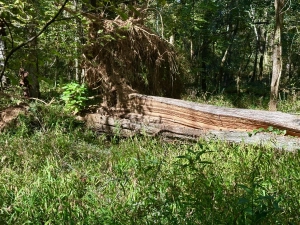
 

I recorded this 58-second video of the toppled water oak.


I wonder whether the crown will hold in place when winter rains swell the river to bankfull and beyond. The force will be powerful. Only Nature knows her limits, yet cares nothing of the consequences. I’ll keep an eye on her antics and impacts.
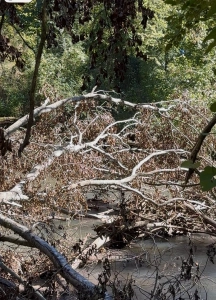
 

I observe in nearly every Post, death is a big part of life in our forests.


Another Big Oak Decomposes and Decays


Across eight years of permanent residence in North Alabama, I am learning better how to estimate the pace of decomposition and decay based on observation. Marian Moore Lewis, author of Southern Sanctuary, and I encountered a recently uprooted red oak on November 18, 2020 in this same bottomland forest. Fine roots were still evident; the root ball soil remined intact; bole bark and crown appeared fresh.
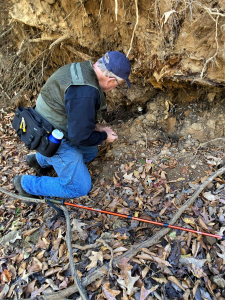
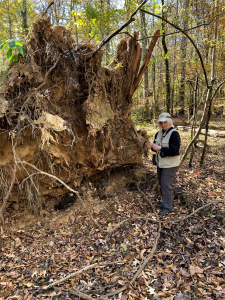
November 2020 November 2020


The massive root ball is clearly weathering away in my October 14, 2025 photo. Only the largest woody roots remain, yet even they are rapidly decaying. Trunk bark is shredding and stripping. Five years leave a striking mark on a large oak. My eye is calibrating. I am confident that I can estimate time since windthrow within 2-3 years, through the first 20 years. By then, the soil incorporation is in control.
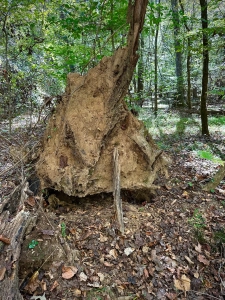
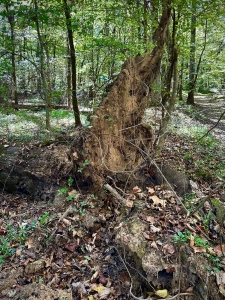
 

I will continue to Monitor…and Learn.

A Rich Species Mix


With litte necessary narrative, here are some of the tree varieties I encountered.

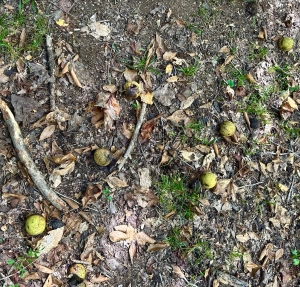
A nice crop of walnuts beneath a 24-inch diameter black walnut.


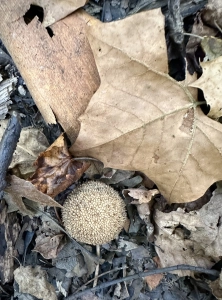
A sycamore and an attractive natural forest floor arrangement of peeled sycamore bark, a dropped leaf, and a seed ball.
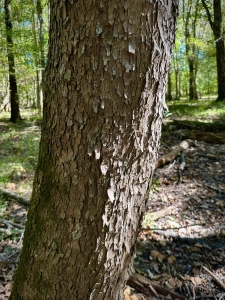
 

Sycamore’s peeling bark is one of its distinctive features.
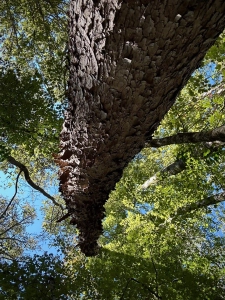
 

During my frequent Nature interpretive walks, more than half of participants recognize sycamore, provided I offer some hints and prompts.

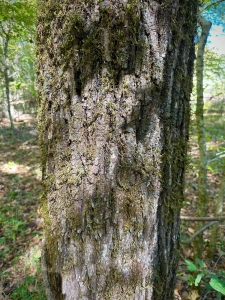
Carpinus caroliniana is an understory to mid-canopy hardwood that has been a favorite of mine since my undergraduate student days. I learned its common name as musclewood. It resembles the sinewed fibers of a muscled arm. Other common monikers include American hornbeam, blue beech, and ironwood. I photographed two individuals.
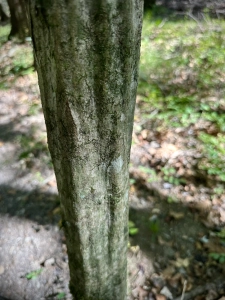
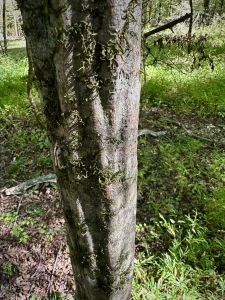
 

I’m a lifetime fancier of tree form oddities and curiosities.


An Attractive Fungal Resident


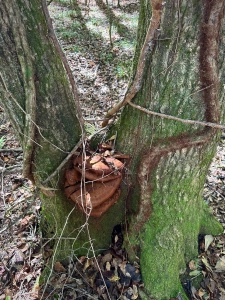
A twin water oak nestled aged resinous polypore brakets in its fork.
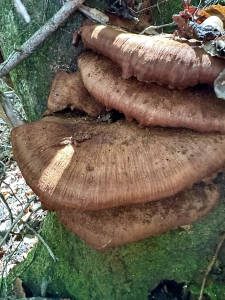
 

I recorded a 58-second video at the infected twin water oak


Again, death is a big part of life in our forests. The twins are diseased. Mycelia are decomposing and decaying the twin. Death is underway. Although macabre, the truth is that the end begins at the start…for all life on earth.


Answer Me This


Just ten feet from the infected twin, I spotted this galvanized nail in another water oak.  Yet another story that I cannot but weakly ponder. Did it mark a survey point? Is it related to transfer of the private property to the city to create the Sanctuary? A scavenger hunt or geocaching site? Pardon the pun, but I am unable to nail the reason!
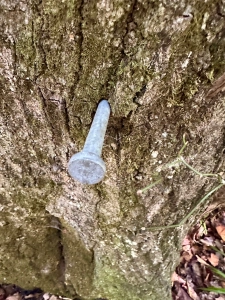
 

I will continue finding riddles I cannot solve.

Water Tupelo Swamp


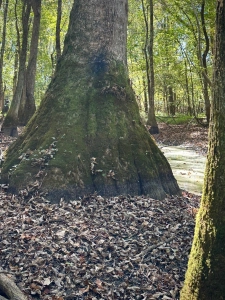
I grew up and attended forestry school far north of the natural range of water tupelo, which may explain my fascination with this forest type. I’ve published at least a dozen Posts about my adventures in this forest type, including several in the Sanctuary. I will offer only an album of photographs without detailed narrative. These buttressed tupelo draw me. The dry season standing water and soil saturation hint at the deeper water ahead in the winter.
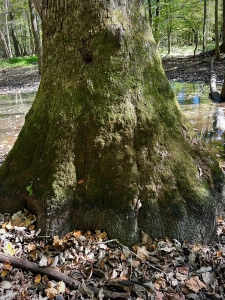
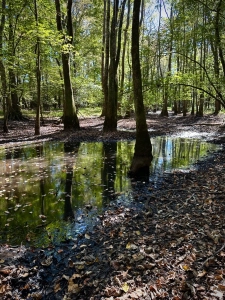
 

You don’t need much beyond my 60-second swamp tour video overview.


Strange tree forms and a haunting aspect dominate.
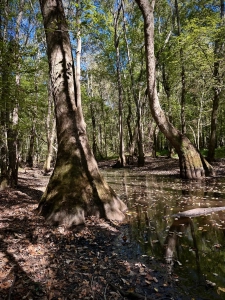
 

This is far removed from the upland hardwood forests I wandered in my youth.
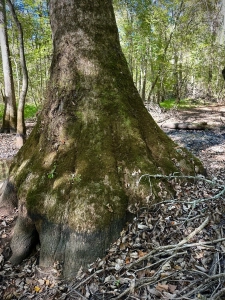
 

I recorded a 48-second video of a massive water tupelo. I estimated its ground-level diameter as 12-14 feet!


I relish the beauty, magic, wonder, awe, and inspiration!


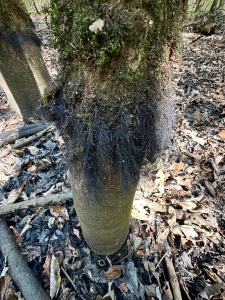
What is the hairy, grizzled, bearded old man of the tupelo forest!?!?


See my related Post (https://stevejonesgbh.com/2025/10/27/brief-form-post-47-strange-bearded-tupelo-trees-air-root-mysteries-and-curiosities/) for the answer!


Thoughts and Reflections


I offer these observations:

  • Tupelo forests are far removed from the upland hardwood forests I wandered in my youth. (Steve Jones)
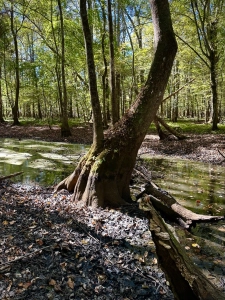
  • Death is a big part of life in our North Alabama forests. (Steve Jones)
  • I have no special talent. I am only passionately curious. (Albert Einstein)

Inhale and absorb Nature’s elixir. May Nature Inspire, Inform, and Reward you!


Note: All blog post images created & photographed by Stephen B. Jones unless otherwise noted. Please circulate images with photo credit: “©2026 Steve Jones, Great Blue Heron LLC. All Rights Reserved.”

I am available for Nature-Inspired Speaking, Writing, and Consulting — contact me at steve.jones.0524@gmail.com

Subscribe to my free weekly photo essays (like this one) at: http://eepurl.com/cKLJdL


Reminder of my Personal and Professional Purpose, Passion, and Cause


If only more of us viewed our precious environment through the filters I employ. If only my mission and vision could be multiplied untold orders of magnitude:

Mission: Employ writing and speaking to educate, inspire, and enable readers and listeners to understand, appreciate, and enjoy Nature… and accept and practice Earth Stewardship.

Vision:

  • People of all ages will pay greater attention to and engage more regularly with Nature… and will accept and practice informed and responsible Earth Stewardship.
  • They will see their relationship to our natural world with new eyes… and will understand more clearly their Earth home.

Tagline/Motto: Steve (Great Blue Heron) encourages and seeks a better tomorrow through Nature-Inspired Living!


Steve’s Four Books


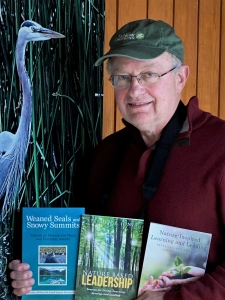
I wrote my books Nature Based Leadership (2016), Nature-Inspired Learning and Leading (2017), Weaned Seals and Snowy Summits: Stories of Passion for Place and Everyday Nature (2019; co-authored with Dr. Jennifer Wilhoit), and Dutton Land & Cattle: A Land Legacy Story (2023) to encourage all citizens to recognize and appreciate that every lesson for living, learning, serving, and leading is either written indelibly in or is powerfully inspired by Nature. All four of my books present compilations of personal experiences expressing my deep passion for Nature. All four books offer observations and reflections on my relationship with the natural world… and the broader implications for society. Order any from your local indie bookstore, or find them on IndieBound or other online sources such as Amazon and LifeRich.

I began writing books and Posts for several reasons:

  • I love hiking and exploring Nature
  • I see images I want to (and do) capture with my trusty iPhone camera
  • I enjoy explaining those images — an educator at heart
  • I don’t play golf!
  • I do love writing — it’s the hobby I never needed when my career consumed me
  • Judy suggested my writing is in large measure my legacy to our two kids, our five grandkids, and all the unborn generations beyond
  • And finally, perhaps my books and Blogs could reach beyond family and touch a few other lives… sow some seeds for the future


Part Two — Huntsville’s Goldsmith-Schiffman Wildlife Sanctuary: Tenth Anniversary of Southern Sanctuary!

Part Two


I initially developed this Tenth-Anniversary photo essay as a single post. However, its length exceeded even my generous tolerance for content and length. Here is the link to Part One: https://stevejonesgbh.com/2025/07/18/part-one-huntsvilles-goldsmith-schiffman-wildlife-sanctuary-tenth-anniversary-of-southern-sanctuary/

I repeat the opening paragraph of Part One:

I visited Huntsville, Alabama’s Goldsmith-Schiffman Wildlife Sanctuary on May 17, 2025, with Marian Moore Lewis, author of Southern Sanctuary: A Naturalist’s Walk through the Seasons ((2015), Bill Heslip, Director of A Tale of Two Extraordinary Women (2022; a 14-minute video telling the tale of the Sanctuary), Chris Stuhlinger, a fellow retired forester, and me (I produced the video). We wanted to keep our friendship and love for the Sanctuary vibrant, and once more discover the delights we would find hidden in plain sight. Objective accomplished; we pledged to do it again in October!

Part One carried our venture from Hidden Spring through the marsh and down Hidden Spring Brook to the third beaver dam discharging the creek into Jobala Pond.


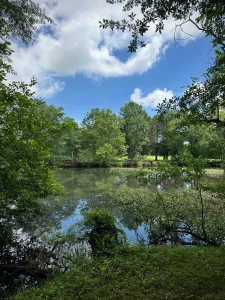
Jobala Pond


I’ve devoted significant narrative in some prior GSWS photo essays to the history of Jobala Pond. I won’t repeat here except to say that highway engineers created the pond by mining sand, clay, and gravel for road construction in the 1950s. All the vegetation and the complex associated ecosystem resulted from naturalization. John Muir missed nothing in Nature. Jobala Pond’s recovery from the mining ravages would not have surprisedthe inveterate Mr. Muir:

Earth has no sorrow that earth can not heal.

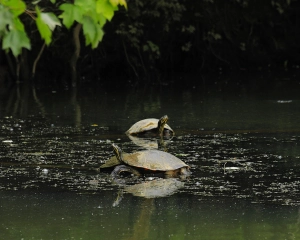
I never tire of the beauty, magic, wonder, awe, and inspiration that this old borrow pit presents and evokes (left). Marian caught images of two cooters from across Jobala (right).

Jobala Pond


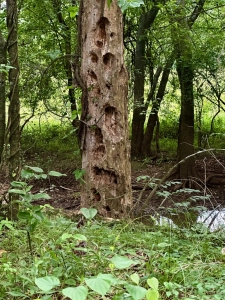
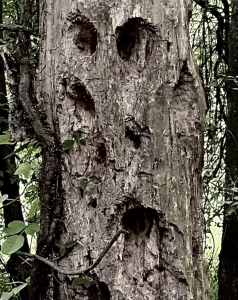
I am hopelessly addicted to tree form oddities and curiosities. As others enjoyed the pond, I drifted to the swampy slough across the gravel path. The old snag was watching us and, with what I thought was a wink of one of the two eyes (at right), beckoned me to take a closer look. I credit woodpeckers, fungi, insects, and other critters with the sculpting. Note that the snag still supports a clinging vine, the tree’s lifelong companion. A new actor will lead the next act in this Nature drama — gravity will once again prevail. The fallen log will decompose into the rich soil. Nothing in Nature is static!


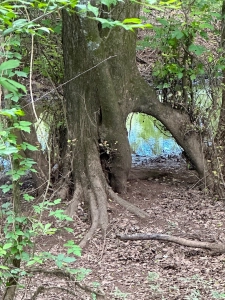
Nearby, its feet anchored in the same slough, a tree (I failed to identify the species on-site) stands on stilted legs…a living natural bridge. One might question the cause of such an odd form. Imagine decades ago a decaying tree stump offering a favorable site for a fallen seed to germinate. The seedling nourished on moisture and nutrients available in the decomposing stump, even as it extended roots downward along the stump into the rich mineral soil where the prior tree grew. In time the stump decomposed in full, leaving the stilted-root tree embracing thin air…the ghost of a stump.


Leonardo da Vinci, a ghost-spirit of a different sort, inspires me to question, puzzle, and offer explanation for the Nature mysteries I encounter:

There is no result in nature without a cause; understand the cause and you will have no need of the experiment.

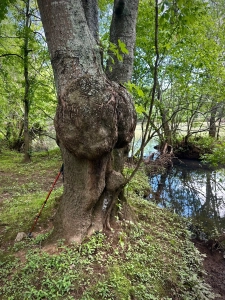
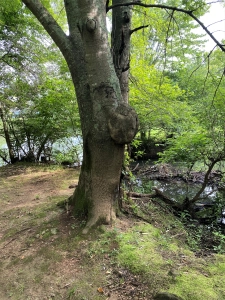
I’ve watched this burled water oak near the outlet of Jobala Pond for several years. Since June 6, 2020 (image at right), the burl has more than doubled its girth.


Whether I’m writing about a North Alabama Land Trust Preserve, one of our 22 Alabama State Parks, the Sanctuary, or some other special place, I urge the managing entity to establish permanent photo points to chronicle the change that is ongoing, inevitable, and significant. The paired photos above tell the story far better than the “inimitable Dr. Jones” standing at the tree claiming, “This burl is twice as big as it was five years ago.” Only one AL State Park has created photo points: Monte Sano with funds I helped raise. Education is a fundamental mission element for the Park system, the Land Trust, and the City of Huntsville. Are these entities falling short of meeting their education imperative? You be the judge.

Here is the 59-second video of Marian offering her thoughts on our tenth anniversary explorations at Jobala Pond.


I recorded this 59-second video just below Jobala.


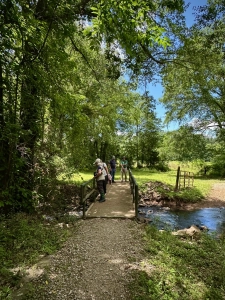
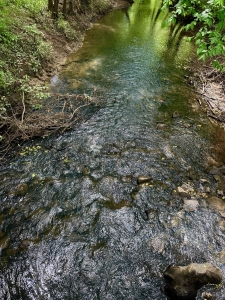
Enjoy the tranquil beauty of the iron bridge and Hidden Spring Brook flowing beyond it, seeking its confluence with the Flint River.


I recorded this 58-second video below Jobala at the iron bridge crossing Hidden Spring Brook.


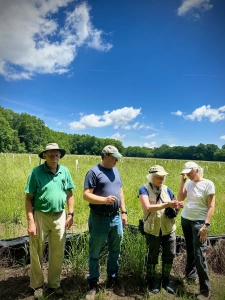
Chris Stuhlinger, Bill Heslip, Marian Moore Lewis, and Becky Heslip posed at the wetland mitigation area.


I recorded this 59-second video of the wetland mitigation. Note, I refer to Bill in the video narrative as the Sanctuary video’s Producer; instead, he directed the production. He kindly declared me the Producer.


Closing

In closing, the Sanctuary is a speciel place. My third book, Weaned Seal and Snowy Summits: Stories of Passion for Place and Everyday Nature, captures the ecological, spiritual, and emotional nature of such special places. I offer this text from my Introduction to the book:

Awakening to Nature does not require a trip to the Grand Canyon or a trek across the Gobi. Nature is in our backyard, a nearby city park, or a state park just down the road. Anyone can develop a relationship with Nature wherever you are, a point I reiterate in each essay and a message I exhort in each and every nature-inspired life and living address I deliver. My relationship with Nature is spiritual. I view my engagement as a calling, and a noble cause to sow seeds so that others might do their own part to change some small corner of this Earth for the better through wisdom, knowledge, and hard work.

Sharing a special place with special friends multiplies the reward:

There’s a land–oh, it beckons and beckons,

And we want to go back–and we will!


Thoughts and Reflections


I offer these observations:

  • Nature reaches far into my heart, soul, body, mind, and spirit. (Steve Jones)
  • Awakening to Nature does not require a trip to the Grand Canyon or a trek across the Gobi. (Steve Jones)
  • Any glimpse into the life of an animal quickens our own and makes it so much the larger and better in every way. (John Muir)

Inhale and absorb Nature’s elixir. May Nature Inspire, Inform, and Reward you!


Note: Unless otherwise noted, all blog post images are created & photographed by Stephen B. Jones.

I am available for Nature-Inspired Speaking, Writing, and Consulting — contact me at steve.jones.0524@gmail.com


A reminder of my Personal and Professional Purpose, Passion, and Cause

If only more of us viewed our precious environment through the filters I employ. If only my mission and vision could be multiplied by untold orders of magnitude:

Mission: Employ writing and speaking to educate, inspire, and enable readers and listeners to understand, appreciate, and enjoy Nature… and accept and practice Earth Stewardship.

Vision:

  • People of all ages will pay greater attention to and engage more regularly with Nature… and will accept and practice informed and responsible Earth Stewardship.
  • They will see their relationship to our natural world with new eyes… and understand their Earth home more clearly.

Tagline/Motto: Steve (Great Blue Heron) encourages and seeks a better tomorrow through Nature-Inspired Living!


Steve’s Four Books


I wrote my books Nature Based Leadership (2016), Nature-Inspired Learning and Leading (2017), Weaned Seals and Snowy Summits: Stories of Passion for Place and Everyday Nature (2019; co-authored with Dr. Jennifer Wilhoit), and Dutton Land & Cattle: A Land Legacy Story (2025) to encourage all citizens to recognize and appreciate that every lesson for living, learning, serving, and leading is either written indelibly in or is powerfully inspired by Nature. All four of my books present compilations of personal experiences expressing my deep passion for Nature. All four books offer observations and reflections on my relationship with the natural world… and the broader implications for society. Order any from your local indie bookstore, or find them on IndieBound or other online sources such as Amazon and LifeRich.

I began writing books and Posts for several reasons:

  • I love hiking and exploring Nature
  • I see images I want to (and do) capture with my trusty iPhone camera
  • I enjoy explaining those images — an educator at heart
  • I don’t play golf!
  • I do love writing — it’s the hobby I never needed when my career consumed me
  • Judy suggested my writing is in large measure my legacy to our two kids, our five grandkids, and all the unborn generations beyond
  • And finally, perhaps my books and Blogs could reach beyond family and touch a few other lives… sow some seeds for the future