Posts

Gray Cemetery: Nature Across Two Centuries of Life, Living, and Dying!

Suburban housing and light commercial establishments surround Gray Cemetery in Madison, Alabama. Urged by friend Gilbert White to visit the 200-year-old cemetery, I (and my 17-year-old grandson, Jack) met him there on September 6, 2025, as a thunderstorm bore down on us. We returned for a leisurely, sunny Sunday afternoon with Gilbert the next day. Abandoned 100 years ago, the cemetery (courtesy of volunteers working feverishly over the past four years) is reappearing from the jungle of natural vegetation regrowth. My central observation is that Nature is adept at disappearing (i.e., hiding, obscuring, and concealing) the dedicated work of man.

The new look will attract saunterers — mature forest, an open understory, and the deep and meaningful history tales told by the ~500 permanent residents whose remains are interred here.
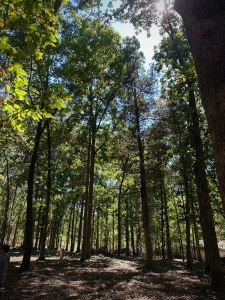
 

This incredible cemetery is a gem recovered from a jungle of natural vegetation and vibrant second-growth forest that strangled the cemetery for a full century. The new scene is park-like, the trees towering above the newly revealed historical site.


Diverse Tree Species


A diverse tree overstory complements the rich human history. I admit to total fascination with the forest that emerged from the grassy knoll that served as an early Madison, Alabama burial oasis. I won’t burden you with the messy dendrology of the species I discovered, admired, and celebrated.

White oak.


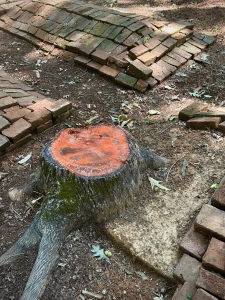
A white oak stump resulted when workers removed the tree decapitated by an F-1 tornado passing nearby earlier in the summer. I accepted the carnage as a gift, permitting me to do a ring count. The tree aged at 103 years, confirming that the tree regenerated at the time of cemetery abandonment and neglect.
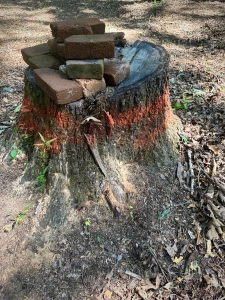
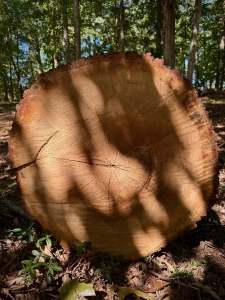
 

The annual rings of oak are easy to count.


I assume that this 44-inch diameter white oak is older, and probably shaded a segment of the cemetery for decades prior to service and maintenance ceased.
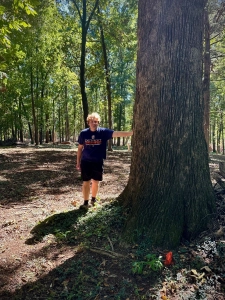
 

See this spectacular white oak on my 27-second video:


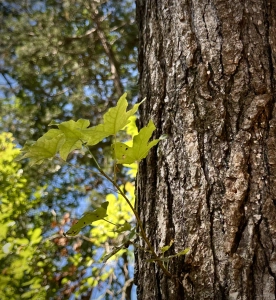
Sweetgum (left) is one of our common Alabama forest denizens. The species aggressively colonizes abandoned crop, pasture, grasslands, and cemeteries. Sugar maple (right).
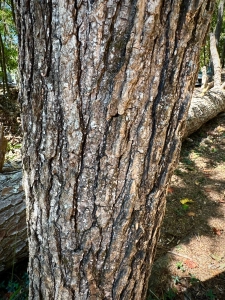
 

Likewise, water oak is ubiquitous in our area.
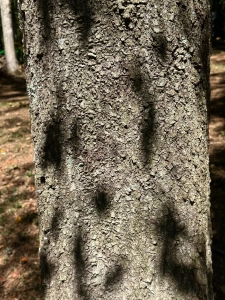
 

As are species of hickory.
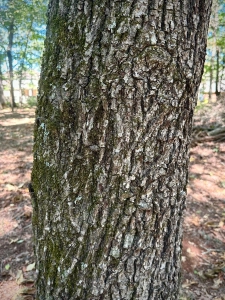
 

Black cherry, not a valuable timber species in northern Alabama, does regenerate valiantly and works its way into the intermediate canopy.
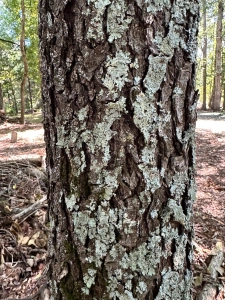
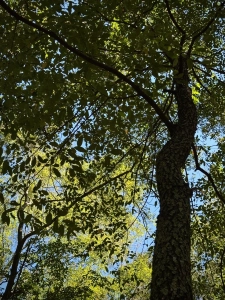
 

Eastern redcedar is a prolific pioneer species. This one is notably large and vibrant. What a magnificent crown, with laddered branching that reaches high above.
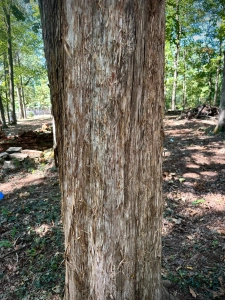
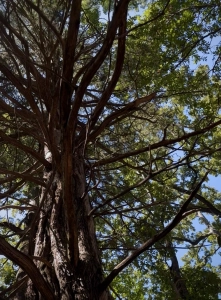
 

I recorded a 57-second video of the handsome Eastern redcedar tree.


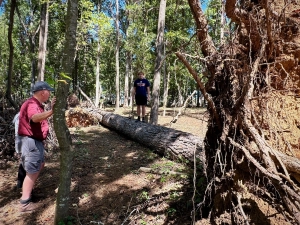
I mentioned the low intensity tornado that side-swiped the old cemetery. It toppled  a large loblolly pine.


The fallen pine, like most of the trees standing within the cemetery, probably dates back to abandonment.


Cemetery Remnants


I had not previously seen such brick tombs.
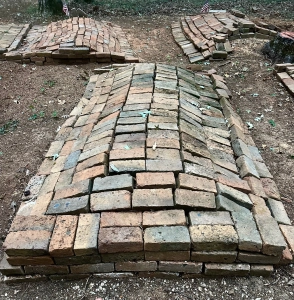


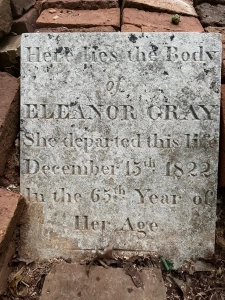
Here is the oldest interment at Gray Cemetery. I am sure that Mrs. Gray’s story is rich with life and living, and that many loved and loving descendents mourned her passing.
 

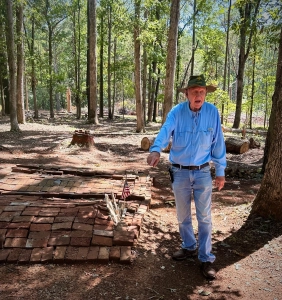
Local celebrated local historian John Rankin shared some time with us. He knows many of the stories that enrich our cemetery explorations and reflections.
 

I recorded this 60-second video showing the four types of tombs.


This is a box tomb.


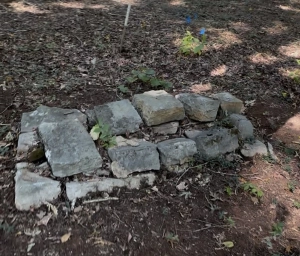
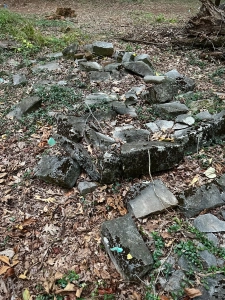
An Irish stone tomb.
 

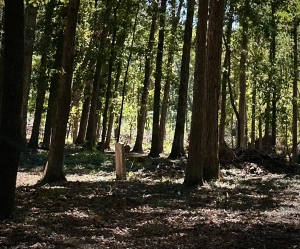
And another example of a standard vertical tombstone.


Cemetery Critters


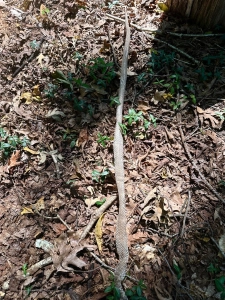
Among the departed humans, I found evidence of a current living resident — the shed skin of a grey ratsnake.
 

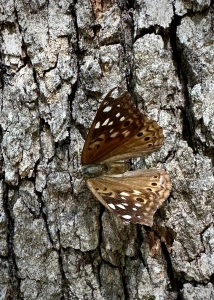
And a hackberry emperor butterfly.
 

Throughout our vibrant ecosystems, including the human realm, life and death are intertwined.


Thoughts and Reflections


I offer these observations:

  • Nature is adept at disappearing (i.e., hiding, obscuring, and concealing) the dedicated works of man. (Steve Jones)
  • Throughout our vibrant ecosystems, including the human realm, life and death are intertwined. (Steve Jones)
  • This incredible cemetery is a gem recovered from a jungle of natural vegetation and vibrant second-growth forest that strangled the cemetery for a full century. (Steve Jones)

Inhale and absorb Nature’s elixir. May Nature Inspire, Inform, and Reward you!


Note: All blog post images created & photographed by Stephen B. Jones unless otherwise noted. Please circulate images with photo credit: “©2025 Steve Jones, Great Blue Heron LLC. All Rights Reserved.”

I am available for Nature-Inspired Speaking, Writing, and Consulting — contact me at steve.jones.0524@gmail.com

Subscribe to my free weekly photo essays (like this one) at: http://eepurl.com/cKLJdL


Reminder of my Personal and Professional Purpose, Passion, and Cause


If only more of us viewed our precious environment through the filters I employ. If only my mission and vision could be multiplied untold orders of magnitude:

Mission: Employ writing and speaking to educate, inspire, and enable readers and listeners to understand, appreciate, and enjoy Nature… and accept and practice Earth Stewardship.

Vision:

  • People of all ages will pay greater attention to and engage more regularly with Nature… and will accept and practice informed and responsible Earth Stewardship.
  • They will see their relationship to our natural world with new eyes… and will understand more clearly their Earth home.

Tagline/Motto: Steve (Great Blue Heron) encourages and seeks a better tomorrow through Nature-Inspired Living!


Steve’s Four Books


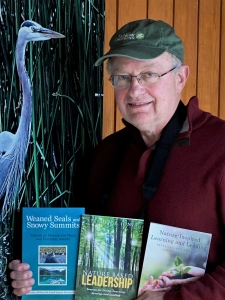
I wrote my books Nature Based Leadership (2016), Nature-Inspired Learning and Leading (2017), Weaned Seals and Snowy Summits: Stories of Passion for Place and Everyday Nature (2019; co-authored with Dr. Jennifer Wilhoit), and Dutton Land & Cattle: A Land Legacy Story (2023) to encourage all citizens to recognize and appreciate that every lesson for living, learning, serving, and leading is either written indelibly in or is powerfully inspired by Nature. All four of my books present compilations of personal experiences expressing my deep passion for Nature. All four books offer observations and reflections on my relationship with the natural world… and the broader implications for society. Order any from your local indie bookstore, or find them on IndieBound or other online sources such as Amazon and LifeRich.

I began writing books and Posts for several reasons:

  • I love hiking and exploring Nature
  • I see images I want to (and do) capture with my trusty iPhone camera
  • I enjoy explaining those images — an educator at heart
  • I don’t play golf!
  • I do love writing — it’s the hobby I never needed when my career consumed me
  • Judy suggested my writing is in large measure my legacy to our two kids, our five grandkids, and all the unborn generations beyond
  • And finally, perhaps my books and Blogs could reach beyond family and touch a few other lives… sow some seeds for the future


Mooresville, Alabama Cemetary: A New Dimension to Life and Death in the Forest! [Volume Two]


Note: I am flagging this photo essay as one of a sub-series that introduces the emerging Singing River Trail:

A 200+ mile greenway system that strengthens regional bonds and creates new health and wellness, educational, economic, tourism, and entrepreneurial opportunities for the people and communities of North Alabama.


On March 8, 2025, at the request of local history buff Gilbert White, I visited the Mooresville, Alabama Cemetery as a group of a dozen friends of the 200-year-old graveyard (Madison History Association) cleared brush and storm debris. I snapped photographs and recorded brief videos to develop a photo essay with observations and reflections. I envisioned a tale of the multi-tiered web of life and death (Nature and Human) interweaving across this hallowed land, a permanent resting place for more than 100 deceased former residents. Volume Two looks deeply into the elements of interaction and overlap.


The story of Mooresville Cemetery encompasses several components:

  • The overlapping natural environment and human community over time and generations (https://stevejonesgbh.com/2025/04/08/mooresville-alabama-cemetary-a-new-dimension-to-life-and-death-in-the-forest-volume-one/).
  • A deeper view into the elements of interaction and overlap (This photo essay).
  • The macabre (and lighter) dimension of an old forested cemetery.
  • Another story along the fledgling 200+ mile Singing River Trail.


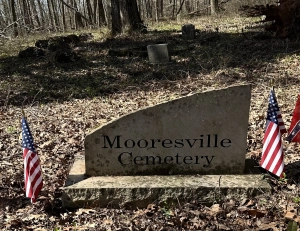
Entrance to the Mooresville Cemetery:


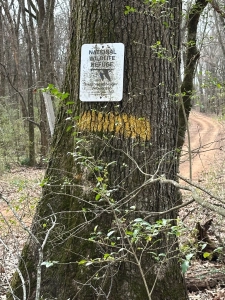
The cemetery adjoins Wheeler National Wildlife Refuge. Its dense forest and the graveyard are nearly indistinguishable except for the monuments and burial depressions.


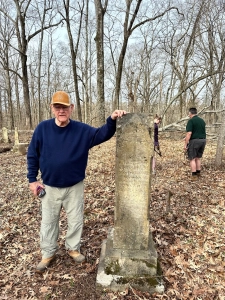
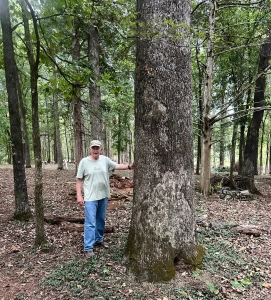
Richard Martin, for whom the Richard Martin Rails to Trail in Limestone County is named, stands at the gravestone of his paternal great, great grandmother, who died 144 years ago. Richard’s linkage to this hallowed ground is blood-strong. This fine woman entered our Earth-bound domain only 13 years after the cemetery welcomed the remains of its first departing soul. Like the forest, the human community cycle is without end. I doubt whether any of today’s trees on site witnessed Nancy B. Martin’s interment!


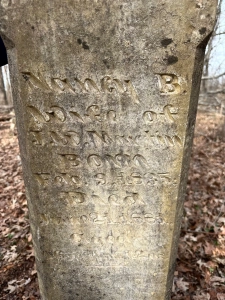
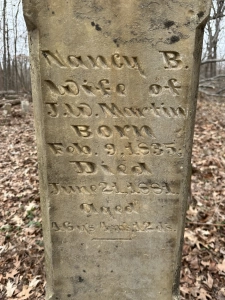
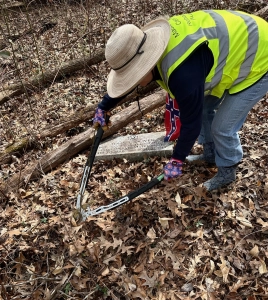
During the course of my two hours at the cemetery, Richard’s niece applied a biological cleaning solution, which brought the engravings back to life!


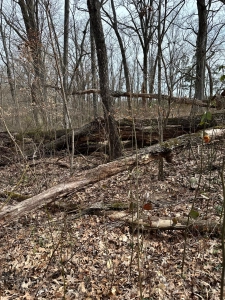
Just as the face of the monument lost its definition and clarity, the forest is changing. Nothing in Nature is static. Forest definition and clarity sufficient to meet the aesthetic standards for a visually attractive generational cemetery demands human attention and ongoing routine and occasionally heavy-duty maintenance. From some angles, the aging hilltop forest hides its cemetery identity!


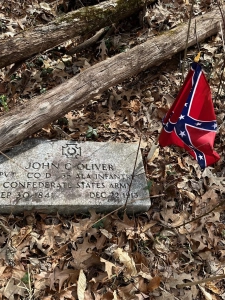
But still, the story is not entirely nor hopelessly subsumed. A colorfull flag marks the final resting place for a Confederate infantryman, his grave tended by volunteer Cindy Wallace.


I recorded this 58-second video at the tombstone of the Confederate infantryman:


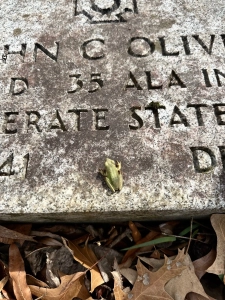
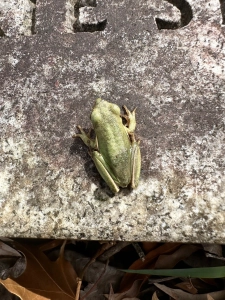
The cycle of life and death plays out across the mammalian/amphibian interface. I wonder whether the green tree frog (Hyla cenerea) visits Mr. Oliver routinely. The Old Folks traded tales of reincarnation. Who are these Old Folks? Am I among them? I admit to appreciating the possibility that the good Confederate infantryman’s soul resides happily on the hallowed hilltop overlooking Limestone Bay and Historic Mooresville.


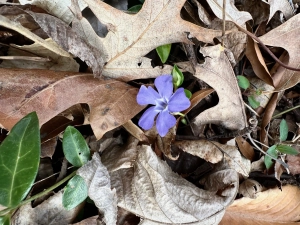
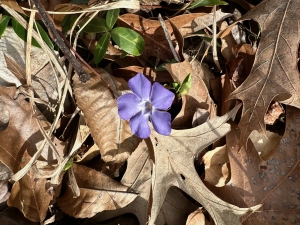
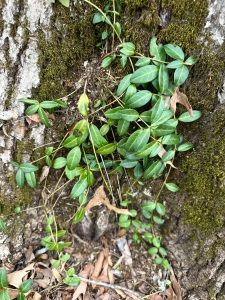
Some gravesite visiter a century or more ago probably planted lesser periwinkle to add everygreen freshness and growing-season color. The plant still persists on the shady forest floor and amidst the aging tombstones.


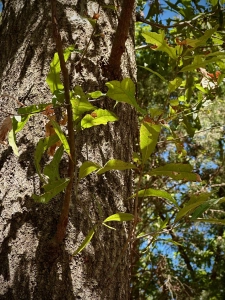
Its leafy vines climb into the moss skirt of a large oak.


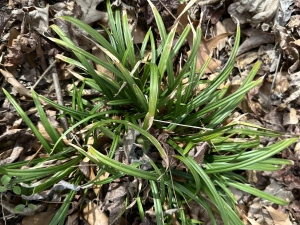
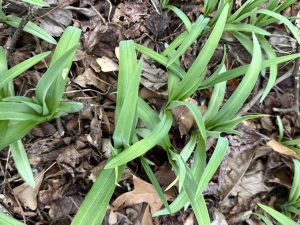
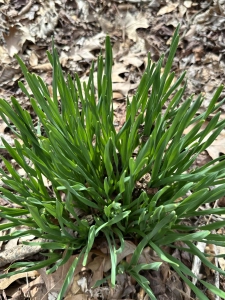
Clumps of liriope and daylilly evidence loved ones brightening gravesites.


I recorded this 55-second video into the overgrown graveyard from the border with Wheeler National Wildlife Refuge, and showing naturalized gravesite ornamental perennials planted on and escaped from gravesides:


I identified two varieties of narcissus growing several hundred feet from the heart of the cemetery just inside the Refuge.


A multi-flora rose grows at the foot of this monument, hinting at the loving care and respect given the deceased. Mourners laid the occupant to rest in 1901. I wonder who remembers and cares today. Even the youngest of those participating in the service is no longer among us. Certainly not in body. Alfred Hitchcock would create a scenario where they do indeed persist in an alternative dimension among the fading tombstones and towering oaks.


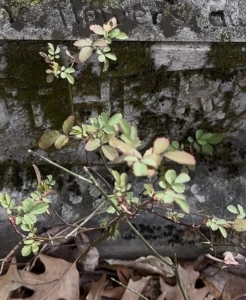
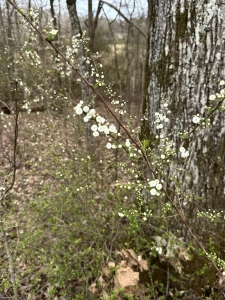
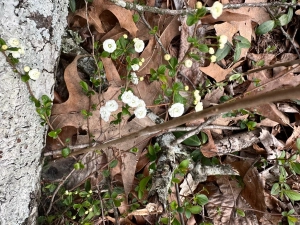
Another decorative planting escapee, several patches of spirea persist, visually echoing memories across the twenty decades here at Mooresville.


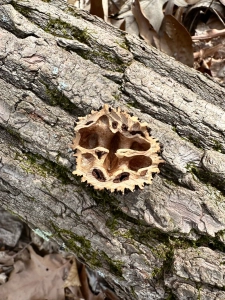
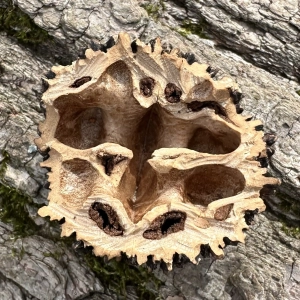
The tree frog is not alone among the memories. A squirrel masterfully chewed its way into the rich meat of a cemetery hickory nut. The cycle of life is without end…as long as our sun shines, rains fall, and Earth remains otherwise inhabitable.


As I said at the outset, the story of Mooresville Cemetery encompasses several components:

  • The overlapping natural environment and human community across time and generations.
  • A deeper view into the elements of interaction and overlap.
  • The macabre dimension of an old forested cemetery (stay tuned).
  • Another story along the fledgling 200+ mile Singing River Trail.

I developed this Volume Two of my Mooresville Cemetery tale as A deeper view into the elements of interaction and overlap.

Coach Jim Valvano directed the 1983 NC State University mens basketball program to the NCAA National Championship. Several years later, succumbing to terminal cancer, Jim delivered powerful motivational speeches across the country. He extolled three recommended essential elements of every day well lived:

  1. Laugh heartily.
  2. Think deeply.
  3. Feel something to the point of tears.

The green frog delivered an element of mirth, even if not belly-laugh worthy. All else about the morning on-site and since then as I’ve organized my thoughts and reflections demanded deep thought. Misty eyes and a few keyboard drops accompanied my reflections on my own mortality and my regrets for not knowing my antecedents more intentionally. Although I seldom (Never, as I recall!) turn to Janis Joplin for philosophical guidance, she hit the mother lode with a line from Me and Bobby McGee:

I’d trade all my tomorrows for a single yesterday.

Nature reaches far into my heart, soul, body, mind, and spirit.


The Nature of the Singing River Trail


The Singing River Trail will be a 200+ mile greenway system that strengthens regional bonds and creates new health and wellness, educational, economic, tourism, and entrepreneurial opportunities for the people and communities of North Alabama.


The SRT is headquartered just two miles west of the cemetery. The trail will prominently feature Mooresville. As a lifelong devotee of hiking/sauntering, running, biking, and Nature exploration, I envision another Great Blue Heron weekly photo essay series focused on The Nature of the Singing River Trail. I will incorporate individual essays into my routine Posts that total approximately 450 to-date (archived and accessible at: https://stevejonesgbh.com/blog/). I offer these photo essays related to the Mooresville Cemetery as the beginning of the new component series.


Thoughts and Reflections


I offer these observations:

  • Nature reaches far into my heart, soul, body, mind, and spirit.
  • The cycle of life is without end…as long as our sun shines, rains fall, and Earth remains otherwise inhabitable.  
  • It’s not what you look at that matters, it’s what you see.

Inhale and absorb Nature’s elixir. May Nature Inspire, Inform, and Reward you!


Note: Unless otherwise noted, all blog post images are created & photographed by Stephen B. Jones.

Please circulate images with photo credit: “©2025 Steve Jones, Great Blue Heron. All Rights Reserved.”

I am available for Nature-Inspired Speaking, Writing, and Consulting — contact me at steve.jones.0524@gmail.com


A reminder of my Personal and Professional Purpose, Passion, and Cause

If only more of us viewed our precious environment through the filters I employ. If only my mission and vision could be multiplied by untold orders of magnitude:

Mission: Employ writing and speaking to educate, inspire, and enable readers and listeners to understand, appreciate, and enjoy Nature… and accept and practice Earth Stewardship.

Vision:

  • People of all ages will pay greater attention to and engage more regularly with Nature… and will accept and practice informed and responsible Earth Stewardship.
  • They will see their relationship to our natural world with new eyes… and understand their Earth home more clearly.

Tagline/Motto: Steve (Great Blue Heron) encourages and seeks a better tomorrow through Nature-Inspired Living!


Steve’s Four Books


I wrote my books Nature Based Leadership (2016), Nature-Inspired Learning and Leading (2017), Weaned Seals and Snowy Summits: Stories of Passion for Place and Everyday Nature (2019; co-authored with Dr. Jennifer Wilhoit), and Dutton Land & Cattle: A Land Legacy Story (2025) to encourage all citizens to recognize and appreciate that every lesson for living, learning, serving, and leading is either written indelibly in or is powerfully inspired by Nature. All four of my books present compilations of personal experiences expressing my deep passion for Nature. All four books offer observations and reflections on my relationship with the natural world… and the broader implications for society. Order any from your local indie bookstore, or find them on IndieBound or other online sources such as Amazon and LifeRich.

I began writing books and Posts for several reasons:

  • I love hiking and exploring Nature
  • I see images I want to (and do) capture with my trusty iPhone camera
  • I enjoy explaining those images — an educator at heart
  • I don’t play golf!
  • I do love writing — it’s the hobby I never needed when my career consumed me
  • Judy suggested my writing is in large measure my legacy to our two kids, our five grandkids, and all the unborn generations beyond
  • And finally, perhaps my books and Blogs could reach beyond family and touch a few other lives… sow some seeds for the future