Brief-Form Post #53: Wolf Creek Narrows Forest Renewal in an Old Growth Northern Hardwood Stand!
I am pleased to add the 53rd of my GBH Brief-Form Posts (Less than five minutes to read!) to my website. I get wordy with my routine Posts. I don’t want my enthusiasm for thoroughness and detail to discourage readers. So, I will occasionally publish these brief Posts.
Wolf Creek Narrows Natural Area, owned and managed by the Western Pennsylvania Conservancy (WPC), is in northwestern Butler County, Pennsylvania, just 30 minutes from where my son and his family reside north of Pittsburgh. Matt, his dog Oakley, and I circuited the 2.35-mile trail on the morning of September 22, the first day of autumn. My heart soared at the prospect of returning to an ecosystem shaped by a continental ice sheet just 13 millennia ago. This Post focuses on a recent blowdown within the Natural Area and my reflections on the implications for the affected stand.
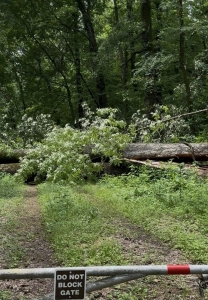
Blowdown in the Forest
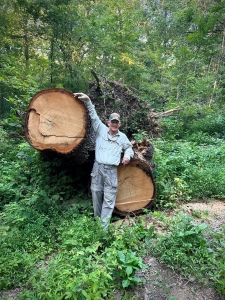
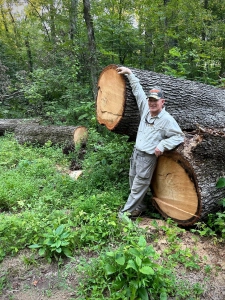
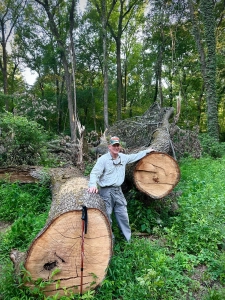
All forests are in flux. Individual trees germinate, grow, senesce, and die. Forests come and go with disturbance. Wind, ice, fire, insects, and disease affect trees and entire forests. I observe often that death is a big part of life in forested ecosystems and, for that matter, in any ecosystem. Within a discreet portion of the Wolf Creek Narrows Natural Area old growth forest, a wind storm (thunderstorm downdraft or microburst; derecho; tornado; or perhaps sustained winter gales) toppled enough mature trees to give the affected stand a unique character.
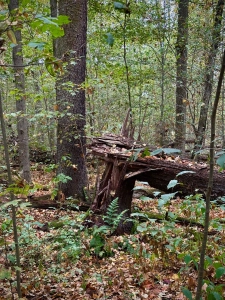
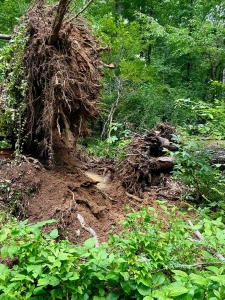
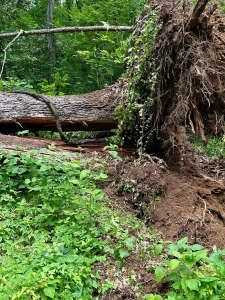
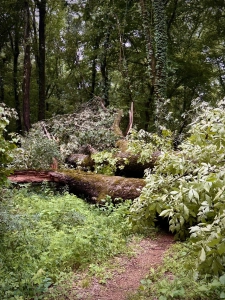
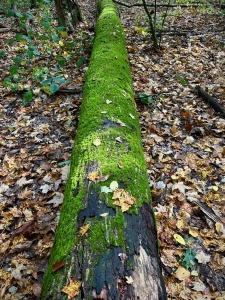
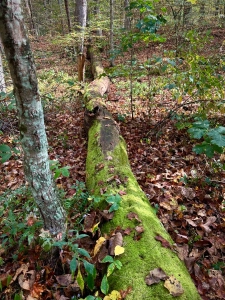
The fallen trees align parallel to the wind direction, their lower trunks shattered or the entire tree uprooted. Based on the apparent progress of woody debris decay, I estimate that the wind event occurred within the past three years.
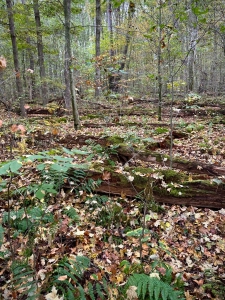
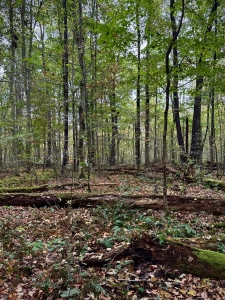
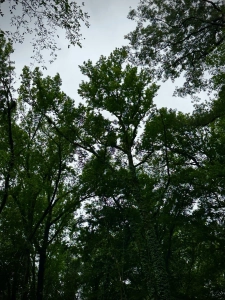
The wind eliminated enough overstory canopy to significantly reduce forest floor shading. Already understory woody and herbaceous plants are responding with increased vitality. Nature abhors a vacuum.
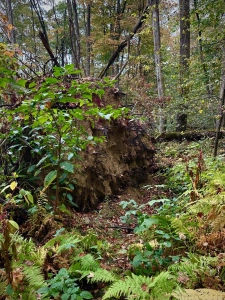
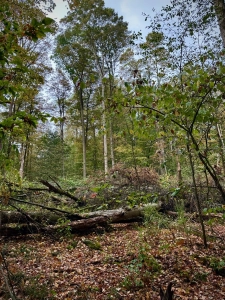
A cinnabar bracket fungus has colonized this downed American beech, evidencing that the windthrow-accelerated carbon cycling is in full gear.
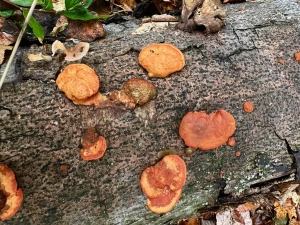
Elevated root mounds provide ideal sites for herbaceous exploitation. White ash seedlings are quickly colonizing the forest floor on either side of the downed white ash tree.
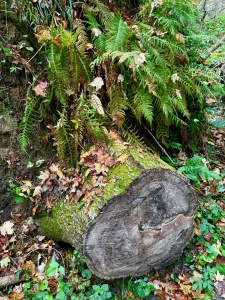
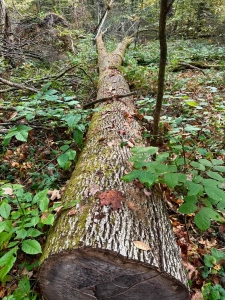
Not all of the downed trees resulted from the discreet recent event. These trunks toppled more than five years ago. This hardwood stand, like most of Pennsylvania’s forests, is probably even-aged, regenerating following some catastrophic event, such as timber harvesting, widespread major wind, or fire.
An even-aged forest grows in a predictable manner. The inverse J-shaped diameter distribution is one such formulaic metric. Consider the graphs below as a generalized representation of the growth pattern across time. A young even-aged stand my have thousands of stems per acre. Look above at the many ash seedlings surrounding the single mature fallen ash. Over decades, the stand density (stems per unit area) declines. What may have been thousands becomes hundreds, and ultimately scores and dozens. Average stem diameter of the white ash seedlings (two rows above) is less than an inch. The fallen mother (seed source) tree is perhaps two feet.
The tendancy of an even-aged old growth hardwood forest is to gradually transition naturally to uneven-age. Some of the windthrow openings may be large enough to allow trees, their germination triggered by the recent storm, to emerge into the upper canopy, representing a younger age class. Many of the openings will at least be large enough to allow a sapling or mid-canopy cohort to establish, staging one or more of those individuals to rapidly ascend into the main canopy when a subsequent storm topples a large dominat tree, or a cluster of the original old growth cohort.
The forest is in no hurry. Its evolutionary pathway prepared this very successful admixture of species to flourish and persist when conditions are favorable and respond when change presents opportunities. The ash seedlings are already carpeting the ground now blessed with open canopy sunlight. Although my examinations were only surperficial, I observed that American beech, sugar maple, and white oak are stand components. They are shade tolerant species that can persist for decades under a full canopy. They and others are poised to constitute a greater percentage of the future dominant canopy.
The forest is changing, as are all forests. The wind event accelerated the change. I’d like to monitor it annually over another several decades, but my own life curve continues unabated. Perhaps I can revisit Wolf Creek Narrows another time or two, but there are no guarantees. I am grateful for having made this inaugural visit. I’ve learned something of this slice of Nature near to my son’s home and not too far from where I conducted my forestry doctoral research four decades ago.
I am addicted to special places and everyday Nature. Wolf Creek Narrows Natural Area is one such Special Place.
Closing
I accept the challenge of distilling these Brief-Form Posts into a single distinct reflection, a task far more elusive than assembling a dozen pithy statements.
I cannot offer a quote more apropos than an observation I made in the text above:
The forest is in no hurry. Its evolutionary pathway prepared it to flourish and persist when conditions are favorable, and to respond when change presents opportunities to exploit.
Nature’s special treats await our discovery, our understanding, and our interpretation!
Subscribe to my free weekly photo essays (like this one) at: http://eepurl.com/cKLJdL